Bonus Issue Bursa Malaysia: Technicalities, Strategy, and Why Investors Love "Free" Shares

Who doesn't love free things, right? In the world of stock investing on Bursa Malaysia, the term "Bonus Issue" or Terbitan Bonus is always a hot topic in WhatsApp and Telegram stock groups. Many investors, especially newcomers, get excited when their favourite company announces bonus shares.
But is it truly a "gift" that will double your wealth overnight? Or is it merely an accounting technique to spruce up the financial statements?
In this article, we will thoroughly unpack everything about Bonus Issues — from the basic definition right through to strategies on how you can make the most of them.
What Exactly Is a Bonus Issue?
In short, a Bonus Issue is the distribution of additional shares to existing shareholders for free. You do not need to spend a single sen to receive these extra units.
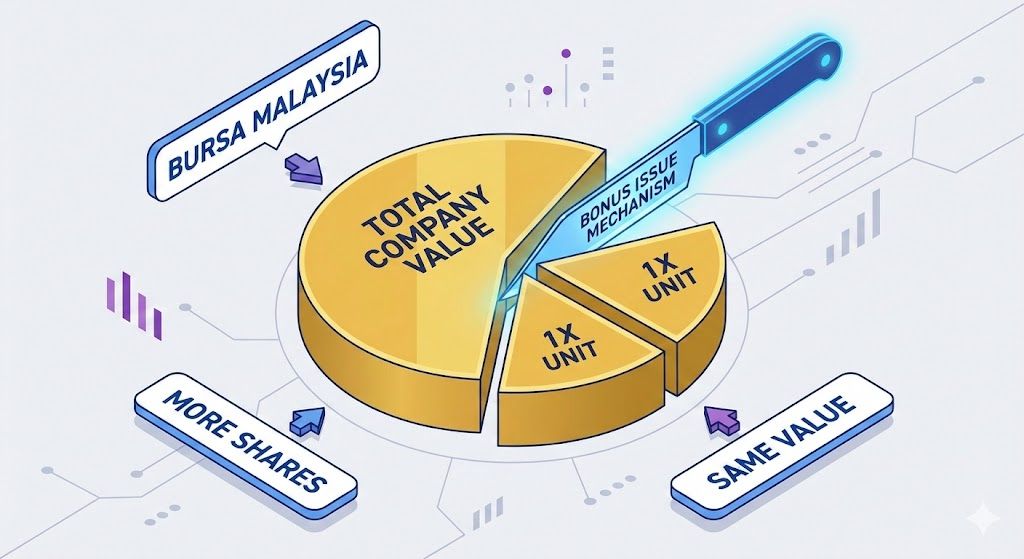
The company does not conjure new shares out of thin air. Instead, it converts a portion of its Retained Earnings or Company Reserves into share capital. In simple terms, the company takes money from its own "savings account" and gives it to you in the form of share units.
Simple Analogy:
Imagine you own a large pizza cut into 4 slices. The company then decides to cut that pizza into 8 slices. Now you have 8 slices of pizza, but the overall size of the pizza remains the same. You haven't received any extra pizza — you've just got more slices!
Why Are Companies So Keen to Issue Bonus Shares?
If the total value of the company doesn't change, why does the management go through all this trouble? Here are the main reasons:
- Increasing Liquidity: When the number of share units in the market increases, the stock becomes more actively traded. This makes it easier for investors to buy and sell without significant price disruption.
- Making the Price "Affordable": Say Company A's share price is RM10.00. For some retail investors, this might seem expensive. After a 1-for-1 Bonus Issue, the price adjusts to RM5.00. Psychologically, RM5.00 looks more "affordable" and attracts more buyers.
- Confidence Signal: Companies that issue Bonus Shares are usually those with substantial reserves and healthy financial performance. It sends a message to investors that: "We are so financially strong that we can convert our reserves into share capital."
Price Adjustment Calculation: Don't Panic When Your Portfolio Turns "Red"!
This is the most important part. Many investors panic on the Ex-Date when they see their share price "plunge" and their portfolio turn red. Don't panic! This is a price adjustment.
Price Adjustment Formula
The share price is adjusted based on the ratio set. You can use the formula below:
Adjusted Price = (Cum-Price x Old Units) / New Units
Example Scenario:
Company XYZ announces a Bonus Issue with a ratio of 1-for-2. This means for every 2 shares you hold, you will receive 1 bonus unit (Total new units = 3).
- Price Before (Cum-Price): RM3.00
- Existing Units: 2,000 units
- Investment Value: RM6,000
After Ex-Date:
- Your New Units: 3,000 units (2,000 original + 1,000 bonus)
- New Price (Adjusted): (RM3.00 x 2) / 3 = RM2.00
- Investment Value: 3,000 units x RM2.00 = RM6,000 (Stays the Same!)
4 Key Dates You Must Know
To qualify for bonus shares, you need to understand the Bursa Malaysia timeline:
- Announcement Date: The day the company announces its intention. The share price usually starts reacting here.
- Ex-Date (The Most Important Date): You must own the shares at least one day before the Ex-Date. If you buy on the Ex-Date itself, you are not entitled to the bonus.
- Entitlement Date (Record Date): The date when the Bursa system checks the list of eligible shareholders. This is usually one day after the Ex-Date.
- Credit Date: The date the bonus shares "enter" your CDS account. Before this date, you may see your portfolio showing a "loss" because the price has already dropped but the bonus units have not yet been credited.
Advantages and Risks of a Bonus Issue
Every corporate action has two sides of the coin. Let's compare:
| Advantages | Risks & Side Effects |
|---|---|
| Quantity Increases: You own more units for your long-term strategy. | Dividend Per Share (DPS) May Drop: If the company's profit remains the same, the dividend per share may appear smaller. |
| Bullish Sentiment: The market usually welcomes bonus issue news positively. | Dilution: Earnings per share (EPS) will be adjusted downward because the number of units has increased. |
| Capital Gain Potential: The "cheap" price after adjustment often attracts new buying interest that pushes the price back up. | No Guarantee: If the company's fundamentals are poor, the price will continue falling even after the bonus. |
Bonus Issue vs. Share Split: What's the Difference?
Many people confuse the two. Visually, the effect is the same (more units, lower price). However, from an accounting perspective on Bursa Malaysia:
- Bonus Issue: Involves transferring funds from the Reserves/Retained Earnings account to Share Capital. It proves the company has "savings".
- Share Split: Simply splits existing share units. There is no effect on the reserves account. It is purely cosmetic to lower the price.
Investor Strategy: How to Make Money?
How should you as a retail investor act?
- Buy on Rumours, Sell on News? Usually the price will spike as soon as the announcement is made. If you are a momentum investor, this is your opportunity. However, beware of the "sell on news" effect on the actual day.
- Focus on Fundamentals: Don't buy simply because you want free bonus shares. Ask yourself: "Even without the bonus issue, would I still buy this company?" If the answer is yes, then the bonus is just the "cherry on top".
- Be Patient and Wait for the "Recovery": After the price drops on the Ex-Date, good companies usually take a few months for the price to climb back to the original level (before adjustment). This is when real wealth is created (compounding).
If you want to learn more about other corporate exercises such as rights issues, share splits, share consolidation and many more, read:
Complete Guide to Corporate Exercises on Bursa Malaysia: What Investors Need to Know
Conclusion
A Bonus Issue is not "magic" that will make you rich overnight. It is a corporate tool to improve trading efficiency and provide a psychological reward to investors.
The key to success in investing in companies that issue bonuses is to ensure the company has consistent earnings growth. Without profits, additional share units will only weaken the value of your holdings in the long run.
Why not start learning and investing in stocks on Bursa Malaysia yourself? If you are still a complete beginner and don't know how to start, you can begin by opening a CDS account under Mahersaham. Tuan Maher is a registered dealer's representative under Broker Mplus.
If you are interested in opening a CDS account, click: OPEN CDS ACCOUNT
FAQ – Bonus Issue in Malaysia
What is a Bonus Issue on Bursa Malaysia?
A Bonus Issue is when a listed company distributes additional shares to existing shareholders for free by converting its retained earnings or reserves into share capital. You receive more units without paying anything.
Does a Bonus Issue increase my total investment value?
No. While the number of units increases, the share price is adjusted proportionally downward. Your total investment value remains the same immediately after the Ex-Date. The real gains come if the company's fundamentals drive the price back up over time.
What is the difference between a Bonus Issue and a Share Split?
A Bonus Issue involves converting reserves or retained earnings into share capital, which signals financial strength. A Share Split simply divides existing shares into smaller units with no impact on reserves — it is purely cosmetic.
When must I buy shares to be eligible for a Bonus Issue?
You must own the shares at least one day before the Ex-Date. If you purchase on the Ex-Date itself, you will not be entitled to the bonus shares.
Should I buy a stock just because it has an upcoming Bonus Issue?
No. Always focus on the company's fundamentals first. Ask yourself whether you would still invest in the company even without the bonus issue. If the answer is yes, the bonus is simply an added benefit.