How to Calculate Average Price for Your Stock Portfolio and Contract Note

Many people are still uncertain about how to calculate the average price of shares they have purchased.
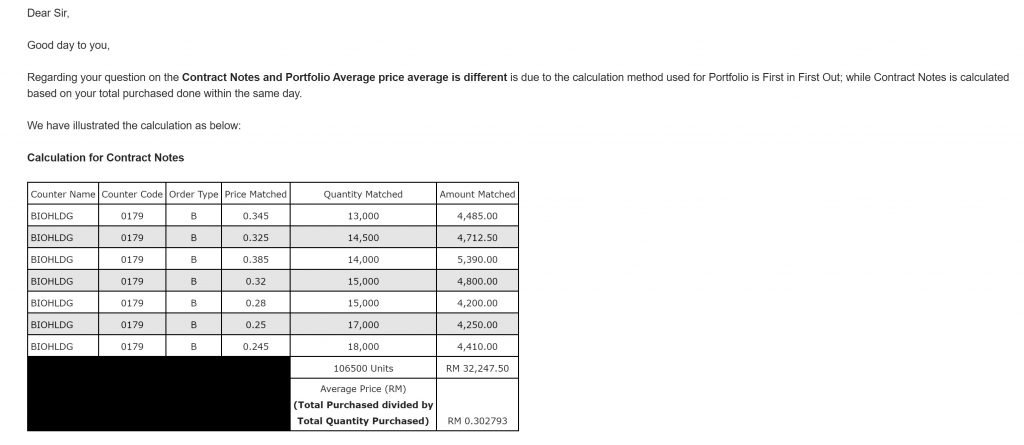
Simply put, what is displayed in your stock portfolio on Mplus is the result of your average purchase cost divided by the number of units you bought.
7 Sept
– Buy Counter A, 20,000 units at RM0.45. Total cost/capital is RM9,000 (20,000 x 0.45)
8 Sept
– Buy Counter A again, 10,000 units at RM0.50. Total cost/capital is RM5,000 (10,000 x 0.50)
So in your portfolio, the total number of units you own is 30,000.
The usual way to calculate the average price:
RM9,000 + RM5,000 = RM14,000
RM14,000 divided by the total units of 30,000, therefore
RM14,000 / 30,000 = 0.467
However, problems arise when you sell your holdings, say on 15 Sept.
You sell 25,000 units.
You have a remaining balance of 30,000 – 25,000 = 5,000 units.
What average price will be shown in your portfolio?
It should still be 0.467 since there was no new purchase, right?
Wrong!
Stock Average Price Calculation Uses FIFO
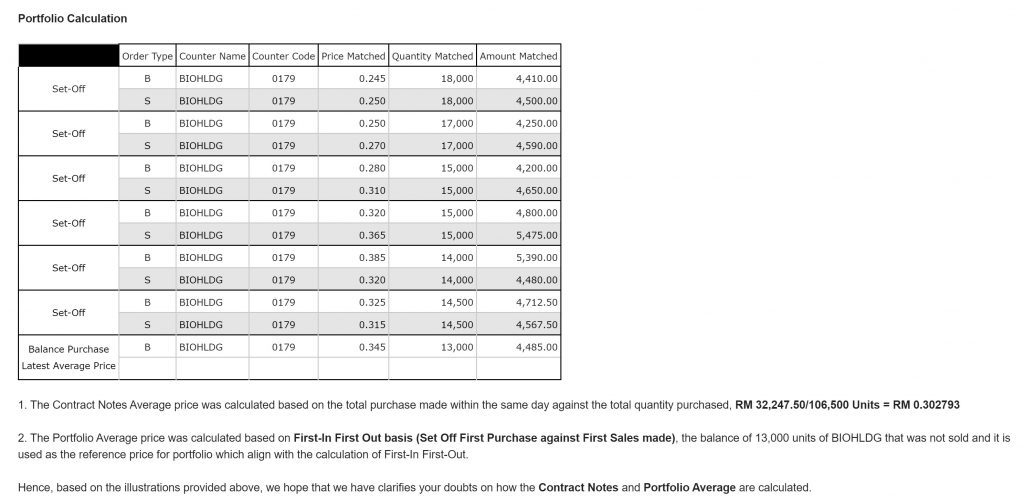
The reason is that the average price calculation used by Mplus follows the FIFO (First In, First Out) method.
Therefore, when you sell 25,000 units, you are actually selling the 20,000 units purchased on the first occasion (at RM0.45) and the remaining 5,000 from the second purchase at RM0.50.
In the end, what remains is 5,000 units from the second purchase at an average price of RM0.50.
Strange, isn't it?
That is due to the different calculation method.
If this already seems odd, calculating share consolidation is even more peculiar.
Although it may not be what some people expect, the calculation is not wrong from an accounting standpoint.
If you sell the shares, you sell at the current market price and it has no relation to your average price.
However, it can cause confusion if you are accustomed to comparing your selling price or current price with your overall purchase average price.
For more calculation examples, see the images below. These were obtained from the Mplus support team.
That is all for this sharing.
We recommend you read How to Calculate and Read a Contract Note next.
Want to Buy and Sell Stocks but Do Not Have a CDS Account Yet?
What are you waiting for? Register for a CDS account with Mahersaham and you can join exclusive classes for Mahersaham clients.
Strengthen Your Investment Knowledge
Successful investing starts with solid knowledge.
Investment Basics:
Download our free ebook for a complete guide.
Open a CDS Account:
Ready to get started? Open a CDS account now.
Frequently Asked Questions (FAQ)
How does Mplus calculate the average price in my stock portfolio?
Mplus uses the FIFO (First In, First Out) method to calculate the average price. This means the earliest purchased shares are considered sold first, which may result in a different average price than you expect after partial sales.
Why does my average price change after I sell some of my shares?
Because of the FIFO method, when you sell shares, the system removes the earliest purchased units first. The remaining units may have been bought at a different price, causing the displayed average price to change.
What is a contract note and how do I read it?
A contract note is an official document from your broker confirming the details of your trade, including the number of units, price per unit, brokerage fees, stamp duty, and clearing fees. It serves as your transaction receipt.
Is the FIFO average price calculation wrong?
No, the FIFO method is a standard accounting practice. Whilst it may differ from a simple weighted average calculation, it is the correct and accepted method used by brokers in Malaysia.