Contrarian Investing: The Art of Buying When Everyone Runs

What Is Contrarian Investing?
Contrarian investing is a strategy that goes against the majority of market participants. When most people panic and sell, contrarian investors buy. Conversely, when everyone is euphoric and buying without thinking, contrarian investors become cautious or sell.
This principle was popularised by Warren Buffett through his famous quote: "Be fearful when others are greedy, and greedy when others are fearful." In the context of Bursa Malaysia, this strategy means searching for quality stocks sold at cheap prices due to market panic - not because of actual fundamental problems.
This article breaks down the concept of contrarian investing in detail - from core principles, data evidence, real examples on Bursa Malaysia, to identifying genuine contrarian opportunities without falling into value traps.
Core Principles of Contrarian Investing
Contrarian investing rests on one crucial assumption: markets are driven by human emotions, and human emotions are not always rational. Greed and fear create patterns of overreaction that can be exploited by disciplined investors.
Here are the three main pillars of the contrarian strategy:
1. Market Sentiment Moves in Cycles
Stock markets do not move in straight lines. They rotate between phases of euphoria (everyone wants to buy) and panic (everyone wants to sell). Contrarian investors understand these cycles and act against the majority sentiment. According to Britannica Money, this concept has been practised since the early 20th century by investors like Benjamin Graham.
2. Price and Value Are Not Always the Same
When markets panic, stock prices can fall far below a company's intrinsic value. This is not because the company is broken - but because other investors are scared and selling blindly. Contrarian investors see this gap between price and value as a golden opportunity.
3. The Majority Is Usually Wrong at Extreme Points
Historical data shows that majority investor sentiment tends to be wrong at the most extreme points. According to academic research published by ScienceDirect, the CNN Fear and Greed Index can predict S&P 500 returns - readings at "Extreme Fear" levels often precede higher returns.
Famous Contrarian Investors and Their Strategies
Contrarian investing is not mere theory - it has proven to generate enormous wealth for disciplined investors. Here are four key figures:
Warren Buffett - "Be Greedy When Others Are Fearful"
Buffett is famous for his contrarian actions during crises. In 2008, when Wall Street collapsed, he invested $5 billion in Goldman Sachs and $5 billion in Bank of America in 2011 - when most investors were still avoiding financial stocks. Both investments ultimately generated billions in returns.
Sir John Templeton - "The Best Time to Buy Is at Maximum Pessimism"
Templeton bought stocks during World War II in 1939, when everyone expected the global economy to collapse. He purchased 100 stocks at under $1 each - and the majority rose several-fold within a few years.
Seth Klarman - Margin of Safety
The Baupost Group fund manager only buys when there is a significant margin of safety - a substantial discount between market price and true value. His approach is highly selective and patient; sometimes holding cash up to 50% of the portfolio while waiting for genuine opportunities. Read more in our article on Seth Klarman & Margin of Safety.
George Soros - Reflexivity and Crises
George Soros is not a traditional contrarian investor, but his Theory of Reflexivity explains how markets can create bubbles through feedback loops. When bubbles burst, contrarian investors can capitalise on falling prices.
Data Evidence: Does the Contrarian Strategy Really Work?
The contrarian strategy is not just philosophy - it is supported by robust empirical data.
CNN Fear and Greed Index
The Fear and Greed Index measures market sentiment on a scale of 0 (Extreme Fear) to 100 (Extreme Greed). According to historical data from 2011 to 2026:
- Extreme Fear (0-20): Average 1-year returns following this signal have historically been higher than market averages.
- Extreme Greed (80-100): Average 1-year returns following this signal were only around -3%, well below market averages.
- As of August 2026, the index sits at 64 (Greed) - meaning the market is optimistic but not yet at extreme levels.
S&P 500 Data: Buying During Crashes
Research from Investing News found that buying the S&P 500 when the VIX (fear index) spiked above 30 generated average returns of 25-40% within 12 months - compared to the normal annual average of ~10%.
KLCI During COVID-19: Local Evidence
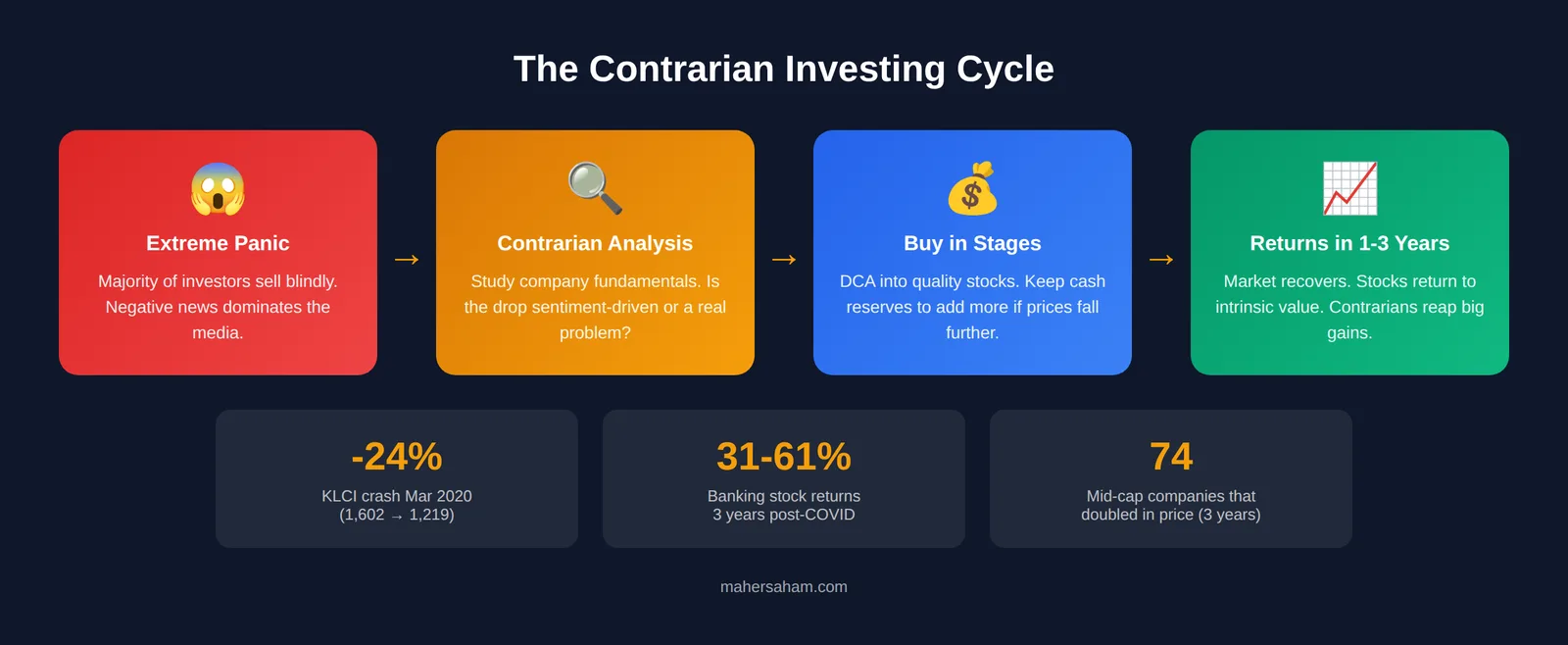
The FBM KLCI opened at 1,602 points in early 2020 and fell to a low of 1,219 points on 19 March 2020 - a drop of nearly 24% within weeks. According to Malaysian media reports, investors who bought at that point enjoyed exceptional returns over the following 3 years:
- KLCI30 banking stocks rose between 31% and 61% within 3 years
- 74 companies with market caps of RM1-10 billion saw their share prices double
- 36 mid-cap companies (RM500 million - RM1 billion) also recorded 100%+ gains
Real Contrarian Opportunities on Bursa Malaysia
Here are several examples of Bursa Malaysia stocks that presented contrarian opportunities at specific times:
Banking Stocks During COVID-19 (March 2020)
When the KLCI dropped 24%, stocks like CIMB Group Holdings, Maybank, and Public Bank also fell sharply. Panicked investors sold fearing NPL (non-performing loans) would spike. However, Malaysian banking fundamentals remained strong - Bank Negara cut the OPR and launched a loan moratorium. Contrarian investors who bought banks in March 2020 enjoyed 30-60% returns within 3 years.
Glove Stocks After the Peak (2021-2022)
This is an example of contrarian investing that DID NOT work. Stocks like Top Glove, Hartalega, and Supermax fell from peaks above RM20 to below RM1. Many investors tried to be "contrarian" by buying on every dip - but this was not a genuine contrarian opportunity because company fundamentals changed permanently (glove demand returned to pre-COVID normal levels). This was a value trap.
Genting Group During Lockdown (2020-2021)
Genting Berhad and Genting Malaysia were severely affected during the lockdown as casinos and theme parks were forced to close. However, contrarian investors who understood that the closures were only temporary and tourism demand would return successfully reaped returns when operations normalised.
Petronas Chemicals During Oil Price Collapse (2020)
Petronas Chemicals (PCHEM) fell alongside global oil prices in April 2020. Contrarian investors who understood commodity cycles and the strength of the DIALOG Group and Petronas value chain bought at low prices and enjoyed the recovery when oil prices stabilised.
How to Identify Contrarian Opportunities
Buying when others are fearful sounds simple - but how do you know when the fear is excessive and the opportunity is genuine? Here are 5 tools and signals to help:
1. Fear and Greed Index
The CNN Fear and Greed Index measures 7 market sentiment factors including momentum, price strength, put/call ratio, and junk bond demand. Readings below 20 (Extreme Fear) have historically been the best times to buy.
2. VIX Index (Volatility Index)
The VIX, also called the "fear index", measures expected market volatility. Readings above 30 typically signal extreme fear - and historically, buying at high VIX levels has generated better returns.
3. Insider Buying
When company directors or CEOs themselves buy their company's shares on the open market during a downturn, this is a strong signal that insiders believe the stock is undervalued. Check Bursa Malaysia announcements for Dealings in Securities.
4. PE Ratio Far Below Historical Average
If a quality stock's PE ratio falls well below its 5-10 year historical average, this may be a contrarian signal. Ensure the PE drop is caused by sentiment - not permanent earnings decline.
5. Temporary vs Permanent Negative News
This is the most critical factor. Temporary negative news (lockdowns, short-term geopolitical crises, new regulations) often creates contrarian opportunities. Permanent negative news (technology disruption, loss of competitive moat, excessive debt) is usually not an opportunity - it is a trap.
Contrarian vs Value Investing
Many confuse contrarian investing with value investing. While both seek undervalued stocks, there are important differences:
| Aspect | Contrarian | Value Investing |
|---|---|---|
| Primary focus | Market sentiment (fear/greed) | Fundamental analysis (price vs value) |
| Buy trigger | Extreme panic, excessive negative news | Price below intrinsic value (DCF) |
| Timing | During crises or major selloffs | Anytime as long as it is cheap |
| Key risk | Catching falling knife, value trap | Value trap, stagnation |
| Holding period | Medium (1-3 years) | Long (3-10+ years) |
| Key figures | John Templeton, David Dreman | Warren Buffett, Seth Klarman |
In practice, both strategies often overlap. Buffett himself is a combination of value investor and contrarian - he seeks quality companies sold at cheap prices due to temporary negative sentiment. Read a more detailed comparison in our article on Growth vs Value Stocks.
5 Key Risks of Contrarian Investing
The contrarian strategy is not without risks. Many investors who try to "buy when fearful" end up losing big because they do not understand the following nuances:
1. Value Trap
Not all cheap stocks are opportunities. Sometimes stocks are cheap because the company genuinely has problems - excessive debt, weak management, or a permanently declining industry. A classic example on Bursa: PN17/GN3 stocks that appear "cheap" but keep declining.
2. Catching a Falling Knife
Buying too early during a downturn can be painful. Prices can continue falling another 30-50% after you enter. Use a DCA (Dollar Cost Averaging) strategy to reduce timing risk - buy in stages, not all at once. Read more: DCA vs Lump Sum.
3. Reverse Confirmation Bias
Contrarian investors can fall into their own confirmation bias trap - only seeking information that supports their contrarian thesis while ignoring signs that fundamentals are genuinely deteriorating.
4. Psychological Pressure
Buying when everyone else is selling requires extraordinary mental resilience. You will be surrounded by negative news, friends who think you are crazy, and a portfolio that may stay red for months before your thesis proves correct. This is far more emotionally challenging than following the crowd.
5. Timing Problems
Even if your thesis is correct that the stock is undervalued, the market can remain "irrational" longer than you can remain solvent. John Maynard Keynes once said: "The market can stay irrational longer than you can stay solvent."
Mental Discipline of Successful Contrarian Investors
To succeed as a contrarian investor, you need more than just the courage to buy when others are afraid. You need systems and discipline:
Build a Watchlist Before Crises
Do not wait for a crisis to start looking for stocks. Build a list of quality stocks you want to own - complete with target prices and investment theses - BEFORE the market falls. When crisis strikes, you already know what to buy.
Keep Cash as "Ammunition"
Successful contrarian investors always keep a portion of their portfolio in cash - typically 20-40%. This cash is not "dead money" - it is ammunition waiting for opportunities. Seth Klarman is famous for the Baupost Group portfolio sometimes holding up to 50% in cash.
Use a Checklist Before Buying
Before buying a stock on a contrarian basis, make sure you can answer "Yes" to these questions:
- Does this company have a strong balance sheet (low debt)?
- Is the price drop caused by sentiment, not fundamentals?
- Is the company's management still competent and trustworthy?
- Am I willing to hold this stock for 2-3 years if the price does not rise?
- Are insiders buying their own shares?
Set Position Sizes
Do not put all your money into a single contrarian idea. Even if you are highly confident, limit each position to 5-10% of your portfolio. This gives you room to be wrong without destroying your entire portfolio.
Frequently Asked Questions (FAQ)
What is contrarian investing in simple terms?
Contrarian investing means buying stocks when the majority of investors are fearful and selling, and selling when the majority are greedy and buying excessively. The principle is that majority sentiment is usually wrong at extreme points.
Is contrarian investing the same as value investing?
Not the same, but they overlap. Value investing focuses on buying stocks priced below their intrinsic value based on fundamental analysis. Contrarian investing focuses on market sentiment - buying during extreme panic. An investor can practise both approaches simultaneously.
How do you differentiate a contrarian opportunity from a value trap?
The key is fundamental analysis. A genuine contrarian opportunity occurs when prices fall due to temporary negative sentiment (e.g., COVID lockdowns) but the company's fundamentals remain intact. A value trap occurs when prices fall due to permanent fundamental problems (e.g., loss of competitiveness, excessive debt, permanently declining industry).
How long does contrarian investing take to produce results?
Typically 1-3 years. The market needs time to "realise" that an overreaction has occurred. COVID-19 data shows investors who bought in March 2020 began seeing significant returns within 6-12 months, but full returns of 30-60% took 2-3 years.
Can the Fear and Greed Index be trusted as a buy signal?
It is useful as one tool, but not the only one. Academic research shows the Fear and Greed Index has predictive power for S&P 500 returns in the 2011-2020 period, although this relationship weakened after 2021. Use it alongside fundamental analysis and other tools like VIX and insider buying.
Can retail investors practise contrarian strategies on Bursa Malaysia?
Yes, but it requires high mental discipline. Retail investors on Bursa Malaysia can practise this strategy by focusing on KLCI30 stocks that fall during crises - these blue-chip stocks have high liquidity and more stable fundamentals compared to small-cap stocks.
What is the most common mistake new contrarian investors make?
The most common mistake is buying falling stocks without analysing WHY they are falling. They assume every price drop is an opportunity, when sometimes prices fall because the company genuinely has problems. Another common mistake is buying too early and too much at once, without keeping cash to buy more if prices continue falling.
Is the contrarian strategy suitable for short-term investors?
Not recommended. The contrarian strategy typically requires 1-3 years of patience to produce results. Short-term investors may not tolerate the period where the portfolio stays red before the contrarian thesis proves correct. This strategy is most suited for investors with an investment horizon of at least 2 years.
Conclusion
Contrarian investing is not simply "buy when everyone sells" - it requires a combination of courage, deep fundamental analysis, and extraordinary mental discipline. Historical data from the Fear and Greed Index, KLCI performance during COVID-19, and the track records of figures like Buffett and Templeton prove that this strategy can generate exceptional returns - but only for those who truly understand the difference between genuine contrarian opportunities and value traps.
If you are interested in practising contrarian strategies on Bursa Malaysia, the first step is setting up your investment infrastructure.
Open a CDS M+ Trading Account to start investing on Bursa Malaysia as well as international stocks including US and Hong Kong markets through our CDS account registration page.
Download our free Stock Market Basics Ebook to understand the fundamentals of stock investing before applying advanced strategies like contrarian investing.
Further Reading
- Seth Klarman & Margin of Safety: The Quiet Value Investor Who Beat Buffett
- Herding Behavior on Bursa: When Following the Crowd Pays, When It Becomes a Deadly Trap
- Growth vs Value Stocks: Which Strategy Suits Your Portfolio?
- George Soros & Theory of Reflexivity
- DCF Valuation: How to Calculate a Stock's Intrinsic Value Like Buffett