DCA vs Lump Sum: Which Strategy Is More Profitable for Malaysian Investors?

You just received a RM20,000 bonus. Or perhaps you have savings sitting idle in your bank account. The question: should you invest it all at once (lump sum), or break it into portions and invest gradually (DCA)?
This is one of the most frequently asked questions among Malaysian investors - and the answer may surprise you. In this article, we break down scientific data, real calculations in ringgit, and practical strategies tailored to your financial situation.
What Is Dollar Cost Averaging (DCA)?
Dollar Cost Averaging (DCA) is an investment strategy where you invest a fixed amount at regular intervals - for example, RM500 every month - regardless of whether the market is going up or down.
How it works:
- When prices are low - your RM500 buys more units
- When prices are high - your RM500 buys fewer units
- The result - your average cost per unit becomes more stable over time
DCA eliminates the pressure to "time the market." You don't need to guess when the market will rise or fall - you just need to be consistent. For a deeper understanding of this technique, read our guide on Dollar Cost Averaging and Regular Savings Plans.
What Is Lump Sum Investing?
Lump sum means investing your entire amount of money at once. If you have RM20,000, you put all RM20,000 into the market today.
This strategy relies on one fundamental principle: the stock market historically tends to rise over time. So the sooner your money is in the market, the longer it has to grow through the power of compounding.
DCA vs Lump Sum: What the Scientific Data Says
This is the most important part - and perhaps the most surprising.
A study by Vanguard Research using stock market data from 1926 to 2021 across three major markets (US, UK, and Australia) found:
Lump sum investing outperformed DCA in 64% of the scenarios studied.
Why? Because stock markets go up more often than they go down. In any given 12-month period, markets tend to deliver positive returns. So money invested earlier has more time to grow.
Another study by Northwestern Mutual reinforced this finding - lump sum investing on average generated 2.3% higher returns than DCA over a 10-year period.
Why Is DCA Still Popular?
If lump sum "wins" mathematically, why do so many still choose DCA? The answer: investor psychology.
Imagine investing RM20,000 all at once in January 2020 - one month before markets crashed due to the COVID-19 pandemic. Your portfolio might have dropped 30% within weeks. Even though it recovered later, the emotional stress was immense. This aligns with what we discuss in our article about the myth of waiting for a market crash.
DCA provides psychological comfort - you know that if the market drops, your next purchase will get you cheaper units.
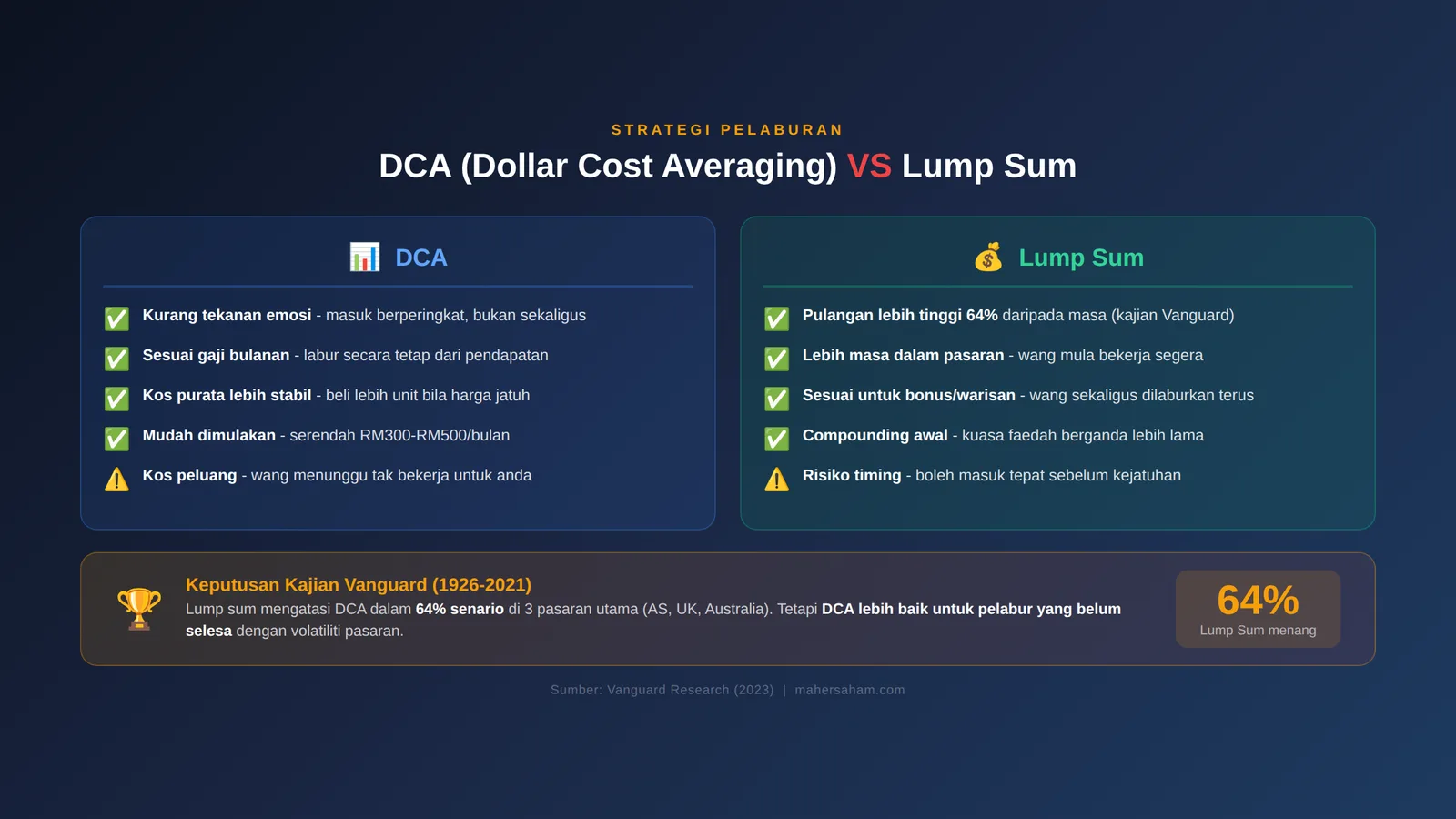
When DCA Is Better for You
DCA isn't a weak strategy - it's highly suitable in certain situations:
1. You're investing from monthly salary
This is the most natural DCA situation. You receive your salary each month and set aside a portion for investment. This isn't DCA by choice - it's DCA by reality.
2. You're a new investor not yet comfortable with volatility
If this is your first time investing, entering the market gradually gives you time to learn and adjust to market fluctuations.
3. Markets are highly uncertain
During periods of high uncertainty - such as geopolitical tensions, rising global interest rates, or economic crises - DCA reduces the risk of entering at peak prices.
4. You know you tend to panic
If you're the type who would sell everything when the market drops 10%, DCA is better suited for you. It reduces regret since you're not "all in" at a single price point.
When Lump Sum Is Better for You
1. You've received a windfall (bonus, inheritance, compensation)
If you have RM50,000 from an annual bonus or inheritance, studies show that investing immediately is statistically more profitable than keeping it in the bank while DCA-ing over 12 months.
2. You believe in the long term (5+ years)
If your investment horizon is over 5 years, short-term fluctuations become less relevant. Lump sum gives your money more time in the market - the principle of "time in the market beats timing the market" as also demonstrated by data on the impact of missing the 10 best market days.
3. Markets have just experienced a major correction
After the market drops 20-30% (like March 2020 or October 2022), lump sum investing can deliver excellent returns since you're entering at low prices.
4. Opportunity cost of holding cash is too high
Money "waiting" in savings accounts earns only 2-3% annually. If the market averages 8-10% per year, every month you wait means missed returns.
Real Calculation Example in Ringgit Malaysia
Let's compare with a realistic Malaysian scenario.
Scenario: Sarah has RM12,000 to invest in an ETF tracking the FBM KLCI
Strategy 1: Lump Sum
Sarah invests all RM12,000 in January at RM1.00 per unit.
- Units purchased: 12,000 units
- If price rises to RM1.10 in December: Value = RM13,200 (profit RM1,200 / 10%)
Strategy 2: DCA (RM1,000/month for 12 months)
| Month | Price/Unit | Units Bought |
|---|---|---|
| January | RM1.00 | 1,000 |
| February | RM0.95 | 1,053 |
| March | RM0.90 | 1,111 |
| April | RM0.92 | 1,087 |
| May | RM0.98 | 1,020 |
| June | RM1.02 | 980 |
| July | RM1.05 | 952 |
| August | RM1.00 | 1,000 |
| September | RM1.03 | 971 |
| October | RM1.06 | 943 |
| November | RM1.08 | 926 |
| December | RM1.10 | 909 |
| Total | 11,952 units |
Average DCA cost: RM12,000 / 11,952 = RM1.004 per unit
Value in December: 11,952 x RM1.10 = RM13,147 (profit RM1,147 / 9.6%)
Result: Lump sum wins by a slim margin (10% vs 9.6%). However, note - if markets dropped 20% in the early months before recovering, DCA could have won since Sarah would have bought more units at lower prices.
Hybrid Strategy: The Best of Both Worlds
You don't actually have to choose just one. Many experienced investors use a combined approach:
1. Core Investment - DCA
Set aside RM500-RM1,000 monthly from your salary for long-term investment. This becomes your portfolio foundation.
2. Tactical Investment - Lump Sum
When you receive lump sums (bonuses, tax refunds, THR), invest them immediately. Don't let them sit idle in a savings account.
3. The 50/50 Rule
If you receive a large sum and aren't comfortable investing it all at once, split 50/50. Invest half immediately (lump sum), and the other half via DCA over 3-6 months. According to Charles Schwab, this approach balances optimal returns with emotional comfort.
Common Mistakes to Avoid
1. Saying you'll DCA but never starting
"I'll wait for prices to drop more" - that's not DCA, that's market timing. DCA means buying consistently regardless of price.
2. Lump sum into a single stock
Lump sum doesn't mean putting all your money into one counter. Diversify - use ETFs or buy several different stocks. Consider diversifying the number of stocks in your portfolio.
3. Stopping DCA when markets fall
This is the most expensive mistake. Market drops mean you're getting more units at cheaper prices. This is precisely the advantage of DCA - it only works if you stay consistent.
4. Holding cash too long waiting for "the right moment"
Research shows that trying to wait for the perfect time to enter the market typically produces lower returns than simply investing and staying invested. According to Vanguard, every day your money sits outside the market is a day it's not growing.
FAQ: Common Questions About DCA vs Lump Sum
Is DCA suitable for beginner investors?
Yes, DCA is ideal for beginners. It reduces the risk of entering at peak prices and gives you time to learn about the market without significant emotional pressure.
What's the minimum to start DCA on Bursa Malaysia?
With platforms like M+ Online, you can start with as little as RM100 for ETFs and selected stocks. For effective DCA, aim for a minimum of RM300-RM500 per month.
Is lump sum too risky for regular investors?
Not necessarily. Lump sum risk depends on your investment horizon. If you're investing for 10+ years, short-term risks become less relevant as markets have historically trended upward.
Can I switch from DCA to lump sum or vice versa?
Absolutely. Many investors start with DCA, then make lump sum investments when they receive bonuses or extra funds. There are no fixed rules - adapt to your financial situation.
Does DCA work for individual stocks or only ETFs?
DCA is most effective for instruments that tend to rise over the long term - such as index ETFs, unit trusts, or blue-chip stocks. For speculative stocks that could go to zero, DCA can become a trap as you keep buying something that's losing all value.
What's the ideal DCA duration?
There's no absolute answer, but Vanguard's research uses 6-12 months as a benchmark. If you're DCA-ing for longer than 12 months with money you already have, you may be giving up too much in opportunity cost.
What does "time in the market beats timing the market" mean?
This phrase means the duration your money spends in the market is more important than trying to guess when to enter and exit. This supports both DCA (staying invested regularly) and lump sum (entering immediately).
Conclusion
Both DCA and lump sum are legitimate, effective investment strategies. Scientific data shows lump sum wins in 64% of scenarios, but DCA provides psychological advantages that shouldn't be underestimated.
What matters most isn't which strategy you choose - it's that you START investing and stay consistent. Money sitting in a savings account will always lose to money working for you in the market.
Whether you choose DCA, lump sum, or a combination of both - the first step is making sure you have the right investment platform.
Open your CDS trading account today to start investing on Bursa Malaysia and international markets including US and Hong Kong stocks through our trusted M+ platform.
Brand new to investing? Download our Free Stock Market Basics eBook to understand how the stock market works before committing your first ringgit.