EPF, SSPN & Takaful: Three Tax Reliefs Most Malaysians Don't Maximise

Every year, many Malaysian workers pay more income tax than they need to - not because tax rates are high, but because they don't know how to use the tax reliefs already available to them.
EPF, SSPN and Takaful are three financial instruments that are already part of most Malaysians' lives. Nearly every employee contributes to EPF. Many parents have an SSPN account for their children. And most families have at least one Takaful policy.
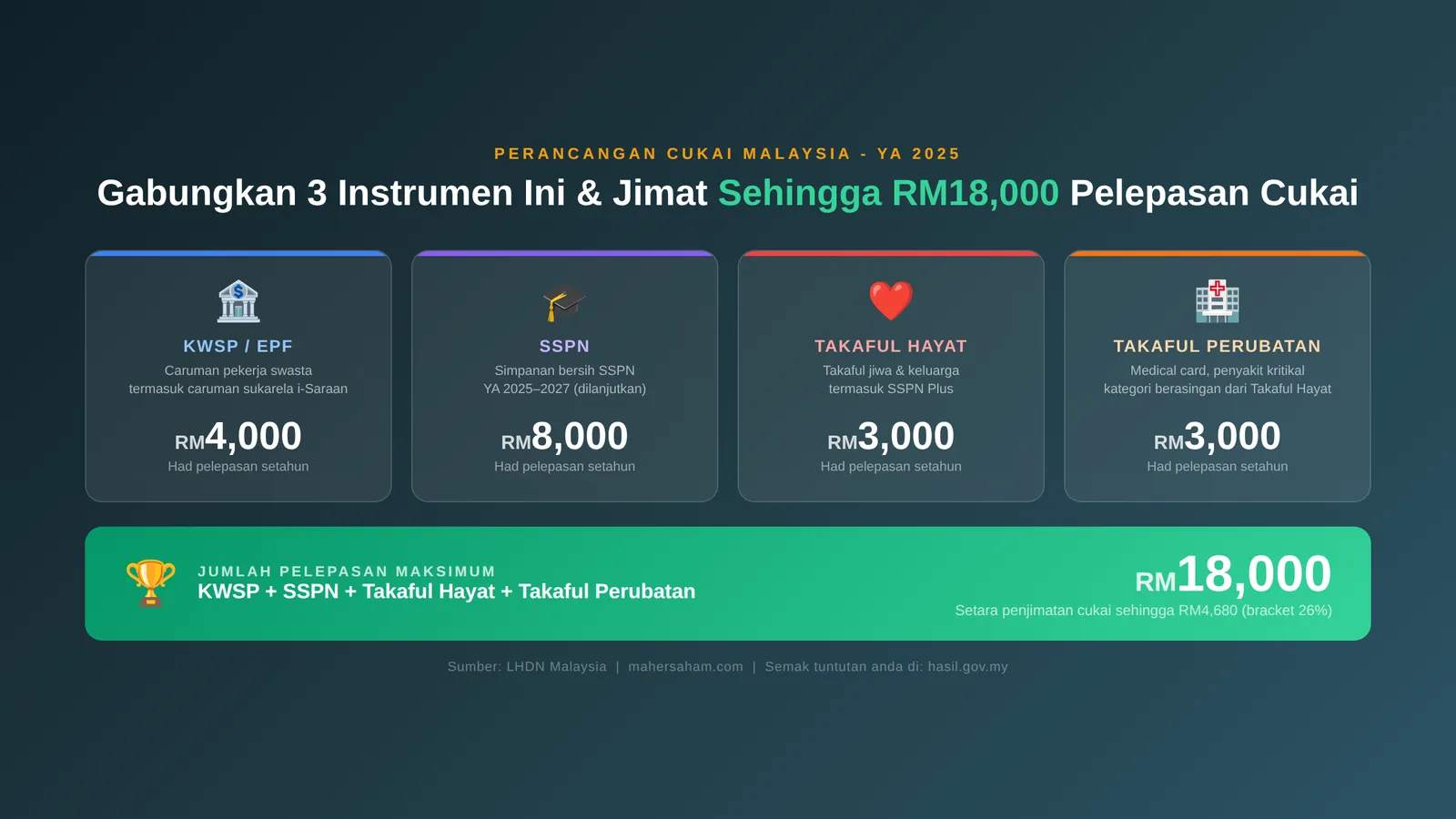
But did you know all three are also legitimate, effective tax planning tools? If you know how to maximise all three, you can enjoy tax reliefs of up to RM18,000 per year - translating to actual tax savings ranging from RM900 to over RM4,680 depending on your tax bracket.
What Is Tax Relief and Why Does It Matter?
Before diving into each instrument, let's understand the basic concept.
Tax relief is an amount deducted from your chargeable income before tax is calculated. It differs from a tax rebate - relief reduces the income subject to tax, while a rebate directly reduces your tax bill.
Simple example: If your chargeable income is RM80,000 and you get RM10,000 in relief, tax is calculated on RM70,000 only. The bigger the relief, the lower the chargeable income, and the less tax you pay to LHDN.
According to LHDN (Inland Revenue Board of Malaysia), individual tax reliefs must be claimed through the annual e-filing - they are not applied automatically. If you don't claim, you don't save.
1. EPF as a Tax Planning Tool
EPF Tax Relief: Up to RM4,000
EPF contributions by private sector employees qualify for tax relief of up to RM4,000 per year (Assessment Year 2025). This applies to both mandatory monthly contributions (deducted from salary) AND voluntary contributions (i-Saraan or voluntary top-ups).
If your salary is RM5,000 per month and your employee EPF contribution is 11% (RM550/month), your total annual contribution is RM6,600. But the tax relief claimable is capped at RM4,000 as set by LHDN.
Who Is Eligible?
- Private sector employees contributing to EPF - fully eligible
- Pensionable government employees - NOT eligible for EPF relief (already have pension scheme)
- Self-employed individuals - eligible if making voluntary contributions to EPF via i-Saraan
Private Retirement Scheme (PRS) - Separate Relief
Beyond EPF, there's another instrument many people overlook: the Private Retirement Scheme (PRS). PRS contributions provide a separate tax relief of up to RM3,000 per year - it's a different category from EPF, so you can claim both simultaneously.
This means if you contribute to EPF (RM4,000) AND PRS (RM3,000), the total relief from these two retirement instruments alone can reach RM7,000.
2. SSPN as a Tax Planning Tool
SSPN Tax Relief: Up to RM8,000
SSPN (National Education Savings Scheme) through PTPTN offers tax relief of up to RM8,000 per year based on net savings. This relief has been extended for Assessment Years 2025 through 2027 - giving you three years to maximise this benefit.
SSPN is among the largest individual tax reliefs available in Malaysia's tax system, yet it's often underestimated because people view it as "just a savings account for children."
Important note: From YA 2025, only one parent (either father or mother) can claim the RM8,000 SSPN relief per household - spouses cannot claim it separately. Plan accordingly to ensure the higher-income earner claims this relief.
How Net Savings Are Calculated
SSPN relief is calculated based on net savings in that year:
Net Savings = Total Deposits - Total Withdrawals (within the same year)
Example: If you deposit RM10,000 but withdraw RM3,000 in the same year, your net savings is RM7,000 - and you can only claim RM7,000 in relief (not the full RM8,000). Strategy: avoid withdrawing from SSPN in the same year you deposit if you want to maximise tax relief.
SSPN Prime vs SSPN Plus - Which Is Better for Tax?
There are two types of SSPN accounts. For a detailed comparison, read our article on SSPN Prime vs SSPN Plus. In brief, from a tax planning perspective:
- SSPN Prime - standard savings account with competitive annual dividends. Only one tax relief (SSPN).
- SSPN Plus - savings account with added Takaful protection. Can claim SSPN relief (up to RM8,000) AND Takaful life relief (within the RM3,000 cap) simultaneously from a single product.
For maximising tax relief, SSPN Plus delivers greater value from a tax planning standpoint.
3. Takaful as a Tax Planning Tool
Two Categories of Takaful Tax Relief
This is the part most people don't know - Takaful actually offers two separate tax relief categories that can be claimed simultaneously:
a) Life & Family Takaful
- Relief up to RM3,000 per year
- Covers: Life Takaful, family Takaful, term life certificates
b) Medical & Education Takaful
- Relief up to RM3,000 per year (SEPARATE category from life Takaful)
- Covers: Medical Takaful (medical card), education Takaful, critical illness Takaful
Maximum combined Takaful relief: RM6,000 per year (RM3,000 + RM3,000)
This means if you have a life Takaful policy AND a medical card Takaful, you can claim both categories in your LHDN tax return - not just one.
Requirements for Claiming Takaful Relief
- Premiums must be paid within the assessment year
- Policy must be under your name, your spouse's, or your child's name
- Keep receipts or annual premium statements from your Takaful provider as proof
- Medical Takaful paid by your employer is NOT eligible for personal tax claims
Takaful vs Conventional Insurance
From LHDN's tax relief perspective, both Takaful and conventional insurance qualify under the same categories. But for those prioritising Shariah compliance, Takaful is the correct choice - and it delivers tax benefits equivalent to conventional insurance.
Calculating Your Real Tax Savings
Let's look at a concrete example with real numbers.
Scenario: Ahmad, 35 years old, private sector employee, chargeable income RM80,000
| Instrument | Maximum Relief | Ahmad Claims |
|---|---|---|
| EPF (employee contributions) | RM4,000 | RM4,000 |
| SSPN (net savings) | RM8,000 | RM8,000 |
| Life Takaful | RM3,000 | RM2,400 |
| Medical Takaful | RM3,000 | RM2,800 |
| Total | RM18,000 | RM17,200 |
By leveraging all three instruments, Ahmad can save over RM4,000 in taxes - without spending any additional money, since these are funds already being saved or paid for protection he genuinely needs.
Savings by Tax Bracket
| Tax Bracket | Full RM18,000 Relief | Estimated Tax Saved |
|---|---|---|
| 13% | RM18,000 | RM2,340 |
| 19% | RM18,000 | RM3,420 |
| 24% | RM18,000 | RM4,320 |
| 26% | RM18,000 | RM4,680 |
The higher your tax bracket, the greater the savings from these reliefs. To find out your tax bracket, read our guide on who pays income tax in Malaysia.
Strategy: Combining All Three Simultaneously
Here's a systematic approach to maximise tax relief from EPF, SSPN and Takaful in a single assessment year:
Step 1: Verify Your EPF Contributions
Check your payslip to confirm your total annual employee contributions. The standard 11% contribution for employees earning under RM5,000/month is generally enough to reach or approach the RM4,000 cap.
If your salary is lower and annual contributions fall short of RM4,000, consider voluntary EPF top-ups via i-KWSP to maximise the limit before 31 December.
Step 2: Open or Activate Your SSPN Account
If you already have SSPN, check your net savings for this year. If it hasn't reached RM8,000, make additional deposits before year-end.
If you don't have SSPN yet, open one at PTPTN's website or any partner bank. One account is sufficient - deposit RM8,000 to claim the full relief.
Step 3: Review Your Existing Takaful Policies
Do a quick audit of your Takaful coverage:
- Have a Medical Takaful card? How much is the annual premium? Claim under medical category (RM3,000 cap)
- Have Life Takaful? How much is the annual premium? Claim under life category (separate RM3,000 cap)
- Don't have either? This is a good time to get the coverage you need - you'll get protection AND tax savings simultaneously
Step 4: Update Records and Keep Documents
| Instrument | Document Required |
|---|---|
| EPF | Annual EPF statement (download from i-KWSP) |
| SSPN | SSPN statement from PTPTN (my.ptptn.gov.my) |
| Takaful | Annual premium statement from your Takaful provider |
Keep all documents in a dedicated folder - physical or digital - for reference during LHDN e-filing. According to LHDN, supporting documents must be retained for 7 years for audit purposes.
Common Mistakes to Avoid
1. Not claiming SSPN relief at all
Many assume SSPN is "just a children's savings account" with no tax benefits. This is a costly mistake - RM8,000 in relief is far too significant to ignore.
2. Claiming Takaful under only one category
Medical Takaful and Life Takaful are TWO separate categories in the LHDN tax form. Make sure you enter both under the correct columns during e-filing to avoid the common tax filing mistakes that cost Malaysians money.
3. Forgetting voluntary EPF contributions
If you make voluntary EPF contributions (i-Saraan) on top of mandatory contributions, these are eligible within the RM4,000 cap. Many people forget to claim this portion.
4. Withdrawing SSPN in the same year as depositing
This reduces "net savings" and reduces the relief you can claim. Plan SSPN withdrawals carefully - avoid withdrawing in the same year you deposit.
5. Waiting until year-end to plan
Tax planning is most effective when done throughout the year, not just in December. By then, your options are already limited. Start now - open SSPN, review Takaful, and plan EPF voluntary contributions if needed.
FAQ: Common Questions About EPF, SSPN & Takaful Tax Relief
Can I claim EPF tax relief if I'm self-employed?
Yes, if you make voluntary contributions to EPF via i-Saraan, you're eligible for tax relief up to RM4,000. Additionally, contributions to a Private Retirement Scheme (PRS) provide separate relief of up to RM3,000.
Does SSPN relief apply to savings in my own name or only my child's?
SSPN relief applies specifically to savings deposited into your child's account (a student or prospective student). The parent who deposits into the child's SSPN account claims the relief on their personal tax return.
Can I claim SSPN relief even if my child is still a baby?
Yes. You can open an SSPN account for your newborn and start depositing immediately. Tax relief is calculated based on net savings in that assessment year regardless of the child's age.
Does the RM4,000 EPF tax relief include employer contributions?
No. Only employee contributions qualify for this tax relief. Employer contributions are not counted within the RM4,000 cap.
Can a husband and wife each claim Takaful tax relief separately?
Yes. Each individual claims based on the Takaful premiums they personally pay. To maximise family tax savings, ensure both spouses have adequate Takaful coverage under their respective names.
If I maximise all three, how much tax can I actually save?
It depends on your tax bracket. With full RM18,000 in relief (EPF + SSPN + Takaful), someone in the 26% bracket can save up to RM4,680 per year. Use a Malaysia income tax calculator to estimate your precise savings.
Can I claim Takaful relief for a policy under my parents' name?
Yes, life Takaful relief can be claimed for premiums paid on policies in your parents' names - as long as you are the one paying the premium. This is common for adult children who cover their parents' Takaful policies.
Conclusion
EPF, SSPN and Takaful are more than just savings or protection tools - they are three pillars of effective, legal, and Shariah-compliant tax planning.
When used strategically, all three can provide tax relief of up to RM18,000 in a single assessment year. For someone in the 24% tax bracket, that translates to savings of over RM4,000 per year - money that can be reinvested or used to improve your family's quality of life.
The key to success: start early, document all contributions, and ensure you claim every eligible relief in your annual LHDN e-filing.
Once you've mastered tax planning, the next step is putting those savings to work through smart investing for long-term wealth building.
If you don't yet have a CDS account to invest in Bursa Malaysia or international stocks like US and Hong Kong markets, open your trading account today through our trusted M+ platform.
New to investing? Download our Free Stock Market Basics eBook - ideal for first-time investors who want to understand how the stock market works before committing their first ringgit.
Further Reading
- How to Save Income Tax in Malaysia: Maximise Every Relief Before Year-End
- Tax Rebate vs Tax Relief Malaysia: What's the Difference?
- SSPN Prime vs SSPN Plus: Which Is Better for Your Child's Education Savings?
- 10 Common Income Tax Filing Mistakes Malaysians Make
- Financial Planning by Life Stage: A Roadmap from Your 20s to Retirement