How to Filter News vs Noise: A 3-Tier Framework for Bursa Malaysia Investors

Every day, Bursa Malaysia investors are flooded with thousands of headlines - phone apps "ding" non-stop, WhatsApp groups full of "hot tips," and financial media publish hundreds of articles. Your brain says all this information is important. In reality, almost none of it is.
Research from Bloomberg Intelligence estimates that 99% of financial news is noise - information that creates no actual trading opportunity or long-term value insight. Yet the average retail investor spends 10-15 hours a week consuming this noise while missing the 1% of signals that genuinely matter.
The problem isn't a lack of information - the problem is too much information without a filter. This article gives you a simple 3-tier framework to classify every piece of news you encounter - so you know which requires action, which is just context, and which should be ignored outright.
In this article, you'll learn:
- The fundamental difference between signal and noise in investing
- The 3-Tier Framework for classifying every piece of news
- Tier 1: Actionable Signal - news that genuinely changes the thesis
- Tier 2: Context - news worth understanding but not trading on
- Tier 3: Noise - news that should be ignored outright
- The filter test - 3 questions for quick classification
- How to build a healthy information diet for investors
Signal vs Noise: What's the Difference?
Before we get into the framework, understand the fundamental difference.
Signal is information that is genuinely relevant to the value of an investment. It is rare, structural, and repeatable. Signal reflects durable economic forces - productivity trends, demographic shifts, technological innovation, changing consumer behaviour, and the direction of monetary and fiscal policy.
Noise, on the other hand, is information that is emotional, reactive, and mean-reverting. It changes nothing fundamentally, but it is loud, dramatic, and demands your attention.
Here's the irony: signal is often subtle, slow, and lacks urgency - so it's easy to miss. Noise arrives suddenly and demands immediate attention - so it's hard to ignore. The human brain is naturally drawn to noise and ignores signal. A disciplined framework is needed to counteract this tendency.
The 3-Tier Framework: Classify Every Piece of News
Instead of trying to process every piece of news equally, classify each one into one of three tiers. This saves time, reduces anxiety, and improves decisions.
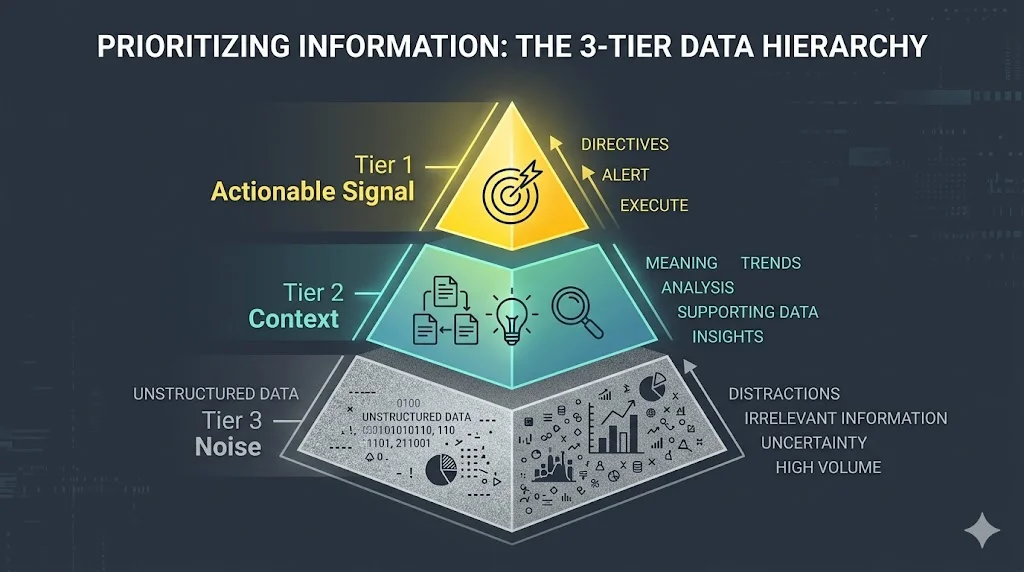
Tier 1: Actionable Signal
This is the 1% of news that genuinely matters. Tier 1 is information that materially changes a company's fundamental value or invalidates your investment thesis.
What Qualifies as Tier 1?
- Earnings results that deviate significantly from expectations - not a small beat/miss, but a structural change in profit, margins, or cash flow
- Business model changes - the company enters/exits a major segment, loses its biggest customer, or a contract affecting 20%+ of revenue
- Critical management changes - the CEO or founder steps down, especially if they are central to the company
- Regulatory changes affecting the industry - new policy that changes the economics of an entire sector
- Material corporate actions - large rights issue, acquisition, disposal of key assets, or a dividend cut
- Governance red flags - massive insider selling, audit problems, securities commission investigations
What Do You Do with Tier 1?
Tier 1 requires you to stop and reassess. Ask: is my original investment thesis still valid? Does this change my buy/hold/sell decision? Tier 1 deserves your time and deep analysis.
But remember - even Tier 1, not all of it requires immediate action. Sometimes the best reaction after reassessing is to do nothing, because the thesis remains intact.
Tier 2: Context
Tier 2 is information that is useful to understand but does not require trading action. It shapes your mental picture of the investment environment, but you should not buy or sell based on it.
What Qualifies as Tier 2?
- Macroeconomic data - GDP figures, inflation, unemployment rate, trade data
- Monetary policy decisions - OPR rate decisions by Bank Negara Malaysia
- Sector trends - developments in the industry you invest in (e.g., global semiconductor demand trends)
- Government policy direction - the National Budget, industry policy changes
- Geopolitical trends - developments that may affect supply chains or capital flows
What Do You Do with Tier 2?
Tier 2 deserves to be read and understood, but not traded on. A big mistake retail investors make is reacting to every macro data point - selling stocks because inflation rose 0.2%, or buying because one GDP figure beat expectations.
Macro data shapes the medium- and long-term context. You use it to understand the environment, not to time the market. The danger of Tier 2 is that it's easily mistaken for Tier 1 - remember, most macro data doesn't change the fundamental value of the individual companies you hold.
Tier 3: Noise
This is the 99% of news - and the most correct response for Tier 3 is to ignore it outright.
What Falls into Tier 3?
- Daily price commentary - "KLCI closed 5 points lower today" - short-term price movements with no fundamental meaning
- Market predictions - "Analysts predict the market will..." - short-term forecasts that are almost never consistently accurate
- Social media hype - "this stock is going to explode!" from influencers or WhatsApp groups
- Dramatic headlines - news designed to trigger emotion (fear or greed) and get clicks
- Daily analyst chatter - small price target changes, routine commentary
- "Market wrap" commentary - daily summaries explaining why the market moved (usually after-the-fact rationalisation)
Why Is Tier 3 Dangerous?
Tier 3 is dangerous not because it's wrong - but because it steals attention and triggers unnecessary action. Every time you react to noise, you:
- Trade more frequently (transaction costs rise)
- Make emotional decisions (not thesis-based)
- Expose yourself to herd mentality and FOMO
The biggest danger of noise is that it triggers cognitive biases. To understand how noise manipulates your mind, read Investor Psychology: 7 Mental Biases That Make You Lose Money on Bursa Malaysia.
The Filter Test: 3 Questions for Quick Classification
When you encounter a piece of news, don't react immediately. Run it through these three questions:
Question 1: Is It NEW?
Is this information genuinely new, or just a repeat/speculation that has been circulating for a while? If a piece of "news" is merely a confirmation of what the market already expected, it's likely already priced in - this relates to the concept of buy the rumor, sell the news. Old information repackaged as news = noise.
Question 2: Does It Change the Investment Thesis?
This is the most important question. Ask: does this information change the original reason I bought (or didn't buy) this stock? If your thesis was "this company generates stable cash flow with a 5% dividend yield," does this news affect the cash flow or dividend? If not - it's not an actionable signal.
Question 3: Is It Confirmed by More Than One Source?
Information from a single source - especially a WhatsApp group or influencer - needs to be verified. Primary data (official financial reports, Bursa announcements, Bank Negara statements) always beats secondhand interpretation. If a "hot tip" only circulates on social media without confirmation from an official source, treat it as noise until proven otherwise.
How to use this test: If the news PASSES all three questions → possibly Tier 1. If it's useful but doesn't change the thesis → Tier 2. If it fails question 1 or 2 → Tier 3, ignore it.
How to Build a Healthy Information Diet
Classifying news alone isn't enough - you also need to control the inflow of information. Here are some practical practices:
1. Reduce Frequency, Increase Quality
You don't need to check stock prices every hour. Successful long-term investors usually check their portfolio weekly or monthly, not every minute. The more often you check, the more noise you absorb.
2. Go to Primary Sources
Instead of reading a journalist's interpretation of a financial report, read the financial report itself. Instead of reading commentary on an annual report, read the annual report. For guidance, refer to How to Read a Bursa Malaysia Annual Report Without a Headache.
3. Turn Off Price Notifications
A "ding" notification every time a price moves is the most toxic noise generator. It trains your brain to react to every small move. Turn it off - check on your own schedule, not the market's schedule.
4. Define Your Own Signal Criteria
Investors who predetermine what counts as "signal" for them will trade less but with more conviction. They ignore information that doesn't meet predefined criteria - this reduces emotional decision-making and improves consistency.
5. Leave the "Hot Tips" Groups
WhatsApp and Telegram groups full of "hot stocks" are noise engines. They create false urgency and FOMO. If you're serious about investing, reduce or leave such groups.
Practical Example: Classifying Real News
Let's apply the framework to a few scenarios:
Scenario A: "KLCI fell 8 points today on cautious sentiment." → Tier 3 (Noise). Daily price movement with no fundamental meaning. Ignore.
Scenario B: "Bank Negara maintains OPR at its latest meeting." → Tier 2 (Context). Important for understanding the interest rate environment, but not a reason to trade your individual stocks.
Scenario C: "Company X that you hold announces a 50% dividend cut due to deteriorating cash flow." → Tier 1 (Actionable Signal). This changes the thesis - if you bought for the dividend, you MUST reassess.
Scenario D: "An influencer says stock Y will rise 300% next month." → Tier 3 (Noise). Fails the source question - no official confirmation, just speculation. Ignore.
Scenario E: "Company Z loses a contract contributing 35% of its revenue." → Tier 1 (Actionable Signal). A material change to fundamentals. Reassess.
Frequently Asked Questions (FAQ)
What's the difference between signal and noise in investing?
Signal is information genuinely relevant to the fundamental value of an investment - rare, structural, and durable. Noise is emotional, reactive, mean-reverting information that changes nothing fundamentally but demands attention. Bloomberg Intelligence estimates 99% of financial news is noise.
How often should I check stock news?
For long-term investors, a weekly or monthly check is sufficient. Checking too frequently (hourly or daily) causes you to absorb more noise and make emotional decisions. Active traders need to check more often, but they also need a stricter filter.
How do I quickly tell if a piece of news is noise?
Use 3 questions: Is it new? Does it change my investment thesis? Is it confirmed by more than one source? If news fails the first or second question, it's almost certainly noise. Daily price commentary, short-term forecasts, and social media hype are almost always noise.
Is macroeconomic data important for investors?
Yes, but as context (Tier 2), not actionable signal (Tier 1). Macro data like GDP and inflation help you understand the medium-term investment environment. But most of it doesn't change the fundamental value of the individual companies you hold - so don't trade on every macro figure.
Why is my brain drawn to noise?
Because noise is (by design or by nature) dramatic, sudden, and triggers emotion (fear or greed). Signal is subtle, slow, and lacks urgency - so it's easy to miss. This is a natural human cognitive weakness that must be countered with a disciplined framework.
Should I stop reading financial news entirely?
No need to stop entirely - you need news for Tier 1 (signal) and Tier 2 (context). What you need to cut is Tier 3 (noise) - daily price commentary, forecasts, social media hype. Reduce frequency, go to primary sources, and turn off price notifications.
What is a "primary source" and why does it matter?
A primary source is the original official document - a company's financial report, Bursa Malaysia announcements, Bank Negara statements, prospectuses. It beats secondhand interpretation (journalist articles, analyst commentary) because there's no layer of interpretation or bias between you and the actual facts.
How does this framework make me a better investor?
It reduces information overload, saves time (you don't need to process every piece of news equally), and most importantly - reduces emotional decisions. Investors with a clear filter trade less but with more conviction, and this improves long-term consistency.
Conclusion
In the age of information overload, the most valuable skill for an investor isn't gathering more information - it's filtering information effectively. The 3-Tier Framework gives you a simple system: Tier 1 (actionable signal) deserves your time and analysis, Tier 2 (context) deserves understanding but not trading, and Tier 3 (noise) - 99% of what you see - should be ignored outright.
Investors who master this filtering will trade less, feel less stress, and make more consistent decisions. Remember: signal is subtle and rare; noise is loud and abundant. The discipline to distinguish them is the real edge.
To start investing with a disciplined approach that isn't caught up in market noise, you'll need a suitable trading account.
A CDS account lets you invest in Bursa Malaysia and overseas markets like US and Hong Kong, giving you a platform to build a long-term portfolio based on genuine signals - open your CDS account here.
For the basics of understanding how to evaluate quality companies and distinguish important information from noise, download the free Stock Market Basics Ebook.
Further Reading
- Investor Psychology: 7 Mental Biases That Make You Lose Money on Bursa Malaysia
- "Buy the Rumor, Sell the News": When This Classic Strategy Wins and When It Loses
- Elections & Bursa Stocks: The Real KLCI Pattern Before and After Malaysian General Elections
- How to Read a Bursa Malaysia Annual Report Without a Headache
- Stocks for Beginners 2026: 7 Criteria to Pick Your First Stock at Bursa Malaysia