How to Compare Stocks: Peer Review Analysis Guide for Beginners

What is Company Peer Review? "Company Peer Review Analysis is the process of comparing a company's financial performance against its competitors within the same industry to determine whether the stock price is cheap or expensive in terms of valuation."
Imagine this situation: You are thinking about buying a new car. Let us say you fancy brand H. Would you just walk into the showroom and put down a deposit?
Of course not, right?
Typically, you would open YouTube, watch comparison reviews. You would compare brand H with brand T or brand P. You want to know which one is more fuel-efficient, which one has better resale value, and which one has cheaper servicing. You would not make a decision based on one car's brochure alone.
Well, in the stock market, this is what we call Company Peer Review Analysis.
Sounds very technical, right? But actually, it is just a fancy term for "checking what the competitors next door are doing".
In the world of stock investing, this process of 'checking the neighbours' is absolutely critical. Many beginners lose money because they buy stocks blindly without knowing how to compare stocks properly.
The professional term is Company Peer Review Analysis, but the basics are simple: we want to find out who is the real champion in that industry.
For beginners on Bursa Malaysia, this analysis is critical. We want to compare the financial performance of the company we are interested in with its competitors (peers) in the same industry.
We want to know whether that company is truly the "King" of its sector, or merely a kampung champion that only looks impressive because we have not compared it with others.
Without doing this peer analysis, you are essentially buying a house without checking the market prices of the surrounding area. You might end up overpaying!
Why Bother Comparing Industry Performance?
Some might ask, "If the company's report clearly shows strong performance, just buy it. Why stress yourself looking at other companies?"
Here is the honest answer: Numbers can be misleading without context.
Let me give you a simple example. Say Company A announces a profit of RM1 million this year. Sounds like a lot, right? But if you do your competitive benchmarking, you suddenly notice that Company B and Company C (its competitors) each made RM50 million profit in the same year.
Suddenly, that RM1 million looks tiny. From this alone, we can tell that Company A is actually the weakest player in the industry.
That is exactly why peer comparison is essential. It helps you answer these pointed questions:
- Is this company performing well or struggling compared to its competitors?
- Is the company's management efficient at controlling costs, or are they overspending?
- Is the stock price cheap because it is "undervalued", or cheap because the business simply is not performing?
We want to avoid investing in a company we think is a "racehorse", when it turns out to be an "old nag".
This is why knowing how to compare stocks is so important. We do not want a company that looks impressive on its own but is actually the weakest contender when placed side by side with its peers.
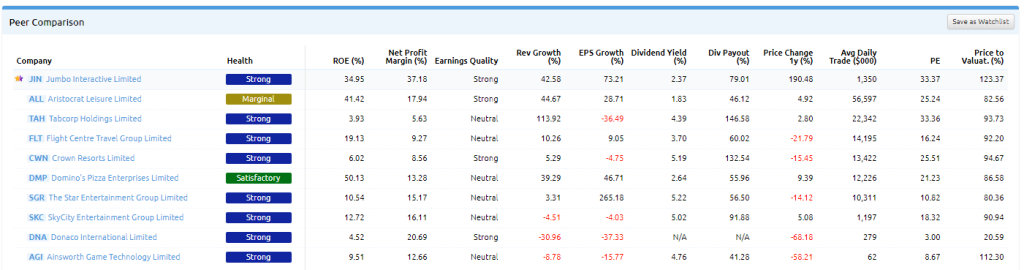
How to Compare Stocks: 5 Key Metrics to Watch (You Do Not Need to Be an Accountant)
Right, now we get into the slightly technical part, but do not worry, I will simplify it. When you open a financial report or stock screener, do not look at everything until your eyes glaze over. If you want to know how to compare stocks like a pro, focus on just these 5 fundamental elements:
Revenue (Sales) & Growth
This is the foundation of any business. No sales, no business. How much revenue are they generating? But do not just look at the figure alone — look at the trend.
If Company A's sales are growing at 5% per year, but the industry average is growing at 20%, something is not right. Perhaps their product is no longer relevant, or competitors have eaten into their market share.
In peer analysis, we want to find companies whose growth is rapid or at least in line with the industry.
Profit Margins (What Actually Goes into the Pocket)
This is the difference between a company that is "just scraping by" and one that "creates surplus wealth".
- Gross Margin: After deducting the cost of goods, how much is left?
- Net Margin: After deducting staff salaries, electricity bills, taxes and everything else, how much net profit actually goes into the pocket?
If Company X sells a burger for RM10 and nets RM2, whilst Company Y also sells a burger for RM10 but nets RM4, clearly Company Y is more efficient. They might be better at negotiating raw material prices or their processes are more streamlined. We want companies like Y. Consistently.
Operating Costs (Who Is More Frugal?)
When evaluating competitor companies, look at who is the best at managing costs. During an economic downturn, companies with low operating costs can usually survive, whilst companies that overspend will start laying off workers or recording losses. Look for management that is prudently frugal.
Debt (Leverage)
Debt is like cholesterol. Some is good, some is bad. But if there is too much, you could have a heart attack.
Compare the Debt-to-Equity Ratio. If in the Property sector, Company P has debt of 0.2 times equity, but Company Q has debt of 1.5 times, Company Q is high risk. If OPR (interest rates) rises, Company Q will be the one scrambling to pay bank interest first.
Business Model (How the Company Makes Money)
Even within the same industry, the way companies make money is not necessarily the same. For example in the aviation sector: some use a low-cost model (like AirAsia), while others use a premium model (like Malaysia Airlines).
When doing peer comparison analysis, make sure you understand their business strategies. Do not be puzzled as to why a premium company's profit margin is different from a budget company's.
How Beginners Can Start Without Spending a Sen
Good news for everyday investors like us: All this data is free.
You do not need to subscribe to a Bloomberg terminal costing tens of thousands of ringgit per month.
Step 1: Use Annual Reports
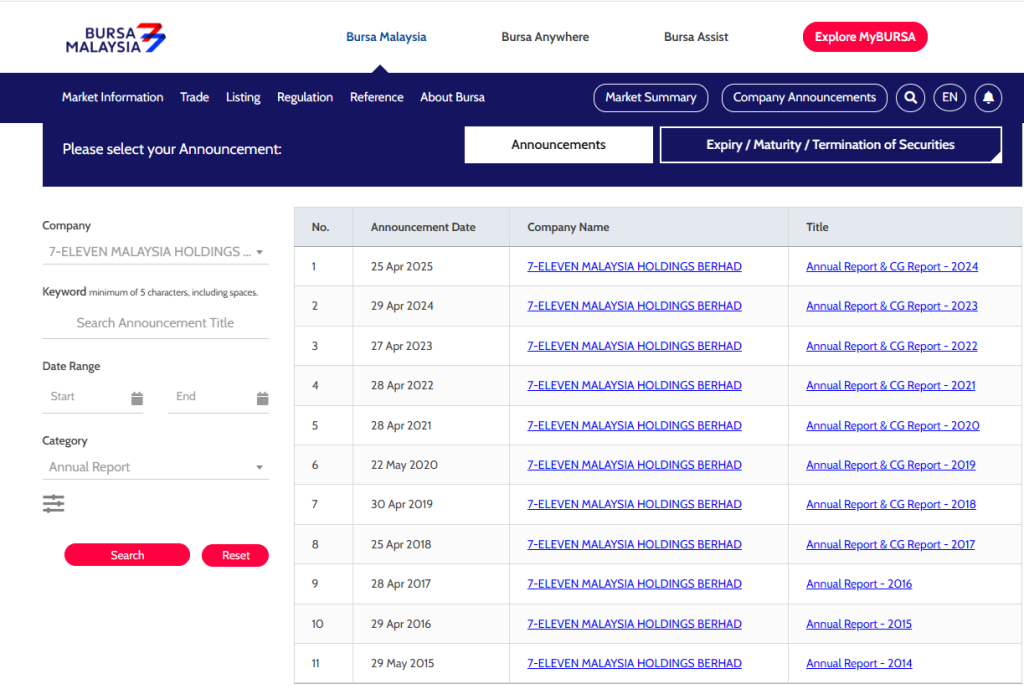
Go to the Bursa Malaysia website and download the Annual Report. Look for the "Management Discussion & Analysis" section. Here, the company CEO will typically share their thoughts. They will talk about industry challenges and their strategy for competing against rivals.
Step 2: Free Screener Portals
Use tools like KLSE Screener, Stock Hunter, TradingView, or Bursa Marketplace. You can place 3-4 companies side by side and the system will automatically compare PE Ratio, ROE, and Dividend Yield. Saves you heaps of time!
Step 3: Read the Prospectus (For IPOs)
If you are interested in IPO stocks, this is a must-read document. Look for the "Independent Market Research" (IMR) chapter. Analysts have already prepared market share pie charts for you. Just read and digest.
Prospectuses are easy to find nowadays — they are all over the official Bursa website: IPO Summary
Want to learn more about IPOs? You can read here: What Is an IPO or Initial Public Offering?
Reality vs Expectations: How to Interpret Data (A Tale of Two Furniture Shops)
Let us do a simple simulation so you can see the real picture. We will not use any confusing numbers.
Imagine two furniture companies on Bursa: Teak Wood Co. (A) and Plywood Co. (B).
- Company A (Premium): Sells sofa sets at RM10,000 each. Sales volume is low — maybe only 100 sets per year. But the profit per set is very large (thick margins).
- Company B (Affordable): Sells ready-to-assemble sofa sets at RM500 each. Sales are brisk — 10,000 sets per year. But profit per set is paper-thin (margins as thin as an onion skin).
When a beginner looks at the Net Profit Margin, they might say: "Wow, Company A is more powerful, 40% margin!"
Hold on. If the economy is in a downturn, people will not buy RM10,000 sofas. Company A's sales might plummet. But people will still buy RM500 sofas because they are affordable. So Company B might have more stable cash flow during tough times.
See the point? Evaluating competitor companies is not just about seeing who has the bigger numbers, but whose business model is more resilient according to the economic climate.
Common Mistakes Beginners Must Avoid
I have seen many beginners stumble because they did their analysis incorrectly. Please avoid these traps:
Comparing Apples with Durians
Do not compare a Technology company that makes software with a Technology company that manufactures semiconductors. Even though both are in the "Technology" sector, their costs and business models are worlds apart. Make sure you compare "Apples with Apples".
Fooled by "One-off Gains"
You see a report showing profit up 500%! You immediately hit buy. Turns out, the company just sold a piece of land. Next year there is no more land to sell, and profit returns to normal. Make sure you look at Core Profit (operating profit), not windfall gains.
Being Overconfident with Small Cap Stocks
Do not compare Blue Chip (large cap) companies directly with Small Cap (small) companies. Small companies may appear to have rapid growth (because their base is small), but the risk if they fall is truly painful!
What Are the Next Steps?
In closing, learning how to compare stocks is not rocket science. It is just common sense combined with a bit of diligent reading. Once you have mastered this technique, you will not be easily swayed by random buy calls because you know how to evaluate for yourself who is truly the strongest player.
This analysis will help you sleep soundly. You will not worry when your stocks dip slightly because you know your company's fundamentals are stronger than its competitors. You know you are holding a "Champion", not a "Spectator".
Your next step: This week, try picking one sector that interests you (for example: F&B or Technology). Pick 2 companies within that sector. Open a stock screener and compare their Profit Margins and Debt levels. Ask yourself: "Why is Company A outperforming Company B?"
The answer you find — that is the key to your investment success.
Happy investing and be a smart investor, not a follow-the-crowd investor!
FAQ: Peer Review Stock Comparison
What is peer review analysis in stock investing?
Peer review analysis (also known as peer comparison or competitive benchmarking) is the process of comparing a company's financial performance — such as revenue, profit margins, debt levels, and growth rates — against its direct competitors within the same industry. This helps investors determine whether a stock is fairly valued, undervalued, or overvalued relative to its peers on Bursa Malaysia.
What metrics should I compare when doing peer analysis?
Focus on five key metrics: (1) Revenue and growth trends, (2) Profit margins (gross and net), (3) Operating costs and efficiency, (4) Debt-to-equity ratio (leverage), and (5) Business model differences. These five elements give you a comprehensive picture of how a company stacks up against its competitors without needing advanced accounting knowledge.
Where can I get free data to compare Malaysian stocks?
You can access free comparison data from several sources: Bursa Malaysia's website for annual reports and prospectuses, KLSE Screener for side-by-side financial comparisons, TradingView for charting and screening, and Bursa Marketplace for PE Ratio, ROE, and Dividend Yield comparisons. You do not need expensive terminals like Bloomberg.
Can I compare companies of different sizes?
It is not advisable to directly compare Blue Chip (large cap) companies with Small Cap companies. Small companies may show rapid percentage growth because their base is smaller, but they carry significantly higher risk. Always compare companies of similar size and within the same sub-sector for meaningful peer analysis.
How often should I update my peer comparison analysis?
You should update your peer comparison at least quarterly, coinciding with companies' quarterly financial report releases on Bursa Malaysia. However, you should also reassess whenever there are major industry developments, changes in interest rates (OPR), or significant corporate announcements that could shift the competitive landscape.
Level Up Your Investment Knowledge
Successful investing starts with solid knowledge.
Investment Basics:
Download our free Stock Market Basics Ebook for a complete guide.
Open a CDS Account:
Ready to get started? Open a CDS Trading Account today.
Read Also:
Learn the complete swing trading guide for beginners.