How to Invest in Stocks in Malaysia: From Zero to Your First Trade

2026 marks a period of positive economic momentum rarely seen in Malaysia. The nation's GDP recorded a growth of 5.7% in the fourth quarter of 2025 — the strongest since mid-2024. The FBM KLCI index has just surpassed the 1,750-point level, its highest since October 2018, driven by a rally in blue chip stocks such as Maybank, Public Bank, and CIMB.
Behind these figures, an interesting trend is emerging: more and more Malaysians are opening investment accounts. Nearly 90,000 new accounts were opened through digital platforms last year, while online broker account openings surged by more than 270% compared to the previous year.
If you are one of those wondering how to start investing in stocks — this article was written specifically for you. This guide will take you from zero, step by step, until you successfully purchase your first stock on Bursa Malaysia.
What Are Stocks?
Stocks, in simple terms, represent partial ownership of a company. When you buy Maybank shares, for example, you technically become one of Maybank's owners — albeit in a very small proportion.
Companies sell shares to raise funds for expanding their business. As a shareholder, you can potentially earn returns through two methods:
- Capital gain — The stock price rises above your purchase price. Example: buy at RM5.00, sell at RM6.00 = RM1.00 profit per unit.
- Dividends — Distribution of company profits to shareholders. Usually paid quarterly or annually.
On Bursa Malaysia, there are over 1,000 listed companies you can choose to invest in.
Why Should You Invest in Stocks?
Many people keep their money in savings accounts or fixed deposits (FD) and feel that is sufficient. However, the reality is:
- FD only yields ~3% per year (2026)
- Malaysia's average inflation is 2-3% per year — meaning your money is gradually "shrinking" in terms of purchasing power
- Malaysia's stock market averages 8-12% returns per year over the long term
This does not mean savings and FD are not important — they remain your emergency fund. But for building long-term wealth, stock investing is one of the most effective and accessible vehicles.
The good news? You do not need to be a financial expert to get started. What matters is basic knowledge and discipline.
Types of Stocks on Bursa Malaysia
Before buying stocks, it is important to understand the main categories available:
Blue Chip Stocks
Shares of large, stable companies like Maybank, Tenaga Nasional, and PETRONAS Chemicals. Typically less volatile, pay consistent dividends, and are suitable for beginners seeking stability.
Growth Stocks
Companies that are expanding rapidly — stock prices can rise significantly but can also drop sharply. Examples: technology and AI companies.
Penny Stocks
Stocks priced below RM1.00. Low initial capital required but high risk. Suitable for those who already understand the market — not for beginners.
Shariah-Compliant Stocks
Approximately 850 stocks on Bursa Malaysia (80% of all listed) are Shariah-compliant, certified by the Shariah Advisory Council of the Securities Commission. This means Muslim investors can invest in the majority of stocks on Bursa with peace of mind.
The Shariah-compliant stock list is updated twice a year (May and November) by the Securities Commission Malaysia.
What Is the Minimum Capital to Invest in Stocks?
This is the most popular question from beginners. The short answer: it depends on the stock price you choose.
On Bursa Malaysia, the minimum purchase quantity is 1 lot = 100 shares. So:
| Stock | Price Per Unit | Capital for 1 Lot (100 units) |
|---|---|---|
| Penny stock (e.g., Widad) | RM0.05 | RM5 |
| Mid-range stock (e.g., Gamuda) | RM5.00 | RM500 |
| Blue chip stock (e.g., Maybank) | RM12.06 | RM1,206 |
Practical recommendation: Start with RM1,000 to RM3,000. This amount gives you the flexibility to buy several different stocks without brokerage fees eating into your returns.
Important: Only use surplus money that you will not need for the next 3-5 years. Do not use rent money, food money, or your emergency fund.
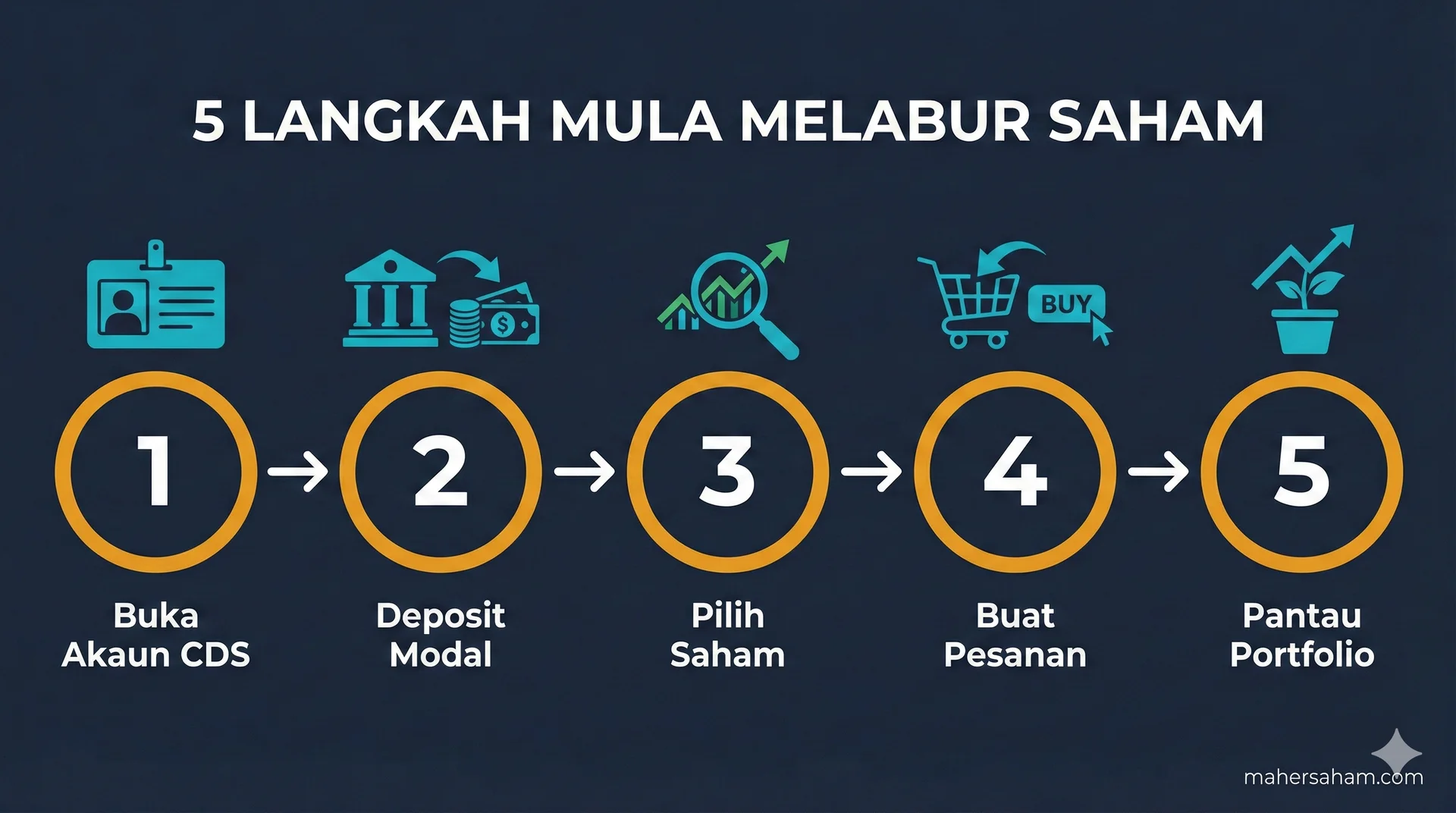
Step 1: Open a CDS Account
Before you can buy stocks, you need two things:
- CDS Account (Central Depository System) — Think of this as a "digital vault" for your stocks. Every stock you purchase is stored here.
- Trading Account — The platform for executing buy and sell orders. Usually opened together with the CDS account through a broker.
The process of opening a CDS account is now very straightforward and can be done entirely online. Most brokers such as Mplus, RHB, and Malacca Securities offer digital registration.
What you will need:
- Malaysian citizen aged 18 and above
- MyKad (National ID)
- Bank account (for deposits and withdrawals)
- Smartphone or computer
For a detailed step-by-step guide, read our article: How to Open a CDS Account with Mplus (2026).
If you are ready to open a CDS account and start investing, you can register for a CDS account here.
Step 2: Deposit Funds & Understand the Trading Platform
After your CDS account is active, the next step is:
Deposit to Trust Account
Transfer funds to your broker's Trust Account. This is a separate account (not the broker's personal account) that is protected by law. Your money is safe here.
Get Familiar with the Platform Interface
Spend some time getting to know your trading platform. Key things to understand:
- Watchlist — A list of stocks you are monitoring
- Order Book — Displays bid (buyer's price) and ask (seller's price)
- Portfolio — Stocks you hold and their current performance
- Chart — Stock price charts for technical analysis
Most brokers provide demo accounts or paper trading. Use these to practice before using real money.
Step 3: Buy Your First Stock
The moment you have been waiting for! Here is how to make your first purchase:
Understand Order Types
- Market Order — Buy at the current market price. Fast, but you accept whatever price is available.
- Limit Order — You set the maximum price you are willing to pay. The order only executes if the price reaches that level. Recommended for beginners.
Quick Steps
- Search for the stock name or code on the platform (e.g., "MAYBANK" or "1155")
- Select Buy
- Enter the quantity (minimum 1 lot = 100 units)
- Choose the order type (Limit Order recommended)
- Set your price
- Review and Confirm
Congratulations — you are now a stock owner! For a visual tutorial with screenshots, read: How to Buy Stocks on Bursa Malaysia (Mplus Global).
Essential Terms Every Investor Should Know
The stock market has its own "language". Here are the basic terms you will encounter daily:
| Term | Meaning |
|---|---|
| Lot | Minimum purchase unit = 100 shares |
| Bid | The highest price a buyer is willing to pay |
| Ask | The lowest price a seller is willing to accept |
| Volume | The number of shares traded on that day |
| Market Cap | Total value of all company shares (price x total shares) |
| PE Ratio | Price-to-Earnings ratio — an indicator of whether a stock is "expensive" or "cheap" |
| Dividend | Distribution of company profits to shareholders |
| Capital Gain | Profit when the selling price exceeds the buying price |
| Bull Market | Market trending upward / positive |
| Bear Market | Market trending downward / negative |
You do not need to memorise everything at once. You will become more familiar as you start actively monitoring your portfolio.
Basic Strategies for Beginners
As a new investor, focus on strategies that are simple and proven:
1. Dollar Cost Averaging (DCA)
Invest a fixed amount every month — regardless of whether prices are up or down. Example: RM500 every month into a blue chip stock. This strategy reduces the risk of "buying at the peak" and is ideal for those who do not have time to monitor the market daily.
2. Buy & Hold
Buy shares of strong companies and hold them for the long term (3-5 years or more). Do not panic sell when prices temporarily dip. Remember: the market always has ups and downs, but the long-term trend is generally upward.
3. Diversification
Do not put all your eggs in one basket. Spread your investments across 3-5 stocks from different sectors. Example: one banking stock, one energy stock, one tech stock.
5 Common Mistakes New Investors Make (And How to Avoid Them)
1. FOMO (Fear of Missing Out)
Buying stocks because "everyone is buying" without doing your own research. By the time you hear everyone talking about profits, the price has usually already risen significantly.
2. No Plan
Entering the market without a strategy — buying on impulse, selling on emotion. Set your profit targets and loss limits before you buy.
3. No Diversification
Putting all your capital into a single stock. If that stock drops, you suffer heavy losses. Spread your risk.
4. Using Margin Too Early
Margin trading allows you to buy stocks with "borrowed" money from your broker. This can double your profits, but also double your losses. Beginners should avoid margin entirely.
5. Checking Prices Too Frequently
Monitoring your portfolio every 5 minutes only adds stress and leads to emotional decisions. If you are using a long-term strategy, checking your portfolio once a week is sufficient.
Safety Tips & Risk Management
Stock investing involves risk. Here is how to protect yourself:
- Only use surplus money — Money you will not need in the near future
- Avoid "tips" from unverified sources — Telegram/WhatsApp groups promising quick profits are usually scams
- Ensure your broker is licensed — Check the list of registered brokers on the Securities Commission Malaysia website
- Do not borrow money to invest — Taking personal loans to buy stocks is not worth the risk
- Keep learning continuously — Read, attend webinars, and follow market developments
Conclusion: Start Now, Not Tomorrow
A journey of a thousand miles begins with a single step. You do not need to wait until you are an expert to start investing — what matters is beginning with basic knowledge and a comfortable amount of capital.
With Malaysia's economy on a positive trajectory, an active stock market, and increasingly accessible digital platforms, 2026 is an excellent year for you to get started.
Next steps:
- Download the Free Stock Market Basics Ebook — free for all Mahersaham readers. Get it here.
- Open a CDS Trading Account — and begin your investment journey today. Register for a CDS account now.
Happy investing!
FAQ (Frequently Asked Questions)
What is the minimum capital to start investing in stocks?
Technically, as low as RM5 if you buy 1 lot (100 units) of a stock priced at 5 sen. However, practically speaking, it is recommended to start with RM1,000 to RM3,000 for a more meaningful portfolio.
Is stock investing halal?
Approximately 80% of stocks on Bursa Malaysia are Shariah-compliant, certified by the Shariah Advisory Council of the Securities Commission. You can check the latest list on the SC website.
How long does it take to open a CDS account?
With online registration, a CDS account is typically active within 1-3 business days. Some brokers can complete the process within 24 hours.
Can I lose all my money?
Stocks can decline in value, but to lose 100%, the company would need to go completely bankrupt — which is rare for listed companies. Diversification helps reduce this risk.
What are the trading hours for Bursa Malaysia?
Morning session: 9:00 AM to 12:30 PM. Afternoon session: 2:30 PM to 5:00 PM (Monday to Friday, except public holidays).
What is the difference between trading and investing?
Trading involves buying and selling stocks within short periods (days or weeks) for quick profits. Investing means holding stocks for the long term (months or years). For beginners, long-term investing is more suitable.
Do I need to pay tax on stock profits?
In Malaysia, capital gains from stock investments are not subject to tax. However, dividends received may be subject to tax depending on the company's payment structure.
Which broker is most suitable for beginners?
Mplus, RHB TradeSmart, and Malacca Securities are among the popular choices. Look for a broker with low fees, a user-friendly platform, and good customer support.