Malaysia-EU FTA Near Final Signing: Real Impact on Bursa Stocks

On 27 April 2026, at the 25th ASEAN-EU Ministerial Meeting (AEMM) in Bandar Seri Begawan, Foreign Minister Datuk Seri Mohamad Hasan confirmed a major development - Malaysia and the European Union (EU) are now in the final stage of signing a Free Trade Agreement (FTA). The story was reported by The Edge Malaysia and The Malaysian Reserve.
For Bursa Malaysia investors, this is more than a diplomatic headline. The Malaysia-EU FTA will reshape the export landscape across 5 major sectors - from semiconductor chips, palm oil, to rubber products - and determine which stocks soar and which struggle over the next 2-3 years.
This article explains: (1) the geopolitical context behind the FTA, (2) what is actually being negotiated, (3) Bursa sectors and stocks affected, (4) the palm oil and EUDR challenge, and (5) what investors must monitor.
What's Happening: Quick Context
The Malaysia-EU FTA (Free Trade Agreement) has been negotiated for over a decade - the original talks began in 2010 and were frozen in 2012 over various issues. But the world of 2026 is very different from 2010.
What triggered the new momentum?
- US unilateral tariffs - Trump 2.0 imposed sweeping tariffs on imports from numerous countries, undermining the global trading system
- Russia-Ukraine conflict - causing instability in supply chains, especially energy and raw materials
- EU wants to diversify trade partners - cannot be too dependent on US or China
The result: the EU now sees Southeast Asia as a strategic new bloc. Foreign Minister Hasan stated directly in his speech: "This positive development is driven by the EU which now views Southeast Asia as a strategic and important bloc following unilateral tariffs by the US and instability resulting from the Russia-Ukraine conflict."
In September 2025, EU Trade Commissioner Maroš Šefčovič said the Malaysia-EU FTA is expected to be finalized in 2026, with bilateral trade reaching €46 billion (~RM230 billion) projected to grow rapidly once the FTA is implemented.
What Is Actually Being Negotiated
Malaysia-EU FTA negotiations resumed in January 2025, with the first round held from 30 June to 4 July 2025. Unlike the 2010 agreement (which only covered 16 areas), the current version covers 21 negotiation chapters including:
- Comprehensive market access - goods, services, investment, government procurement
- Digital trade - a new chapter absent from the 2010 talks
- Sustainable development - including environmental and social standards
- Energy and raw materials - access to strategic supplies
- Industrial tariff liberalization - including the automotive sector (still under negotiation)
According to MITI, Malaysia's Ministry of Investment, Trade and Industry is the Lead Agency coordinating the negotiations, with sectoral ministries leading working groups.
The second round was held in November 2025, and now in April 2026, both parties are at the final stage of signing.
The Trade Scale: How Big Is the Malaysia-EU Relationship?
To understand the importance of this FTA, look at the size of bilateral trade:
- Total Malaysia-EU trade 2025: ~€45.6 billion (RM228 billion)
- Malaysian exports to the EU 2025: ~€25.8 billion (11.5% growth)
- EU as export destination: one of Malaysia's top 5
- Malaysia's total trade 2025: €630 billion (RM3.15 trillion)
This is no small scale. The EU is the largest single economic bloc Malaysia handles without a comprehensive FTA - until now.
Sectors and Bursa Stocks Affected
This is the important part for investors. The FTA will impact different sectors in Bursa Malaysia in different ways:
Sector 1: Electrical & Electronics (E&E) + Semiconductors
This is the biggest winner of the Malaysia-EU FTA.
Key statistics:
- E&E contributed €146.9 billion (RM711 billion) to Malaysia's total exports in 2025 - 44.3% of total national exports
- Semiconductors and integrated circuits alone reached €78 billion with 16.4% YoY growth in Q1 2025
- Malaysia's National Semiconductor Strategy 2025 involves €4.5 billion investment and training of 60,000 new engineers
According to CEIAS analysis, this FTA has shifted from a "palm oil" agreement to a "semiconductor power play" - the EU wants access to Malaysia's back-end packaging and testing capacity (back-end OSAT) which contributes ~13% of global capacity.
Bursa stocks that could benefit:
- INARI Amertron (0166) - back-end OSAT, global clients including Broadcom, Qorvo
- MPI / Malaysian Pacific Industries (3867) - back-end packaging
- UNISEM (5005) - OSAT services
- VITROX (0097) - automated inspection systems for semiconductor fabs
- Greatech (0208) - automation equipment
- KESM (9334) - burn-in and testing services
- PIE Industrial (7095) - EMS contracts for EU products
- SKP Resources (7155) - EMS contracts for EU consumer goods
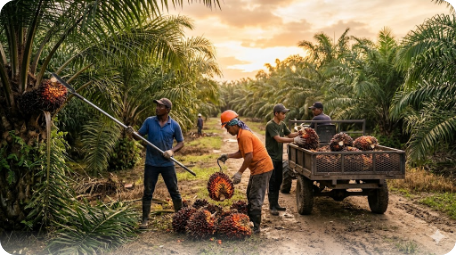
Sector 2: Palm Oil and Related Industries
This is the most controversial sector in the FTA negotiations.
Malaysia's palm oil and palm-based product exports to the EU are worth ~€8.1 billion annually. But the sector faces two challenges:
- Anti-palm oil campaign in Europe - promoted by competing oil lobbies (rapeseed, sunflower, soy)
- EUDR (EU Deforestation Regulation) - in force from 30 December 2025
Minister Hasan stated directly to Kaja Kallas (EU High Representative) that the anti-palm oil campaign "is not based on scientific evidence but driven by lobbyists" and Malaysia does not accept its sustainability practices being equated with practices in other countries.
He also emphasized: "More than 55% of our land is still covered by tropical forests, and we do not destroy forests to plant palm oil." Malaysia's palm oil industry is mostly managed professionally by large plantation companies that fully comply with the MSPO (Malaysian Sustainable Palm Oil) standard.
Palm oil Bursa stocks (mixed - depends on FTA outcome):
- KLK / Kuala Lumpur Kepong (2445) - large plantation, MSPO certified
- IOI Corporation (1961) - integrated palm oil
- Sime Darby Plantation (5285) - world's largest by land area
- Genting Plantations (2291) - integrated plantation
- FGV Holdings (5222) - state-owned, high EU exports
- Hap Seng Plantations (5138) - small-mid cap plantation
- TSH Resources (9059) - plantation + bio-integration
If the FTA opens EU palm oil market access by recognizing MSPO, these stocks could re-rate. If the EUDR is implemented strictly without exceptions, the sector remains under pressure.
Sector 3: Rubber and Gloves
The rubber sector is also affected by EUDR (similar to palm oil). But from an FTA perspective, market access could expand for gloves and rubber products:
Related Bursa stocks:
- TOP GLOVE (7113) - world's largest glove producer
- HARTALEGA (5168) - premium nitrile gloves
- KOSSAN Rubber (7153) - integrated rubber-glove
- SUPERMAX (7106) - gloves
- KAREX (5247) - condoms and rubber products
Sector 4: Manufacturing and Industrial Exports
Manufacturing as a whole accounts for ~86.4% of Malaysia's exports (€278 billion). The FTA will reduce EU tariffs on a range of Malaysian products:
Related Bursa stocks:
- YTLPOWR (6742) - power, infrastructure
- PETRONAS Chemicals (5183) - export petrochemicals
- MISC Berhad (3816) - energy transportation
- Hong Leong Industries (3301) - consumer goods
- Hap Seng Consolidated (3034) - diversified industrial
Sector 5: Financial and Professional Services
The FTA also includes services liberalization. Malaysian banks may gain easier access to EU markets and vice versa:
Bursa stocks:
- MAYBANK (1155) - largest bank, EU operations
- CIMB Group (1023) - regional bank
- PUBLIC BANK (1295) - can expand to professional services
The Main Challenge: EUDR and Sustainability Issues
EUDR (EU Deforestation Regulation) is the biggest challenge intersecting with the FTA. According to European Forest Institute, EUDR requires ALL palm oil, rubber, and timber shipments from Malaysia to the EU must be:
- Deforestation-free - demonstrably not involving forest clearing after 31 Dec 2020
- Compliant with Malaysian law - fully
- Traceable to plot - traceable to the source farm
Compliance costs can be high especially for smallholders. A "two-tier" market is emerging:
- "Clean" oil (traceable, premium) - flows to EU/US
- "Conventional" oil - flows to less regulated markets (China, India, Africa)
In the meeting with Kallas, Minister Hasan urged the EU not to equate Malaysia's forest sustainability standards with practices in other countries, and to conduct a detailed assessment of Malaysia's palm oil estate management before imposing new discriminatory measures.
Lessons from Other FTAs Malaysia Has Signed
Malaysia is no stranger to FTAs. To understand the possible impact, look at Malaysia's existing FTAs:
| FTA | Status | Impact on Malaysian Exports |
|---|---|---|
| Malaysia-Japan (MJEPA) | Since 2006 | Exports increased ~RM50B+ |
| Malaysia-China (ACFTA) | Since 2010 | China is now #1 trading partner |
| Malaysia-EFTA (Norway, Iceland, etc.) | 2025 | Newly signed |
| CPTPP | 2018 | Access to 11 Pacific countries |
| RCEP | 2022 | World's largest trade bloc |
The consistent pattern: FTAs typically boost exports by 10-30% within the first 5-10 years, especially for sectors with price competitiveness.
Outlook: What Happens After the FTA Is Signed?
Several possible scenarios:
Scenario 1: FTA Signed in 2026 (Optimistic)
If the FTA is successfully signed in 2026 and implemented 2027-2028:
- E&E and semiconductor sectors get the biggest boost
- Palm oil market access remains complex (EUDR still in force)
- Affected Bursa stocks could re-rate 10-30% over 2-3 years
Scenario 2: FTA Delayed to 2027 (Realistic)
Based on the EU's track record of long negotiations and the palm oil issue:
- FTA may complete in 2027 (not 2026)
- Implementation 2028-2029
- Investors should monitor "pre-FTA positioning" - companies already preparing
- Market volatility expected throughout the negotiation period
Scenario 3: FTA Fails (Less Likely)
If negotiations stall over palm oil or labor rights issues:
- Palm oil sector remains under pressure
- E&E sector may still profit since not dependent on FTA
- Stocks already priced high on FTA assumptions could fall
For investors, portfolio diversification and focus on quality companies (high margins, strong balance sheets) is the best strategy.
FAQ: Common Questions About the Malaysia-EU FTA
1. When will the Malaysia-EU FTA be signed?
According to Minister Mohamad Hasan (April 2026), both sides are at the final stage. EU Commissioner Šefčovič stated the target is to complete in 2026. However complex negotiations are typically delayed - 2027 may be more realistic for signing and 2028-2029 for implementation.
2. What is the direct impact on Bursa stocks once the FTA is signed?
Stocks expected to benefit immediately are in the E&E sector (INARI, MPI, UNISEM), semiconductors (VITROX, GREATECH), and industrial exporters. Palm oil stocks (KLK, IOI, Sime Darby Plantation) are subject to EUDR negotiation outcomes.
3. Will EUDR be canceled with the FTA?
No. EUDR is an EU regulation separate from the FTA. But the FTA could provide a framework for Malaysia to gain MSPO recognition as an equivalent standard, easing EUDR compliance burden for Malaysian producers.
4. How much does Malaysia export to the EU now?
In 2025, Malaysian exports to the EU reached €25.8 billion (RM129 billion), with 11.5% YoY growth. Total bilateral trade was €45.6 billion.
5. Which sector benefits most from this FTA?
Semiconductors and E&E benefit most because the EU needs supply chain diversification away from China and Taiwan. Malaysia is seen as a "strategic node" in back-end OSAT and electronics.
6. What's the difference between Malaysia-EU FTA and CPTPP or RCEP?
The Malaysia-EU FTA is a bilateral agreement (Malaysia and EU only). CPTPP involves 11 Pacific countries, RCEP 15 ASEAN+ countries. Each FTA has different rules of origin and market access.
7. Should I buy palm oil stocks now?
Depends on your assumptions. If you believe Malaysia will gain MSPO recognition equivalent to EUDR standards, MSPO-certified palm oil stocks (KLK, IOI, SDPLNTN) could be a pick. But if EUDR is implemented strictly without exceptions, the palm oil sector remains under pressure. Don't put all eggs in one basket.
8. What should I monitor as an investor?
(i) FTA signing date, (ii) Final content of MSPO/EUDR chapters, (iii) MITI and Bank Negara statements on market access, (iv) Individual company announcements on EU strategy, (v) Monthly export growth to EU.
Conclusion
The Malaysia-EU FTA is a strategic development that will determine Malaysia's export landscape for the next decade. For Bursa Malaysia investors, it is an opportunity and risk simultaneously - a major opportunity for E&E and semiconductor sectors, but a risk for the palm oil sector still grappling with EUDR.
Smart investors will diversify their portfolio across winning sectors (E&E, semiconductors) and defensive sectors, while monitoring the negotiation progress closely.
To participate in the opportunities brought by the Malaysia-EU FTA, you need access to Bursa Malaysia and foreign markets first.
Open a CDS account with Mahersaham to start investing in Bursa Malaysia and also in foreign stocks like the US and Hong Kong.
For beginners who want to understand the basics of stock investing before starting, download our free Stock Basics Ebook.
Further Reading
- Taiwan Labor Crisis: 1,000 Indian Workers Plan Sparks Racist Backlash - Lessons For Malaysia
- What Is Asian Development Bank (ADB)? Purpose, History & Role in Malaysia
- World Bank vs IMF: What's the Difference & Their Role for Malaysia?
- AI Memory Price Surge: DRAM, NAND, HBM & Stocks Involved
- US Raises 50% Tariff on India, Major Export Impact