How to Use Orderflow Analysis in Stock Trading

What Is Orderflow Analysis?
Orderflow analysis is a technique that examines how buy and sell orders are placed in the market — essentially studying the buy queue and sell queue.
For your information, the buy queue and sell queue are collectively known as market depth.
In simple terms, orderflow analysis involves reading, analysing, and forecasting stock price movements based on the dynamics of investors' buy orders and sell orders.
All of this happens in real-time.
It becomes more complex when multiple order types are involved:
- Stop orders
- Limit orders
- Market orders
In the stock market, every transaction consists of a buy and a sell.
There must be a buyer and a seller for a transaction to match and take place.
Importance of Orderflow Analysis
1. It is the earliest form of analysis — before charts or trading processes are formed.
As explained earlier, the buying and selling process happens in real-time.
2. It is the game of the old-timers.
In the early days, charts did not yet exist. What traders did was observe stock price movements directly.
Old-school traders simply watched the transactions, and from that alone, they could tell whether a stock was going to move up or down.
This is more commonly known as tape reading.
3. It is closely related to market psychology and the games played by big players (smart money)
When we talk about the games of big players, it relates to how we interpret orders — whether someone is holding, accumulating, or placing fake queues.
All of this is manipulation or strategy by big players or syndicates to accumulate shares if they want a particular stock to go much higher.
Or it could be a strategy to distribute shares when they feel the stock has reached their target profit level.
Components of Orderflow
- Market depth / DOM – Level 1 and Level 2
- Transactions / Time and Sales / Print
- Volume distribution chart
- VWAP
- Tick Chart
Market Depth / DOM – Level 1 and Level 2
This refers to the buy or sell orders visible on your trading platform.
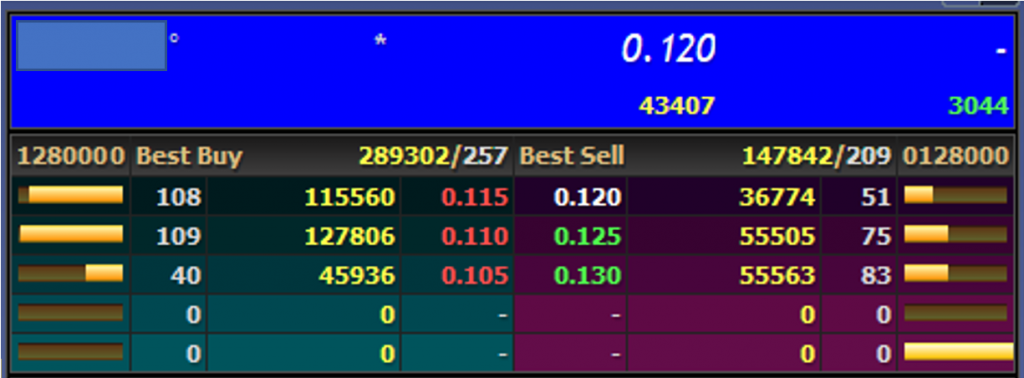
Referring to the image above, the right column is the sell queue and the left column is the buy queue.
Now focus on the colour-coded numbers.
The white numbers represent the number of investors currently queuing to buy.
The yellow numbers represent the total number of share lots being traded.
The green/red figures represent the price per unit of the shares being traded.
Clear so far? Good.
Now focus on the market depth levels. Based on the image above, there are 3 levels.
Focus on the buy queue at Level 1 — the topmost row.
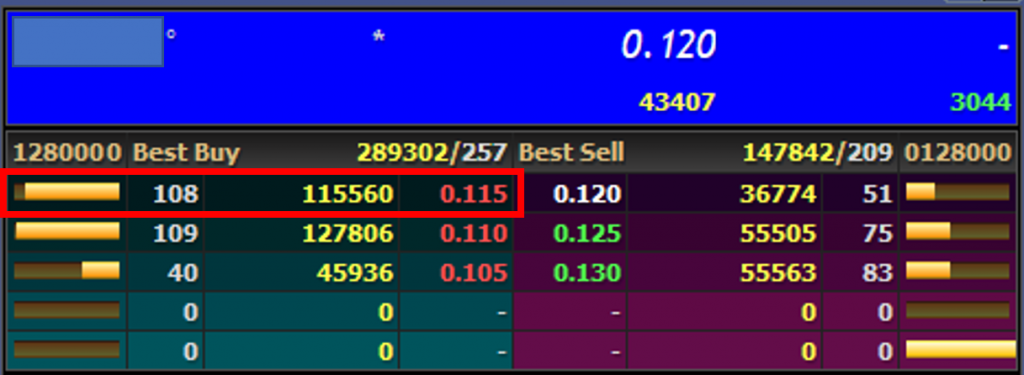
Pay attention — I am going to teach you how to read and understand these levels.
At Level 1, there are 108 investors queuing to buy stock XYZ at a price of RM0.115, and their total combined buy orders amount to 115,560 lots.
The same reading method applies to Levels 2 and 3.
What about the sell queue?
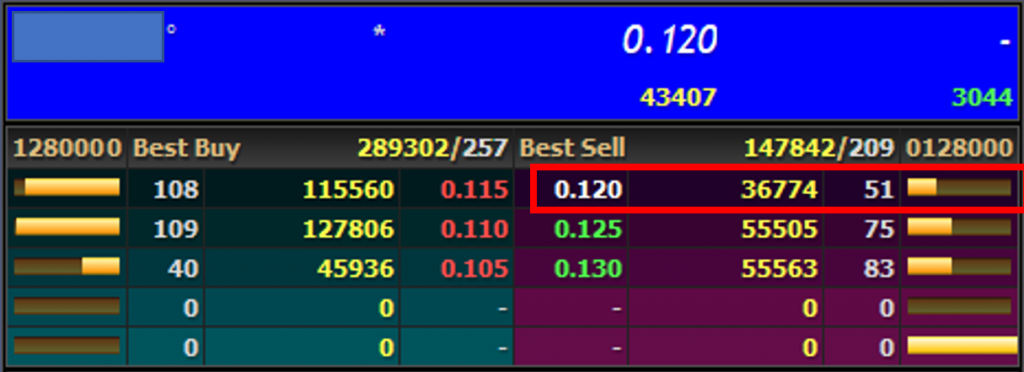
At Level 1, there are 51 investors queuing to sell stock XYZ at a price of RM0.120, and their total combined sell orders amount to 36,774 lots.
The same reading method applies to Levels 2 and 3.
Remember — just because you place an order does not guarantee it will be filled.
For a transaction to occur on Bursa Malaysia, there must be both a willing buyer and a willing seller.
For example, if you previously bought stock XYZ and now want to sell it at RM0.150, but no one is willing to buy at that price, then the shares cannot be sold.
Buy Up
For instance, you want to buy 100 lots of stock XYZ urgently.
So you would place your buy price at the seller's asking price or the willing seller's price (refer to the sell queue).
Based on the diagram above, you would simply place your order at RM0.120 — no need to queue on the buy side.
Because you urgently want to buy.
Sell Down
You plan to sell stock XYZ immediately because your technical analysis indicates the stock price is going to fall.
To avoid further losses, and based on your trading plan, the stock price has reached your cut loss level.
So you are forced to sell even though the price is lower. This is better than the price dropping further and causing more emotional distress.
You would place your sell price at the buyer's bid price or the willing buyer's price (refer to the buy queue).
Based on the diagram above, you would simply place your order at RM0.115 — no need to queue on the sell side.
Because you urgently want to sell.
Questions About Orderflow Analysis
1. Why Do Gap Ups Occur / What Happens at Market Open?
Let us say stock ABC closed yesterday at RM0.60.
Then, overnight, news breaks that company ABC is among the most profitable companies every year and has just secured a new multi-million ringgit project.
Before the market opens the next morning, investors will already be keying in orders to queue up to buy the stock.
With such positive news, do you think many investors want to buy shares in this company?
Of course — because company ABC just landed a multi-million ringgit project.
If many people want to buy, the stock price is very likely to rise.
What price do you think investors are willing to pay (on the buy queue)?
For example, some investors want to buy at RM0.60 or RM0.65. Others are willing to buy at RM0.70 or RM0.75.
Imagine 40% of investors are willing to buy at RM0.70.
30% of investors want to buy at RM0.60.
20% want to buy at RM0.65.
And 10% are willing to buy at RM0.75.
Can you guess at what price stock ABC will trade when the market opens that morning?
Naturally, the price will gravitate towards the majority.
And anyone who placed an order before 9 AM (before the market opens) at a price higher than the market price will confirm getting their buy filled at the prevailing market price.
Example Scenario
Puan Taichy keyed in her order before market open at RM0.75, and when the market opened, the stock was trading at RM0.65.
What happened?
It means Puan Taichy got her shares at RM0.65 instead of the RM0.75 she keyed in.
2. What Is Queue Cutting?
For example, you want to buy stock XYZ immediately without queuing — and get matched straight away. This is when you would "cut the queue".
How?
It is simple — you just place a price higher than the current market price of the stock.
For example, if stock XYZ is currently priced at RM0.50, and you buy at a price above RM0.50 such as RM0.51 or RM0.52, you will get matched immediately.
No more queuing.
3. Why Is There a Purple Colour?
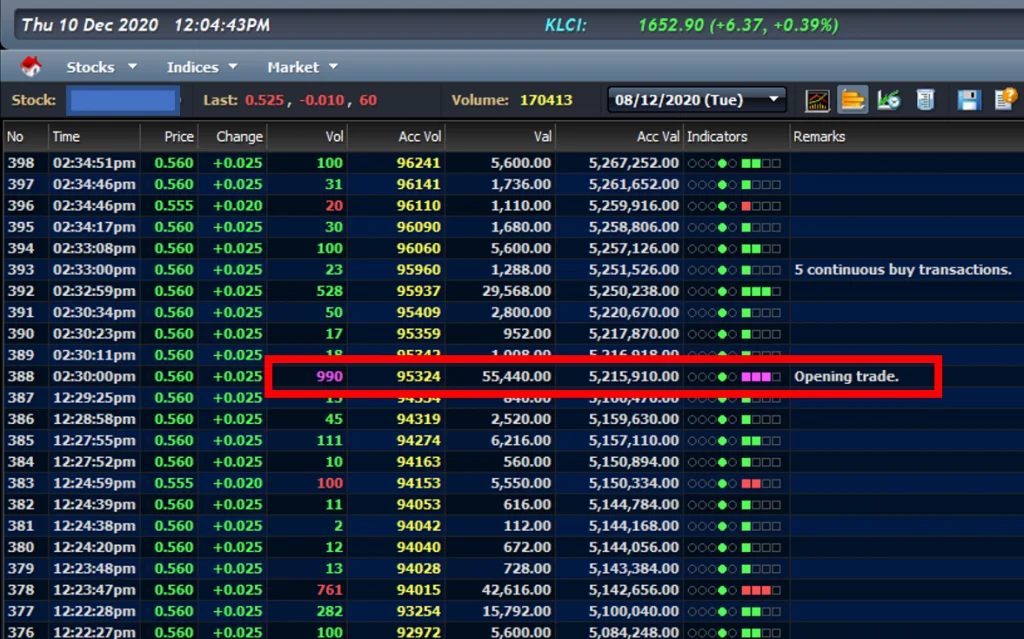
The purple colour indicates that at that moment, there is no buy up or sell down taking place.
Instead, it represents the matching of orders that were keyed in before 9 AM (before the market opens).
This also occurs at 2:30 PM (before the market reopens) after the 12:30 PM lunch break, and at 4:50 PM because the market pauses briefly before finalising the closing price at 5 PM.
4. Explanation of Plus (+) and Minus (-) Signs
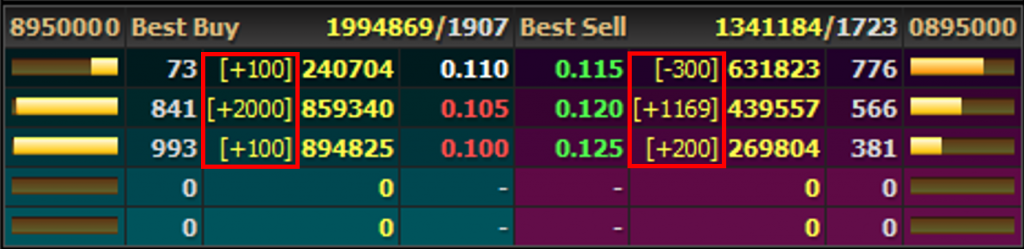
The minus sign [-] means an investor is cancelling their queue or a transaction is being matched.
The plus sign [+] means an investor is joining the queue.
Market Trade Monitor
To view this feature, you need to open the platform using a laptop or PC.
You can access it via the Chrome web browser or Internet Explorer.
However, bear in mind that when using the Mplus (M+) platform, Internet Explorer is the better option as not all features are supported on Google Chrome.
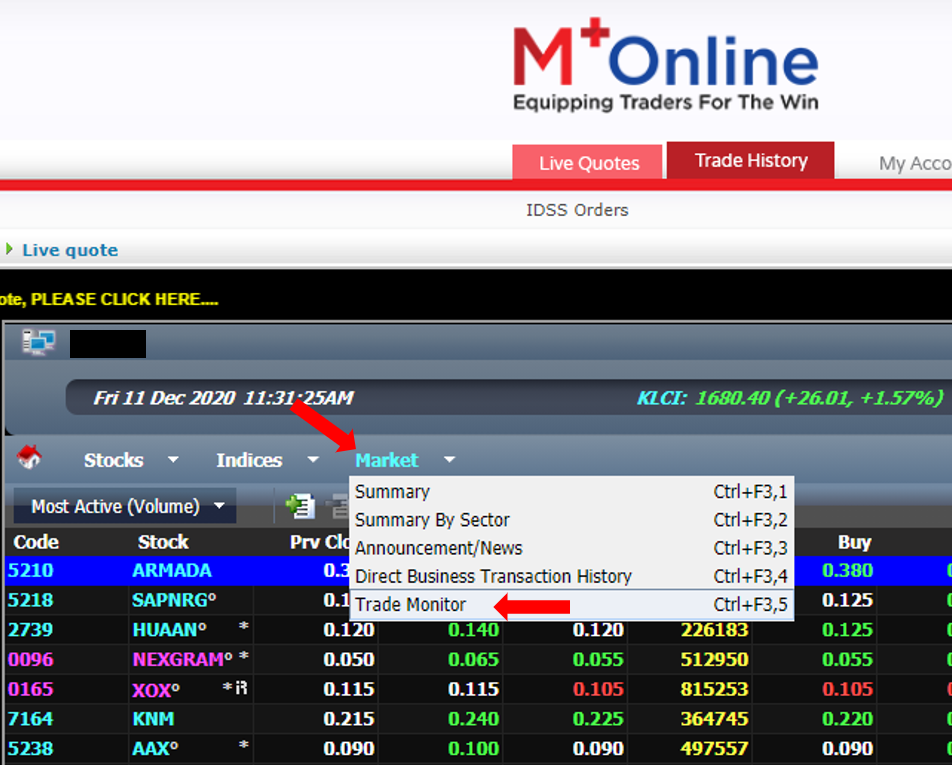
If you open the Mplus (M+) platform using Chrome:
- Visit www.mplusonline.com
- Log in
- Find the Market menu
- Click Trade Monitor
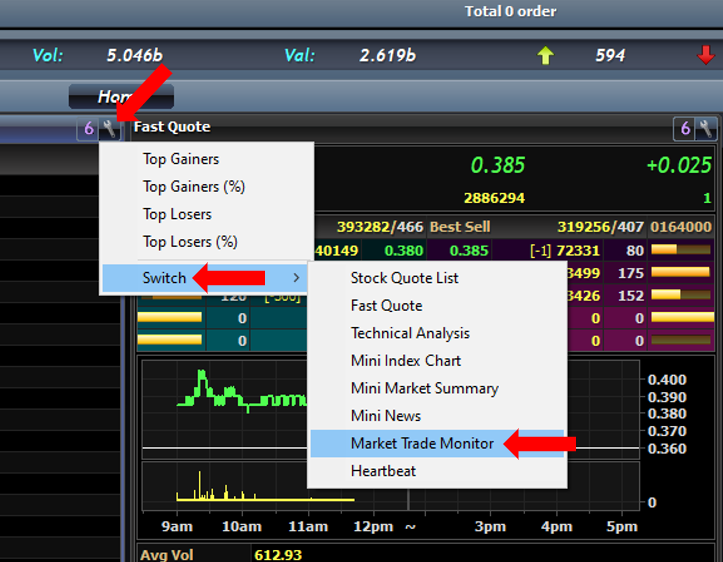
If you open the Mplus (M+) platform using Internet Explorer:
- Visit www.mplusonline.com
- Log in
- Go to the spanner icon
- Press Switch
- Market Trade Monitor
The Market Trade Monitor displays stock prices being traded in real-time.
Every transaction is shown.
This is one of the tools used by practitioners of orderflow analysis, as well as old-school traders better known as tape readers.
What is tape?
Every transaction that comes through is the tape. By reading these transactions, traders can predict where the market is heading.
Not many people possess this skill. It requires continuous training and experience.
This is the most valuable skill if your goal is to become an intraday trader.
What to Watch on the Market Trade Monitor
- 1. Large Orders
- 2. Frequency
- 3. Buy or Sell
Transactions / Time and Sales / Print
Key things to take note of:
- 1. How many transactions are occurring in a particular company/counter.
- 2. Buy rate
- 3. Where to view it for each stock
Viewing a stock is straightforward — open the platform and double-click on the counter you want to study.
If the screen below does not appear, click on the second icon (I have placed an arrow in the image below).
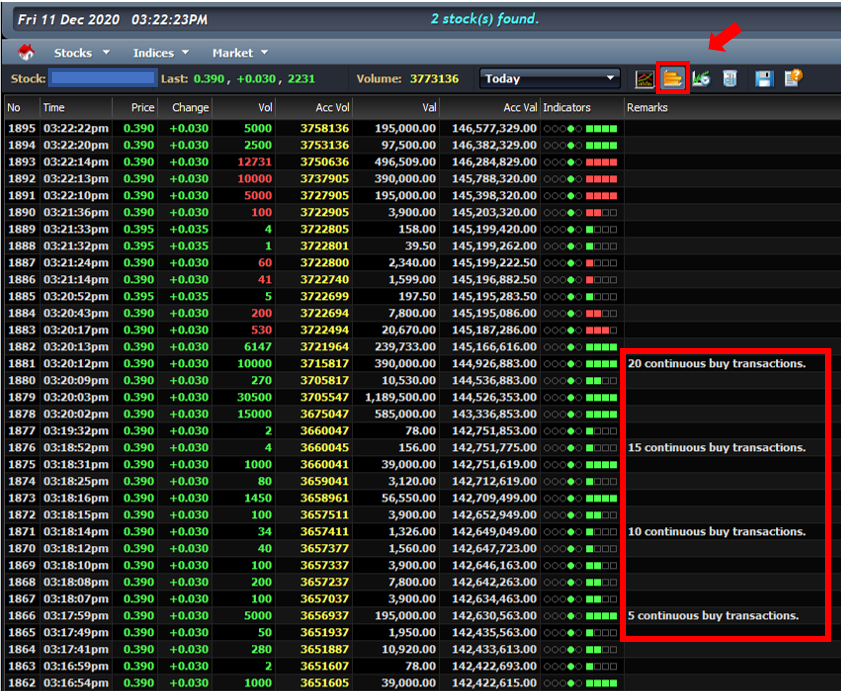
Notice in the image above — in the remarks section within the red box, it says "continuous transaction".
For a counter to be bullish, there must be a high number of continuous buy transactions.
What does this mean?
It means purchases are happening simultaneously at the same time, possibly by the same person or organisation. They are buying in bulk.
It could also be that the purchases are not from the same person or organisation, but the buying is continuous.
Continuous buying supported by price increases — even slight ones — represents momentum that signals the stock could go much further.
Based on the image above, we can see several columns, including:
- Number (No)
- Time
- Price
- Change
- Volume (Vol)
- Accumulated Volume (Acc Vol)
- Value (Val)
- Accumulated Value (Acc Val)
- Indicator
The most important element in orderflow analysis is value.
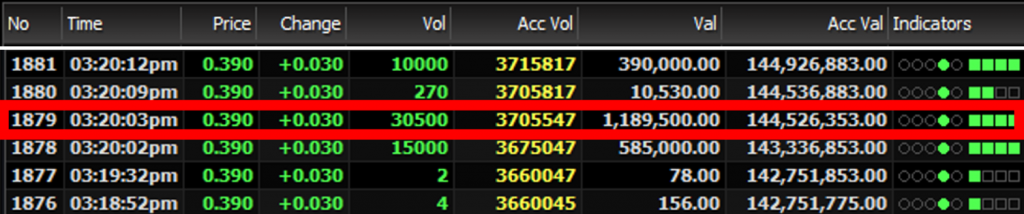
Notice the red box — the value is extremely high compared to the rest.
A single purchase worth RM1,189,500.00 totalling 30,500 lots.
That is over a million ringgit in one trade.
This is where the intraday smart money screener concept comes from.
We detect large volume entries exceeding RM100,000.00.
Hopefully You Understand So Far
If earlier you clicked the second icon, now click the fourth icon (red box in the image below).
After clicking, a screen like the one below will appear.
This screen helps us identify support and resistance levels in the market.
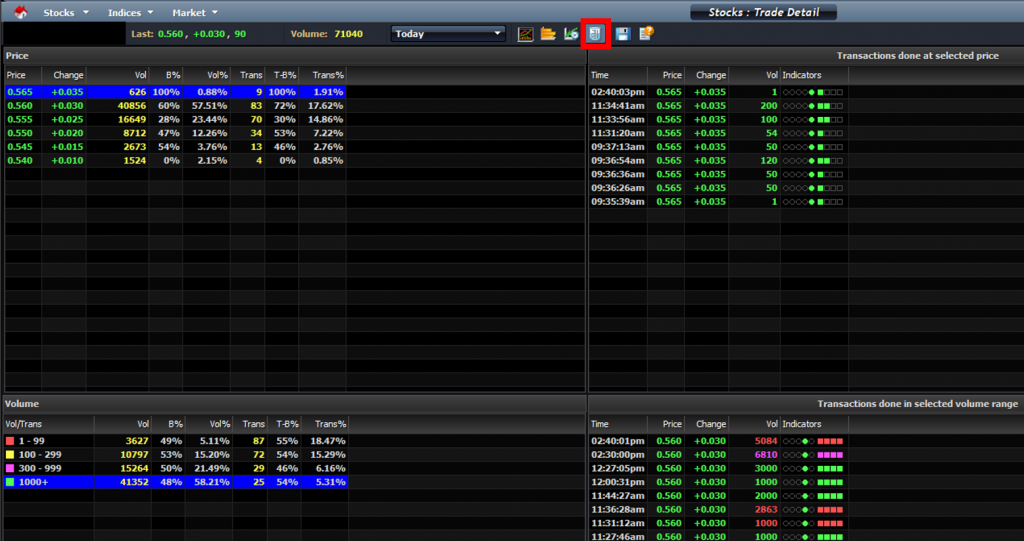
Let us go through it one by one. I will zoom in on the image above.
First, we will look at the price section.
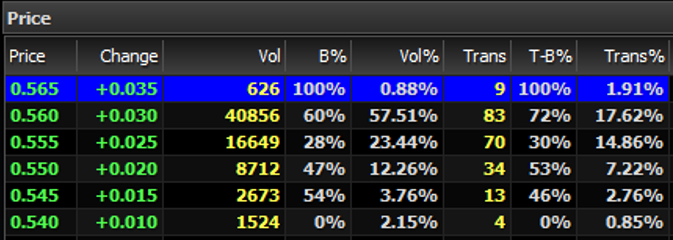
This shows the prices at which shares were traded on that day. From this image, we can see the buy rate (B%) and volume (Vol%).
At which price did the most volume accumulate?
Based on the data, we can say that 57.51% of shares were traded or changed hands at the price of RM0.560.
The highest volume usually occurs at support or resistance areas.
Looking at the buy rate, at the highest volume level (57.51%), the buy rate is 60%.
A buy rate is considered better when it is above 60%.
What is the significance? If it is above 60%, it means many investors are buying up at that price — in this example, RM0.560.
When this combination occurs (highest volume and buy rate above 60%), we would say that a strong support level exists at the RM0.560 price point.
Therefore, those looking for a strategic entry point could enter at RM0.560.
Next, we will look at the volume section.
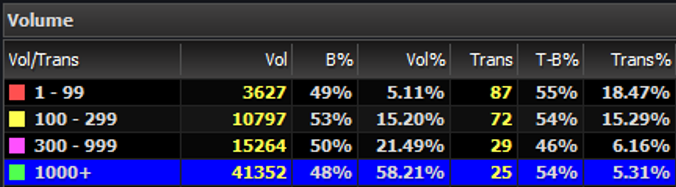
To spot smart money activity, focus on the green box.
What does "1000+" mean?
It means each time that investor enters, they are buying 1,000+ lots in a single order.
Want to know how many people entered with 1,000+ lots?
Refer to the Transaction (Trans) column.
There were 25 transactions involving more than 1,000 lots.
Among those 25 transactions, some were selling and some were buying.
How to Set Up the Buy Rate Column
When it comes to buy rate, there is actually a way to view it at a glance across all stocks.
The method is to add a buy rate column to your view.
Method One:
- 1. Right click
- 2. Insert new column
- 3. Transaction info
- 4. Buy rate
Method Two:
- 1. Click the gear icon
- 2. Window customise column
- 3. Transaction info
- 4. Buy rate
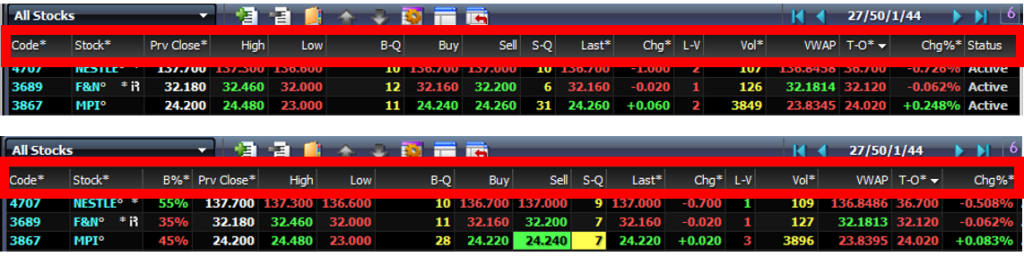
Top image: without buy rate (B%)
Bottom image: after adding buy rate.
Reference Sources for Orderflow Analysis
Simply open any search engine and type "orderflow analysis" or "tape reader".
You will find plenty of resources to learn from.
Below is one reference link I have prepared — click through and continue your learning journey.
https://www.slideshare.net/jcastellon2/tape-reading-101
https://optimusfutures.com/tradeblog/archives/best-order-flow-indicators
We hope this has been beneficial!
FAQ - Orderflow Analysis in Stock Trading
What is orderflow analysis in stock trading?
Orderflow analysis is a stock market technique that studies the flow of buy orders (buy queue) and sell orders (sell queue) to understand investors' true sentiment. It helps traders identify buying or selling pressure before price movements occur.
Is orderflow analysis suitable for beginner investors?
Yes, beginners can start learning orderflow analysis, but they should first understand the fundamentals of the stock market. Concepts such as market depth, buy rate, and transaction info need to be mastered progressively before applying them in actual trading.
Which platforms support orderflow analysis on Bursa Malaysia?
Platforms such as Mplus Online provide market depth displays that allow investors to view buy and sell queues. Investors can customise columns to display information like buy rate (B%) and transaction info to facilitate analysis.
How does orderflow analysis differ from standard technical analysis?
Standard technical analysis relies on price charts and indicators like moving averages. Orderflow analysis, on the other hand, looks directly at order data — who is buying and selling at each price level — providing a deeper understanding of price movement strength.
Level Up Your Investing Journey
Interested in starting your stock investing journey on Bursa Malaysia? Open your CDS account today via Mahersaham's CDS account opening guide.
Download the free stock basics ebook from Mahersaham to learn from the fundamentals to mastery!
Further reading: