Check If Your Stocks Are Shariah-Compliant

For Muslim traders, it is compulsory to check whether the stocks are SHARIAH-COMPLIANT or not.
This article explains the Shariah compliance assessment carried out by the Securities Commission.

Why Shariah-Compliant Status Is So Important
As Muslims, we are obligated to choose halal stocks.
Do not hesitate to buy Shariah-compliant stocks, as they must go through a rigorous audit process.
Shariah Compliance Audit Process
For the information of all traders, the audit process carried out by the SECURITIES COMMISSION takes place twice a year, in MAY and NOVEMBER.
For the year 2018/2019 up to MAY, the audit results were released on 30 NOVEMBER 2018.
Stocks That Received Shariah-Compliant Status
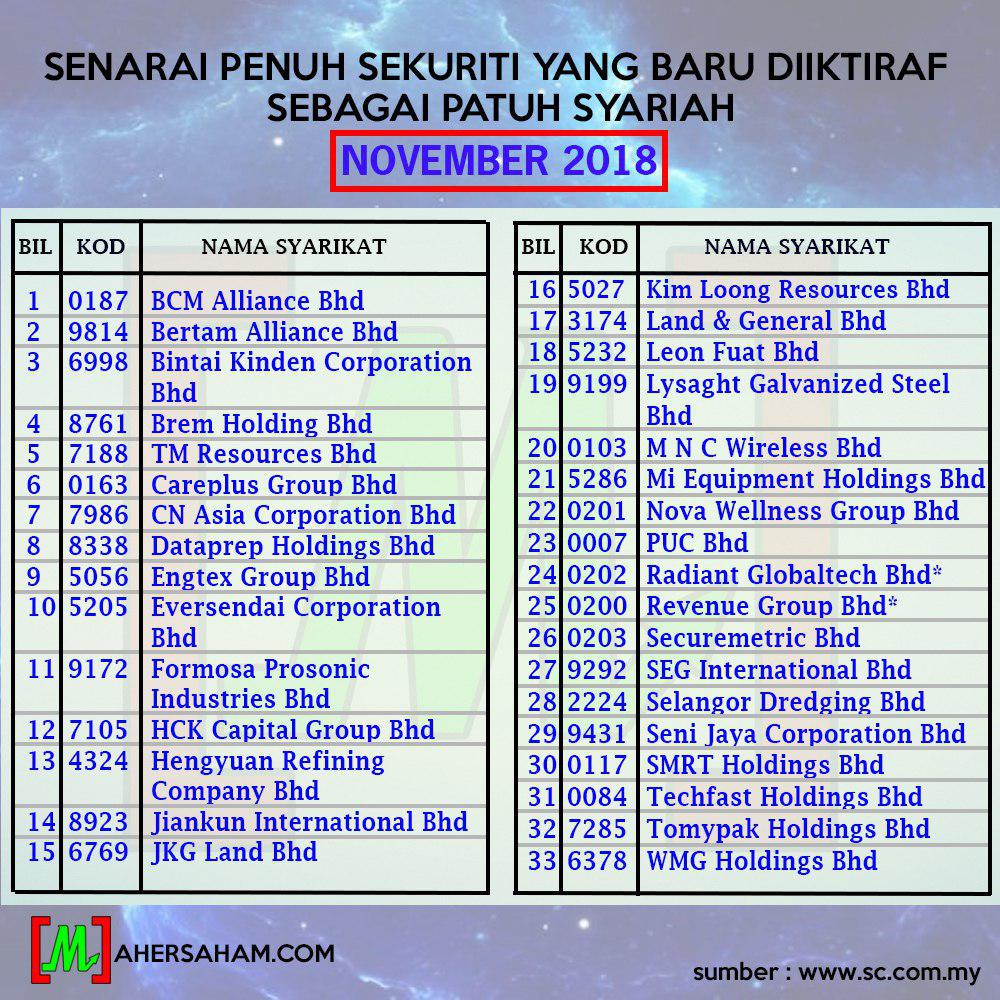
From this diagram, we can see 33 securities that received Shariah-compliant status.
Stocks That Lost Shariah-Compliant Status
From this diagram, we can see 34 securities that lost Shariah-compliant status.
Many beginner traders worry about this.
Do not worry, identifying Shariah-compliant stocks is actually quite simple.
When you log in to the platform, whether on your MOBILE PHONE or PC, you will notice a circle symbol after the counter name. This means the counter is Shariah-compliant.
Refer to the image below
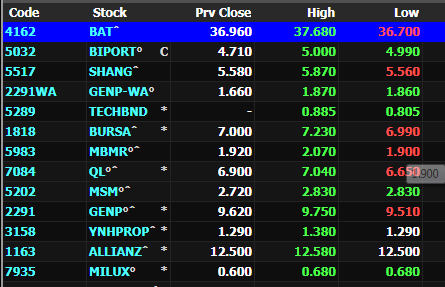
In the example image above, we take QL — after the counter name QL, there is a circle symbol which means QL is a Shariah-compliant stock.
Who Is Responsible for Auditing Shariah-Compliant Stocks?
It is not easy for us to know whether a stock is Shariah-compliant or not. Usually, we want to know who is responsible for the audit.
Within the Securities Commission, the body responsible for the audit is the Shariah Advisory Council of the Securities Commission (SAC). Among the distinguished members of the SAC are:
Mechanism Used by SAC in Auditing Shariah-Compliant Stocks
In classifying these securities, the SAC receives input and support from the SC, which obtains information about the company through, among other things, annual reports and enquiries made to the company.
The SAC, through the SC, will continue to review the Shariah status of securities listed on Bursa Malaysia every year, based on the latest audited annual financial statements of the company.
They adopt a two-tier quantitative approach that uses business activity benchmarks and financial ratio benchmarks in determining and classifying the Shariah status of listed securities.
Therefore, securities will be classified as Shariah-compliant if their business activity ratios and financial ratios are below the said benchmarks.
Business Activity Benchmarks
Contributions from non-Shariah-compliant activities to the group revenue and group profit before tax of a company will be calculated and compared with the relevant business activity benchmarks as follows:
First: Five Percent Benchmark
Applied to the following businesses/activities:
- Conventional banking;
- Conventional insurance;
- Gambling;
- Liquor and liquor-related activities;
- Pork and pork-related activities;
- Non-halal food and beverages;
- Non-Shariah-compliant entertainment;
- Tobacco and tobacco-related activities;
- Interest income from conventional accounts and instruments (including interest income received as a result of court or arbitrator decisions)
- Dividends from non-Shariah-compliant investments
- Other activities deemed non-Shariah-compliant.
For the businesses/activities listed above, the contribution from non-Shariah-compliant businesses/activities to the Group revenue or Group profit before tax of a company must be less than five percent.
Second: Twenty Percent Benchmark
Applied to the following businesses/activities:
- share trading
- stockbroking
- rental from non-Shariah-compliant activities
- other activities deemed non-Shariah-compliant
For the businesses/activities listed above, the contribution from non-Shariah-compliant businesses/activities to the Group revenue or Group profit before tax of a company must be less than 20 percent.
Financial Ratio Benchmarks
For the financial ratio benchmarks, the SAC takes into account the following:
(i) Cash over total assets — The cash taken into account is cash placed in conventional accounts and instruments, while cash placed in Islamic accounts and instruments is not included in this calculation.
(ii) Debt over total assets — The debt taken into account is interest-based debt, while Islamic financing or sukuk is not included in this calculation.
Each ratio above, which aims to assess riba and interest-based elements in a company's financial position statement, must be less than 33 percent.
In addition to the two-tier quantitative criteria above, the SAC also takes into account qualitative aspects involving public perception or the image of the company's activities from the perspective of Islamic teachings.
Special Purpose Acquisition Company (SPAC)
In classifying SPAC securities, the SAC considers the following criteria:
(i) The proposed business activities must be Shariah-compliant
(ii) The entire proceeds from the issuance of the initial public offering must be placed in an Islamic account
(iii) If the proceeds are invested, the entire investment must be Shariah-compliant.
Shariah-compliant securities include ordinary shares and warrants (issued by the company itself).
This means warrants are classified as Shariah-compliant securities provided their underlying shares are also Shariah-compliant.
Additionally, loan stocks and bonds are non-Shariah-compliant securities unless they are structured based on decisions, concepts, and Shariah principles approved by the SAC.
Conclusion
For those who opened an Islamic CDS account, it is not a major issue because only Shariah-compliant stocks can be bought and sold.
If you accidentally attempt to buy a non-Shariah-compliant stock, the transaction will not go through.
That is the advantage of opening an Islamic CDS account — we no longer have doubts in our trading activities.
The income we receive is indeed halal because the Islamic account is free from riba.
You can refer to the article on types of CDS accounts if you wish to learn more about the types of accounts used for stock trading.
Frequently Asked Questions (FAQ)
1. What are Shariah-compliant stocks?
Shariah-compliant stocks are securities that have been approved by the Shariah Advisory Council (SAC) of the Securities Commission Malaysia. They meet strict criteria regarding business activities and financial ratios to ensure compliance with Islamic principles.
2. How often is the Shariah compliance audit conducted?
The Securities Commission conducts the Shariah compliance audit twice a year, typically in May and November. Stocks may gain or lose their Shariah-compliant status based on these reviews.
3. How can I identify Shariah-compliant stocks on the trading platform?
On most trading platforms, Shariah-compliant stocks are marked with a circle symbol next to the counter name. If you have an Islamic CDS account, you can only buy Shariah-compliant stocks, providing an additional layer of assurance.
4. What happens if a stock loses its Shariah-compliant status?
If a stock you hold loses its Shariah-compliant status, you are generally given a grace period to dispose of it. Consult your broker or the Securities Commission's latest Shariah-compliant list for guidance.
Interested in learning more about stock investing on Bursa Malaysia?
Download the Stock Ebook for FREE now!