What Happens to Small-Cap Stocks When Interest Rates Drop? Most People Don't Know This Pattern

Small-Cap Stocks & Interest Rates: What Is the Real Connection?
Every time a central bank (like the Federal Reserve in the US) signals that it plans to lower interest rates, investors typically focus on mega-cap stocks such as Apple, Tesla, or Microsoft.
But there is one group of stocks that is often overlooked — and can actually move faster when interest rates fall: small-cap stocks.
The question is, why?
Why Small-Cap Stocks Always Rally When Interest Rates Drop
Here is the logic. Many small companies (small-caps) depend on short-term debt. When interest rates drop, their borrowing costs become cheaper, and net profits can increase.
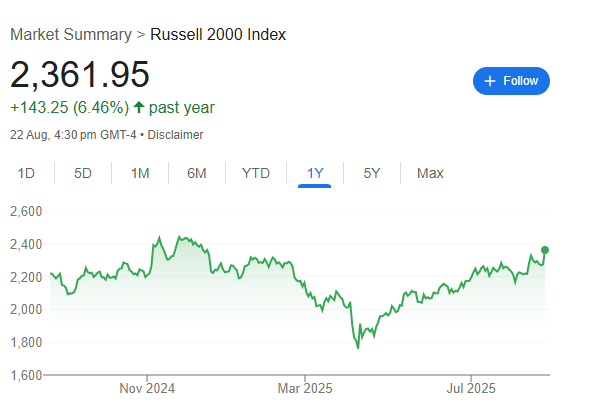
For example, in August 2025, when the Fed hinted at lowering interest rates, the Russell 2000 index (which represents small-caps) surged nearly 4% in a single day — more than double the gain of the S&P 500.
And this is not the first time it has happened. In many previous cycles, small-caps outperformed large-cap stocks in the first 6 to 18 months after rate cuts.
But Here Is the Plot Twist: After a Year, the Story Changes
Although the initial performance of small-cap stocks after rate cuts looks impressive, when you look at the longer timeframe — the picture is not as rosy.
According to a study involving 8 rate-cutting cycles:
In 6 out of 8 times, large-cap stocks actually outperformed small-caps after 12 months.
The initial rally usually fades quickly if the economy is not strong enough.
This means, yes — small-caps can soar when rates drop, but not every landing is a safe one.
Yield Curve: The Hidden Factor Most People Miss
There is another indicator that many retail investors overlook — the shape of the yield curve. It has a significant impact on small-cap stocks:
- When the curve is steepening (long-term rates are higher than short-term rates), small-caps typically rise.
- When the curve is inverted (short-term rates are higher), it signals a weakening economy and large-cap stocks tend to be safer.
In 2025, although small-caps rallied, the yield curve started flattening, which made institutional investors more cautious.
Current Valuations: Are Small-Caps Already Too Expensive?
Although many are now optimistic about the small-cap rally, the PE ratio (price-to-earnings) for the Russell 2000 has exceeded its historical average.
Several investment firms have warned:
- Without strong earnings growth, this rally is only temporary.
- If economic data weakens, small-caps may fall first.
RBC Capital also noted that this rally may not last unless the economy truly enters a recession, or suddenly rebounds.
Should You Buy Small-Cap Stocks Now — Or Wait?
If you are a tactical investor:
- Rate cuts are indeed an opportunity to act.
- But make sure you monitor corporate earnings trends, the Fed's tone, and current stock prices.
If you are a long-term investor:
Do not chase short-term rallies if you do not understand the overall economic picture.
Not Just a Reaction, But a Strategy
When interest rates drop, small-cap stocks usually do surge. But will they stay high? That is a different story.
What you should ask:
- Are rates being cut because the economy is weak or strong?
- Can small companies generate higher profits?
- And is the yield curve quietly sounding an alarm?
Because the answers are rarely found in the headlines — but hidden in data that most people do not look at.
Strengthen Your Investment Knowledge
Successful investing begins with solid knowledge. Continue your learning journey.
Investment Fundamentals:
Want to learn from the basics? Download our free ebook for a complete guide.
Open a CDS Account:
Ready to start? Open a CDS account and put what you have learnt into practice.