T+2 Settlement Explained: What Really Happens After You Hit 'Buy' on Bursa Malaysia

You open your broker app, type in the stock code, set your price, and tap the 'Buy' button. The screen flashes "Order Matched". Congratulations, you now own those shares. But hold on - the money hasn't left your account yet. The shares haven't actually "landed" in your CDS account either. So what really happens over the next two days?
Welcome to the world of T+2 settlement - a behind-the-scenes process that many new investors never think about, until they accidentally buy without enough funds, or get caught off guard when proceeds from a sale don't appear instantly. This article walks you through, step by step, exactly what happens after you hit 'Buy', why it matters, and how it can affect your wallet.
What Is T+2 Settlement?
T+2 settlement means that the settlement of a share transaction happens 2 trading days after the trade date. The letter "T" stands for Transaction Day (the day you trade), and "+2" means two trading days after that.
In practical terms: if you buy shares on Monday, you only need to pay for them by Wednesday. Likewise, if you sell shares on Monday, the proceeds only reach your account on Wednesday.
Bursa Malaysia officially moved to the T+2 cycle on 29 April 2019, replacing the older T+3 (three-day) system. The change aligned Malaysia with regional markets such as Singapore, Thailand and Indonesia, as well as larger global exchanges. According to a Finextra report, the transition was aimed at improving operational efficiency and reducing systemic risk in the capital market.
The T+2 Timeline: Buying Shares on a Monday
Let's look at a concrete example. Say you buy 1,000 units of a stock at RM2.00 each on Monday. Here is what happens:
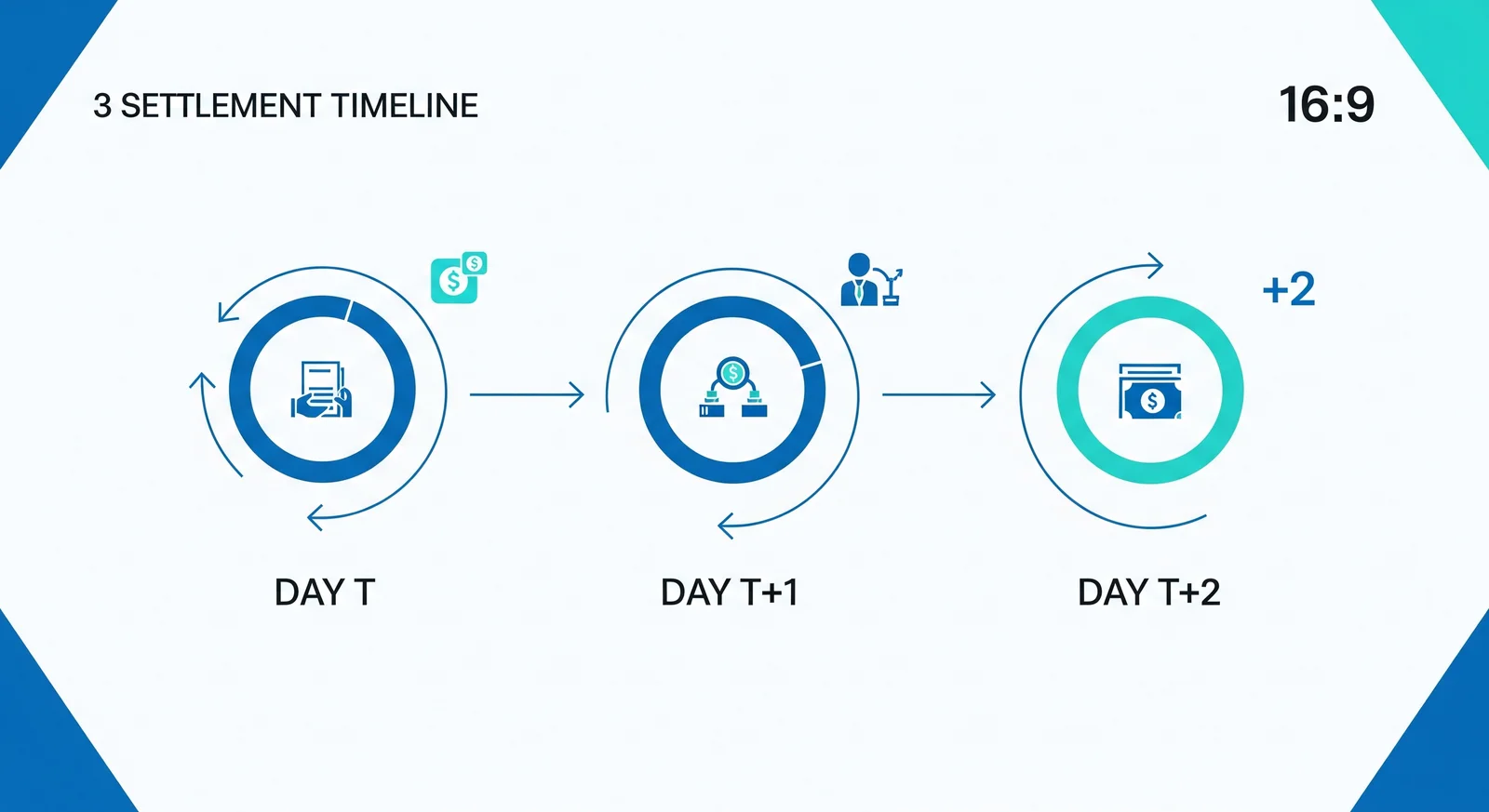
- Monday (T) - Trade Day: Your order is matched. You legally own the shares, but they are still in "pending settlement" status. The RM2,000 has not been deducted.
- Tuesday (T+1): Clearing runs behind the scenes. Bursa Malaysia Securities Clearing calculates the net position of all trades.
- Wednesday (T+2) - Settlement Day: RM2,000 is deducted from your trust account, and the shares are officially delivered into your CDS account. The seller receives their money the same day.
For sellers, the rules are stricter: they must deliver their securities by 11:30 am on T+2 via the Bursa Depository Transfer mechanism, and receive payment by 4:00 pm on T+2 at the latest.
Behind the Scenes: CDS, the Clearing House & the Book Entry System
Many investors imagine there is a physical "share certificate" changing hands. The reality is very different. The Central Depository System (CDS) uses book entry - purely electronic records. No paper, no physical certificate moves. When shares "transfer", it is just a number being updated in Bursa Depository's computer system.
Between T and T+2, two important things happen:
- Clearing: Bursa Malaysia Securities Clearing acts as the central counterparty (clearing house) that calculates how much each broker must pay or receive on a net basis. From thousands of individual transactions, it is reduced to a single net position between the clearing house and each clearing participant.
- Settlement: On T+2, the actual exchange takes place - money changes hands and share records are updated via electronic book entry.
This structure matters because it reduces risk. If every transaction settled one by one in real time, the system would be chaotic and high-risk. The net settlement model run by Bursa Malaysia makes the process smoother and safer. To understand the difference between owning shares through your own CDS account versus a nominee, read our guide on Direct CDS vs Nominee Account.
How to Count T+2 With Holidays & Weekends
This is the part that often trips up new investors. T+2 is counted based on trading days, not calendar days. Weekends (Saturday and Sunday) and public holidays when Bursa is closed are NOT counted.
Examples:
- Buy on Friday: T+1 falls on Monday (skipping Sat-Sun), and T+2 falls on Tuesday. So you pay on Tuesday, not Sunday.
- Buy on Thursday before a Friday public holiday: T+1 falls on Monday (Friday is a holiday, Sat-Sun skipped), and T+2 falls on Tuesday.
That's why investors who trade near long holiday seasons (such as Hari Raya or Chinese New Year) need to be extra careful when working out the actual settlement date. Miscalculating can make you think the money has arrived when it hasn't.
Account Types & Their Effect on Settlement
How you need to settle depends on the type of trading account you use. In Malaysia, there are three main types:
1. Cash Upfront Account
This is like a debit card - you can only buy shares up to the funds available in your trust account. The money is "held" when you buy, and settled on T+2. This account is the safest for new investors because you cannot "overbuy". For outstanding purchases, the broker will typically force sell on T+6 from the transaction date.
2. Contra (Collateralised) Account
This is like a charge card - the broker extends you a spending limit (trading limit) based on the collateral you place, whether cash or existing shares. You are still required to settle within T+2. If you fail, force selling can happen as early as T+3. According to Rakuten Trade, unsettled contra losses are issued a Letter of Demand from T+7 onwards, plus an interest charge of 6% per annum until fully settled.
3. Margin Account
An account that lets you borrow funds from your broker to buy shares worth more than your own capital. It offers leverage, but also carries the risk of a margin call if share values fall. This account is suitable for experienced investors only.
If you are just starting out, we recommend a Cash Upfront account. See our guide on How to Use an M+ Global Account to understand how trading accounts work in practice.
What If You Don't Pay? Force Selling & Buy-in
This is the part that can "burn" a careless investor's wallet. There are two main penalty mechanisms:
Force Selling (for buyers who don't pay)
If you buy shares but fail to settle by the set date, the broker has the right to force sell your shares to cover the outstanding amount. For Cash Upfront accounts this usually happens on T+6; for contra accounts, as early as T+3. The problem is that the broker sells at the prevailing market price, which may be lower than your purchase price. You bear the loss, plus interest charges and fees.
Buy-in (for sellers who don't have the shares)
Conversely, if you sell shares but have no shares in your CDS account by midnight of T+2, Bursa will impose a 'Buy-in' on your account. The automated buy-in is imposed on T+2 from 2:00 pm to 5:00 pm, where Bursa buys the shares on your behalf - usually at a higher price (several ticks above the last closing price). Once again, you bear the extra cost.
The simple lesson: don't sell shares you don't actually own in CDS, and don't buy beyond what you can afford to pay within the T+2 window.
Contra Trading: Opportunity or Trap?
Because there is a 2-day gap between buying and paying, some traders use a technique called contra trading - buying shares, then selling them back before the T+2 settlement date, without putting up the full capital. If the price rises, you profit from the price difference without ever paying in full. If the price falls, you must pay the loss (contra loss).
It sounds attractive, but this is a high-risk game. You are effectively trading with money you haven't put up, so any adverse price movement can cause large losses in a short time. For Muslim investors, the Shariah status of contra trading is also debated due to the element of selling before complete ownership. Our approach always prioritises long-term investing over short-term speculation - understand the mental biases that make investors lose money before being tempted by techniques like this.
Why T+2 Matters to You as an Investor
Understanding T+2 is not just academic theory. It has practical consequences:
- Cash planning: If you sell shares today to raise emergency cash, that money does not arrive instantly - you wait until T+2. Don't count on sale proceeds for tomorrow's expenses.
- Switching stocks: If you sell Stock A to buy Stock B, you need to make sure your account has enough limit or cash, because the proceeds from Stock A may not arrive in time to pay for Stock B instantly.
- Avoiding penalties: Understanding the settlement timeline helps you avoid costly force selling and buy-ins.
- Capital discipline: T+2 gives a little "breathing room" - but it is not an invitation to spend beyond your means. Buy according to the money you actually have.
For investors who are just starting, understanding basic mechanics like this is part of building a solid foundation. Read How to Start Investing in Stocks From Zero for a complete picture of the new investor's journey.
T+2 vs the World: The US Has Moved to T+1
Interestingly, the world of settlement is changing again. On 28 May 2024, the United States officially moved from T+2 to T+1 - meaning settlement just one day after the trade. According to Investor.gov (SEC), Canada and Mexico also moved to T+1 around the same time, while Europe and the UK are considering similar steps.
Bursa Malaysia still remains on T+2 for now. This means that if you invest in US stocks (for example via a global account), your US share settlement may be faster (T+1) than local shares (T+2). Understanding this difference matters if you are a cross-border investor. It is not impossible that Malaysia will follow the global trend toward T+1 in the future, in line with ongoing efforts to align regional capital markets.
Frequently Asked Questions (FAQ) About T+2 Settlement
When is my money deducted after I buy a stock?
The money is deducted on T+2, which is 2 trading days after you buy. If you buy on Monday, the money is deducted on Wednesday. Weekends and public holidays are not counted.
When does the money arrive after I sell a stock?
Same as a purchase - sale proceeds arrive on T+2. If you sell on Monday, the money arrives on Wednesday (by 4:00 pm at the latest).
Do I really own the shares as soon as the order is matched?
Yes, legally you own the shares as soon as the order is matched, but the official transfer into your CDS account and the exchange of money are only completed on T+2.
What happens if I don't have enough money to pay on T+2?
The broker can force sell your shares to cover the outstanding amount, typically on T+6 for Cash Upfront accounts or as early as T+3 for contra accounts. You bear any losses and interest charges.
What is a buy-in in the context of T+2?
A buy-in happens when a seller has no shares in CDS by T+2. Bursa buys the shares on the seller's behalf, usually at a higher price, and the seller bears the cost.
How do I count T+2 when there is a public holiday?
Count only trading days (days Bursa is open). Skip Saturdays, Sundays and public holidays. Example: buy on Thursday, with Friday being a holiday - then T+2 falls on Tuesday the following week.
Do all brokers use the same T+2?
Yes, T+2 is Bursa Malaysia's official settlement cycle for all normal trades. However, force selling policies and account types (cash upfront, contra, margin) can differ between brokers.
Why hasn't Bursa Malaysia gone straight to T+1 like the US?
Shifting the settlement cycle requires infrastructure upgrades and industry-wide coordination. Bursa moved from T+3 to T+2 in 2019, and may evaluate T+1 in the future in line with the global trend.
Conclusion
T+2 settlement is the hidden heart of every share trade on Bursa Malaysia. From the moment you hit 'Buy' until the money is deducted and shares land in your CDS account, there is an orderly clearing and settlement process running behind the scenes to keep every transaction safe and smooth. Understanding this timeline - and its implications for cash planning, account types, and force selling risk - makes you a more disciplined investor who avoids costly mistakes.
Now that you understand what happens after you hit 'Buy', the next step is making sure you have the right account to start investing with confidence.
To invest on Bursa Malaysia as well as foreign markets such as the US and Hong Kong, you can open a CDS account through us and start building your investment portfolio.
And if you are just starting out, grab our free Stock Market Basics Ebook to understand the ins and outs of stock investing from the ground up.
Further Reading
- Direct CDS vs Nominee Account: The Real Difference in Owning Your Shares
- How to Start Investing in Stocks: From Zero to Your First Investment
- How to Use an M+ Global Account: From A to Z
- Stocks for Beginners: 7 Criteria to Pick Your First Stock on Bursa Malaysia
- Financial Glossary: Stock Market Terms for Malaysian Investors