Tanco Holdings Lost Nearly RM10 Billion in Market Value - What Happened in One Month

Imagine a stock you hold falling limit-down three days in a row, losing more than 70% of its value in just three days. That is what happened to shareholders of Tanco Holdings Bhd (Bursa: 2429) in June 2026 - one of the most drastic stock collapses recorded on Bursa Malaysia this year.
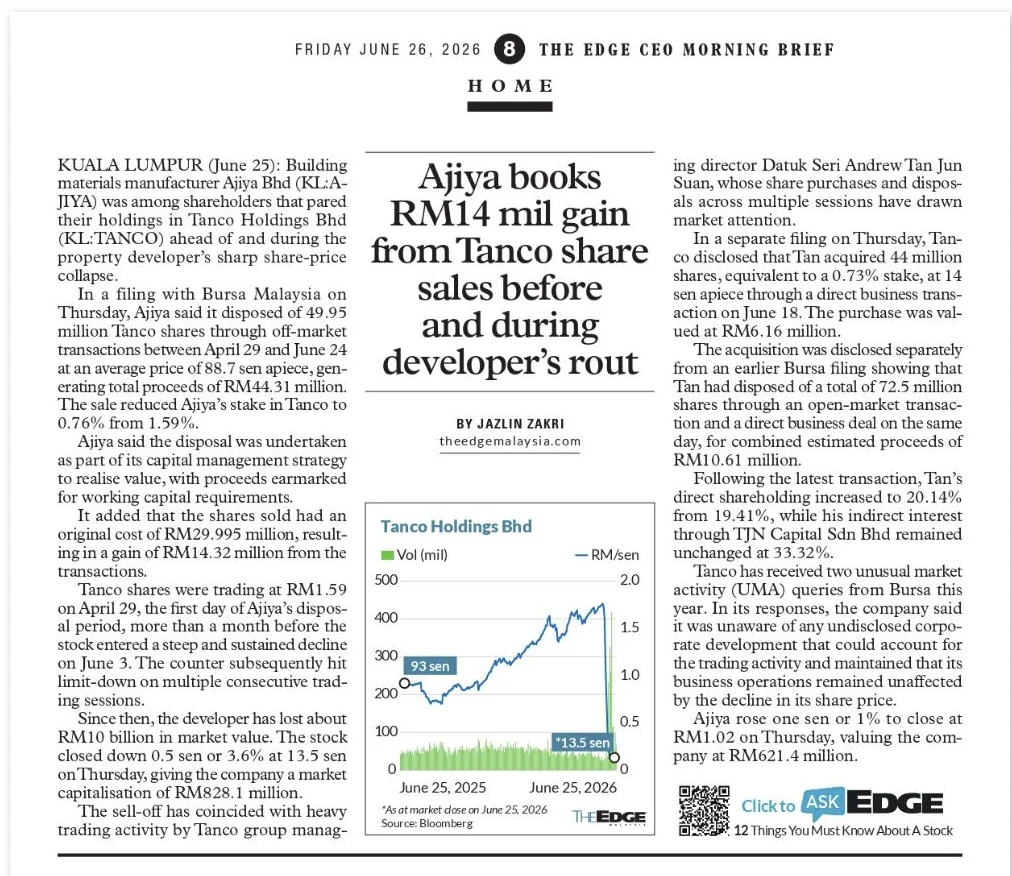
From an all-time high of RM1.76 on 3 June, Tanco shares crashed to as low as 13.5 sen by 25 June. In under three weeks, the company's market value evaporated by close to RM10 billion - a figure larger than the market cap of most FBM KLCI component companies. But how exactly was this "RM10 billion" figure calculated, what triggered the crash, and why was the company's own management also active in share transactions throughout this critical period?
In this article, we break down the full timeline, the real math behind the viral RM10 billion figure, and the key lessons for retail investors.
Why Did Tanco Shares Surge In The First Place? The MIDPORTS Story
To understand why this crash was so shocking, you first need to understand why Tanco shares climbed so high in the first place. Tanco isn't just an ordinary resort and property company in Port Dickson - since 2024/2025, the company has been transforming into a strategic national infrastructure player through the MIDPORTS project, Malaysia's first AI-powered container port planned for Teluk Kemang, Port Dickson, Negeri Sembilan.
This is no small project - it has received National Strategic Priority status (April 2025), unconditional approval from the Marine Department of Malaysia, and the green light from the Ministry of Transport. Tanco's most valuable asset isn't its buildings or hotels, but 480 acres of waterfront land in Port Dickson (where Palm Resort operates) plus 180 acres of reserve land in Teluk Kemang earmarked for the port's development.
It was this "Malaysia's first AI container port" narrative that drove Tanco shares from around 69 sen to RM1.76 over 52 weeks - a surge of more than 150%. In fact, mahersaham.com's own analysis of Tanco had already raised an important question before this crash happened: was a RM10.2 billion valuation at a P/B ratio of 27 times and P/E of 1,009 times justified when the MIDPORTS project was still at the pre-construction stage? This is a classic warning sign - a share price soaring based on future potential, not the company's actual current financial results.
Timeline Of The Crash: From Limit-Down To Limit-Down
The crash began abruptly on 3 June 2026 - the same date as the all-time high of RM1.76-RM1.80. Interestingly, just days before that, on 9 June, Tanco announced signing a Memorandum of Understanding (MOU) with China Mobile International Ltd to explore developing a 50MW data centre in Port Dickson - news that should have been positive, but it did not stop the crash that had already begun.
According to ongoing coverage from The Edge Malaysia, the market value wiped from Tanco grew day by day throughout this crash:
- 10 June: Shares fell 37.5% to the limit-down floor, short selling was temporarily suspended, as reported by The Star.
- Early the following week: Tanco hit limit-down again, with The Edge reporting that market value wiped out had already reached nearly RM6 billion at that point.
- A few days later: The wiped-out figure grew to nearly RM8 billion as Tanco hit limit-down for a third consecutive day.
- The worst phase: The Edge reported that Tanco experienced its "steepest plunge on record", with this string of losses wiping out nearly RM10 billion.
- 25 June (closing): Shares closed at 13.5 sen, giving Tanco a market cap of RM828.1 million - down 0.5 sen, or 3.6%, on that day alone.
Note something important here - the "RM6 billion", "RM7.7 billion", "RM8 billion" and "RM10 billion" figures that appeared in different reports are NOT conflicting data. They are progressive snapshots of the same crash unfolding in stages over several weeks - each report took its measurement on a different day as the stock continued to plunge.
Throughout this period, Tanco also received two Unusual Market Activity (UMA) queries from Bursa Malaysia - a warning sign that many investors tend to ignore. In its response, the company acknowledged the scale of the share price decline "appears odd" but stated it was not aware of any undisclosed corporate developments that could explain the trading pattern, as reported by The Edge.
How Much Value Actually Vanished? Do The Math Yourself
This is the part that's important to understand precisely - because the "RM10 billion" figure can be misinterpreted if you don't understand the underlying calculation.
Starting with the confirmed fact: at the close on 25 June 2026, Tanco closed at 13.5 sen with a market cap of RM828.1 million. From here, we can calculate the number of shares outstanding:
RM828.1 million ÷ RM0.135 = approximately 6.134 billion shares
With this share count, we can recalculate the market cap at various price points before the crash:
| Price Reference Point | Date | Estimated Market Cap | Value Wiped vs 25 June |
|---|---|---|---|
| RM1.59 | 29 April 2026 | ≈RM9.75 billion | ≈RM8.9 billion |
| RM1.75 - RM1.80 (peak zone) | 3 June 2026 (all-time high) | ≈RM10.43 - RM11.04 billion | ≈RM9.6 - RM10.2 billion |
So the headline "around RM10 billion wiped out" is reasonable if measured from the peak price zone (RM1.75-RM1.80 on 3 June) - and this aligns with The Edge's own reporting citing "nearly RM10 billion", as well as the peak valuation estimate of RM10.2 billion in mahersaham.com's study of Tanco before the crash took place.
But if you measure specifically from 29 April 2026 (the first day Ajiya Bhd began disposing of Tanco shares, as discussed below) when the stock was at RM1.59, a more precise calculation shows value wiped out closer to RM8.9 billion, not the full RM10 billion.
The lesson here: whenever you read a headline saying "RM X billion wiped out" for any stock, always ask - wiped out compared to which price reference point? The all-time high? The price a month ago? Or the price at the start of the year? The answer can differ by hundreds of millions of ringgit depending on the reference point used - especially for stocks with a small free float like Tanco, where even small price movements can cause large swings in market cap.
Shareholder Activity During The Crash
One of the aspects that has drawn the most market attention is the share transactions carried out by Tanco's stakeholders throughout this critical period.
Ajiya Bhd - RM14.3 Million Profit From Disposal
Ajiya Bhd (KL:AJIYA), a building materials manufacturer that is also a Tanco shareholder, disposed of 49.95 million Tanco shares via off-market transactions between 29 April and 24 June at an average price of 88.7 sen per share, generating total proceeds of RM44.31 million. Since the original cost of these shares was RM29.995 million, Ajiya booked a net profit of around RM14.32 million from this transaction, as reported by EdgeProp.my.
This disposal reduced Ajiya's stake in Tanco from 1.59% to just 0.76%. Ajiya explained the move as part of a capital management strategy to realise value, with the sale proceeds allocated for working capital needs including payments to suppliers and operating costs. Follow-up reports also showed that Ajiya's remaining stake in Tanco has drawn attention - with the company subsequently disclosing plans to reinvest 98% of the disposal proceeds into another listed stock.
Group Managing Director - A Dense Trading Pattern
Even more striking is the activity of Datuk Seri Andrew Tan Jun Suan, Tanco's Group Managing Director. From 1 January to 10 June 2026 alone, he recorded 241 share transaction notices over 95 trading days - an unusually high frequency for a public company director.
His transaction pattern was also complex:
- Before the deep crash, he sold 24.63 million shares (0.41% stake) via direct business transactions at RM1.555 per share - a premium over the market price at the time - worth RM38.29 million.
- On 18 June, in a single filing, Tanco disclosed that Tan had disposed of a total of 72.5 million shares (a combination of open-market and direct transactions) with combined estimated proceeds of RM10.61 million.
- On the same day, in a separate filing, he acquired 44 million shares (0.73% stake) at 14 sen per share via a direct business transaction, worth RM6.16 million.
- Following the latest transactions, Tan's direct stake rose to 20.14% from 19.41%, while his indirect interest through TJN Capital Sdn Bhd remained unchanged at 33.32%.
Bursa Malaysia also issued two UMA queries in relation to this unusual trading activity. In its official response, Tanco stated it was "not aware of any undisclosed corporate developments" that could explain the trading pattern, and that the company's business operations were not affected by the share price decline.
It's important to remember: as of now, there is no officially confirmed cause for this crash - whether it was due to internal corporate issues, forced selling from margin calls, or simply a drastic shift in market sentiment after the MIDPORTS narrative failed to be backed by actual financial results. Tanco itself denies knowledge of any undisclosed corporate developments.
Where Does Tanco Stand Now?
After hitting a low of 13.5 sen on 25 June, Tanco shares showed some signs of recovery. By 1 July 2026, the stock was trading in the range of 15.5 sen to 17.5 sen - a recovery from the low, but still representing a drop of more than 90% from the peak price of RM1.76-RM1.80. The "consecutive limit-down" phase that sparked the market panic has ended, and the stock is now in a consolidation phase.
As for the MIDPORTS project itself, there has been no official announcement indicating that the project's status has been affected by the share price crash. However, investors who retain their holdings now need to reassess whether the project's long-term growth narrative remains intact, against the governance risks and uncertainty exposed throughout this episode.
Lessons For Retail Investors
The Tanco Holdings case offers several important lessons, especially for investors drawn to small-cap "growth story" stocks:
-
Small free float = extreme volatility. With a relatively small number of shares outstanding and highly concentrated ownership among key stakeholders (the managing director holds more than 20% directly and 33% indirectly), any large-scale selling can move the price drastically in either direction.
-
A narrative is not a substitute for fundamentals. A stock that surges based on the potential of a future project (such as MIDPORTS) - before that project generates any revenue - carries the risk of a sudden re-rating when sentiment shifts. mahersaham.com's study of Tanco had already raised this question before the crash happened.
-
Understand limit up and limit down - Bursa Malaysia's price limit mechanism is designed to slow down panic selling, but it does not prevent a continuous decline across several trading days, as seen in Tanco's case.
-
Take UMA queries seriously. When Bursa Malaysia issues an Unusual Market Activity query, it's a signal that the trading activity is being closely watched by the regulator - even though a company's "no corporate developments" response doesn't necessarily mean everything is fine.
-
Headline market cap figures need context. As we've shown above, the "RM10 billion wiped out" figure depends entirely on which price reference point is used - always check the underlying calculation before acting on a headline alone.
Frequently Asked Questions (FAQ)
1. What is Tanco Holdings and why is it linked to MIDPORTS?
Tanco Holdings Bhd (Bursa: 2429) is a conglomerate originally focused on property development and resort operations in Port Dickson. Since 2024/2025, it has become the concession holder for MIDPORTS, Malaysia's first AI-powered container port project, which has received National Strategic Priority status.
2. Why did Tanco shares crash so suddenly in June 2026?
The actual cause remains officially unconfirmed. Tanco itself stated it was not aware of any undisclosed corporate developments that could explain the crash, although it acknowledged the scale of the decline "appears odd".
3. Is it true that Tanco lost RM10 billion in market value?
It depends on the reference point. Measured from the all-time high price (RM1.75-RM1.80 on 3 June 2026), the estimated value wiped out is around RM9.6-RM10.2 billion. Measured from 29 April 2026 (RM1.59), the more precise figure is around RM8.9 billion.
4. What is the UMA query Tanco received from Bursa Malaysia?
UMA (Unusual Market Activity) is an official query issued by Bursa Malaysia when there is unusual price or trading volume movement in a stock. Tanco received two UMA queries throughout this episode. Read the full explanation of UMA here.
5. Was Tanco's management involved in share sales during the crash?
Yes. Ajiya Bhd (a shareholder) disposed of its stake for a RM14.32 million profit between April-June 2026. Tanco's Group Managing Director, Datuk Seri Andrew Tan Jun Suan, also recorded 241 share transaction notices over 95 trading days, including sales at a premium price before the deep crash, and buybacks at low prices during the crash.
6. Was the MIDPORTS project affected by this share price crash?
There has been no official announcement indicating that the MIDPORTS project's status has changed as a result of the share price crash. Tanco has stated that its business operations were not affected by the share price movement.
7. Where is Tanco's share price now?
After hitting a low of 13.5 sen on 25 June 2026, the stock showed some recovery and traded in the range of 15.5-17.5 sen by early July 2026 - still representing a decline of more than 90% from the peak price.
8. What is the main lesson for investors from the Tanco case?
Be cautious with small free-float stocks that surge based on a growth narrative without supporting financial results, understand the limit up/down mechanism, and don't ignore UMA queries from Bursa Malaysia.
Conclusion
The Tanco Holdings case is an important reminder that a stock that surges drastically based on a narrative - without being backed by actual financial results - carries the risk of an equally drastic re-rating. In under three weeks, the company's market value fell between RM8.9 and RM10 billion depending on the reference point used, with the trading activity of key stakeholders also drawing regulatory attention through two UMA queries.
Before you start investing on Bursa Malaysia or adding exposure to small-cap "growth story" stocks, the first step is making sure you have a valid account to trade.
A CDS account is the basic requirement to start investing legally in the stock market.
Open a CDS account to let you invest not just on Bursa Malaysia, but also in foreign stocks such as the US and Hong Kong.
If you're just starting out and want to understand the basics of stock investing before taking on real risk, download the Basic Stocks Ebook for free.
Further Reading
- Tanco Holdings Bhd (2429) Stock Study
- UMA (Unusual Market Activity): When Bursa Queries A Stock - The Warning Sign Investors Ignore
- Limit Up And Limit Down For IPOs And Bursa Malaysia Stocks
- Bursa Roundup 17 June 2026: Vantris Exits PN17, UEM Sunrise Secures RM906 Million Partner
- Investment Risk Analysis: Stock & IPO Risk Management Strategy