Types of Businesses and Companies in Malaysia

Definition or Meaning of Business
Before I elaborate further on the types of businesses and companies, readers should first understand the definition of business itself.
Business is an activity involving the transaction of buying and selling goods or services between sellers and buyers to fulfil the needs and wants of consumers, involving the exchange of value to generate profit.
Profits from businesses vary and are exposed to various factors. If you are interested in analysing the profit factors of Layhong's egg company as an example, you may refer to the article Why Did Layhong's Profits Decrease?
Once readers understand the meaning of business, those who wish to start a business must register their business with SSM, the Companies Commission of Malaysia.
Among the functions of SSM is to regulate matters relating to corporations, companies and businesses in accordance with the laws stated in the First Schedule, as well as being the regulatory body for companies in Peninsular Malaysia to ensure compliance through comprehensive enforcement and monitoring activities. Anything related to business, industry, corporate and others falls under the jurisdiction of SSM.

Figure 1: Companies Commission of Malaysia (SSM) Logo
Source: Google.com
What Type of Business to Run?
Before readers start a business, you need to know what type of business you wish to run. There are two forms of business in Malaysia:
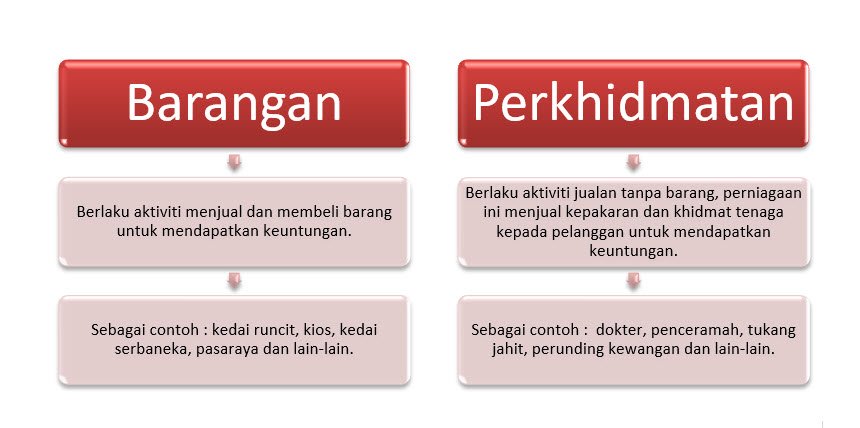
Figure 2: Forms of Business
Source: Business Studies Textbook
Types of Businesses
In Malaysia, there are five types of businesses. Readers need to identify and choose the type of business based on their position; this capability is assessed from the perspective of financial strength, skills, and knowledge in running, developing and bearing the risks of the business. The five types of businesses are:
- Sole proprietorship / Enterprise
- Partnership
- Cooperative
- Private Limited Company (Sdn Bhd)
- Public Limited Company (Berhad)
Sole Proprietorship or Enterprise
A sole proprietorship or enterprise is a business owned by a single owner under the Registration of Businesses Act 1956. The company or business name is also registered under the personal name of the owner. This business is registered with the Companies Commission of Malaysia (SSM). The registration process takes only 1 hour at the SSM counter. Typically, the capital used for this type of business is small, similar in concept to investing in the stock market with small capital.
The source of capital is also small, derived from the owner's personal assets, loans from family, trusted friends, and banks offering micro loans. Examples of such businesses include grocery shops, shoe shops, and so on.
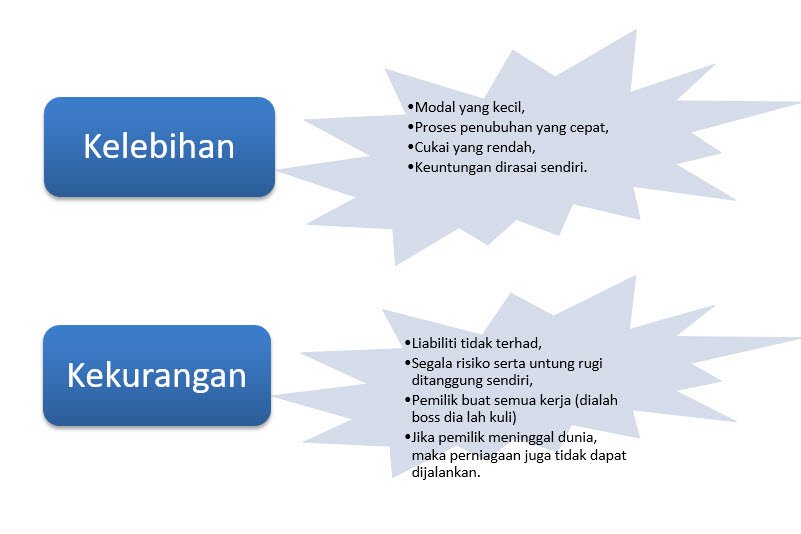
Figure 3: Advantages and Disadvantages
of Sole Proprietorship or Enterprise
Partnership
A partnership business is similar to a sole proprietorship, except it has more than 1 owner and not more than 20 owners. This business falls under the Partnership Act 1961. The capital obtained is not large as it comes from the partnership members or bank loans. The registration period for a partnership company is 1 hour at the SSM counter. Company profits are divided according to capital contribution, work done, and mutual agreement among company members. Likewise, company losses must be shared together. Examples of partnership businesses include accounting firms, law firms, and so on. The ruling on partnership business is derived from the saying of the Prophet Muhammad (peace be upon him) which means:
Whoever has a partner in a building, then do not sell your portion until you have offered it to your partner. (HR. Tirmidhi)
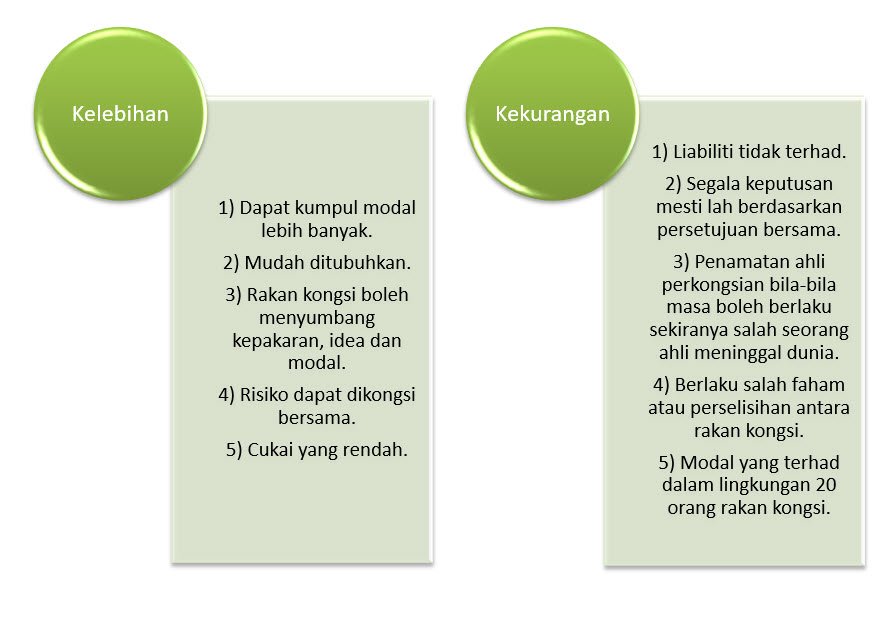
Figure 4: Advantages and Disadvantages
of Partnership Company
Cooperative
The purpose of establishing a cooperative is to improve the economy of its members. A cooperative must have at least 50 active members; if even one of those 50 members becomes inactive, the cooperative company cannot operate. The establishment of cooperatives falls under the Cooperatives Act 1993, where members have the right to receive profits through dividends if the cooperative makes a profit. Cooperative members also have the right to vote for their board of directors at the annual general meeting. To register a cooperative company, it is done under the Malaysia Co-operative Societies Commission (SKM). Among the best cooperatives in Malaysia: http://www.kosma.com.my/pdf/indeks100.pdf
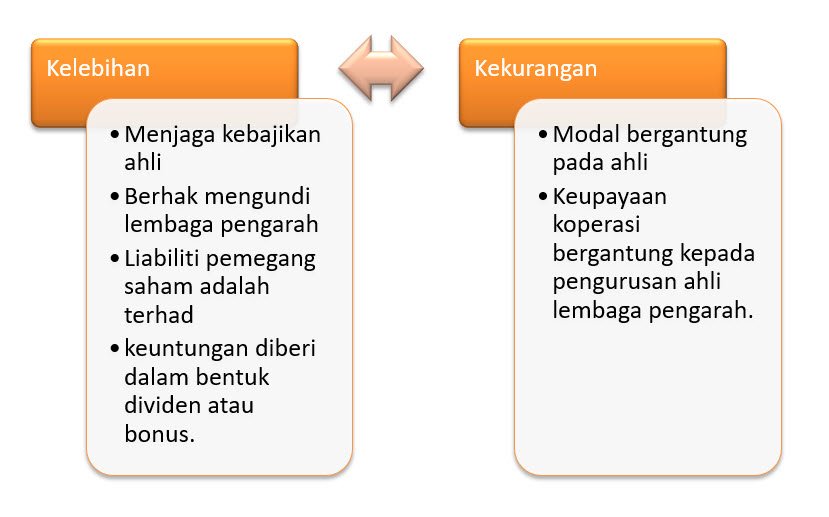
Figure 5: Advantages and Disadvantages
of Cooperative Company
Private Limited Company (Sdn Bhd)
A Sdn Bhd company is a business registered under the Companies Act 1965.
However, recently, this act has been replaced with a new act, namely the Companies Act 2016.
The differences between these acts will be shared at the end of this chapter.
An example of a Sdn Bhd company is one that has "Sdn Bhd" written after its company name, such as Syahlam Sdn Bhd, Terus Maju Sdn Bhd, and so on.
The ownership of a Sdn Bhd company is limited to 2 to 50 persons only.
The capital used is not from the company owners but from the sale of shares.
Likewise, the company's liability does not involve the personal assets of the owners; the liability of a Sdn Bhd is limited.
If any loss or bankruptcy occurs to the company, the loss does not involve the owner's personal assets — what suffers the loss is the company, not the owner.
This is one of the key advantages of a Sdn Bhd company.
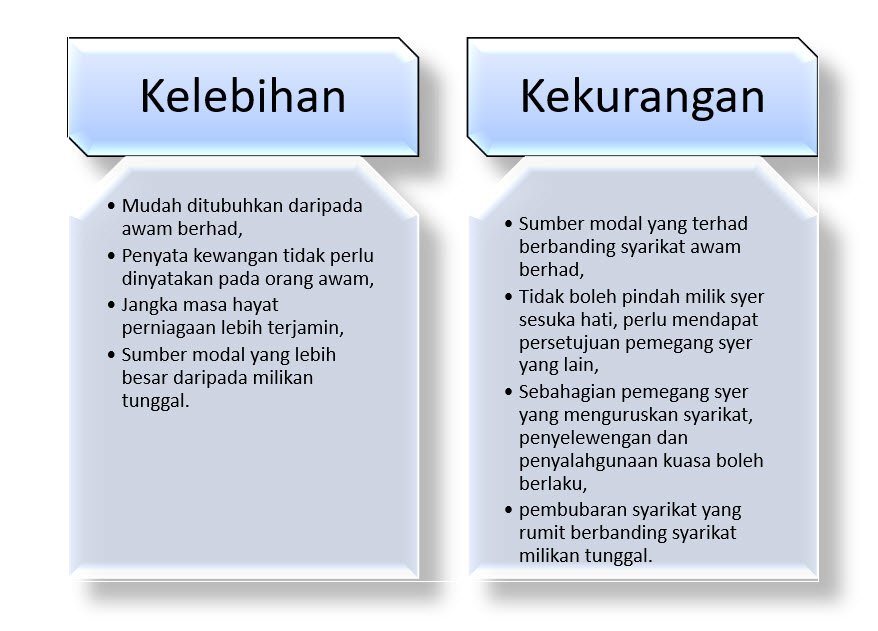
Figure 6: Advantages and Disadvantages
of Sdn Bhd Company
Public Limited Company
The simplest definition of a public limited company is a company that is listed on Bursa Malaysia.
Shares of companies listed on Bursa Malaysia can be bought and sold by the public.
To learn more about shares, you may refer to the article What Are Shares.
For example, companies such as TM, Padini, AEON, Petron, Nestle, and many more.
You can click this link to view public limited companies listed on Bursa Malaysia: http://www.bursamalaysia.com/market/listed-companies.
The minimum number of owners is 2 persons and the maximum is unlimited.
Liability or debt is limited, meaning it does not involve personal assets.
The company's capital is obtained from the sale of shares to the public. The minimum to purchase shares of a public limited company is 100 units, and the price depends on the company's share price on that particular day.
This company is established under the Companies Act 1965. However, it has been repealed and replaced with the Companies Act 2016; the application of this act is the same as for Sdn Bhd companies.
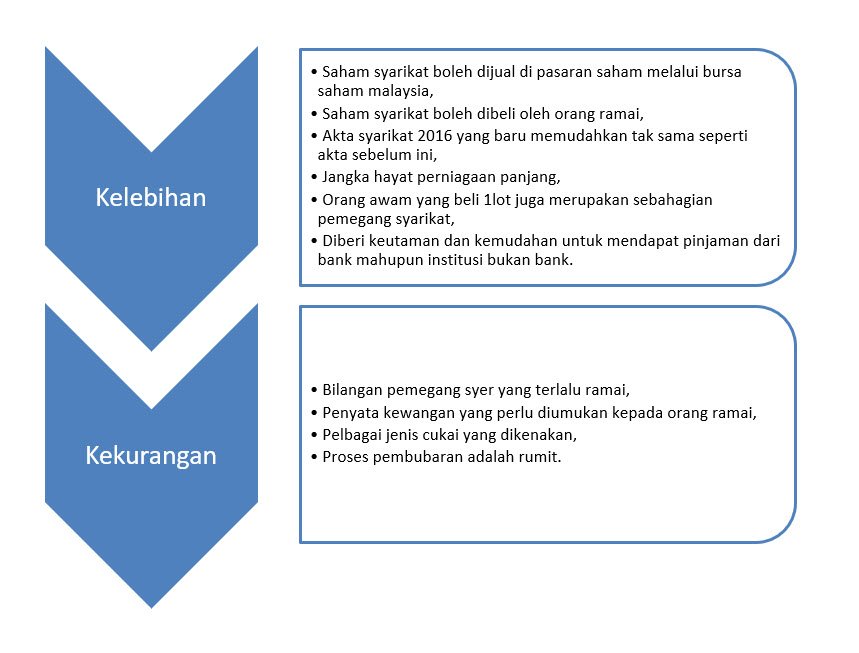
Figure 7: Advantages and Disadvantages
of Public Limited Company
Recommendations for Readers
For those who have already started a business, whether it is an enterprise or a partnership, whether running a product sales or services business, you must set targets for your business to expand further and ensure your business lasts longer, like KFC which was established in 1930 and has been standing strong worldwide for nearly 88 years.
Therefore, I encourage those who are already in business or just starting out to have goals and targets for your business to be listed on Bursa Malaysia.
This is not an easy feat.
There is a Malay proverb that says: Where there is a will, there is a way; where there is none, there are a thousand excuses.
Getting glass is easy, but obtaining a gem requires sacrifice proportional to the goal — it is not as easy as the saliva that flows from one's mouth.
May whatever goals our readers have become reality and be blessed by Allah S.W.T. For any shortcomings in this writing and its content, I sincerely apologise, and if readers have any suggestions for improvement, I warmly welcome them for the betterment of my future writings.
Frequently Asked Questions (FAQ)
What types of businesses can be registered in Malaysia?
In Malaysia, there are several main types of businesses including sole proprietorship, partnership, private limited company (Sdn Bhd), and public limited company (Berhad). Each type has a different structure and set of responsibilities.
What is the difference between a Sdn Bhd and a Berhad company?
A Sdn Bhd is a private company that cannot sell shares to the public, whereas a Berhad (public limited) company can list its shares on Bursa Malaysia to be purchased by public investors.
Why must businesses be registered with SSM?
Registration with the Companies Commission of Malaysia (SSM) is mandatory by law. It protects both consumers and business owners, and grants legal status for the business to operate in Malaysia.
How do company types relate to stock market investing?
Only public limited companies (Berhad) can be listed on Bursa Malaysia. When you buy shares on Bursa, you are actually purchasing partial ownership in these public limited companies.
Understanding the types of businesses and companies is an essential foundation before you begin investing in stocks — start your investment journey today.
Open a CDS account and start investing in companies listed on Bursa Malaysia — Register for a CDS account now.
Get a free stock investment basics ebook to understand how listed companies operate — Download the free ebook here.
Further reading: