Understanding Business With the Business Model Canvas

What Is the Business Model Canvas?
If you are an entrepreneur, the Business Model Canvas is a fundamental concept you MUST understand in the world of business and, to some extent, in the world of stock investing as well.
The Business Model Canvas (BMC) is defined as a blueprint for a company's business operations, identifying revenue sources, target customers, products, and costs.
Did you know that the BMC is a model that helps you understand the nature of a business holistically, systematically, and clearly?
This is because the model provides a picture of every element related to the business — from customers, partners, and markets to sales and production costs.
In simple terms, the BMC provides a holistic summary of your business.
The BMC is extremely popular and useful among startup companies and assists in innovation frameworks for the future.
Furthermore, the BMC is a tool that can help you achieve your company's targets, mission, and vision.
The BMC is also easy to manage — all you need is a single spreadsheet divided into several sections.
Why Understanding Business With the Business Model Canvas Matters
You might be wondering what the advantages of the BMC are and why you MUST master this model:
• Identify problems that your product can solve
• Analyse competitors along with their strengths and weaknesses
• Find solutions for customer problems
• Discover potential partners to expand your business
• Create unique value so that customers remain loyal to your products
• Gain deeper understanding of your customer background
• Serve as a medium for marketing research
• Identify the best revenue channels
• Understand the operations carried out by the company
• Estimate costs incurred at each stage of product development
The 9 Building Blocks of the Business Model Canvas
The BMC contains 9 important building blocks.
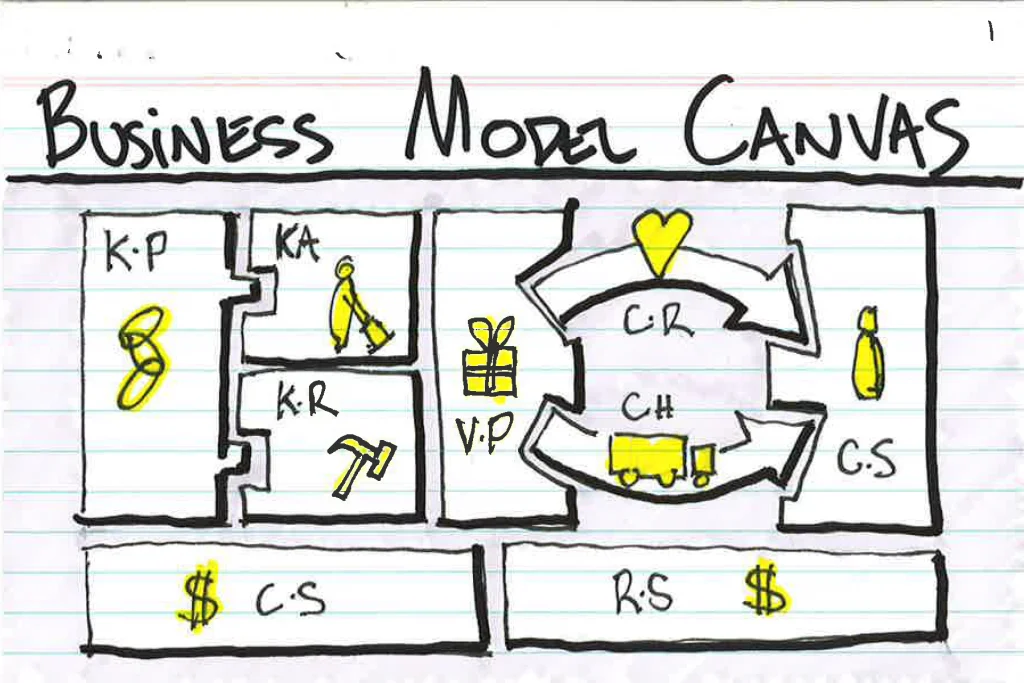
1. Key Partnership
These are the parties involved in producing products and indirectly driving the business.
Their collaboration impacts product development. They are also known as the company's outsourced resources.
Examples include suppliers, partners, and freelancers.
2. Key Activities
All the processes and activities carried out within the company, from manufacturing through to product marketing.
Examples: research processes, marketing using Facebook Ads.
3. Value Propositions
The value your product offers that competitors do not, as well as the unique appeal of your product.
Examples: affordable pricing, innovation on existing products, ease of use, and a strong market brand.
4. Key Resources
Key Resources are what is needed to run the business.
Examples include raw material supply, workforce, and equipment.
5. Customer Relationship
Communication between the business and its customers to maintain good engagement with them.
For example, requesting feedback from customers — are they satisfied with the company's service?
6. Channels
Knowing the channels for promoting your product and the medium used to connect with customers.
What is the journey a customer takes to obtain your product?
7. Customer Segments
Who is the target customer of your business?
Which group are you targeting to buy your product?
Do you know who has the potential to purchase your product or service?
What actions do you take to attract customers to buy your product?
This is important so you can focus your marketing on the groups most likely to purchase your product or service.
8. Cost Structure
How much does it cost to produce the product and what are the costs involved in the business?
Business owners need to identify costs involved so that the company's revenue can be fully optimised.
Unnecessary costs can be reduced or eliminated, and other costs can be saved to increase business profits.
Examples include electricity bills, building rental, and salaries.
9. Revenue Streams
Revenue streams are the sales income of your company.
Conclusion
As an entrepreneur, you should plan your business so that you stay focused on its direction.
To create a plan, you do not necessarily need to follow it too meticulously or have a highly formatted document with many pages.
You do not need to prepare a prospectus or a working paper.
Unless, of course, you are planning to raise capital through equity or a bank loan.
Planning your business on paper is also important so you are clear about your goals and can see every process carried out within the company from a holistic perspective.
This is because you will see all the processes occurring in the company and can evaluate in greater detail the matters that have an impact on it.
Although this step may seem old school, it has a significant effect as a starting point for other steps in business.
If you fail to plan, you plan to fail.
Strengthen Your Investment Knowledge
Successful investing starts with solid knowledge.
Investment Basics:
Download our free ebook for a complete guide.
Open a CDS Account:
Ready to start? Open a CDS account today.
Frequently Asked Questions (FAQ)
What is the Business Model Canvas?
The Business Model Canvas is a business planning framework that encompasses 9 key elements — such as value proposition, customer segments, and revenue streams — all on a single page.
Why is the Business Model Canvas important for entrepreneurs?
It helps entrepreneurs view the entire business process holistically, identify strengths and weaknesses, and plan strategies with greater focus without needing lengthy documents.
What are the 9 key elements of the Business Model Canvas?
The nine elements are Customer Segments, Value Propositions, Channels, Customer Relationships, Revenue Streams, Key Resources, Key Activities, Key Partnerships, and Cost Structure.
How does the Business Model Canvas help investors evaluate companies?
Investors can use this framework to understand a company's business model, assess the strength of its value proposition, and identify growth potential before making investment decisions.
Understanding a company's business model is an essential skill for every investor — it helps you select stocks with strong business fundamentals.
Open a CDS account today to start investing in companies with proven business models on Bursa Malaysia.
Download the free stock basics ebook to learn how to analyse companies before making an investment.
Further reading: