What Is Bid in Stocks? Understanding Bid Size & Price Movement

What Is Bid?
Bid is a term used to refer to the price in stocks.
Typically, the bid price that goes up or down has a fixed size or value according to the price scale.
To put it simply, bid is the price difference of a stock from one price to another.
Stock prices move in a volatile manner, where the price can drop or rise very quickly.
Therefore, every increase or decrease in stock price follows the bid size of that particular stock.
But many of you might be wondering, what is the value of 1 bid?
What Is the Size of 1 Bid?
The size of 1 bid depends on the stock's price scale. This means that stocks have a fixed price scale.
For a clearer understanding, please refer to the diagram below:
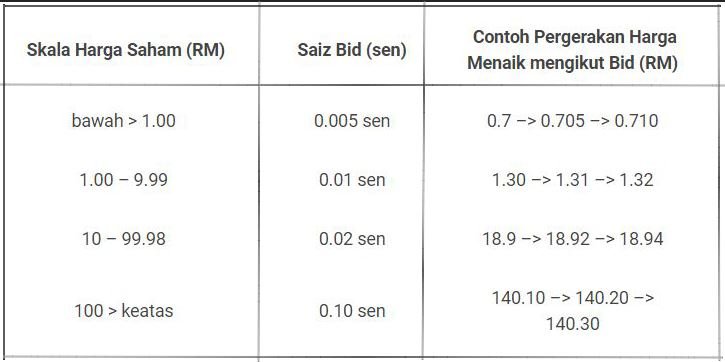
What you need to understand here is that stock prices have specific price scales and bid values move according to those price scales.
For example, if the price of stock X is RM1.30, it falls within the RM1-RM9.99 price scale.
So the rise and fall of stock X will follow the bid size calculation of 0.01 sen.
Therefore, when stock X rises, the next prices would be RM1.31, RM1.32, RM1.33, and so on.
Similarly, when stock X falls, the price will drop according to the bid size calculation of 0.01 sen, i.e. from RM1.30 to RM1.29, RM1.28, RM1.27, and so on.
The same applies to other stock prices as well, whether the stock price is RM5, RM10, RM20, or RM100 and above.
First, you need to know which price scale the stock falls under. Then the calculation of price increases or decreases will follow the bid size (sen) that has been set.
How Many Bids to Target?
In stocks, you need to know that stock profit follows the bid increases and the number of lots you purchase.
For example, if you buy 100 lots of stock with a bid size of 0.005 sen, then if the stock rises by 1 bid you will profit RM50 (excluding brokerage charges), and if it drops by 1 bid you will lose RM50 (excluding brokerage charges).
Here is how to calculate profit / loss:
100 lots = 10,000 units
Selling price – Buying price
(10,000 units x RM0.705) – (10,000 units x RM0.7)
= RM7,050 – RM7,000
= RM50
If you buy stocks at other bid values such as 0.01 sen, 0.02 sen, and 0.10 sen, you can calculate using the example shown above.
For more details on calculations including brokerage charges, refer to how to calculate brokerage.
Conclusion
So by knowing the bid size in stocks, as investors we will know how many bids we need to TP (take profit) to reach our target.
For example, if we buy a stock at RM1.30 for 100 lots = 10,000 units.
Then we want to profit RM200, so the price we need to TP at is RM1.32, which is equivalent to 2 bids from the buying price of RM1.30.
Here is how to calculate:
Selling price – Buying price = RM200
(10,000 units x RM X) – (10,000 units x RM1.30) = RM200
(10,000 units x RM X) – RM13,000 = RM200
RM X = (RM200 + RM13,000) / 10,000 units
RM X = RM 1.32 -------> 2 bids from the price of RM1.30
Hope this was helpful!
Frequently Asked Questions (FAQ)
What is a bid in stocks?
A bid in stocks refers to the minimum price increment or decrement that a stock price can move. The bid size varies depending on the stock's price scale on Bursa Malaysia, with different tick sizes for different price ranges.
How is the bid size determined on Bursa Malaysia?
The bid size is determined by the stock's price range. For example, stocks priced between RM1 and RM9.99 have a bid size of RM0.01, whilst stocks below RM1 may have smaller bid sizes such as RM0.005. Each price scale has its own fixed bid increment.
How do I calculate profit or loss based on bid movement?
To calculate profit or loss, multiply the number of units you hold by the bid movement. For example, if you hold 10,000 units (100 lots) and the stock moves 1 bid of RM0.01, your profit or loss would be RM100 (10,000 x RM0.01), excluding brokerage charges.
How many bids should I target for take profit?
The number of bids to target depends on your desired profit and the number of lots you hold. Divide your target profit by the total units to find the required price movement, then calculate how many bids that represents based on the stock's bid size.
Improve Your Investment Knowledge
Successful investing starts with solid knowledge.
Investment Basics:
Download our free ebook for a complete guide.
Open a CDS Account:
Ready to start? Open a CDS account now.