The World Cup Effect: How the 2026 World Cup Impacts Stock Markets & the Economy

Every four years, the world pauses to watch football. The 2026 World Cup, co-hosted by the United States, Canada and Mexico, will be the largest in history - 48 teams, 104 matches, and a viewership reaching into the billions. But behind the cheers and the euphoria lies an intriguing question for investors: does the World Cup really affect the stock market and the economy?
This phenomenon even has a formal name - the "World Cup Effect". It is not just a coffee-shop myth; it has been studied by leading finance researchers. In this article, we unpack what the World Cup actually does to equity markets, which sectors stand to benefit, and most importantly, the lessons that help you as a Bursa Malaysia investor avoid the trap of investing on emotion and hype.
What Is the 'World Cup Effect'?
The "World Cup Effect" refers to the patterns of financial-market behaviour often observed during the World Cup tournament. Broadly, it covers two things: first, changes in trading activity (volume) because many investors and traders are busy watching matches; and second, the impact of sentiment or "mood" that can move share prices in line with match results.
The underlying idea is simple. The stock market is not driven by numbers alone, but also by people - and people have feelings. When millions of people share the same emotion at the same time (joy from a win, or disappointment from a loss), that collective emotion can spill over into their financial decisions. This is the core of behavioural finance.
Historical Evidence: What Does the Research Say?
The strongest evidence for the World Cup Effect comes from a classic study titled "Sports Sentiment and Stock Returns" by Alex Edmans, Diego Garcia and Oyvind Norli, published in The Journal of Finance in 2007. The researchers analysed international football results across 39 countries between 1974 and 2004.
Their key finding was striking: a country whose team is eliminated (loses) in the knockout stage of the World Cup experiences an abnormal stock return of roughly -49 basis points the next day. In other words, a loss in an important match can push that country's stock index down more than fundamentals would justify, purely because of the negative sentiment among its people.
Even more interesting, the effect is asymmetric. Wins do not produce a statistically significant rise in stocks, but losses clearly drag the market down. This is consistent with the concept of "loss aversion" - humans feel the sting of a loss more strongly than the pleasure of a win. The effect is also more pronounced in small-cap stocks and in countries with deep football traditions.
Other research in the Journal of Financial and Quantitative Analysis also documents the World Cup effect on the US stock market, showing that this pattern is not mere coincidence.
Impact on Trading Volume and Productivity
Beyond sentiment, the World Cup Effect also shows up as a drop in trading activity. When matches are on - especially those involving popular teams or in prime time - many retail traders shift their attention from trading screens to television screens.
In our region, for example, data from the Indonesian market shows the average daily trading value (RNTH) of the IHSG index fell by around 11% during the 2022 World Cup period, particularly from the younger investor segment. Lower volume means price movements can become more erratic because there are fewer participants in the market.
From a macroeconomic angle, there is a productivity cost too. When millions of workers watch matches during working hours or stay up late, workplace productivity can take a temporary hit. However, this effect is usually small and short-lived - the economy recovers as soon as the tournament ends.
Historical Examples: Past World Cups and the Stock Market
To understand the World Cup Effect more clearly, let us look at a few examples from previous tournaments:
- 1998 World Cup (Brazil lost to France in the final): Edmans and colleagues found that Brazil - a nation that loves football dearly - saw a notable market decline after this major defeat, in line with the sentiment theory.
- 2014 World Cup (Brazil thrashed 1-7 by Germany): This humiliating defeat of the host nation became a classic example of how national disappointment can affect economic mood and local market sentiment, even as other economic factors were at play.
- 2022 World Cup (Qatar): Because it ran at year-end (November-December), the tournament overlapped with active trading periods. Regional markets such as Indonesia recorded a notable drop in trading volume during this window, showing the "attention diversion" effect on retail investors.
The consistent pattern is this: the sentiment effect is stronger in countries whose teams are emotionally involved, while the volume effect (lower trading) happens almost anywhere when attention shifts to the matches. Both effects are temporary and rarely change a market's long-term trend.
Sectors That Stand to Benefit During the World Cup
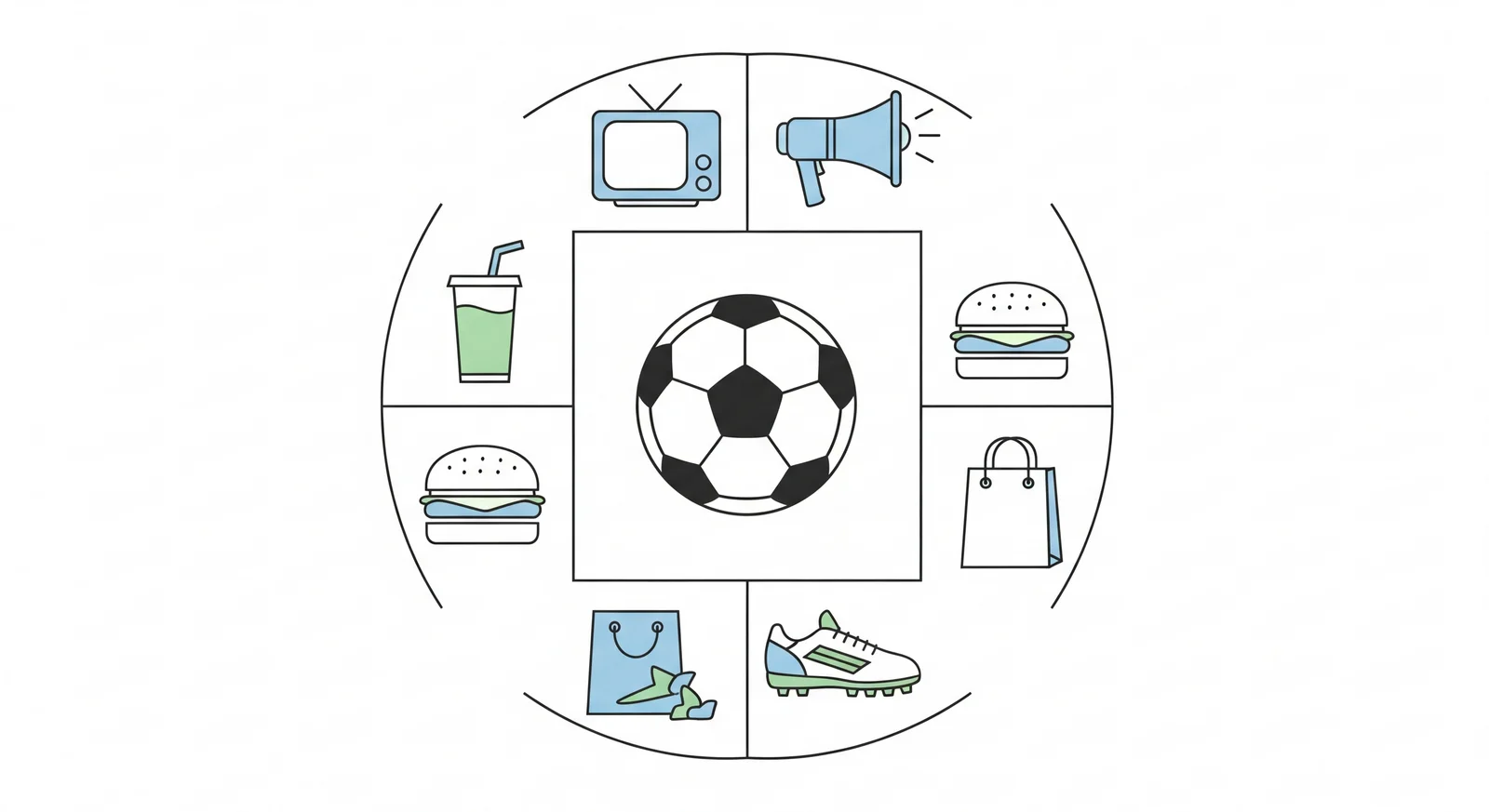
Even if the broad market goes quiet, the World Cup creates a huge flow of spending that benefits certain sectors. FIFA itself expects the 2026 tournament to generate nearly USD13 billion in revenue, with broadcasting rights contributing around USD3.92 billion and marketing and sponsorship around USD2.69 billion. Here are the sectors that typically receive the windfall:
1. Broadcasting and Media
Broadcasting rights are FIFA's biggest revenue source. Broadcasters and media companies holding the rights enjoy a surge in viewership and advertising rates. In Malaysia, the media sector - including pay-TV operators and free-to-air channels - can attract more viewers throughout this period.
2. Advertising
Brands compete to appear in front of a global audience. Official sponsors pay between USD65 million and USD95 million for tournament sponsorship rights. Advertising agencies and digital platforms see a spike in demand for ad space.
3. Food and Beverage (F&B)
Watching football means gathering - and gathering means eating and drinking. Restaurants, fast-food chains, snack suppliers and beverage retailers typically record higher sales. Sponsors like Coca-Cola and McDonald's are among the big names ever-present at every World Cup.
4. Retail and Sportswear
Team jerseys, balls, boots and fan merchandise sell briskly. Sportswear brands such as Adidas (the official supplier of the 2026 match ball and tournament kit) get massive publicity. Interestingly, Nike has no official FIFA rights for this tournament, although it still sponsors several national teams individually - a reminder of how important it is to distinguish tournament-level sponsorship from team-level deals.
5. Global Corporate Sponsors
FIFA's 2026 official partners include Adidas, Coca-Cola, Visa, Hyundai-Kia, Aramco, Lenovo and Qatar Airways, plus major sponsors such as Bank of America, McDonald's, Verizon and Unilever (see the full sponsor list). For investors, this shows which brands are willing to invest heavily for global exposure.
An important note: for Muslim investors, some World Cup beneficiaries such as alcohol producers or sports-betting platforms are not Shariah-compliant. Always check the Shariah status of a stock before investing, and prioritise Shariah-compliant alternatives within the same sector, such as halal retail, media, or halal F&B.
The 2026 World Cup: What Is Different This Time?
The 2026 World Cup is no ordinary tournament. It expands from 32 to 48 teams, making it the largest ever staged, with 104 matches across 16 host cities in three countries. A longer tournament means a longer "World Cup Effect" too - more days of dampened trading volume, but also a longer flow of spending to the benefiting sectors.
The location in American time zones also means many matches take place at night or early morning in Malaysia. This may reduce disruption to Bursa Malaysia's trading hours (9am to 5pm), compared with World Cups in Europe or West Asia whose matches overlap with our market hours.
Impact on Bursa Malaysia and Local Investors
Will Bursa Malaysia fall because of the World Cup? The answer: not directly, and not significantly. Malaysia is not a football powerhouse, so the "win-loss" sentiment effect studied by Edmans and colleagues does not apply strongly to us. Our market is more influenced by factors such as commodity prices, foreign fund flows, interest rates, and local corporate results.
Still, indirect effects exist. Active Malaysian retail investors may trade less during exciting matches, causing volume to dip slightly. Global sentiment can also spill over - if the US or European markets move on tournament-related factors, it can indirectly affect our market. But overall, the World Cup is not a primary factor that should drive your investment decisions.
Lessons for Investors: Do Not Invest on Emotion and Hype
This is the heart of the article. The World Cup Effect is really a valuable lesson about the dangers of investing on emotion. According to Bursa Malaysia's retail investor research, many local investors tend to act emotionally - greedy when the market rises (FOMO) and panic-selling when they see red numbers.
Here are the key lessons you can take away:
- Markets are moved by emotion, not just logic. If a football result can drag stocks down by 49 basis points, imagine how powerful emotions like fear and greed are on your portfolio.
- Do not chase "hot themes" without research. Buying a stock just because it is a "World Cup stock" is a recipe for losses. The tournament's spending windfall is usually short-term and is partly already priced in.
- Focus on fundamentals. A good company stays good after the tournament ends. Value a company based on earnings, debt, and business model - not temporary hype.
- Discipline beats euphoria. Successful investors build a system and stick to it, no matter how exciting an event is. Market sentiment is a tool to understand, not to follow blindly.
In other words, treat the World Cup Effect as a free case study in market psychology. It reminds us that investors who win over the long run are those who control their emotions, not those controlled by them.
Frequently Asked Questions (FAQ)
Is the 'World Cup Effect' real?
Yes, there is solid academic evidence. The Edmans, Garcia and Norli (2007) study shows that a loss in an important match can push a country's stock returns down by around -49 basis points the next day. However, the effect varies by country and is stronger in nations with deep football traditions.
Is Bursa Malaysia affected during the World Cup?
Not significantly. Malaysia is not a football power, so the win-loss sentiment effect is weak here. What may happen is a slight drop in trading volume because retail investors are less active during exciting matches.
Which sectors usually benefit during the World Cup?
Broadcasting and media, advertising, food and beverage (F&B), retail, and sportswear brands typically receive a spending boost. Global corporate sponsors such as Adidas, Visa and Coca-Cola also gain major exposure.
Should I buy "World Cup stocks" for quick profit?
Not recommended without research. The tournament's spending windfall is short-term and is often already priced in. Investing based on theme or hype without assessing company fundamentals is high-risk.
Are all "World Cup stocks" Shariah-compliant?
No. Some beneficiaries such as alcohol companies and sports-betting platforms are not Shariah-compliant. Muslim investors should check each stock's Shariah status and prioritise compliant alternatives within the same sector.
How do I avoid investing on emotion during big events like the World Cup?
Stick to your investment plan, focus on company fundamentals, avoid rushed decisions driven by hype, and remember that temporary events rarely change a company's true long-term value.
Conclusion
The World Cup Effect is a real phenomenon that shows how collective emotion can move financial markets. Although its impact on Bursa Malaysia is small and indirect, it offers a big lesson: stock markets are driven by people with feelings, and successful investors are those who can separate financial decisions from fleeting euphoria.
If you want to start your investment journey with a disciplined, knowledge-based approach, the first step is to have an account to invest with.
You can open a CDS account with us to start investing on Bursa Malaysia as well as foreign stocks such as the United States (US) and Hong Kong markets.
To build a strong foundation before you begin, get our free stock market basics ebook as your starter guide.
Further Reading
- Investor Psychology: 7 Mental Biases That Make You Lose on Bursa Malaysia
- Dumb Money & the GameStop Saga: The Danger of FOMO and Herd Mentality
- Stock Investing Psychology: 13 Emotional Traps That Can Destroy Your Portfolio
- Market Outlook: How to Master Global Sentiment and Technical Analysis
- How to Start Investing in Stocks: From Zero to Your First Investment