Beyond NVIDIA: 8 Companies Winning From the AI Boom

NVIDIA gets 90% of media attention when we talk about AI investing - but it's just one name in a very long value chain. In reality, for every NVIDIA GPU sold, eight to ten other companies also benefit in different ways. From companies that fabricate the chips, companies that supply the lithography machines for the fabs, companies that do packaging and testing, all the way to companies that design custom AI chips for the cloud giants.
For Bursa Malaysia investors watching the AI theme, understanding this value chain matters more than just buying NVIDIA. Why? Because: - Diversifying across layers reduces concentration risk - Some value chain players have stronger moats than NVIDIA itself - Malaysian exposure (INARI, ViTrox, Pentamaster) gives local retail investors a way in without forex risk
This article isn't a buy call. It's an educational profile of 8 major companies in the AI value chain, broken into 3 layers. For a foundational understanding of the 5-layer AI value chain structure overall, read our article first: Rantaian Nilai AI: 5 Lapisan Yang Pelabur Wajib Faham Sebelum Melabur.
Layer 1: Upstream - Foundry & Chip Equipment
This is the most upstream layer - without these companies, not a single AI chip can be made. NVIDIA, AMD, Broadcom are all fabless - they only design chips, manufacturing is outsourced.
#1. Taiwan Semiconductor Manufacturing Company (TSMC)
TSMC is the single enabler of the AI world. Every advanced AI chip today - NVIDIA H100/Blackwell B200 GPUs, AMD MI350, Google's custom TPU, Meta's MTIA chip - all are fabricated at TSMC in Taiwan. No other fab in the world can produce chips at 3nm and 5nm nodes with high yields.
What Makes TSMC So Important: - Controls over 72% of the pure-play foundry market and >90% of leading-edge chip production (source: 24/7 Wall St April 2026 analysis) - 2026 capex expected to reach US$56 billion to meet AI demand - and likely to fall short for 2027 - Customers include: NVIDIA, Apple, AMD, Broadcom, Qualcomm - all dependent on TSMC
Defensive Moat: - Advanced node technology requires decades of R&D + billions in capital - No serious competitor at 3nm/2nm node (Samsung and Intel still trail) - Process maturity - TSMC knows how to use ASML machines with the highest yields
Risks Investors Should Know: - Taiwan geopolitical risk is the biggest threat - any China-Taiwan tension can disrupt the entire global AI chain - Customer concentration - if hyperscalers cut AI capex, TSMC has no short-term Plan B
#2. ASML Holding (Netherlands)
ASML is a more monolithic monopoly than NVIDIA. The company holds 100% market share in EUV lithography machines - machines costing €200 million each and mandatory for fabricating 7nm or smaller chips. No TSMC without ASML. No advanced AI chip without ASML.
What ASML Does: - Designs and builds Extreme Ultraviolet (EUV) lithography machines - the most complex machines in the world (more complex than spacecraft) - Each machine has millions of parts, taking 18 months to assemble - Each machine can print chip patterns on wafers with 3 nanometer precision (1/30,000 the width of a human hair)
Moat Position: - 30+ years of R&D that cannot be replicated quickly - Supply chain of thousands of specialised vendors (Zeiss optics, Cymer light source, etc.) - No other company in the world can produce EUV machines
Risks: - US export controls to China have restricted ASML exports to Chinese fabs - Cyclical - EUV machine orders depend on the capex cycle of semiconductor fabs - Any single machine production delay can push customer fab projects months back
#3. ASMPT (ASM Pacific Technology)
ASMPT may be a less well-known name, but it is a hidden giant in advanced packaging. Listed in Hong Kong (ticker 0522.HK) with major operations in Singapore, ASMPT is the market leader in Thermo-Compression Bonding (TCB) tools - critical technology for packaging advanced AI chips.
What ASMPT Does: - Manufactures TCB and hybrid bonding tools for advanced packaging - Holds 35-40% of the global TCB market with over 500 TCB tools installed worldwide (official ASMPT source) - Key supplier of equipment for HBM (High Bandwidth Memory) - special memory for AI chips
Why AI Needs ASMPT: - Modern AI chips aren't a single chip - they are multi-chip modules that need to be connected with high precision - HBM stacks (12 layers of memory stacked) require TCB - Every NVIDIA Blackwell GPU has multiple layers of HBM3E bonded using ASMPT tools
2026 Performance: - Q1 FY2026 bookings reached HK$5.67 billion (US$727 million), +71.6% YoY - First to secure HBM4 12H orders from SK Hynix - Samsung Electronics reportedly evaluating ASMPT technology adoption
Risks: - Highly sensitive to global fab capex - Competitors like BE Semiconductor (BESI) from the Netherlands and Shinkawa from Japan are catching up - HBM technology evolution can shift dominant packaging tech
Layer 2: Midstream - AI-Specific Chip Designers
This is the layer where NVIDIA dominates most, but isn't the only player. Major hyperscalers (Microsoft, Meta, Google, Amazon) don't want 100% NVIDIA dependency - they're diversifying into custom chips they design themselves (or with partners).
#4. Broadcom Inc (AVGO)
Broadcom is the hidden partner of hyperscalers in custom AI silicon. When Google builds TPUs (Tensor Processing Units), when Meta builds MTIA chips - Broadcom is the design partner and IP supplier.
What Broadcom Does in AI: - Controls an estimated 70% of the custom AI accelerator market (Tipranks 2026 analysis) - Designs custom AI ASICs (XPUs) for hyperscalers - alternatives to NVIDIA's "off-the-shelf" GPUs - Q1 FY2026 AI revenue: US$8.4 billion (+106% YoY), about 43% of total revenue - Targeting US$100 billion AI revenue by 2027
Major Customers: - Google - Broadcom helps design TPU silicon and provides interconnect IP - Meta - Broadcom collaborates on MTIA (Meta Training and Inference Accelerator) - Apple, OpenAI reportedly may collaborate on custom silicon
Moat Position: - Networking IP for AI data centres (Tomahawk switches) - no equally strong competitor - Mixed-signal expertise for SerDes (Serializer/Deserializer) - critical for AI cluster networking - Customer lock-in - once a hyperscaler invests in a Broadcom custom chip, switching cost is very high
Risks: - Hyperscalers could decide to fully in-source design (cut Broadcom) - VMware acquisition (US$69 billion) adds complexity & debt - Competition with Marvell intensifying in custom silicon
#5. Advanced Micro Devices (AMD)
AMD is the main rival to NVIDIA in AI GPUs. Although NVIDIA still dominates (75-85% of AI accelerator market), AMD has positioned itself as the "second supplier" of choice for hyperscalers that don't want 100% NVIDIA dependency.
What AMD Offers: - MI300 series - AMD's first generation seriously competing with NVIDIA - MI350 series (mid-2025) - up to 35x AI inference performance improvement vs MI300, with 288GB HBM3E memory - MI400 series (2026) - next generation for rack-level solutions - ROCm software stack - open-source alternative to NVIDIA's CUDA, recently gained native PyTorch support
Customer Wins: - OpenAI: takes a 10% stake in AMD to secure 6GW of GPU supply (multi-year commitment) - Microsoft & Meta: deployment commitments for the MI350 series - Dell, HPE, Supermicro: integrating MI350 in their OEM platforms
Moat Position: - 50+ years of x86 CPU + GPU experience - deep technical infrastructure - ROCm software catching up fast on NVIDIA's CUDA - Open standard approach more attractive to hyperscalers wary of lock-in
Risks: - NVIDIA still dominates high-end training - CUDA software ecosystem is far more mature than ROCm - AMD AI accelerator margins are lower than NVIDIA's (less pricing power)
Layer 3: Malaysia OSAT - Domestic Exposure for Bursa Investors
For Bursa Malaysia investors, this is the most relevant section. Malaysia is the world's 7th largest OSAT (Outsourced Semiconductor Assembly & Test) hub, and several local companies plug directly into the AI value chain. No forex risk, accessible via standard CDS account.
#6. Inari Amertron Berhad (INARI, 0166)
Inari Amertron is Malaysia's largest OSAT, with specialised expertise in RF (Radio Frequency) packaging and optoelectronics. Although not a "pure AI play", Inari has significant exposure to AI infrastructure through its key customer.
What Inari Does: - Outsourced packaging & testing for RF chips (5G smartphones, base stations, AI data centre networking) - Optoelectronics packaging for lasers, sensors, photonics - critical for optical interconnects in AI data centres - Memory module assembly - Automotive semiconductor testing
Why the AI Boom Benefits Inari: - Long-term partnership with Broadcom as primary packaging vendor - Broadcom designs custom AI ASICs for hyperscalers - a portion of package work likely flows to Inari - Inari is investing in next-gen packaging: system-in-package, flip-chip, 2.5D packaging - all relevant to AI/data centres - Deep stock research: Inari Amertron (INARI, 0166)
Market Position: - Customer concentration: Broadcom contributes ~50%+ of Inari's revenue - Long-term relationship with Broadcom (over 15 years) - mutual trust built - Capacity reportedly to double by FY27-28
Risks: - Highly dependent on Broadcom (single-customer risk) - Smartphone cycle slowdown impacts revenue - Labour and electricity costs in Malaysia rising
#7. ViTrox Corporation Berhad (VITROX, 0097)
ViTrox is a global leader in automated visual inspection (AVI) and machine vision for semiconductor + electronics manufacturing. Every chip made worldwide must be inspected before leaving the fab - and ViTrox is one of the major players.
What ViTrox Does: - Automated 3D AOI (Automated Optical Inspection) for PCB & chip inspection - Automated X-Ray Inspection (AXI) - Component Inspection Equipment - These inspection systems are used by OSATs, EMS firms, and fabs worldwide
Why Edge-AI Is a Game-Changer: - Edge AI (AI running on devices, not cloud) requires more rigorous inspection because defect rates are more critical - ViTrox is already established as a key supplier within the edge-AI factory ecosystem (source: The Edge Malaysia) - AI-linked inspection demand is expected to remain robust through H2 2026 - Deep stock research: ViTrox Corporation (VITROX, 0097)
Moat Position: - Pioneer status in AVI - 20+ years of R&D - Diversified global customer base (US, Europe, China, ASEAN) - Network effects - the more factories use ViTrox, the more data to improve algorithms
Risks: - International competitors like Koh Young, MIRTEC, Test Research Inc - Capex semiconductor fab cyclicality - Geopolitical: if US-China trade war escalates, China customers are hit
#8. Pentamaster Corporation Berhad (PENTA, 7160)
Pentamaster is a Penang-based automated test equipment (ATE) and factory automation player. Their specialisation in back-end testing for semiconductor, medical device, and EV provides revenue source diversification.
What Pentamaster Does: - Automated test equipment for semiconductor & sensors - Factory automation systems - Medical device manufacturing (a growing segment) - EV components testing
Specific AI Exposure: - RM400 million order backlog that is skewed toward AI server and advanced chip packaging verticals (source: I3investor analyst report) - AI server makers (whether hyperscalers or OEMs) need testing equipment to verify performance - Pentamaster expects double-digit revenue growth in FY2026 driven by this order backlog - Deep stock research: Pentamaster Corporation (PENTA, 7160)
Moat Position: - Engineering depth in custom test solutions - not commoditised - Long-term relationships with global customers - Diversification (semiconductor + medical + EV) reduces cyclical risk
Risks: - Capex semiconductor cyclicality - Larger global competitors (Teradyne, Advantest) - Dependent on on-time delivery - delays can cause order cancellations
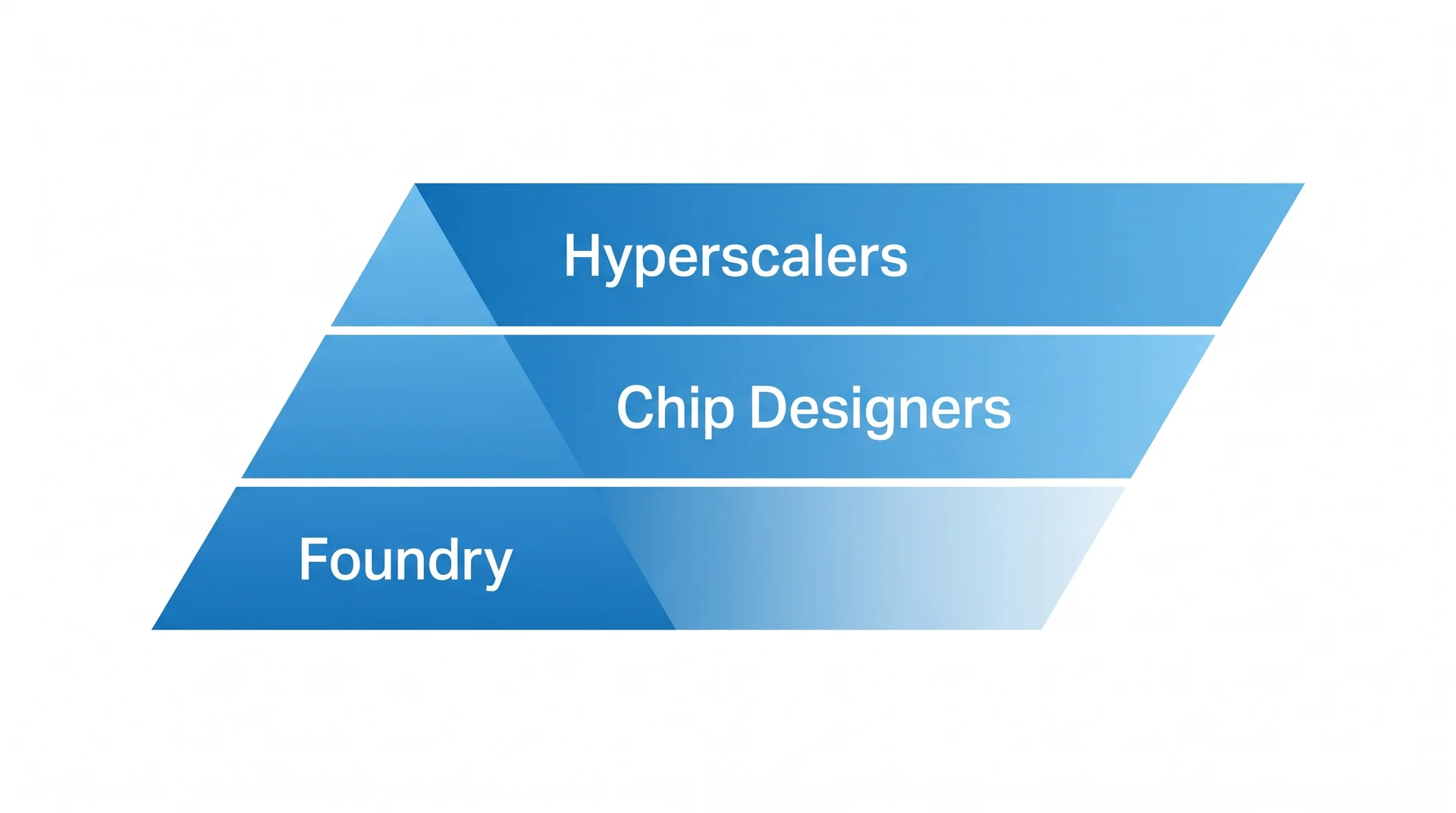
Hyperscalers: The Demand Drivers
It wouldn't be complete to discuss the AI value chain without mentioning who buys all these chips. This is the most downstream layer - the end users filling data centres with millions of GPUs and ASICs.
The 4 Major Hyperscalers: - Microsoft (MSFT) - Azure cloud + OpenAI partnership, AI capex among the world's largest - Meta Platforms (META) - building AI infrastructure for Llama models, Reels recommendations - Alphabet (GOOGL) - Google Cloud + custom TPU + Gemini models - Amazon (AMZN) - AWS cloud + custom Trainium/Inferentia chips
While they are NVIDIA's biggest customers, they are also massive AI investors themselves. Some 2026 AI capex figures alone: - Microsoft FY2026: expected to exceed US$80 billion - Meta 2026: US$60-65 billion - Google: US$75-85 billion
All this big spending eventually flows to the value chain players - TSMC, ASML, ASMPT, Broadcom, AMD, and packaging partners like Inari.
Lessons for Retail Investors
Rather than focusing too heavily on one name (NVIDIA), retail investors can apply a layered exposure framework:
1. Understand the Layer Before Picking a Stock
Each layer has a different risk-reward profile: - Upstream (TSMC, ASML, ASMPT) = most stable, strongest moat, but tied to capex cycles - Midstream (NVIDIA, AMD, Broadcom) = highest growth, most volatile, large customer concentration - OSAT/Malaysia (Inari, ViTrox, Penta) = indirect exposure, less volatile, but upside may be capped
2. Diversify Across Layers
Rather than 100% NVIDIA or 100% Inari, consider spreading exposure: - 1 name from upstream (TSMC or ASML) - 1-2 names from midstream (could include NVIDIA + 1 other) - 2-3 names from Malaysia OSAT for local exposure
This isn't a formula - just a framework to think about diversification.
3. Match Holding Period With Cycle
- Upstream cycle = 3-5 years (capex cycle)
- Midstream cycle = 2-3 years (product/AI demand cycle)
- Malaysia OSAT = 1-2 years (more sensitive to smartphone + EV cycles)
Long-term investors fit better with upstream. More active investors can mix midstream with trades.
4. Geopolitical Risk as a Theme Itself
Almost every major AI value chain player has geopolitical exposure: - Taiwan: TSMC (tension hotspot) - Netherlands: ASML (US export control) - Hong Kong: ASMPT (US-China tension) - Malaysia: Inari, ViTrox, Penta (relatively "neutral" - an advantage)
This is why Malaysian players may gain structural investment flow as neutral diversification - the US, Europe, and China governments all want to avoid total dependency on Taiwan.
Risks & Important Considerations
1. Capex Cycles Can Turn
Hyperscaler capex doesn't rise forever. If Microsoft, Meta, or Google reduce AI capex in the next 1-2 years, the entire value chain will feel it - not just NVIDIA.
2. Concentration Risk on a Few Customers
Many value chain players depend on 3-5 major customers. If one customer reduces orders, the impact cascades.
3. Technology Can Shift
The DeepSeek shock in January 2025 showed that the assumption "lots of GPUs needed" can be challenged. If more efficient algorithm breakthroughs emerge, GPU demand may not be as steady as expected.
4. Geopolitical is the Wild Card
China-Taiwan, US export controls, and trump tariff policies can all reshape the landscape rapidly.
5. Diversification Remains Critical
Even if you're 100% bullish on AI, don't put more than 25% of your portfolio in this single theme. Banking, healthcare, REITs, plantation - all should be in a diversified portfolio.
FAQ: Common Questions About the AI Value Chain & 8 Companies
1. Which stock is "safest" for new retail investors?
No stock is 100% "safe", but in terms of moat and business stability: - Upstream: TSMC and ASML have the widest moats (monopoly or near-monopoly) - more predictable business models - Malaysia: ViTrox and Pentamaster have diversified revenue sources, less single customer risk
2. What's the difference between ASMPT and ASML?
Very different despite similar names: - ASML (Netherlands) - lithography machines for upstream chip fabrication (printing patterns on wafers) - ASMPT (Hong Kong) - packaging & bonding machines for backend (connecting multiple chips into one module)
Both companies share historical ties to ASM International (Netherlands) but operate separately now.
3. Can I buy TSMC, ASML, ASMPT shares from Malaysia?
Yes: - TSMC: NYSE listed (ticker TSM) - buyable through brokers supporting US stocks - ASML: NASDAQ listed (ticker ASML) - same - ASMPT: Hong Kong listed (ticker 0522.HK) - need a broker supporting HK stocks
For US and HK stock access, you need a CDS account with a platform offering foreign market access.
4. Inari, ViTrox, Pentamaster - which is most AI-exposed?
Based on direct exposure: - Pentamaster has the most specific AI mention - RM400 million order backlog skewed to AI server - ViTrox is strong in edge-AI factory ecosystem - Inari is more indirect - via Broadcom which designs AI ASICs for hyperscalers
But exposure ≠ return. Many other factors matter (company execution, valuation, cycle).
5. Why aren't hyperscalers (Microsoft, Meta, Google) in the list of 8?
They are actually end customers driving demand for the entire chain. They benefit from AI but in different ways - through end products (cloud services, advertising). Their size and business profiles differ greatly from the 8 names listed, so we profile them separately.
6. What's the biggest risk for the entire AI value chain?
Three main risks: 1. Taiwan geopolitics - can disrupt TSMC, and ultimately the entire chain 2. AI capex cooling - if hyperscalers reduce AI spending, demand falls 3. Algorithmic breakthroughs - if more efficient AI models emerge, chip demand may slow
7. Is ASMPT comparable to ASML in terms of moat?
Not equivalent, but very strong in its segment. ASML has 100% monopoly in EUV. ASMPT has 35-40% in TCB - strong but with competitors (BESI, Shinkawa). But in HBM packaging, ASMPT has significant first-mover advantage.
8. As a Bursa Malaysia investor, should I focus on local or global stocks?
Depends on profile: - Conservative / new investors: start with local stocks (Inari, ViTrox, Penta) because familiar, no forex risk, easy access via standard CDS - Experienced investors / want pure-play AI: add global exposure (TSMC, ASML, ASMPT, AMD, Broadcom) for direct exposure
Ideally, combine both for diversified exposure across geographies and layers.
Conclusion
NVIDIA may be the most popular AI company, but the AI value chain is actually far deeper and more diverse. From the foundry monopolies TSMC and ASML at the upstream, custom AI silicon designers like Broadcom and AMD in the middle, all the way to backend specialists Inari, ViTrox, and Pentamaster in Malaysia - each layer has its own risk-reward profile. Understanding this structure is the first step toward building a more mature and diversified AI investment strategy, rather than just chasing the trending name.
For Bursa Malaysia investors, this means you have two paths: local exposure through Inari, ViTrox, Pentamaster (moderate, easy access), or global exposure through platforms supporting US/HK stocks.
Before making any investment decision, ensure you have an active trading account and a strong grasp of investing fundamentals.
To start investing in Bursa Malaysia and overseas markets like the US and Hong Kong (for access to TSMC, ASML, ASMPT, AMD, Broadcom, and other AI stocks), you need a CDS account - register your CDS account with Mahersaham here.
For investing fundamentals including how to read financial statements, company valuation, and thematic diversification strategies, get our free stock investing basics ebook.
Further Reading
- Rantaian Nilai AI: 5 Lapisan Yang Pelabur Wajib Faham Sebelum Melabur - Deeper understanding of the 5-layer AI value chain
- NVIDIA Hari Ini = Cisco 2000? Pengajaran Sejarah & Saham AI Lain Untuk Pelabur - Historical NVIDIA context and bubble risk
- Inari Amertron (INARI, 0166) - Deep stock research on Malaysia's largest OSAT
- ViTrox Corporation (VITROX, 0097) - Stock research on the edge-AI inspection player
- Pentamaster Corporation (PENTA, 7160) - Stock research on AI server packaging exposure