Bloomberg Exposé: 'Corporate Mafia' and Azam Baki's Share Scandal

When a prestigious international media outlet like Bloomberg publishes an exclusive report titled "Who's Watching Malaysia's Anti-Corruption Watchdog?", it is not mere tabloid sensationalism. It is a systematic dissection of the nation's institutional integrity — involving testimony from internal witnesses, court documents, and classified police records.
Recently, Bloomberg published an exclusive article and video exposing the 'possible' misconduct of Tan Sri Azam Baki, Chief Commissioner of the Malaysian Anti-Corruption Commission (MACC). Rafizi Ramli also weighed in on the issue in his video commentary, providing deeper perspectives.
Here are the key takeaways from both sources — and why every investor and Malaysian citizen should be concerned.
MACC's Reaction Raises More Questions
What is more striking than Bloomberg's revelations themselves is the over-eager reaction from MACC.
Within less than three hours of an NGO (Perkasa) filing a report, MACC promptly issued a media statement regarding a RM1.1 billion investigation involving a "former minister" (Rafizi Ramli). This dramatic plot twist was widely seen as an attempt to divert attention from the gravity of Bloomberg's exposé.
The question is: was MACC carrying out its duty, or was it using the "political attack" narrative to shield itself from far darker revelations?
The 'Corporate Mafia' Modus Operandi: Robbery in the Investigation Room
The term "Corporate Mafia" discussed by Rafizi refers to a network accused of weaponizing law enforcement agencies to seize publicly listed companies on Bursa Malaysia. This is not mere conspiracy theory — it is a chilling signal to investors that the justice system can be "rented" for certain interests.
Their modus operandi is sophisticated and lethal:
- Targeting Public Companies: Selecting high-potential companies on Bursa Malaysia and acquiring small stakes (2-3%).
- Tactical Reports to MACC: Filing reports to trigger investigations against company founders or management.
- Maximum Pressure: MACC officers raid, freeze accounts, and suspend the targets from their positions.
- Discount Negotiations: Here is the climax — victims are allegedly pressured inside MACC investigation rooms to sell their shares at heavily discounted prices to mafia members in exchange for dropping the investigation.
If these allegations are true, it paints a picture of a system where law enforcement not only fails to protect investors but actively becomes a tool for corporate asset seizure.
The Andy Lim Story: Gun Threats and Bukit Aman Intervention
One of the main characters in this drama is Andy Lim (Lim Kok Han), who Bloomberg alleges has been a close associate of Tan Sri Azam Baki since 2015. The chronology revealed is deeply alarming:
- Restaurant Intimidation: Andy Lim allegedly met Tai Bun Wee (CEO of GIB Holdings) at a restaurant and demanded board seats while displaying a pistol tucked in his waistband — supported by CCTV footage evidence.
- Intervention from 'Higher-Ups': Despite a police report being filed and the weapon being confiscated, the case ended with No Further Action (NFA).
- Extraordinary Orders: Bloomberg's report mentions that the Weapons Enforcement Division at Bukit Aman received a call from a "MACC superior" directing that the weapon be returned and the case dropped.
"A chief of law enforcement should not have overly close relationships with individuals frequently linked to corporate takeover scandals. Such relationships create 'leverage' that can paralyze the agency's independence." — Rafizi Ramli's Analysis
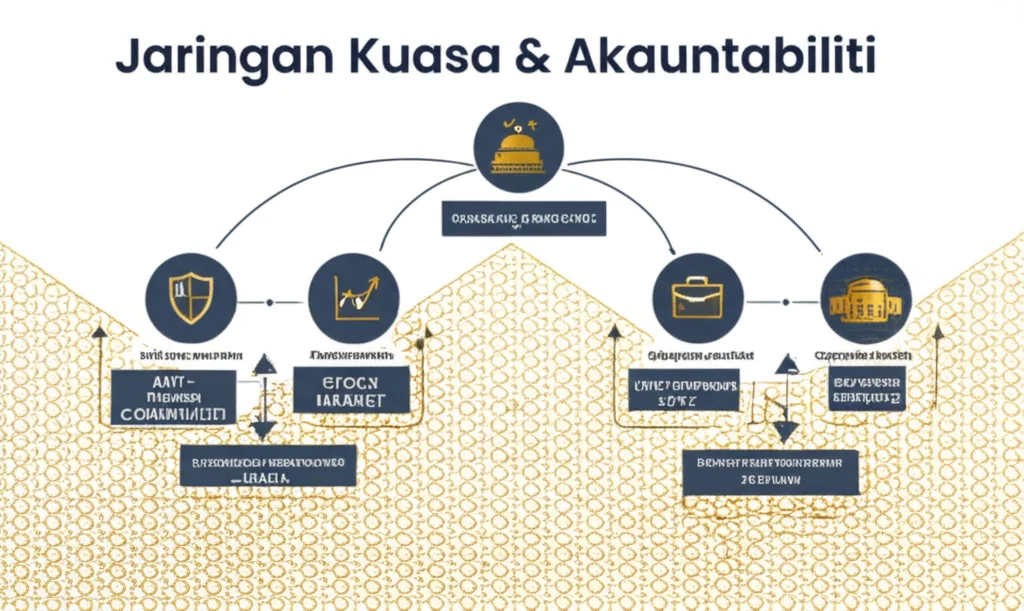
Victor Chin: RM6.5 Million in Shoe Boxes and Organised Crime Links
Victor Chin's profile takes this narrative to an even more dangerous level — organised crime.
- Internal Leak: A 2021 LHDN (Inland Revenue Board) letter revealing Victor Chin's involvement in money laundering exceeding RM500 million linked to organised crime was not leaked by opponents, but by his own audit firm — which also audited MMAG.
- Cash in Shoe Boxes: There are 2024 court records regarding the disappearance of RM6.5 million in cash stored in five shoe boxes at his luxury condominium, allegedly stolen by police officers. The case mysteriously collapsed as witnesses failed to appear.
- National Security Irony: Victor Chin is linked to companies like Next Green (DATA) which hold sensitive public security contracts (passport and IC supply) worth RM2.5 billion. How can an individual investigated for organised crime connections operate within the national security contract ecosystem?
The Intersection: Farhash, MMAG, and Velocity Capital
This web of interests forms a highly suspicious chain when we examine how these stocks moved:
| Individual / Company | Connection & 'Smoking Gun' |
|---|---|
| Farhash Wafa Salvador | Former Political Secretary to Anwar Ibrahim; held significant shares in MMAG Holdings before dramatically selling them. |
| MMAG Holdings | Company investigated by LHDN for alleged RM500 million money laundering; closely linked to Victor Chin. |
| Velocity Capital Berhad | Farhash's MMAG shares were pledged to Velocity's subsidiary (Velocity Kredit) — a licensed moneylender; Azam Baki is a shareholder in Velocity Capital. |
| Awan Biru & Gas Global | Companies where Azam Baki historically held shares alongside his associate, Andy Lim. |
This chain shows how money, power, and law enforcement converge at a deeply concerning point. For investors, the presence of these names in any listed company should serve as a serious red flag.
Azam Baki's Unconvincing Defence on Share Ownership
Azam Baki's argument that his share ownership does not violate regulations because they are preference shares or were purchased on the open market is an intellectual insult.
Even a Form 4 Accounting Principles student would know that:
- All Are Paid-Up Capital: Whether ordinary or preference shares, both constitute paid-up capital subject to Public Service Circular regulations — the RM100,000 limit.
- Missing KSN Documentation: Azam claims to have an exemption, but to this day, the Chief Secretary to the Government remains silent. No evidence of declaration in the HRMIS system has been produced to conclusively clear his name.
- The 'Leverage' Problem: When a MACC Chief Commissioner actively trades millions in shares, he signals that he is open for business. This financial motivation makes him vulnerable to compromise.
Impact on Bursa Malaysia Investors
For retail and institutional investors on Bursa Malaysia, Bloomberg's revelations should serve as a red warning light. Here are the key impacts to understand:
Systemic Governance Risk: When law enforcement agencies themselves are accused of involvement in corporate raids, investor confidence in capital market integrity takes a severe hit. Foreign investors in particular closely monitor governance and transparency indices before making investment decisions on Bursa Malaysia.
High-Risk 'Tainted' Stocks: Companies linked in this report — including MMAG, Velocity Capital, Awan Biru, and Gas Global — carry high reputational risk. Investors should exercise caution with stocks connected to problematic individuals, particularly in the LEAP Market and ACE Market segments which receive less rigorous oversight.
The Importance of Due Diligence: This exposé reinforces the importance of thorough research before investing. It is not enough to examine financial statements alone — you must also investigate who is behind the company — major shareholders, board members, and their political connections. For new investors looking to start investing in stocks, understanding governance risks is crucial.
Institutional Reform: Eliminating the Mafia's 'Leverage'
Rafizi's proposal to place the appointment of the MACC Chief Commissioner under Parliament is not merely bureaucratic procedure — it is a matter of institutional integrity.
- Whiter than White: A chief of law enforcement must have no "black marks". If they have personal scandals, the corporate mafia will use that information as leverage (blackmail capital) to ensure the agency continues to turn a blind eye.
- Accountability Mechanism: There must be a way to remove agency chiefs who violate regulations without Prime Ministerial intervention, to prevent MACC from becoming a "political weapon" or "corporate protector".
This reform is not only crucial for national integrity but also for attracting foreign investment and restoring investor confidence in Malaysia's capital markets.
Latest Developments: Cabinet Orders Investigation
The pressure from Bloomberg's revelations has yielded results. On 13 February 2026, the Cabinet agreed to establish a special committee to investigate allegations involving Azam Baki, chaired by the Chief Secretary to the Government.
Azam Baki in turn announced he would serve Bloomberg with a letter of demand, while asserting that the disputed shares were declared to the Public Service Department in 2025 and disposed of within the same year.
Meanwhile, institutional reform coalition Bersih staged protests in Kuala Lumpur on 15 February, criticising the government's response as "too soft" and demanding sterner action.
These developments demonstrate that this is no mere media controversy — it has become an institutional crisis requiring urgent resolution.
Conclusion
The Madani government now stands at a crossroads of integrity. History will not judge a leader by the amusing nicknames given to his critics — but by his courage to confront the "Untouchables" who now hide behind the MACC badge.
Are we witnessing genuine institutional restructuring, or is this a new version of 1MDB quietly growing under the nose of today's administration? The answer lies in whether Azam Baki's contract will continue to be renewed or whether the truth will finally be allowed to breathe.
If you are an investor on Bursa Malaysia, this question is not merely political — it directly affects your confidence in the transparency and fairness of the nation's capital markets.
The first step as a smart investor is to equip yourself with the right account and knowledge.
Open a CDS trading account through Mahersaham's official platform to start investing safely and systematically.
Download the free Stock Market Basics Ebook to understand the fundamentals of investing before making financial decisions.
Further Reading
- Civil Servants & Shares: Ownership Rules, RM100,000 Limit & Asset Declaration
- LEAP Market Bursa Malaysia: Opportunities & Risks
- Getting Started with Stock Investing
- Stocks for Beginners: Criteria for Choosing Your First Stock
FAQ — Frequently Asked Questions
What is the main issue in Bloomberg's MACC exposé?
Bloomberg revealed allegations that a 'corporate mafia' network has been using law enforcement agencies, including MACC, to seize control of publicly listed companies on Bursa Malaysia. The report also questions the close relationship between MACC Chief Commissioner Azam Baki and individuals linked to illegal activities.
Who is Andy Lim and what is his connection to Azam Baki?
Andy Lim (Lim Kok Han) is alleged by Bloomberg to have been a close associate of Azam Baki since 2015. He was reportedly involved in a firearm intimidation incident against a company CEO, and the case ended with No Further Action (NFA) after alleged intervention from a "MACC superior".
What is Victor Chin's connection to MACC and organised crime?
Victor Chin is linked to allegations of money laundering exceeding RM500 million connected to organised crime. He is also associated with companies holding RM2.5 billion in national security contracts, including passport and identity card supply.
Did Azam Baki's share ownership violate regulations?
According to Rafizi Ramli's analysis, yes. The Public Service Circular sets a RM100,000 limit on share ownership for civil servants. Whether preference shares or ordinary shares, both constitute paid-up capital subject to this regulation. Azam Baki has yet to produce official exemption documentation.
What is the 'corporate mafia' mentioned in the report?
The term refers to a network of individuals who allegedly use law enforcement as a tool to pressure owners of publicly listed companies on Bursa Malaysia into selling their shares at discounted prices. This is not direct seizure, but manipulation through official investigation processes.
How does this revelation affect investors on Bursa Malaysia?
It undermines investor confidence in the integrity of Malaysia's capital markets. Foreign investors may become more cautious, while domestic investors need to be more thorough in their due diligence — not only financially, but also regarding major shareholders and their political connections.
What reforms have been proposed for MACC?
Rafizi proposed that the appointment of the MACC Chief Commissioner be placed under Parliament rather than the Prime Minister's authority. This aims to eliminate the 'leverage' that interested parties could use to compromise the head of the enforcement agency.
Can investors take action based on this exposé?
Investors should be proactive: avoid stocks linked to problematic individuals, conduct thorough research before investing, and monitor developments on this issue. Successful governance reforms will boost market confidence and benefit all investors in the long run.