Brent vs WTI vs Tapis: What's the Difference Between These Three Crude Oils?

Crude oil prices regularly make headline news. Yet many people are confused — why are there so many different oil prices? What is the difference between Brent, WTI, and Tapis? This article explains all three global oil benchmarks, how they differ, and why they matter to Malaysia's economy and investors.
What Is Crude Oil?
Crude oil is a fossil fuel extracted from underground or beneath the seabed. It is the primary raw material for producing petrol, diesel, jet fuel, and various petrochemical products.
However, not all crude oil is the same. Each producing region yields oil with different chemical compositions — in terms of density (heavy vs light) and sulphur content (sour vs sweet). These differences determine the quality, price, and end use of the oil.
To facilitate global trade, the oil industry uses several key benchmarks. The three most important are Brent, WTI, and Tapis.
Brent Crude — The Global Benchmark
Brent Crude is the most widely used oil benchmark in the world. According to the Intercontinental Exchange (ICE), approximately 60% of globally traded oil is priced against Brent.
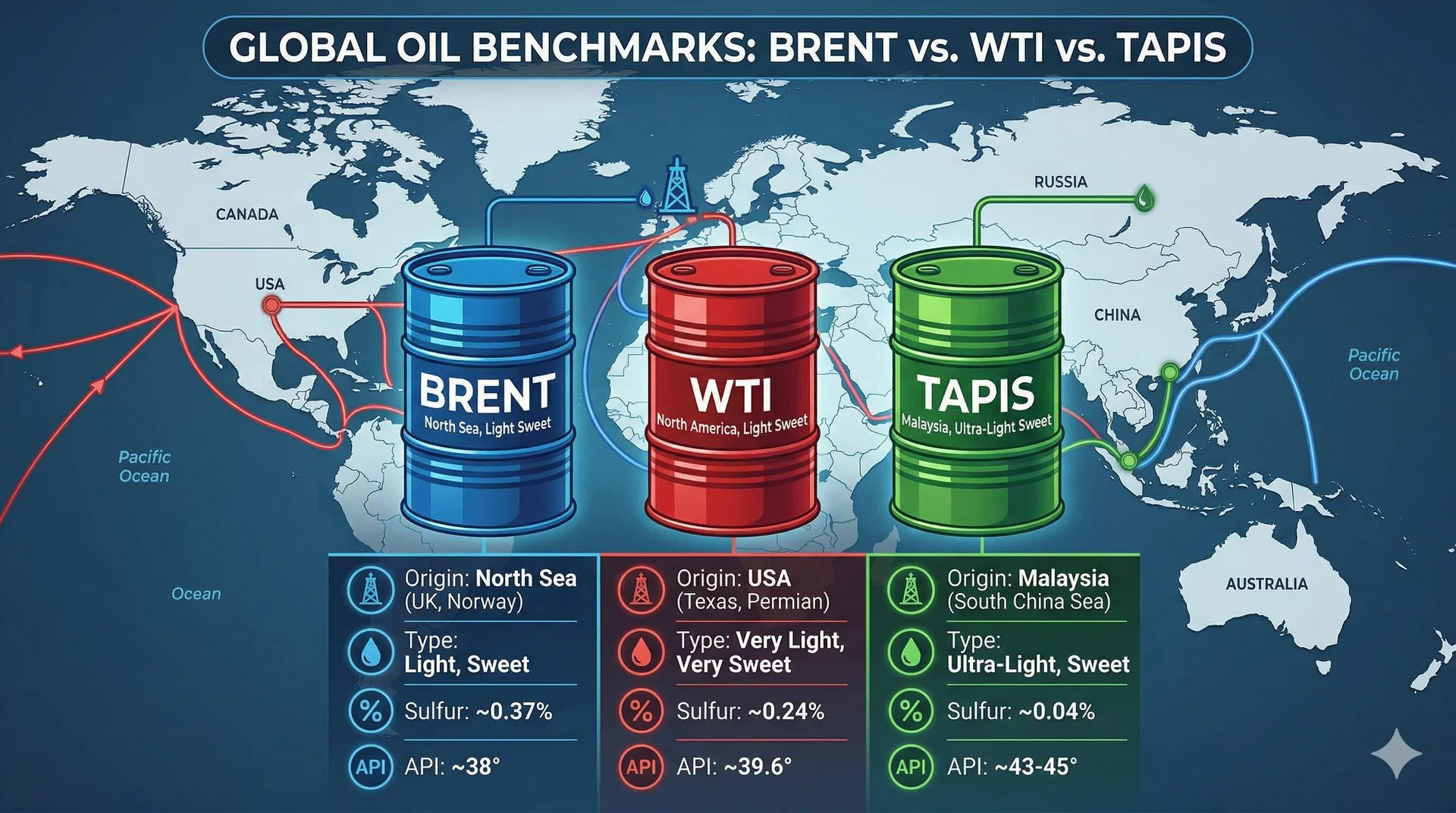
Origin: Brent is named after the Brent oilfield in the North Sea, between the UK and Norway. Today it actually refers to a blend of four North Sea crude oils — Brent, Forties, Oseberg, and Ekofisk (known as BFOE).
Key characteristics:
- API Gravity: 38.0° (light)
- Sulphur content: 0.37% (low — "sweet crude")
- Transport: Seaborne via tankers — easily shipped to any port worldwide
- Main users: Europe, Asia, Africa, Middle East
Brent's main advantage is its global accessibility — extracted from offshore platforms and transported by tanker, making it an ideal benchmark for international markets.
Brent prices are also more sensitive to global geopolitical events, especially conflicts in the Middle East that can disrupt oil shipping routes.
WTI (West Texas Intermediate) — The American Benchmark
WTI, or West Texas Intermediate, is the primary benchmark for the US oil market. According to Charles Schwab, WTI is considered a high-quality crude oil because it is lighter and has lower sulphur content than Brent.
Origin: WTI is extracted from oilfields in Texas, Louisiana, and North Dakota, USA. Its delivery hub is Cushing, Oklahoma — a small town that serves as the largest oil storage hub in the US.
Key characteristics:
- API Gravity: 39.6° (lighter than Brent)
- Sulphur content: 0.24% (lower — "sweeter")
- Transport: Via pipeline to Cushing, Oklahoma
- Main users: North America
Although WTI is technically higher quality than Brent, its price is usually lower. Why? WTI's delivery point at Cushing is landlocked — stuck inland, making it more expensive to transport to international markets.
WTI is more influenced by US domestic factors such as oil inventory levels, shale oil production, and US energy policy.
Tapis Crude — Malaysia's Premium Oil
For Malaysian investors, there is another critically important benchmark — Tapis Crude. This is Malaysia's own crude oil, extracted from offshore platforms off the coast of Terengganu.
What makes Tapis special?
Tapis is regarded as a premium crude oil because it is extremely light and has very low sulphur content. According to Petronas, Tapis Blend is among the easiest crude oils to refine — it yields a higher proportion of valuable products such as petrol and naphtha compared to heavier crudes.
Key characteristics:
- API Gravity: ~45° (very light — significantly lighter than both Brent and WTI)
- Sulphur content: very low (~0.04%)
- Producer: Petronas and its partners
- Usage: Exported at a premium, especially to refineries across Asia
Malaysia's unique strategy is to export Tapis crude at a premium price, then import cheaper crude oil (such as Middle Eastern blends) for domestic refining. This maximises revenue from the country's oil resources.
Brent vs WTI vs Tapis Comparison
| Feature | Brent Crude | WTI | Tapis |
|---|---|---|---|
| Origin | North Sea (UK/Norway) | Texas, USA | Offshore Terengganu |
| API Gravity | 38.0° | 39.6° | ~45° |
| Sulphur | 0.37% | 0.24% | ~0.04% |
| Type | Light sweet | Lighter & sweeter | Ultra-light sweet |
| Transport | Tanker ships | Pipeline (Cushing) | Tanker ships |
| Benchmark for | Global (~60% of world) | US & North America | Asia Pacific |
| Price (Mar 2026) | ~USD 112-115/barrel | ~USD 99-101/barrel | Premium over Brent |
Why Is Brent Always More Expensive Than WTI?
Many people wonder — if WTI is higher quality, why is it cheaper? The Brent-WTI spread in March 2026 reached USD 12-15 per barrel, far wider than the usual USD 2-5 average.
Several key factors explain this:
1. Global vs domestic demand
Brent is used as the pricing reference by the majority of oil-importing nations worldwide, including Asian countries experiencing the highest demand growth. WTI is more limited to the US market.
2. WTI logistics constraints
Cushing, Oklahoma is located deep inland. When US production increases, storage at Cushing sometimes fills up — pushing WTI prices down. In April 2020, WTI prices actually went negative due to this storage problem.
3. Geopolitical premium
Brent is more sensitive to Middle East conflicts and shipping lane disruptions. In March 2026, the US-Iran confrontation and Houthi attacks on Israel drove a significant geopolitical premium into Brent prices.
4. Transport costs
Brent crude shipped by tanker can be delivered to any port in the world with ease. WTI requires expensive pipeline infrastructure to reach export terminals.
How Oil Prices Affect Malaysia
Malaysia has a unique relationship with oil prices. As both an oil producer and a net importer since 2022, the impact of rising oil prices is a double-edged sword.
Positive effects of high oil prices
Increased government revenue — Petronas, which is wholly government-owned, contributes substantial dividends and taxes. According to Free Malaysia Today, Malaysia's status as an oil producer provides an advantage when prices are high.
Ringgit strengthens — Traditionally, high oil prices strengthen the Malaysian Ringgit because Malaysia is an energy commodity exporter.
O&G stocks rise — Oil and gas companies listed on Bursa Malaysia such as Dialog, Yinson, and Hibiscus tend to rally when oil prices increase.
Negative effects of high oil prices
Subsidy burden balloons — According to the Malaysian Ministry of Finance, BUDI95 (RON95) petrol is maintained at RM1.99/litre through government subsidies. However, the fuel subsidy burden has surged from RM700 million to RM3.2 billion per month due to rising global oil prices.
Cost of living rises — Diesel and RON97, which follow market pricing, affect transport costs and subsequently the price of goods.
Strait of Hormuz risk — Approximately 50% of Malaysia's oil supply passes through the Strait of Hormuz. Any conflict in the region could seriously disrupt supply.
Oil Market Situation in 2026
The oil market in Q1 2026 experienced a sharp rally. According to CNBC, Brent prices surged over 44% in a single month — the highest level since June 2022.
Key drivers of the rally:
- The US ultimatum to Iran (deadline 6 April 2026) heightened the risk of a major conflict
- Houthi missile attacks on Israel disrupted shipping lanes
- Threats to close the Strait of Hormuz, which handles 20% of global oil supply
- OPEC+ agreed to increase output by 206,000 barrels/day from April 2026, but this was insufficient to calm market fears
Forward outlook: The EIA (Energy Information Administration) forecasts Brent will average USD 91/barrel in Q2 2026, potentially falling to USD 70/barrel by Q4 2026 if tensions ease.
According to the IEA, global oil demand growth is expected at 1.4 million barrels/day in 2026, while world production is projected to rise by 2.4 million barrels/day to 108.6 million barrels/day.
Can Malaysian Investors Invest in Oil?
Yes, Malaysian investors have several options to gain exposure to oil markets:
1. Oil & gas stocks on Bursa Malaysia
The easiest way is to invest in oil and gas companies listed on Bursa Malaysia such as Petronas Chemicals (PCHEM), Dialog Group, Yinson Holdings, Hibiscus Petroleum, and Velesto Energy.
2. Commodity ETFs
Through platforms like M+ Global, Malaysian investors can access oil commodity ETFs listed on international exchanges.
3. CFDs (Contracts for Difference)
Regulated trading platforms allow investors to trade Brent or WTI crude oil CFDs. However, CFDs carry high risk and are more suitable for experienced investors.
4. Global oil company stocks
Investors can also invest in major global oil companies like ExxonMobil, Chevron, or Shell through a CDS account that supports international stock trading.
Frequently Asked Questions (FAQ)
What is the main difference between Brent and WTI crude oil?
Brent originates from the North Sea and serves as the global benchmark (~60% of world oil), while WTI comes from the US and is the domestic American benchmark. Brent is transported by tanker, WTI by pipeline to Cushing, Oklahoma. Although WTI is lighter and higher quality, Brent is usually more expensive due to stronger global demand.
Why is Brent always more expensive than WTI?
Three main factors: higher global demand for Brent, WTI's logistical constraints at landlocked Cushing, and the geopolitical premium as Brent is more sensitive to Middle East conflicts.
What is Tapis crude oil?
Tapis Crude is a premium crude oil produced in Malaysia from offshore platforms off Terengganu. It is very light (API ~45°) with near-zero sulphur, making it among the highest-quality crude oils in the world.
How do global oil prices affect petrol prices in Malaysia?
RON95 (BUDI95) is subsidised by the government at RM1.99/litre. However, RON97 and diesel follow global market prices. When crude oil prices rise, RON97 and diesel prices increase accordingly, and the government's RON95 subsidy burden also grows.
Is Malaysia an oil producer or importer?
Both. Malaysia produces crude oil (mainly Tapis) but has been a net importer since 2022 as domestic production has declined while consumption has increased.
Why did oil prices spike in early 2026?
The US-Iran confrontation (deadline 6 April), Houthi attacks on Israel, and threats to the Strait of Hormuz pushed Brent prices up over 44% in a single month.
What is the Brent-WTI spread and why does it matter?
The spread is the price difference between Brent and WTI. Normally USD 2-5, it widened to USD 12-15 in March 2026 due to the geopolitical premium. A wide spread indicates high global supply pressure.
Can retail investors in Malaysia invest in crude oil?
Yes, through O&G stocks on Bursa Malaysia, international commodity ETFs, or oil CFDs. The simplest approach is to buy shares in O&G companies listed on Bursa Malaysia.
Conclusion
Understanding the differences between Brent, WTI, and Tapis is not just general knowledge — it is essential for Malaysian investors who want to make informed investment decisions. With oil prices surging in 2026 due to geopolitical tensions, understanding global oil market dynamics has become more critical than ever.
If you are interested in starting to invest in oil and gas stocks or any other sector, the first step is opening the right trading account.
Open a CDS trading account to start investing on Bursa Malaysia as well as international stocks in the US and Hong Kong markets through a single platform — register here.
Download the free Stock Market Basics Ebook to understand fundamental concepts before you begin investing — get your free ebook here.
Further Reading
- Jet Fuel Hedging: How Airlines Manage Their Oil Costs
- Oil & Gas Stock Catalysts: 7 Key Factors Investors Need to Know
- Iran Conflict 2026: How It Reshapes Malaysia's Stock Investment Landscape
- Financial Dictionary & Stock Market Glossary
- The Link Between Global Oil Prices, Stock Markets & Profit Opportunities