Bursa Malaysia Closing Auction: What Happens Between 4.45pm and 5.00pm

Have you ever noticed a stock's price suddenly shift in the final moments before the market closes at 5.00pm? Or placed an order after 4.45pm that did not match immediately even though the price looked right? That is not a system glitch. That is the closing auction - a special mechanism that determines the official closing price of every stock on Bursa Malaysia.
Between 4.45pm and 5.00pm, Bursa Malaysia no longer operates like normal trading. It switches to two special phases that many retail investors do not understand. This article explains exactly what happens in those final 15 minutes, why it matters, and how it affects your orders.
What Is the Bursa Malaysia Closing Auction?
The closing auction is a call-auction process that determines a single official closing price for each stock, where all buy and sell orders are first collected before being matched simultaneously at one single price. It takes place between 4.45pm and 5.00pm, divided into two phases: Pre-Closing (4.45pm - 4.50pm) and Trading At Last (4.50pm - 5.00pm).
Unlike continuous trading that happens throughout the day, where orders are matched one by one according to time and price, the closing auction gathers all orders within a set window, then calculates a single price that maximises the volume of shares that can be traded. This concept mirrors the Theoretical Opening Price at the market open at 9.00am, except this time it happens at the end of the day.
Bursa Malaysia Trading Phases Throughout the Day
To understand the closing auction, you need to see the bigger picture of how a trading day on Bursa Malaysia is structured. According to official Bursa Malaysia information, the equity market is divided into two main sessions with the following phases:
| Phase | Time | What Happens |
|---|---|---|
| Pre-Opening | 8.30 - 9.00am | Orders collected, no matching |
| Opening Auction | 9.00am | Opening price (TOP) calculated |
| Continuous Trading (Morning) | 9.00am - 12.30pm | Orders matched continuously |
| Lunch Break | 12.30 - 2.30pm | Market temporarily closed |
| Pre-Opening (Afternoon) | 2.00 - 2.30pm | Orders collected again |
| Continuous Trading (Afternoon) | 2.30 - 4.45pm | Orders matched continuously |
| Pre-Closing | 4.45 - 4.50pm | Orders collected, TCP calculated |
| Trading At Last | 4.50 - 5.00pm | Trading at closing price only |
Notice that continuous trading actually ends at 4.45pm, not 5.00pm as many assume. Those final 15 minutes are the special closing auction zone. If you want a full breakdown of every trading session, see our article on Bursa Malaysia trading hours.
Pre-Closing (4.45pm - 4.50pm): The Order Collection Phase
Exactly at 4.45pm, Bursa Malaysia stops matching orders continuously and enters the Pre-Closing phase. During these five minutes, the following happens:
- Orders can be entered, modified, or cancelled as usual.
- No matching takes place - even if the buy and sell prices appear to align, the transaction will not be executed yet.
- The Automated Trading System (ATS) calculates and disseminates the Theoretical Closing Price (TCP) and Theoretical Closing Volume (TCV) continuously.
This is why if you press "Buy" after 4.45pm and the order does not match immediately, it is not a problem. The system deliberately holds all orders until the auction process is complete. This unmatched-order phenomenon also happens in other situations - read why your buy order does not match to understand other causes.
The TCP figure displayed throughout Pre-Closing is "theoretical" because it can still change every second based on new incoming orders. It only becomes final when the clock strikes 4.50pm.
Theoretical Closing Price (TCP): How the Closing Price Is Calculated
At 4.50pm, the system executes a simultaneous match (uncrossing) and the last calculated TCP becomes the official closing price of that stock for the day. But how is a single price chosen from thousands of orders at various price levels?
The Bursa Malaysia auction algorithm follows these principles, according to the official Bursa Trading Manual:
- Maximise the matched quantity - the system picks the price that allows the largest volume of shares to be traded. This is the primary criterion.
- Minimise the imbalance - if several prices yield the same matched quantity, the system chooses the price that leaves the fewest unfilled orders.
- Price reference rule - if an imbalance remains on the buy side, the TCP is set at the highest price. If the imbalance is on the sell side, the TCP is set at the lowest price.
The purpose of this algorithm is to produce a closing price that is fair and difficult to manipulate. Before the TCP mechanism was introduced, the closing price was simply the last transacted price, which could easily be "marked" by a single small order at the last second. With the auction method, the closing price reflects the true balance of supply and demand. This balance concept is closely tied to the relationship between bid-ask, volume, and supply and demand that determines where prices move.
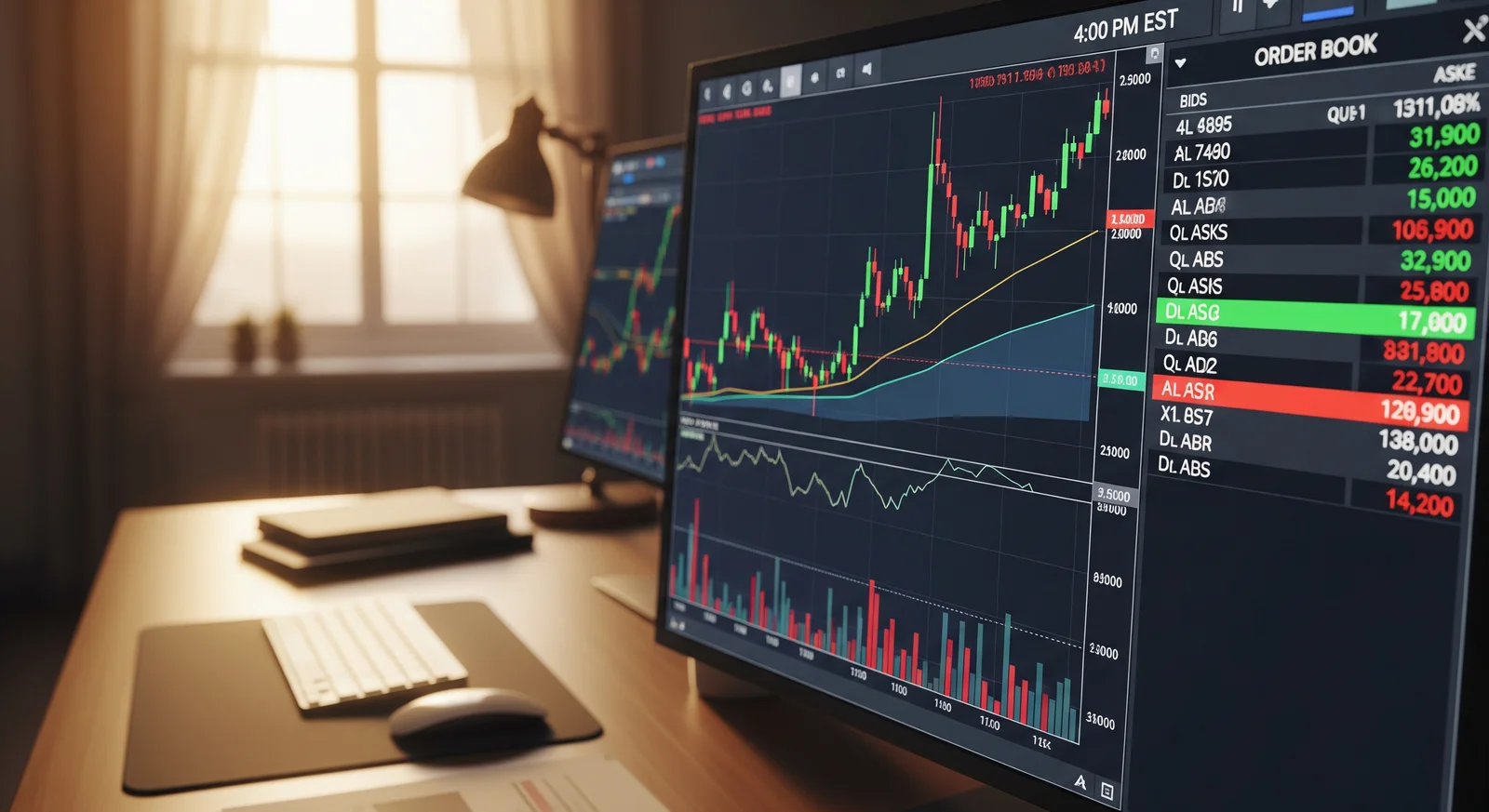
Trading At Last (4.50pm - 5.00pm): Trading at the Closing Price
After the closing price is set at 4.50pm, the market enters its final phase, Trading At Last (TAL), for ten minutes until 5.00pm. In this phase:
- Orders can only be entered and matched at the closing price - not at any other price.
- If you enter an order at a price other than the closing price, the order will be rejected by the system.
- Matching happens continuously (by time priority) as long as there are orders at that exact price.
The Trading At Last phase gives investors who missed the auction match an opportunity to buy or sell at the official closing price. It is especially useful for institutional funds and fund managers who need to execute transactions at the closing price for benchmark or portfolio valuation reasons. Bursa Malaysia introduced several trade execution options including this mechanism to improve market efficiency, as reported by The Star.
Why the Closing Auction Matters
The closing auction is not just a technical formality. It plays several critical roles in the market ecosystem:
1. Fair price discovery. By gathering all orders into a single auction, the closing price reflects the collective view of all market participants, not one final transaction that may not represent true value.
2. Reducing price manipulation. At the end of the day, some parties might try to "mark" the closing price to a certain level for specific purposes (such as inflating their portfolio value on valuation day). The auction mechanism makes this tactic harder because a single small order cannot determine the closing price on its own.
3. Concentrated liquidity. The closing auction draws many orders to one point in time, creating high liquidity that allows large transactions to be executed with minimal price impact.
Why the Closing Price Matters to You
As a retail investor, the closing price determined by the closing auction directly affects several things:
- Index calculation - the FBM KLCI and other indices are calculated based on the closing prices of their components. The index movement you read in the evening news is the result of the closing auction.
- Net Asset Value (NAV) of unit trusts and ETFs - investment funds are valued based on the closing prices of the stocks in their portfolios.
- Margin and collateral levels - for investors using margin accounts, the closing price determines the collateral value and whether you receive a margin call.
- Daily chart reference - every daily candlestick you see in technical analysis uses the closing price as its close point. Understanding this matters when you study volume analysis and price movement.
Common Investor Mistakes During the Closing Auction
Many new investors are confused by the market's behaviour in the final 15 minutes. Among the common misconceptions:
"My order is stuck, the broker must have a problem." No. During the Pre-Closing phase (4.45pm - 4.50pm), no matching takes place. Your order is in the queue waiting for the auction, not stuck.
"The price jumped suddenly at 4.50pm, there must be manipulation." Not necessarily. When the auction is resolved at 4.50pm, the price "jumps" from the last theoretical level to the actual matched price. This is normal, not a sign of wrongdoing.
"I want to buy at a lower price during Trading At Last." You cannot. In the TAL phase, only orders at the closing price are accepted. Orders at other prices will be rejected.
"Placing an order early in the morning is safer than at close." It depends on your strategy. Long-term investors usually do not need to worry about the exact time of day. But if you need to enter or exit at the closing price, the closing auction is your opportunity.
Practical Tips for Handling the Closing Auction
Here are some practical guidelines for investors:
- Do not panic if your order does not match after 4.45pm. Wait until the auction is resolved at 4.50pm before making a decision.
- Monitor the TCP during Pre-Closing. The displayed TCP gives an early indication of where the closing price might land.
- If you want to be sure of getting the closing price, place your order during the Pre-Closing phase so it is included in the auction.
- For long-term investors, the exact time of day rarely matters. Focus on a reasonable average price, not chasing the final tick.
- Avoid placing large orders at the very end of Trading At Last because liquidity may be thin after the main auction is complete.
Before you can trade directly, you need an account that gives you access to the market. If you are just starting out, see our guide on how to start investing in stocks.
Frequently Asked Questions (FAQ)
When does continuous trading on Bursa Malaysia end?
Continuous trading in the afternoon session ends at 4.45pm, not 5.00pm. After that the market enters the closing auction phases (Pre-Closing and Trading At Last) until 5.00pm.
What is the Theoretical Closing Price (TCP)?
The TCP is the theoretical closing price calculated by the automated trading system during the Pre-Closing phase. It is calculated to maximise the matched quantity and becomes the official closing price when the auction is resolved at 4.50pm.
Why doesn't my order match after 4.45pm?
Because during the Pre-Closing phase (4.45pm - 4.50pm), orders are collected but no matching takes place. All orders wait until the auction is resolved at 4.50pm.
Can I buy at a different price during Trading At Last?
No. During the Trading At Last phase (4.50pm - 5.00pm), orders can only be matched at the closing price. Orders at any other price will be rejected by the system.
Is the closing auction the same as the opening auction?
The concept is the same - both use an auction mechanism to determine a single price. The opening auction determines the opening price at 9.00am (see Theoretical Opening Price), while the closing auction determines the closing price at 4.50pm.
Why is the closing price important?
The closing price is used to calculate indices (such as the FBM KLCI), NAV of unit trusts and ETFs, margin levels, and the close point on daily charts. It is the official reference value of a stock for the day.
Do all stocks have a closing auction?
Yes, the closing auction and Trading At Last mechanism apply to securities traded in the Bursa Malaysia equity market under standard trading procedures.
Conclusion
The Bursa Malaysia closing auction is an important mechanism that determines the official closing price of every stock between 4.45pm and 5.00pm. The Pre-Closing phase collects orders and calculates the TCP, while the Trading At Last phase allows trading at the closing price. Understanding this process helps you interpret price movements at the end of the day and avoid the common misconceptions.
Once you understand how stock prices form from open to close, the next step is to start investing yourself on Bursa Malaysia.
To start trading, you need a CDS account that lets you invest in Bursa Malaysia as well as foreign stocks such as the US and Hong Kong markets.
And if you are just starting out, download our free stock market basics ebook to understand the key concepts before investing real money.