Business First or Invest First? The Math-Based Answer for Malaysian Entrepreneurs

Business First or Invest First? The Question Most Malaysians Get Wrong
"Focus on your business first. Once it's stable, then start investing."
This is the most popular advice in Malaysia - especially among entrepreneurs and business coaches. The logic seems sound: build a high active income through business, then channel the surplus into stock investments, property, or other assets.
But is this strategy truly optimal? Or are we actually losing time that can never be bought back?
The answer - like most financial questions - is not black and white. This article will dissect both sides with mathematics, real data, and practical examples specific to the Malaysian context.
Why Many Believe "Business First, Invest Later"
This advice didn't come from thin air. There are several solid reasons why many successful entrepreneurs hold this belief:
1. Business ROI is far higher than the stock market
The average return of Bursa Malaysia (FBMKLCI) over the past 10 years has been around 3-5% annually including dividends. Compare that with a successful business - profit margins of 20-50% per year are not unusual, especially for service or digital businesses with low overhead costs.
If you have RM50,000, is it wiser to put it in stocks for a 5% return (RM2,500 per year), or use it as business capital with the potential to generate RM25,000 per year?
2. Robert Kiyosaki and the Cashflow Quadrant
Kiyosaki divides people into 4 quadrants: Employee (E), Self-Employed (S), Business Owner (B), and Investor (I). His advice is clear - build a business (B quadrant) first that generates cash flow, then move to the I quadrant (Investor).
The logic: you need a strong and consistent income source before you can invest meaningfully. Investing RM500 a month is possible, but the impact is too small compared to growing a profitable business.
3. Full control vs unpredictable markets
In business, you have control. You can change your marketing strategy, raise prices, cut costs, or pivot to new products. In the stock market, you're merely a passenger - entirely dependent on other companies' performance and global market sentiment.
The Biggest Problem With the "Wait First" Strategy
While the arguments above seem logical, there's one major problem that's often overlooked - the opportunity cost of time.
Compound interest mathematics waits for no one.
Say you're 25 years old and choose to focus 100% on business for 10 years. At age 35, your business succeeds and you start investing RM1,000 per month. With an average return of 8% per year, by age 55 you'll have approximately RM589,000.
Conversely, if you start investing RM500 per month from age 25 (while building your business), by age 55 you'll have approximately RM745,000 - even though your monthly investment amount was smaller.
That's a RM156,000 difference. The reason? You had 10 extra years for compound interest to work. This isn't theory - this is mathematics.
Warren Buffett himself started investing at age 11, and he once said: "The best thing about compound interest is that it never stops working."
The Real Answer: Not One or the Other, But Both
Here's the truth rarely spoken: you don't have to choose between business OR investing. You can - and should - do both simultaneously.
Here's a smarter approach:
Phase 1: Financial Foundation (0-6 months)
- Clear high-interest debt (credit cards, personal loans)
- Build an emergency fund of 3-6 months' expenses
- This is mandatory whether you're running a business or earning a salary
Phase 2: Start Both Simultaneously
- Allocate 70% of focus and capital to business (active income source)
- Allocate 30% of income to investments (let compound interest start working)
- Investing doesn't need to be complicated - start with RM100-500 per month in Shariah-compliant stocks or ETFs
Phase 3: Shift the Ratio as Business Matures
- When business is stable and generating consistent cashflow, increase your investment allocation
- Ultimate goal: business generates active income, investments generate passive income
- Both income streams protect you if either one fails
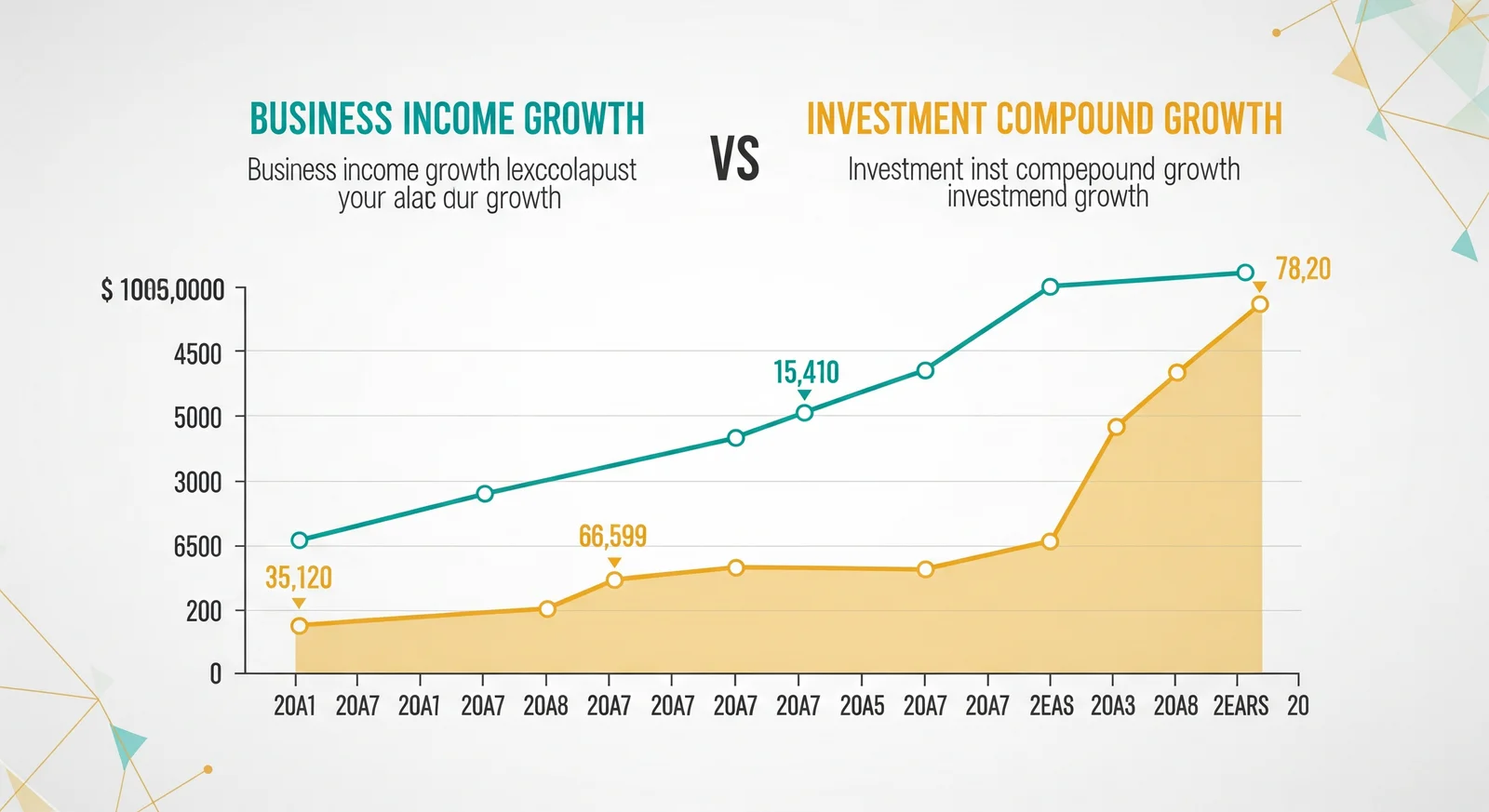
3 Comparison Scenarios - Who's Wealthier at Age 50?
Let's compare 3 people who all start at age 25 with the same income:
| Scenario | Strategy | Monthly Investment | Investment Period | Value at Age 50 (8% p.a.) |
|---|---|---|---|---|
| Ali | 100% business focus, starts investing at 35 | RM1,500/month | 15 years | RM523,000 |
| Ahmad | Business + investing simultaneously from 25 | RM500/month (increases to RM1,500 after 10 years) | 25 years | RM640,000 |
| Amir | Salaried employee, consistent investing from 25 | RM1,000/month | 25 years | RM956,000 |
Analysis:
- Ali - despite investing RM1,500 per month (3x Ahmad's initial amount), he still loses because he only has 15 years of compound interest
- Ahmad - the hybrid approach delivers the best balanced result. He has both a business AND an investment portfolio
- Amir - consistency and time in the market beats a larger capital amount that starts late
Important note: this calculation assumes an average 8% annual return, based on long-term global stock market performance. The FBMKLCI index may deliver different returns, but the compound interest principle remains the same.
5 Mistakes Entrepreneurs Make by Delaying Investing
Many entrepreneurs succeed in business but fail to build long-term wealth. This is because they fall into several common traps:
1. "My business IS my investment"
This is the most dangerous mistake. Your business is not an investment - it's your job. If your business fails (and SME Corp statistics show a high failure rate for SMEs), you lose BOTH your income and your "investment" at the same time. Diversification is a fundamental principle of risk management.
2. "I'll invest once my business is stable"
The problem - when exactly is "stable"? Many entrepreneurs continuously reinvest profits into the business, chasing unlimited growth. 10 years pass, and they're still not "stable" enough to start investing.
3. "My business returns are higher than the stock market"
This might be true - but it ignores risk. A 50% return from business comes with the risk of total failure. An 8% return from a diversified stock portfolio comes with far lower risk. Smart investors don't just look at returns - they look at risk-adjusted returns.
4. No financial protection beyond the business
If all your money is in your business, you're extremely exposed. One crisis - a pandemic, regulatory changes, or a new competitor - could wipe out everything. A separate investment portfolio acts as a financial buffer.
5. Too busy chasing active income
Entrepreneurs often get trapped in an endless cycle of work. They forget that the ultimate goal isn't to work harder - but to build assets that work for them. As written in Rich Dad Poor Dad, real wealth comes from owning assets that generate passive income.
When You SHOULD Focus 100% on Business
While this article recommends a simultaneous approach, there are situations where full focus on business is indeed wiser:
- First 6-12 months of business - the survival phase requires full focus and capital. Investing can be postponed temporarily, but DON'T let it drag on for years.
- Business is scaling aggressively - if your business is growing rapidly and every ringgit reinvested gives 3-5x returns, it may be wiser than putting money in stocks temporarily.
- Business debt that needs clearing - if you have high-interest business debt, clear it before investing. An 8% stock market return is meaningless if you're paying 12% interest on a loan.
- Once-in-a-lifetime opportunity - if you have a clear, time-limited business opportunity (e.g. government contract, limited franchise), focus temporarily to seize it.
But after these phases pass, return to the simultaneous approach - business + investing.
Practical Strategy: How to Invest While Running a Business
You don't need to be a stock market expert to start investing. Here are practical steps for busy entrepreneurs:
1. Automate and forget
Set up a standing instruction to transfer RM300-500 monthly to your investment account. Choose 2-3 strong Shariah-compliant stocks or index ETFs. You don't need to monitor them daily.
2. Separate business and investment accounts
NEVER mix business funds and investment funds. Money transferred to your investment account is "off limits" - it's not for covering next month's business costs.
3. Start with beginner-friendly platforms
According to the Securities Commission Malaysia, there are various licensed investment platforms in Malaysia that allow you to start with as little as RM100. Choose a broker that offers low fees and an easy-to-use interface.
4. Use the "Profit First" method
Every time your business generates profit, allocate a fixed percentage (minimum 10%) directly to investments BEFORE paying anything else. This is based on the "pay yourself first" principle from the book The Richest Man in Babylon.
5. Review once every quarter
You don't need to monitor your portfolio daily. Set a date every 3 months to review portfolio performance and make adjustments if needed. This takes less than 1 hour - far less time than you spend on your business.
Real Stories: Malaysian Entrepreneurs Who Invest Simultaneously
Many successful entrepreneurs in Malaysia actively invest in the stock market while running their businesses. They understand that business generates today's income, but investment builds wealth for the future.
In fact, if you look at the list of Malaysia's richest people on the Forbes Malaysia Rich List, almost all of them have diversified investment portfolios - not just relying on a single business.
The principle is simple: business builds income, investment builds wealth. Both are needed.
Roadmap by Life Stage
Each life stage requires a different strategy. Here's a concise guide that you can adapt to your situation (refer to financial planning by life stage for a detailed version):
| Age | Primary Focus | Business:Investment Ratio | Key Actions |
|---|---|---|---|
| 20-25 | Learn & start | 80:20 | Build skills, start a small business, invest a minimum of RM100-300/month |
| 25-30 | Aggressive in business | 70:30 | Scale the business, increase monthly investments as income grows |
| 30-35 | Balance | 50:50 | Business is stable, investment portfolio starts growing |
| 35-45 | Build passive assets | 40:60 | Focus on building a portfolio that generates dividends/passive income |
| 45+ | Wealth protection | 30:70 | Reduce risk, increase defensive investments, plan for retirement |
FAQ - Business vs Investing: Common Questions Answered
What is the minimum I should invest while running a business?
A minimum of 10% of your net business profits. If your business is still new and profits are small, start with RM100-300 per month. What matters is consistency, not the amount.
Do I need to sell my business before I can invest fully?
No. You can run your business and invest simultaneously. In fact, many successful investors use income from their business to fund their investments. Both complement each other.
My business is still losing money. Should I invest?
If your business is still making losses, focus on making it profitable first, or consider shutting it down if there are no prospects. Don't use investment money to cover business losses. However, if you have income from other sources (part-time salary, freelancing), you can still invest a small portion.
What stocks are suitable for busy entrepreneurs?
Choose blue chip stocks or index ETFs that don't require daily monitoring. Consistent dividend stocks are also suitable because you earn returns without needing to actively trade. Make sure to choose Shariah-compliant stocks if that's your priority.
What if I need my investment money for my business?
This is exactly why you need to keep separate accounts. Investment money is not your business emergency fund. If your business needs additional capital, get it from other sources - SME loans, government grants, or external investors. Don't touch your investment portfolio.
Do EPF and ASB already count as investments?
Yes, EPF contributions and ASB investments are forms of investment. However, they may not be sufficient to build significant wealth. Consider adding direct investments in stocks or ETFs for diversification and higher return potential.
What's the difference between business and investment in terms of risk?
Business has higher risk (potential for complete failure) but also higher return potential. A diversified stock portfolio has lower risk (markets rarely drop to zero) with more moderate returns. Combining both gives you a more balanced risk profile.
At what age is it "too late" to start investing?
It's never too late, but the earlier the better. If you're 40 and haven't started investing, you still have 15-20 years before retirement. Start today - every day that passes without investing is one day of compound interest lost forever.
Conclusion
The advice to "focus on business first before investing" isn't entirely wrong - but it's incomplete. The smarter strategy is to run both simultaneously: use your business to generate high active income, and channel a portion of profits into investments to build long-term wealth through the power of compound interest.
Every day you delay investing is one day of compound interest lost forever. Don't wait for your business to be "perfect" - start with what you can afford today.
If you're ready to take the first step in investing, start by opening a trading account.
Open a CDS Trading Account today to start investing on Bursa Malaysia as well as international markets including US and Hong Kong stocks.
Download our Free Stock Market Basics Ebook to understand the fundamentals of stock investing even if you're busy managing a business.
Further Reading
- Cashflow Quadrant Kiyosaki: Kenapa Pekerja Tak Boleh Kaya Tanpa Tukar Kuadran
- Modal Besar Baru Boleh Melabur? Ini 8 Cara Mula Dengan RM10 - RM500
- Fokus Pemilikan Harta, Bukan Keuntungan Sementara
- Perancangan Kewangan Mengikut Peringkat Hidup
- Rich Dad Poor Dad: Kenapa Orang Kaya Beli Aset, Orang Miskin Beli Liabiliti