Construction Stocks: MRT3, Mega Projects & When the Construction Cycle Recovers

Malaysia's construction sector on Bursa is one of the most cyclical sectors in the market. When the pipeline of large projects flows, companies like Gamuda, IJM, Sunway Construction, MRCB, and WCT see their order books expand significantly. When the pipeline dries up, they have to compete fiercely for small projects with thin margins.
In early 2026, Malaysia's construction sector is in a paradox state. On one side, building material costs are up 12.59% (see our article on the Economy Minister's warning) which compresses margins on existing contracts. On the other side, the biggest mega project pipeline in a decade is awaiting launch - MRT3 Circle Line, Penang LRT Mutiara Line, RTS Johor-Singapore, plus the data centre boom that has secured over US$4 billion in commitments from Microsoft and Google.
For retail investors watching the construction sector, the key question isn't "which stock to buy" - this article is not a buy call for any stock. The real questions are: - When will the construction cycle recover? - What signal indicators should be monitored? - How will the mega project landscape reshape the sector?
Let's break it down.
Why Is Construction a Cyclical Sector?
Before discussing timing, understand why construction is cyclical:
1. Project-Driven Revenue - Revenue comes from contracts won - No recurring revenue like telco/utilities - When pipeline is empty, revenue drops - even though companies remain operational
2. Order Book Visibility 2-4 Years - Contractors build multi-year order books - Today's order book = revenue 2026-2029 - When order books grow, visibility improves - investor sentiment usually rises
3. Sensitive to Government Spending - Government is the largest customer for infrastructure - Annual budget + 5-Year Malaysia Plan determine the pipeline - Political cycles (elections) often encourage mega project launches
4. High Operating Leverage - Many fixed costs (equipment, labour, overhead) - When utilisation is high (many projects), margins improve - When utilisation is low, fixed costs squeeze margins
2026 Context: CIDB Data & Pipeline
According to Construction Industry Development Board Malaysia (CIDB) data, contract awards are at near-record levels:
| Year | Contract Awards Value |
|---|---|
| 2016 | RM241 billion (historical peak) |
| 2024 | RM232 billion |
| 2025 | RM225.5 billion |
| 2026 (forecast) | ~RM180 billion (analyst consensus) |
This shows that despite some slowdown in new contracts, overall levels remain historically strong. Retail investors should understand: the construction sector has already been in a structural upswing since 2023, driven by a mega project pipeline that will flow through to 2030+.
Mordor Intelligence forecasts Malaysia's construction market to grow from US$41.2 billion (2026) to US$62.4 billion (2031) - a CAGR of 8.66%.
Mega Project Pipeline 2026-2033
Here are the mega projects that will reshape Malaysia's construction industry over the next decade:
MRT3 Circle Line - The Big One
MRT3 Circle Line is the most important transit project awaiting launch: - Scope: 51 km orbital line, 31 stations - Components: 40 km elevated + 11 km underground - Civil construction value: estimated RM31 billion across 3 main packages - Timeline status: - Final Railway Scheme approved on 17 July 2025 by Transport Minister Anthony Loke (source: Malay Mail) - Land acquisition: 690 lots (down from original 1,012 after public inspection) - target completion end 2026 - New tenders: expected to begin mid-2026 (MBSB Research) - Contract awards: end-2026 to mid-2027 - Construction: starts CY2027, runs through 2033
Major Packages Being Watched: - CMC303 - the most lucrative tunneling package, estimated RM14.29 billion. Gamuda-MMC JV is seen as the frontrunner - Other elevated packages - likely Sunway Construction, IJM, MRCB, WCT, Gadang, Mudajaya in the bidder list
Penang LRT Mutiara Line
- Scope: 29.5 km, 21 stations, from Komtar to Penang Sentral
- Project cost: ~US$2.9 - 3.8 billion (RM12-16 billion)
- Civil construction package: RM7.9 billion awarded to SRS Consortium (Gamuda-led)
- Status: Construction started 2025, major traffic diversion in Bayan Lepas began early 2026
- Completion target: December 2031
RTS Johor-Singapore
- Scope: 4 km cross-border link between Bukit Chagar (JB) and Woodlands North (Singapore)
- Capacity: 10,000 passengers per hour per direction
- Status: Structural works for the station and CIQ facility were largely completed by April 2026
- Operations target: starting January 2027
While RTS contract value is smaller than MRT3, the project is critical for Iskandar Malaysia / JS-SEZ economic growth.
ECRL (East Coast Rail Link)
- Scope: 665 km, connecting Port Klang to Kuantan Port and Kelantan
- Status: ~89% complete, expected operational 2027
- Main contractor: CCCC (China) with local partners
- Not in typical retail investor orbit since it's dominated by foreign contractors, but has spillover effects for local players in support services
Pan Borneo Highway
- Sabah: various upgrade packages currently under construction
- Sarawak: Phase 1 largely complete, Phase 2 still in rolling tender
New Catalyst: Data Centre Boom
Beyond transit and highway projects, the data centre boom has become the fastest-growing demand driver for the construction sector in the last 2-3 years:
- Data centre construction market Malaysia: US$3.71 billion (2026) → US$7.74 billion (2031), CAGR 15.88% (source: Mordor Intelligence)
- Microsoft + Google: commitments exceeding US$4 billion for hyperscale data centres in Malaysia
- Johor-Singapore SEZ: inflows exceeding US$5.5 billion for infrastructure
- Some data centre packages like RM10 billion data centre jobs in Selangor are expected to be awarded to Gamuda, IJM, or Sunway
For full context on this phenomenon, read our article: RM185 Billion Coming to Malaysia - Who Wins From the Data Centre Boom?
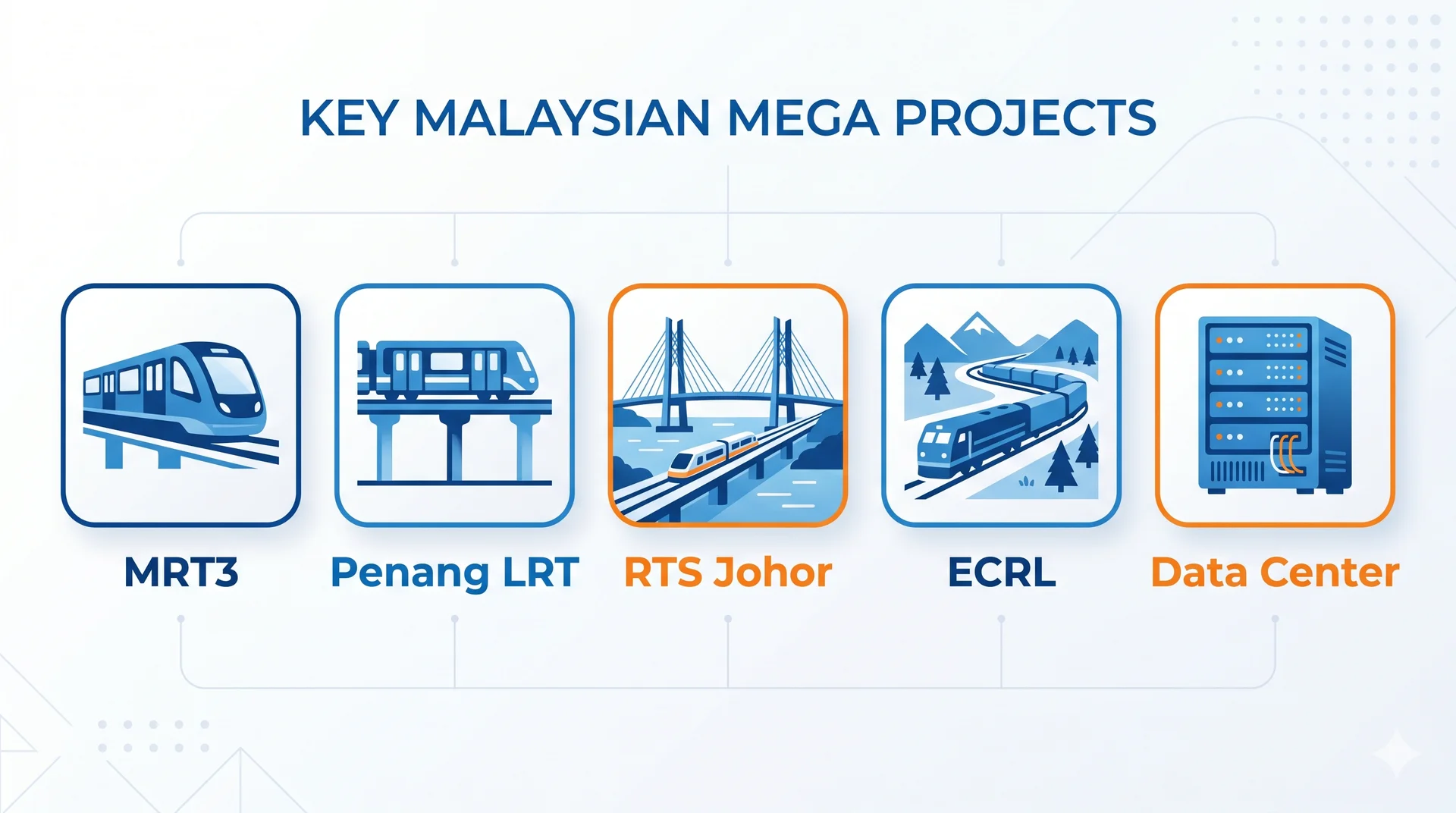
Bursa Malaysia Construction Sector Landscape
Below are the key players in Bursa's construction sector, broken down by tier based on size and track record:
Tier 1: The Big 3 (Mega Project Track Record)
Gamuda Berhad (5398) - Diversified: Construction + Property + Infrastructure (highway concessions) - Construction order book ~RM44 billion (largest in Malaysia, diversified across Australia, Taiwan, Singapore) - Frontrunner for MRT3 CMC303 (tunneling) via the Gamuda-MMC JV - Lead consortium SRS for the Penang LRT Mutiara civil package
IJM Corporation Berhad (3336) - Diversified: Construction + Property + Tolled Highway + Plantation + Industries - Currently in the process of being acquired by Sunway - see Sunway's RM11 Billion Bid for IJM - Post-merger, the combined entity is expected to become Malaysia's largest contractor with combined order book ~RM13 billion and combined market cap ~US$11.7 billion
Sunway Construction Group Berhad (5263) - Largest pure-play builder in Malaysia - Outstanding order book ~RM6.785 billion (company record high) - Bidding for PDP role in High-Speed Rail if revived
Tier 2: Mid-Cap Established
WCT Holdings Berhad (9679) - Construction + Property + Concessions (highway, airport) Malaysian Resources Corporation Berhad (MRCB, 1651) - Construction + Property + Engineering. Stock research: MRCB (1651) Kerjaya Prospek Group Berhad (7161) - Specialisation in private property contracts Mitrajaya Holdings Berhad (5085) - Government & private sector mix MMC Corporation Berhad - Conglomerate with ports, water utilities, construction (post-privatisation by JV) Ekovest Berhad (8877) - DUKE highway concession + construction. Stock research: Ekovest (8877)
Tier 3: Smaller-Cap Specialised
Gadang Holdings Berhad - Earthworks, civil engineering Mudajaya Group Berhad - Power plant + civil works TRC Synergy Berhad - Building + infrastructure Vizione Holdings Berhad - Government affordable housing HSL Bina Berhad - Sarawak-focused
Each player has a different risk-reward profile. Tier 1 has moats in technical expertise and track record - but is also more expensive and crowded from an investment standpoint. Tier 2-3 is more speculative but can have larger upside when major contracts land.
5 Cyclical Drivers of the Construction Sector
To understand when the construction cycle will recover, monitor these 5 drivers:
Driver #1: Government Project Pipeline & PDP Awards
- Project Delivery Partner (PDP) awards - government appoints PDPs for major infrastructure projects
- PDP is typically a consortium with mega project track record (Gamuda, IJM, Sunway, MRCB)
- When PDP is appointed, trickle-down occurs to sub-contractors and suppliers
Driver #2: Budget & 5-Year Plan
- The annual budget determines infrastructure allocation
- The 12th & 13th Malaysia Plans (2021-2025, 2026-2030) provide the roadmap of mega projects
- Foreign direct investment (FDI) can trigger new projects (data centres, JS-SEZ)
Driver #3: Cost of Inputs (Materials + Labour)
- Cost increases can squeeze margins on existing fixed-price contracts
- Stabilising costs = better margin outlook for new contracts
- Watch CIDB material cost index and monthly steel/cement prices
Driver #4: Funding Cost (OPR & Bond Yields)
- BNM Overnight Policy Rate (OPR) influences contractors' cost of debt
- Long-term government bond yields (10-yr MGS) determine infrastructure financing costs
- Lower OPR = projects more feasibly executable
Driver #5: Property & Real Estate Cycle
- Many contractors also have property segments (Gamuda, IJM, MRCB)
- A healthy property cycle = recurring orders for affiliated builders
- Residential housing demand drives demand for building contractors
6 Signal Indicators: When the Construction Cycle Recovers
Below are signal indicators worth monitoring to understand when a new upswing begins or strengthens:
Signal #1: CIDB Contract Awards Trending Up Monthly
- Track monthly CIDB contract award data
- Upward trend for 3-6 consecutive months = bullish indicator
- Downward trend = sector slowing
Signal #2: MRT3 Package Awards (End-2026 - Mid-2027)
- Each MRT3 package awarded = catalyst for the winner
- Even contractors that don't win can get spillover from sub-contracting
- Watch announcements from MRT Corp and the ministry
Signal #3: Penang LRT Mutiara Systems Contract
- Civil package already awarded to SRS (Gamuda)
- Systems package (rolling stock + signalling + electrical) is currently in tender process
- Systems contract award ~RM3-4 billion = major catalyst
Signal #4: Material Cost Stabilising/Declining
- Early indicator of sector recovery = stable building material costs
- When steel + cement + bitumen prices stabilise, contractors can lock in new margins
- Watch CIDB Material Cost Index monthly
Signal #5: Major Order Book Growth
- All-time high order book announcements from major players (Gamuda, Sunway Construction)
- This trend shows revenue visibility for 2-4 years ahead
- Investors can anticipate sector re-rating
Signal #6: Foreign Investment Commitments
- Major hyperscaler announcements (Microsoft, Google, Amazon, Meta) = more construction work
- JS-SEZ commitments from foreign companies = trickle-down to local builders
- Watch MIDA and Prime Minister's statements
Risks & Challenges Facing the Sector
Despite the large pipeline, important risks retail investors should understand:
1. Building Material Cost Inflation
The cost of 7 key building materials rose 12.59% according to CIDB data presented at MTEN. For full context, read Construction Costs Up 12.59%, 4,708 Layoffs: Economy Minister's Warning. This compresses margins on existing fixed-price contracts.
2. Labour Shortage
- The construction sector relies heavily on foreign workers (90%+ workforce in certain segments)
- Government foreign labour policies can affect capacity
- Labour costs are also rising
3. Project Delays
- MRT3 alone has been delayed 2-3 years from the original plan
- Penang LRT is taking longer than the original target
- Each delay = opportunity cost for contractors
4. Margin Compression
- Contractors who won at aggressive prices before pandemic + cost spike are now suffering
- Variation Orders (VO) are not always approved
- Fixed-price contracts without escalation clauses are exposed
5. Regulation & ESG Concerns
- Climate adaptation push requires green building standards
- Higher compliance costs for small contractors
- But for major players who adapt early, this can become a competitive advantage
Thinking Framework for Retail Investors (General)
Below is a general framework for retail investors approaching the construction sector - not a buy call, just a more disciplined way to think:
Focus #1: Understand Your Cycle Position
- Sector is recovering from the 2020-2022 trough
- The big pipeline hasn't fully landed (MRT3, several data centres)
- But the cost crisis has compressed margins
- This cycle is mid-cycle, not early or late
Focus #2: Diversify Across Tiers
Instead of one single name, consider a basket: - 2-3 names from Tier 1 for stability - 1-2 names from Tier 2 for upside potential - Tier 3 speculative only if you understand the risk profile
Focus #3: Watch Order Book Quality, Not Just Size
- An RM10 billion order book from recent contracts (post-2024 cost spike) is worth more than an RM10 billion legacy fixed-price order book
- Ask: when was the contract signed? Does it have escalation clauses?
Focus #4: Monitor Catalyst Events
- MRT3 package awards (key catalyst 2026-2027)
- Penang LRT systems contract
- Data centre mega awards
- Budget 2027 announcements (infrastructure allocation)
Focus #5: Realistic Holding Periods
- Construction cycle 3-5 years from trough to peak
- Short-term investors may be disappointed by volatility
- Long-term investors (3-5 years+) fit the sector profile better
Focus #6: Combine With Macro Awareness
The construction sector cannot be separated from macro: - BNM OPR direction - Inflation cycle - Government fiscal policy - Geopolitical (foreign investment flows)
FAQ: Common Questions About the Construction Sector
1. When will MRT3 actually start construction?
According to the official timeline, MRT3 construction will start CY2027 (after contract awards end-2026 to mid-2027), running through 2033. Land acquisition is targeted to complete by end-2026, with new tenders starting mid-2026.
2. What is the contract value of MRT3?
Estimated civil construction value is RM31 billion across 3 main packages. The most lucrative package is CMC303 (tunneling), estimated at RM14.29 billion.
3. After Sunway-IJM merger, who is Malaysia's largest contractor?
Post-merger, the combined Sunway+IJM will have an estimated market cap of US$11.7 billion - surpassing Gamuda (US$7.2 billion) as the largest contractor by market cap. Combined order book ~RM13 billion. But Gamuda still has the largest individual order book at RM44 billion.
4. Are construction stocks Shariah-compliant?
Most major contractors are Shariah-compliant: - Shariah-compliant: Gamuda, IJM, Sunway Construction, WCT, MRCB, Kerjaya Prospek, Ekovest - The list is reviewed every 6 months by the Securities Commission (SC)
5. Which construction stock is most cyclical?
Pure-play builders without diversification are most cyclical: - Sunway Construction (no property/concession buffer) - Mitrajaya, Vizione, smaller pure-play
Integrated players (Gamuda, IJM, MRCB) are more cushioned because they have property + concession segments providing recurring earnings.
6. What is the role of "PDP" in mega projects?
Project Delivery Partner (PDP) is a model where the government appoints a consortium to manage an entire mega project - from planning, procurement, construction management, to handover. The PDP is responsible for delivery on time + on budget. PDP fees are typically 6-8% of project value - lucrative for selected contractors.
7. Why is "data centre boom" relevant to the construction sector?
Data centres are building projects with high complexity - requiring civil works, electrical, mechanical, cooling systems, and security. Each hyperscale data centre is worth hundreds of millions to billions of ringgit. Microsoft + Google alone have committed over US$4 billion to Malaysia. For full context, read RM185 Billion Coming to Malaysia - Who Wins From the Data Centre Boom?.
8. How can retail investors track the construction sector?
Key sources: - CIDB Malaysia - contract data, industry statistics - MRT Corp - MRT3 and rail project updates - Bursa Malaysia announcements - contract announcements from each contractor - The Edge Malaysia, BernamaBiz - sector news - Analyst reports from MIDF, Maybank IB, Hong Leong, Kenanga, MBSB Research
Conclusion
Malaysia's construction sector is in a paradoxical but opportunity-rich phase: short-term cost pressures on one side, the largest mega project pipeline in a decade on the other. MRT3 alone will keep contractors busy through 2033, and with Penang LRT, RTS Johor-Singapore, ECRL completion, plus the data centre boom involving over US$4 billion in hyperscaler commitments - the structural foundation of this sector is strong for the coming decade. But timing and stock selection require careful cycle understanding.
For retail investors, the key message is discipline: monitor signal indicators (CIDB awards, mega project tender announcements, material cost stabilisation), diversify across tiers, and avoid concentration risk. Construction is a long-cycle sector - patience pays, haste hurts.
Before making any investment decision, ensure you have an active trading account and a strong grasp of investing fundamentals.
To start investing in Bursa Malaysia and overseas markets like the US and Hong Kong, you need a CDS account - register your CDS account with Mahersaham here.
For investing fundamentals including how to read financial statements, valuing cyclical companies, and thematic investment strategies, get our free stock investing basics ebook.
Further Reading
- Construction Costs Up 12.59%, 4,708 Layoffs: 3 Warnings From Malaysia's Economy Minister - Context on current sector cost pressures
- Sunway's RM11 Billion Bid for IJM: Full Chronology - Construction sector consolidation context
- RM185 Billion Coming to Malaysia - Who Wins From the Data Centre Boom? - The biggest construction catalyst
- Plantation Stocks: The CPO Price Cycle & When Investors Should Enter - Another cyclical sector framework
- Malaysian Resources Corporation (MRCB, 1651) - Deep stock research on a mid-cap construction player