Essential Things to Know About Bonus Issue

What Is a Bonus Issue?
Bonus issue is one type of corporate exercise.
It is the issuance of FREE shares to SHAREHOLDERS of the company, completely FREE OF CHARGE.
Did you notice I repeated the word "free" twice? That's to emphasise that this is a free share issuance. You don't need to buy anything.
Important Matters in a Bonus Issue
- 1. When is the ex-date?
- 2. What is the conversion ratio?
- 3. When will the shares be credited?
- 4. What are the advantages?
To understand this better, let's learn through a case study.
Our case study this time is the bonus issue carried out by Top Glove Corporation BHD.
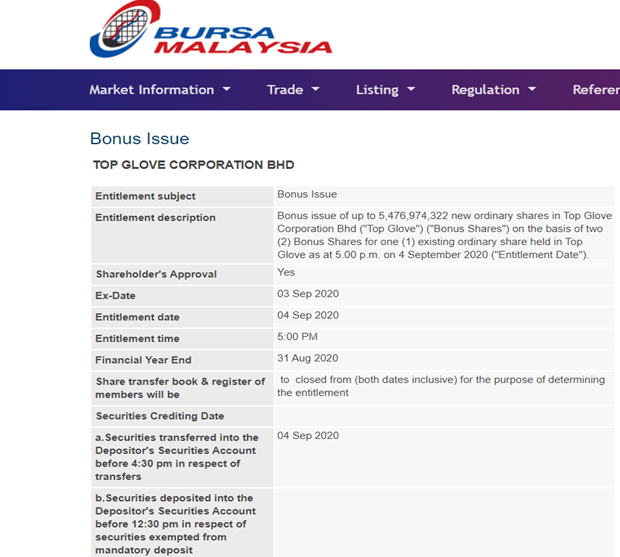
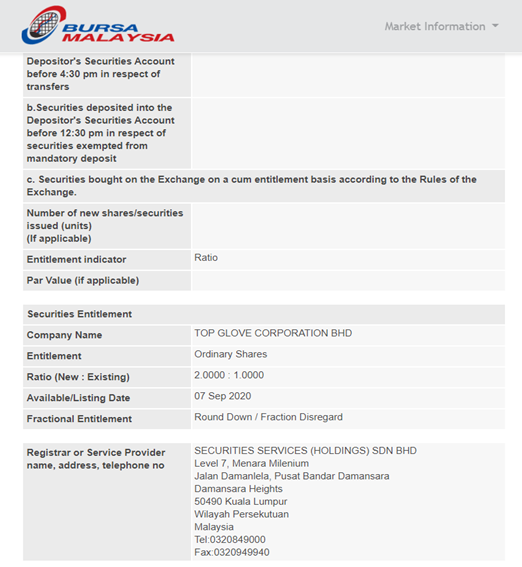
Based on the two diagrams above, what information can you gather?
When Is the Ex-Date?
What does the ex-date mean?

The ex-date is the last day of share count to qualify for the bonus issue.
Based on this case study, the ex-date is 3 September 2020.
So if you buy shares on or after 3 September, you will not be eligible to receive the bonus issue.
If you buy the shares on 2 September, you are indeed eligible for the bonus issue, but an adjusted price (price change) will occur.
For example, the day before the ex-date the share price was RM28 per unit, but after the ex-date the price dropped to RM9 per unit.
Some investors may not notice the announcement about the corporate exercise (bonus issue) and buy shares the day before the ex-date.
This could understandably affect the investor's emotions.
After all, you bought at a high price only to find the price much lower compared to your purchase price the next morning.
Whatever the case, before you buy any shares, make sure you have done your analysis and have your own trading plan.
What Is the Conversion Ratio?
What is a conversion ratio?
In simple terms, the conversion ratio is how many parts you will receive.
Let's refer back to the Bursa Malaysia announcement in the Top Glove case study.
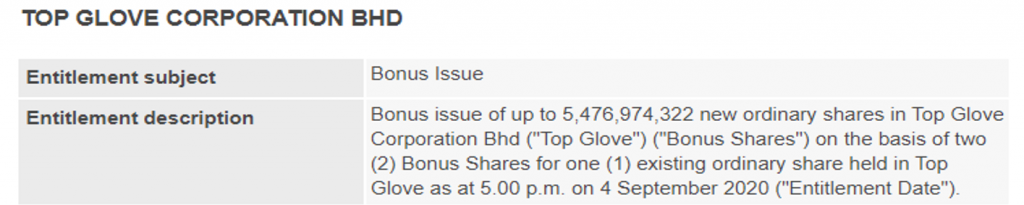
Based on the information in the diagram above, shareholders will receive two units of shares for every one unit of shares they hold.
Conversion ratio = (new:existing)
For example, Puan Taichy holds 1,000 units of Top Glove shares. When the bonus issue takes place with a conversion ratio of 2:1, Puan Taichy's new total share units will be 3,000 units.
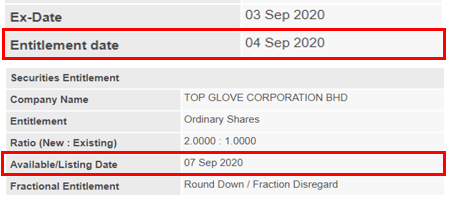
Based on the image above, there are two dates: 4 September and 7 September.
Which one do you think it is?
The answer is that on 4 September 2020, the shares will be transferred to your trading account, but they will be available for trading on 7 September 2020.
What Are the Advantages?
Your share units will naturally increase.
Have you ever wondered why companies carry out bonus issues? Why give away shares for free?

The actual purpose of a bonus issue is to lower the share price so it becomes more affordable.
In the Top Glove case study, the price per unit of Top Glove shares before the corporate exercise (bonus issue) was RM28.00.
After the corporate exercise (bonus issue), the price per unit became RM9.00 on 3 September 2020.
Why lower the price? Because the company wants ordinary people like us to be able to afford to buy their shares.
Simply put, it is to encourage more people to buy their shares.
Profit or Loss?
I know you have been wondering about this.
Is a bonus issue profitable? Or does it cause you to lose money?
If you buy shares the day before the ex-date, you will indeed incur a loss because an adjusted price will take effect.
As discussed in the case study above, before the ex-date the price per unit of Top Glove shares was RM28.00.
After the ex-date, the price per unit became RM9.00.
However, it is advantageous for investors who hold shares in a company with a mid-term to long-term target.
Before I end this article, I have one question for you.
Are you buying shares as a trader or an investor?
That is a question for you to ponder. Until we meet again in the next article.
Hope this was helpful!
Want to learn about shares? Want to know more?
But don't know where to start?
Don't worry, download the FREE Mahersaham ebook now!
Check out the video we have prepared.
Hope this was helpful!
Frequently Asked Questions (FAQ)
What is a bonus issue in the stock market?
A bonus issue is a corporate exercise where a company gives free shares to its existing shareholders. You do not need to pay anything to receive these additional shares. The number of bonus shares you receive depends on the conversion ratio set by the company.
Does a bonus issue change the value of my investment?
No, a bonus issue does not change the total value of your investment. Whilst you receive more share units, the price per unit is adjusted downward proportionally. For example, if the share price was RM28 before the bonus issue, it may be adjusted to RM9 per unit after accounting for the new shares issued.
What is the ex-date for a bonus issue and why is it important?
The ex-date is the cut-off date set by Bursa Malaysia. You must own the shares before the ex-date to be eligible for the bonus issue. If you buy shares on or after the ex-date, you will not receive the bonus shares. Be aware that the share price will be adjusted (reduced) on the ex-date.
How do I calculate my new shares after a bonus issue?
Use the conversion ratio (new:existing) announced by the company. For example, with a 2:1 ratio, you receive 2 new shares for every 1 share you hold. So if you hold 1,000 units, your new total would be 3,000 units (1,000 original + 2,000 bonus shares).
Want to start investing in shares on Bursa Malaysia? Register a CDS account with Mahersaham and get access to exclusive classes for our clients.
New to shares? Download the free basic shares ebook to take your first step.