US Plans to Restrict Chinese Optical Transceivers - Can NATGATE and INARI Benefit?

News out of Washington is shaking up the global technology supply chain, and this time Malaysia sits on the winning side of the table. The US Federal Communications Commission (FCC) is reportedly drafting restrictions on Chinese-made optical transceivers, a critical component inside AI data centres. According to M+ Global's market note dated 6 August 2026, the move is expected to further accelerate the "China+1" supply chain shift towards Malaysian tech players, with NATGATE and INARI named among the key beneficiaries.
In this article, we break down what is actually happening, why this tiny component matters so much to AI infrastructure, and what it means for investors on Bursa Malaysia and Wall Street.
What Happened: FCC Drafts Restrictions on Chinese Optical Transceivers
According to a Reuters report cited by Tom's Hardware, the FCC is drafting rules to bar imports of new models of Chinese optical transceivers over concerns of data theft, malware and service disruption at AI data centres. The proposal is expected to be published this year and could take effect before the end of 2026, although the FCC could still modify or shelve it.
The scale of the impact is significant. Zhongji Innolight, the largest Chinese producer, is estimated to control around 27% of the global data centre transceiver market, and the company was added to the Pentagon's list of Chinese military-linked companies in June. Analysis by TechTimes estimates a full ban could remove up to 60% of AI data centre module supply from the US market - a huge gap that alternative producers will need to fill.
What Is an Optical Transceiver and Why Is It Critical for AI?
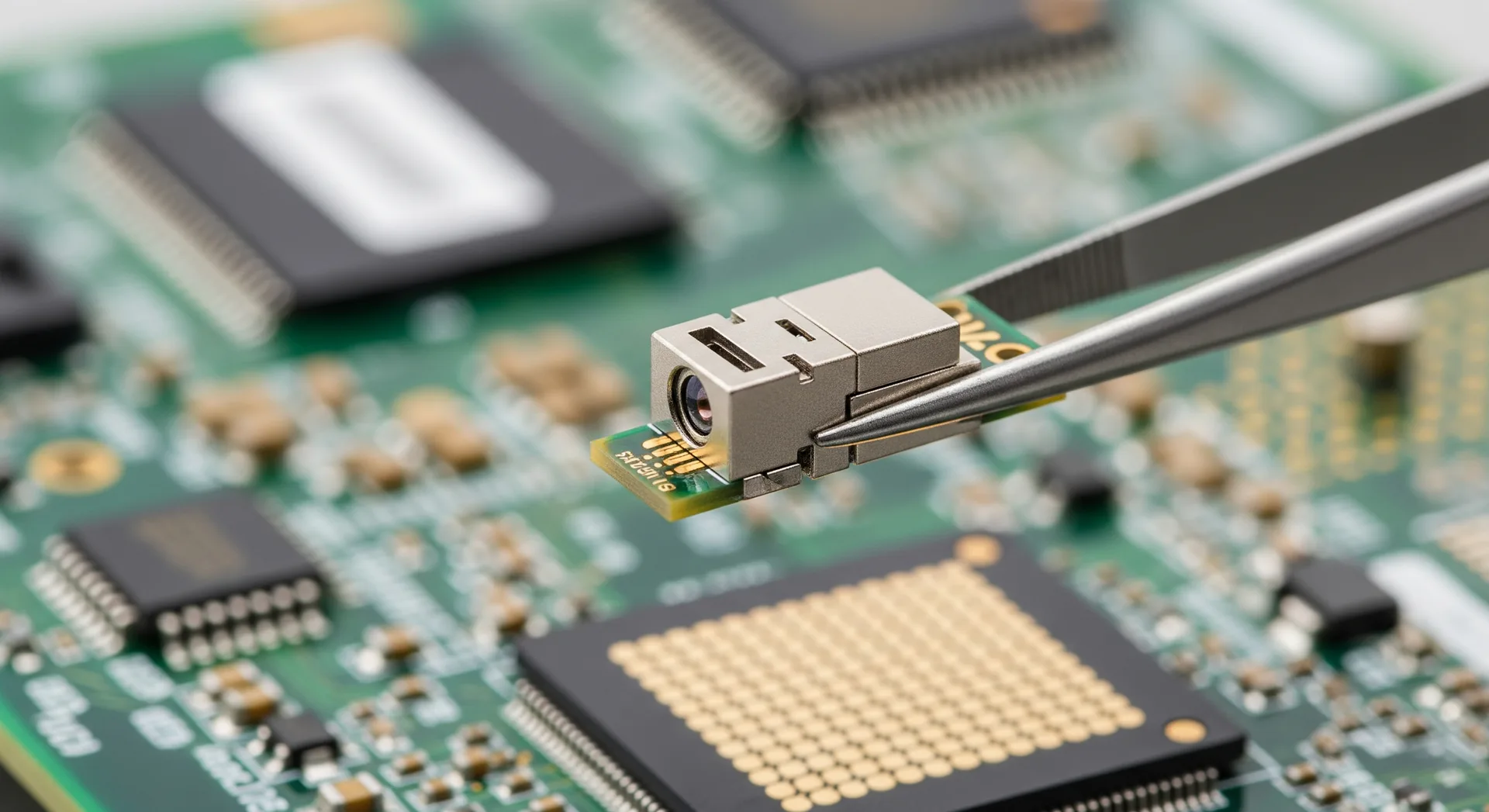
An optical transceiver is a small device that converts electrical signals into light signals (and back) so data can travel at very high speeds through fibre-optic cables. Inside an AI data centre, thousands of GPU chips need to "talk" to each other constantly - and optical transceivers are the nervous system making that possible.
The bigger the AI model, the higher the bandwidth requirement. That is why demand for high-speed transceivers (800G and above) has exploded alongside the massive AI infrastructure investments by Microsoft, Google, Meta and Amazon. Whoever controls the supply of this component controls the pulse of AI data centre construction.
The Impact on the Global Supply Chain
The restriction is not without complications for the US itself. The Western producers viewed as the main replacements, Coherent and Lumentum, still depend on indium phosphide from China - a key raw material that Beijing placed under export controls in 2025. In other words, both superpowers remain locked in the same interdependent supply chain, as detailed by Caixin Global.
Markets have already reacted. Shares of US optical companies such as Coherent, Lumentum and Applied Optoelectronics jumped more than 10% after the report surfaced. But behind that rally lies a practical question: manufacturing capacity. Non-Chinese producers need to scale up fast, and that is where Malaysia enters the picture.
Not the First Episode: The Pattern of US-China Tech Restrictions
This transceiver restriction continues a pattern that has been running for nearly a decade. It started with the Huawei and ZTE telecom equipment bans through the FCC's "Covered List", followed by hundreds of Chinese companies entering the US Commerce Department's Entity List, then the advanced chip and lithography equipment export controls of 2022-2023 - each round of restrictions pushed global companies to reorganise their supply chains.
What matters for Malaysian investors: every one of those rounds consistently benefited alternative destinations such as Malaysia, Vietnam and India. Penang recorded record foreign direct investment inflows after the chip export control wave, with big names like Intel, Infineon and Micron expanding operations. Malaysia is now estimated to handle around 13% of global chip assembly, testing and packaging activity - a position that makes it a natural beneficiary every time orders shift out of China.
The difference this time is that the restriction targets optical components specifically for AI data centres - the fastest-growing segment in the entire semiconductor industry. The size of the opportunity, if the rules are finalised, is potentially larger than in previous rounds.
China+1: Why Malaysia Stands to Benefit
The "China+1" strategy refers to multinational companies diversifying their manufacturing footprint outside China to reduce geopolitical risk. Malaysia, with its mature semiconductor ecosystem in Penang and Kulim, has long been a preferred destination for that shift.
According to Focus Malaysia, the proposed transceiver restrictions are expected to directly benefit Malaysian tech supply chain players as US customers accelerate the migration of orders out of China. The two names analysts mention most often are NATGATE and INARI - both with direct relationships to the US tech giants set to fill the supply gap.
NATGATE: Coherent's Manufacturing Partner
According to M+ Global, NationGate Holdings Berhad (NATGATE) is expected to capture higher order volumes given its deep manufacturing relationship with Coherent, the US optical networking giant. NationGate supports its customer's China+1 expansion plan through a "factory-within-a-factory" setup in Malaysia, enabling high-speed optical transceivers to be produced locally.
If the FCC restrictions are finalised and Coherent's orders rise, NationGate's factory capacity utilisation could climb significantly. That is the logic behind analysts' positive view on the counter - it is not pure thematic speculation, but grounded in an existing customer relationship that is already running.
INARI: A Close Partnership With Broadcom
Inari Amertron Berhad (INARI) is expected to secure increased chip-packaging demand through its close partnership with Broadcom as global tech giants re-route orders away from China. Inari has long been Broadcom's key OSAT (outsourced semiconductor assembly and test) partner in Malaysia, particularly for radio frequency (RF) components.
With Broadcom itself a major player in custom AI chips for hyperscaler customers, any increase in Broadcom's volumes could trickle down to Inari. For investors who have been watching the local semiconductor sector, this narrative completes the recovery cycle awaited since the 2024-2025 slowdown.
Wall Street: Profit-Taking After Record Highs
Turning to the US market, M+ Global expects Wall Street to see further profit-taking in the near term following recent all-time-high rallies, before resuming its upward momentum. This is a healthy pattern - a market that climbs endlessly without consolidation is usually the riskier one.
The market's main support currently comes from AI earnings outperformance, which is driving a recovery in chip and AI-related counters. We previously covered the structural risks in the US market in our article on 7 charts revealing the real risks in the US stock market - useful context before weighing any of the US stock ideas below.
For retail investors, a "mixed sentiment" phase like this calls for patience, not panic. Profit-taking after a major rally is the market's natural mechanism - institutions lock in gains, prices pull back slightly, and fresh capital gets a chance to enter at more reasonable levels. The common mistake is selling in fear during the dip, then chasing back in at higher prices once momentum returns. A more productive focus: list the quality counters you genuinely want to own, and set the price levels where you are comfortable adding.
Marvell Technology (MRVL): Riding Custom AI ASIC Demand
Among M+ Global's picks in the US market is Marvell Technology (MRVL). The Group benefits from strong custom AI ASIC demand and accelerating high-speed data centre optical interconnect orders - the same theme driving the entire optical sector right now.
Interestingly, Marvell's position intersects with the transceiver narrative above: the company develops optical interconnect technology (including DSPs for 800G transceivers) that forms the networking backbone inside AI data centres. If hyperscaler capital spending stays elevated and supply shifts to non-Chinese producers, demand for Marvell's technology rises with it.
The macro context is supportive too: cloud giants such as Microsoft, Alphabet, Amazon and Meta collectively spend hundreds of billions of dollars a year on AI infrastructure, and a large share of that spending flows into custom chips and data centre networking - Marvell's two core segments. As long as this AI spending cycle holds, structural demand for the company's products remains intact.
Logitech (LOGI): Higher Margins on Premium Products
M+ Global's second US pick is Logitech International S.A. (LOGI). The Group anticipates higher margins moving forward following the launch of premium products such as the MX Master 4 mouse and the PRO X2 SUPERSTRIKE gaming mouse, both of which have rapidly become top-selling products.
The latest numbers back the narrative. In its second quarter fiscal 2026 results, Logitech's Pointing Devices revenue rose 16% year on year to USD227.3 million while Gaming climbed 12% to USD354.2 million, with non-GAAP EPS jumping 21% to USD1.45 - beating analyst expectations. The premium product strategy is clearly lifting average selling values rather than relying on volume alone.
What Does It Mean for Malaysian Investors?
A few important points before acting on this news:
- The FCC proposal is not final. The rules are still in draft form and could be amended or withdrawn. Any delay or carve-out could soften this theme for a while.
- The earnings impact takes time. Order migration from China to Malaysia does not happen in a single quarter. New orders must go through qualification, ramp-up and capacity expansion.
- Prices may have moved first. The China+1 theme is not new - part of the expectation may already be priced in. Buy on fundamentals and valuation, not FOMO.
- Risk of Chinese retaliation. Beijing has said it will respond if necessary, including via export controls on raw materials such as indium phosphide that could disrupt the entire industry.
This note is for information sharing and is not investment advice. Always do your own research and make sure any decision fits your risk profile.
FAQ
What is an optical transceiver?
A device that converts electrical signals into light signals and back, enabling high-speed data transmission through fibre-optic cables. It is an essential component in AI data centres, connecting thousands of GPU chips.
When will the FCC restrictions take effect?
The proposal is expected to be published in 2026 and could take effect before year-end, but it remains a draft. The FCC could amend, delay or abandon the rules.
Why is NATGATE seen as a beneficiary?
NationGate has a deep manufacturing relationship with Coherent, one of the US optical transceiver producers expected to fill the supply gap if Chinese products are restricted. Higher Coherent orders could lift NationGate's manufacturing volumes and capacity utilisation.
How is INARI connected to this theme?
Inari Amertron is Broadcom's key semiconductor assembly and test (OSAT) partner in Malaysia. As global tech giants re-route orders away from China, chip-packaging demand flowing to Inari is expected to increase.
Is this guaranteed to benefit Malaysian tech stocks?
No. The actual impact depends on the final form of the rules, the speed of order migration, and Malaysian companies' ability to add capacity. Part of the expectation may also already be priced in.
What is profit-taking and should I worry?
Profit-taking is when investors sell part of their holdings to lock in gains after a strong run-up. It is normal after record rallies and usually temporary. As long as company fundamentals and the core theme are unchanged, a short-term pullback is not a reason to panic.
How can I buy US stocks like MRVL from Malaysia?
You can buy US stocks directly through local broker platforms such as M+ Global using the same CDS account. We show the process in our article on selling US stocks in the M+ Global app.
Conclusion
The proposed FCC restrictions on Chinese optical transceivers could become a fresh catalyst for the China+1 theme, with NATGATE and INARI strategically positioned through their relationships with Coherent and Broadcom. In the US, near-term profit-taking is expected after the record rally, with Marvell and Logitech remaining M+ Global's picks. As always, big themes need to be matched with fundamentals and proper risk management.
If you want to capture technology themes like this one, the first step is making sure you have access to the right markets.
Open a CDS account to invest in Bursa Malaysia as well as foreign stocks such as US and Hong Kong markets on a single platform.
Download the Stock Market Basics Ebook for free to master the fundamentals before you start investing.