The Fed Meets This Week: What Bursa Malaysia Investors Should Watch

This week, the eyes of global investors are fixed on a single event: the US Federal Reserve's Federal Open Market Committee (FOMC) meeting on 16-17 June 2026. For the first time, this crucial policy meeting is chaired by Kevin Warsh, after Jerome Powell's term ended in May 2026. Although it unfolds thousands of kilometres from Kuala Lumpur, the Fed's decision can shake the ringgit, foreign fund flows, and share prices on Bursa Malaysia within hours.
Financial markets are now pricing a near 99% probability that the Fed will hold its benchmark rate at the current 3.50%-3.75%, according to CME FedWatch data. So if the rate itself is not the surprise, what should Malaysian investors actually watch? The answer: not the rate, but the signal the Fed sends about where interest rates are heading for the rest of 2026. This article explains what is happening, why it matters for your portfolio, and the practical steps you can take.
What Happens at the Fed Meeting This Week
This June FOMC meeting is special because it is an "SEP" (Summary of Economic Projections) meeting. That means, besides the rate decision, the Fed will also release the "dot plot" - a chart showing each committee member's expectation of where rates will go. This is the document investors scrutinise most, because it hints at whether the Fed leans toward cutting, holding, or even raising rates in the second half of the year.
The backdrop is not simple. US headline inflation remained elevated at 4.2% year-on-year in May 2026, largely driven by energy-price pressure following the war in West Asia and the surge in crude oil prices. At the same time, the US labour market is still firm, with unemployment around 4.3%. This combination of stubborn inflation and a resilient economy is exactly why most economists expect the Fed to stay "higher for longer" - keeping rates elevated for an extended period - while a small slice of the market even prices in the possibility of a hike.
For Warsh, who is known for a more hawkish tone (inclined to tighten policy to fight inflation), his first announcement as Chair will be closely examined. Every word in the FOMC statement and the post-meeting press conference can move currency and equity markets worldwide, including Bursa Malaysia.
Why the Fed's Decision Matters for Bursa Malaysia Investors
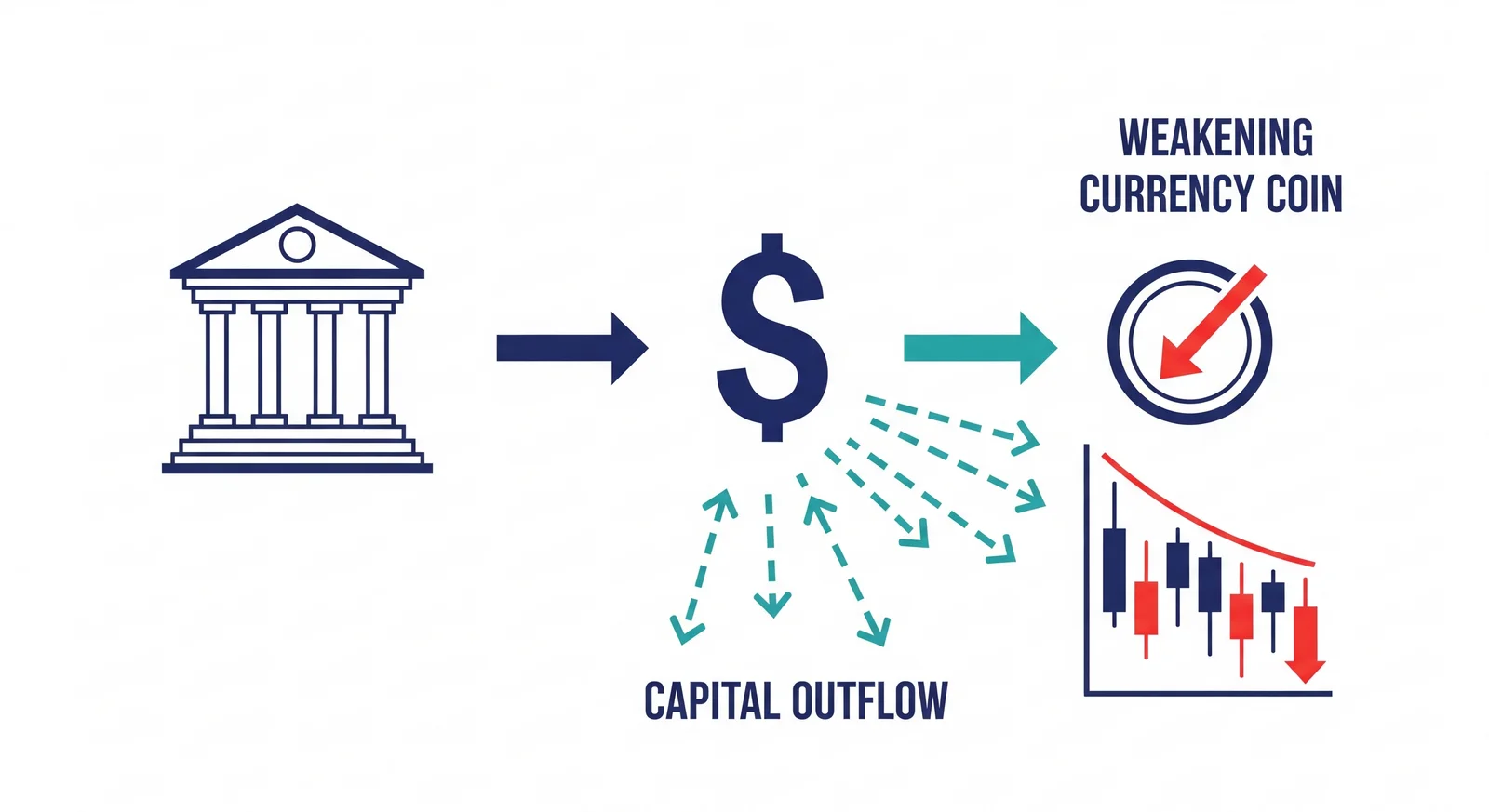
Put simply: the Fed sets the "price of money" for the world's largest economy, and the US dollar is the global reserve currency. When US rates are high, dollar assets (such as US government bonds) offer attractive returns with little risk. This pulls capital out of emerging markets like Malaysia and back into the US. The effect is a chain reaction: the dollar strengthens, the ringgit comes under pressure, and foreign funds tend to sell shares on Bursa.
Conversely, if the Fed signals a dovish stance (inclined to cut rates), the flow usually reverses - the ringgit strengthens and foreign funds return to hunt for Malaysian assets considered "cheap". This is why KLCI moves on the day after an FOMC decision often have nothing to do with the performance of local companies, but everything to do with the Fed's tone.
First Effect: The Ringgit Against the US Dollar
The ringgit is the first variable to react. Heading into this meeting, the ringgit traded around RM4.05 to the US dollar, after stronger-than-expected US inflation data reinforced expectations that the Fed would stay restrictive. In early June, the ringgit also weakened after strong US jobs data dimmed hopes of a rate cut.
Why does this matter? For investors holding export stocks (such as glove makers, semiconductors, and palm oil companies), a weak ringgit can actually help earnings because dollar sales convert into more ringgit. But for companies that import a lot of raw materials or carry dollar-denominated debt, a weak ringgit raises costs. So the Fed's decision is not just macroeconomic news - it affects the real profits of companies in your portfolio.
The good news is that the ringgit does not move in a vacuum. Bank Negara Malaysia stressed that the ringgit is supported by strong domestic fundamentals and reform momentum, so the pressure from the Fed may not be as severe as for other emerging markets with weaker fundamentals.
Second Effect: Foreign Fund Flows into Bursa
Foreign institutional funds hold a significant portion of large-cap stocks on Bursa Malaysia. When the Fed stays restrictive, these funds often go "risk-off" - pulling capital out of emerging markets into safe dollar assets. This is the pattern frequently seen in weekly fund-flow data: foreign funds sell, while local institutions such as the EPF and PNB absorb the selling.
Retail investors can use this data as a sentiment signal. If foreign funds keep selling heavily after the Fed decision, it points to short-term pressure on large-cap (blue chip) stocks in the KLCI. Understanding how to read foreign fund flows on Bursa can help you distinguish between a temporary technical sell-off and genuine fundamental weakness.
One counterbalancing factor: Malaysia is currently attracting renewed interest amid several regional issues, and the return of funds to ASEAN could soften the Fed's negative impact. The net move depends on the tug-of-war between these two forces.
Third Effect: Which Sectors Win, Which Lose
Not all stocks react the same way to a Fed decision. Here is a quick breakdown:
- Export stocks (semiconductors, gloves, palm oil) - tend to benefit when the ringgit is weak because dollar earnings convert into more ringgit. But they are also sensitive to global demand, which may slow if high rates restrain the world economy.
- Banks - complex. High rates can support net interest margins, but banks are also among the most foreign-owned stocks, so they are exposed to selling when funds exit.
- REITs (real estate investment trusts) - usually weak when global rates are high, because REIT dividend yields become less attractive than bonds offering higher returns.
- Growth tech stocks - the most sensitive. Growth valuations rely on future earnings, which become less valuable when the discount rate (interest rate) is high. History shows small-cap stocks tend to surge when rates start to fall - so a dovish signal from the Fed could be a catalyst.
- Dividend and defensive stocks (utilities, telcos, consumer) - more stable during uncertainty, and a favourite of investors who want to "shelter" while awaiting policy clarity.
The Malaysian Context: OPR, GDP & Fundamentals
It is important to remember that Malaysia has its own monetary policy. Bank Negara maintained the Overnight Policy Rate (OPR) at 2.75% to balance growth and inflation. The gap between the Fed's rate (3.50%-3.75%) and the OPR (2.75%) is one reason the ringgit is under pressure - money tends to flow to where it earns a higher rate.
Still, the Malaysian economy remains solid. Gross Domestic Product (GDP) grew 5.4% in the first quarter of 2026, supported by household spending, investment activity, and resilient electrical & electronics (E&E) exports - though this is a moderation from 6.2% in the final quarter of 2025. These healthy fundamentals give Bursa Malaysia a "shield" relative to weaker regional markets.
"Higher for Longer" and the Shadow of Oil Prices
One key reason the Fed is hesitant to cut rates is energy inflation. The war in West Asia and uncertainty around the Strait of Hormuz have pushed crude oil prices far higher than many governments originally assumed. High oil prices lift US inflation, which in turn forces the Fed to stay restrictive - and this puts indirect pressure on the ringgit and foreign funds on Bursa.
For Malaysia, the situation is double-edged. As an energy exporter, high oil prices benefit Petronas and local oil & gas companies. But as a country that still subsidises fuel, it adds fiscal pressure. For investors, understanding that "a hawkish Fed" and "high oil prices" often arrive together helps you anticipate market moves more accurately.
Two Scenarios: Hawkish vs Dovish Market Reaction
Since the rate is expected to hold, Bursa's actual reaction depends on the tone the Fed delivers. Here are two scenarios investors can anticipate:
Hawkish scenario (tight tone): If the dot plot shows FOMC members expecting rates to stay high for longer, or even hinting at a hike, the US dollar will likely strengthen. As a result, the ringgit could weaken past RM4.05, foreign funds tend to sell large-cap stocks, and the KLCI may come under short-term pressure. Rate-sensitive sectors such as REITs and growth tech usually suffer most, while dollar-oriented export stocks may hold up better.
Dovish scenario (soft tone): If the Fed hints that inflation is easing and opens room for rate cuts later this year, the dollar will likely weaken. This is usually positive for the ringgit, encouraging foreign funds back into emerging markets and supporting a KLCI rise. In this scenario, small-cap stocks and growth sectors are often the biggest beneficiaries as borrowing costs are expected to fall.
In reality, the actual reaction usually lands somewhere between these two scenarios, and can shift within days as investors reinterpret the data. That is why reacting impulsively on announcement day often costs retail investors.
What Investors Should Do Now
First, do not trade based on predicting the Fed's decision. Since the probability of a hold is near 99%, the real surprise (if any) comes from the tone and the dot plot - something hard to predict even for professionals. Trying to "guess" the market direction before the announcement is closer to gambling than investing.
Second, focus on companies, not macro. Post-FOMC moves are usually temporary. Companies with strong balance sheets, low debt, and stable cash flow will recover from short-term shocks. Volatility after the Fed sometimes creates opportunities to buy quality stocks at a discount.
Third, diversify and keep cash reserves. Global policy uncertainty is a strong reason not to put all your capital into a single sector. Understanding how ringgit movements affect Bursa investors and the key factors that move the ringgit will help you stay calm when shocking news strikes.
Frequently Asked Questions (FAQ)
When will the Fed decision be announced?
The FOMC meeting runs 16-17 June 2026. The rate decision is usually announced on the second day (17 June) in the US afternoon, which corresponds to the early morning of 18 June Malaysian time.
Is the Fed expected to cut rates this time?
No. Markets price a near 99% probability the Fed will hold its rate at 3.50%-3.75%. The real focus is the "dot plot" showing rate expectations for the rest of 2026.
Why does the Fed's decision affect the ringgit?
High US rates make dollar assets more attractive, pulling capital out of emerging markets like Malaysia. This strengthens the dollar and pressures the ringgit. The gap between the Fed's rate and Malaysia's OPR (2.75%) adds to this pressure.
Who is Kevin Warsh and why does he matter?
Kevin Warsh is the new Chair of the Federal Reserve, replacing Jerome Powell whose term ended in May 2026. He is known for a more hawkish tone, so markets scrutinise his first announcement for clues on policy direction.
Which sectors are most affected by a Fed decision?
Growth tech stocks and REITs are most sensitive to high rates, while export stocks can benefit from a weak ringgit. Banks are complex because they are exposed to foreign fund flows even though net interest margins may improve.
Should I sell stocks before the Fed decision?
Selling purely out of fear of the Fed decision is rarely a good strategy, because the market reaction is hard to predict and often temporary. It is better to focus on company quality and your long-term investment horizon.
How does a strong Malaysian economy help Bursa?
Malaysia's GDP grew 5.4% in the first quarter of 2026 and the ringgit is supported by domestic fundamentals. This gives Bursa Malaysia a relative "shield" compared with other emerging markets that are more exposed to pressure from the Fed.
Conclusion
The Fed meeting this week may not change the interest rate, but the tone and the dot plot under new Chair Kevin Warsh could set the direction of the ringgit, foreign fund flows, and Bursa Malaysia sentiment for the coming weeks. Smart investors do not try to predict this decision, but instead understand its chain of effects and stay disciplined on their long-term strategy.
If you are just starting to invest and want to capitalise on every opportunity that emerges from market volatility like this, the first step is to own the right investment account.
Open a CDS account with Mahersaham to start investing on Bursa Malaysia as well as foreign markets such as the US and Hong Kong, so your portfolio is better diversified across markets.
You can also download our free stock market basics ebook to understand the key concepts before you invest.
Further Reading
- A Falling Ringgit - What It Means for Bursa Malaysia Investors
- Foreign Fund Flow: How to Read Foreign Fund Data to Predict Bursa's Direction
- Bank Indonesia's Surprise Rate Hike to 5.5% - Impact for Malaysian & ASEAN Investors
- What Happens to Small-Cap Stocks When Interest Rates Fall?
- 3 Key Factors That Move the Malaysian Ringgit