Financial Planner for High Net Worth Clients in Malaysia

Most people nowadays are becoming increasingly financially literate. Some may not know this, but in the financial industry in Malaysia, there is a licence called RFP/Shariah RFP. RFP stands for Registered Financial Planner. Shariah RFP is the same as RFP — both are financial advisers. It is a branch you can pursue if you are interested in becoming a financial adviser for others.
.
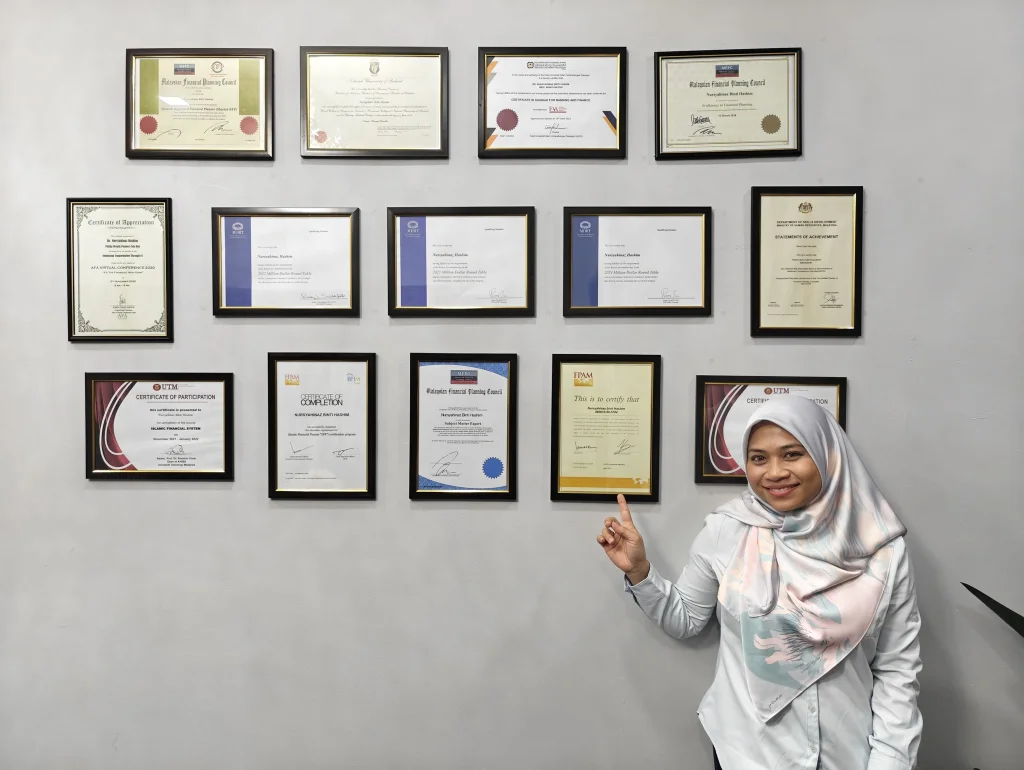
I met with a financial planner the other day. I had been planning to meet her for quite some time, but hadn't had the opportunity until then. Finally, I managed to visit her at her office. She and her husband welcomed me into the office. Upon entering, I could already see client testimonials displayed on the walls.
.
From our conversation, I learnt that her clients nowadays come entirely through referrals. She no longer needs to actively seek new clients — her existing clients recommend her to their friends and acquaintances.
.
It is certainly true that in the financial industry, referrals work extremely well — other people help promote your services, your client base grows, and your income increases. However, if your reputation suffers or there are negative stories about your company, all those clients can disappear in the blink of an eye and may switch to someone else.
.
So, that is one of the risks that people in the financial industry must manage — maintaining a good reputation.
.
When I asked about the demographics of her clients, the majority are indeed Malay. However, she also has Chinese and Indian clients. On top of that, she made it clear from the start that all products taken through her must be Shariah-compliant, such as takaful. So, her clients must comply with this — if not, they cannot engage her financial planning services. She mentioned that this is a form of dakwah (Islamic outreach) on her part.
.
Yes. As I mentioned earlier, even Chinese and Indian clients who engage her financial planning services are required to take takaful as well. Despite having to take takaful, they do not mind at all because they receive excellent service.
.
It is truly inspiring that through her career as a financial planner, her husband also works alongside her to manage the business where needed. Now, she has several staff members whom she is training. Perhaps in the future, they will become financial planners just like her.
.
Next, I looked around her office and noticed various certificates displayed on the walls. Among them, she has received the MDRT award for several consecutive years. MDRT stands for 'Million Dollar Round Table'. Earning this qualification is no easy feat.
.
One thing I only just learnt is that I had thought MDRT was only for takaful or insurance agents who sell large volumes of takaful/insurance. However, for a Financial Planner, the award is given based on income from all branches of financial planning services, not just takaful alone.
.
While we were deep in conversation, I also asked about zakat (Islamic tithe) money.
.
From what I understand, people pay zakat to save on tax. The zakat money is then returned as though it were a 'cashback', but it is actually not a cashback. That money is actually a 'wakalah' (delegation) of zakat funds to be distributed to asnaf (eligible recipients).
.
People misunderstand this — they think that after receiving the wakalah of zakat money, they can keep it. That is why they do not distribute the wakalah funds to the rightful asnaf. So, she said straight away that this is essentially dishonest, untrustworthy, and deceitful.
.
The actual function of wakalah is to widen the distribution of zakat funds so that more asnaf can receive zakat. Sometimes, the existing list does not cover all areas. So, by delegating (wakalah) the zakat money, more asnaf can benefit from it.
.

She added that we pay zakat at 2.5% as a religious obligation and to grow our wealth with blessings. However, if you pay more, you can earn extra reward (pahala), and at the same time, receive a tax rebate to reduce your tax payment. But once you have paid extra, you must treat that money as zakat funds even if the wakalah is returned to you.
.
In managing her clients' finances, when a client needs to pay zakat, she already has specific channels to distribute zakat effectively.
.
Besides that, she also takes her staff on overseas holidays. I think her staff are quite fortunate to get overseas trips. I myself have not yet been able to take my staff on an overseas holiday together.
.
I was also curious to know a little about what wealthy people commonly do that can serve as good examples. As it happens, I had recently watched a video promoting overseas property purchases. So, I asked her about it.
.
She explained that her clients can be divided into several categories. T20 clients rarely purchase overseas property. Typically, it is the Ultra High Net Worth clients — those with assets exceeding RM5 million — who buy overseas property and even have a 'family office' and so on.
.
A 'family office' refers to a company established by Ultra High Net Worth individuals to manage their assets, including investments.
.
So, it is different from a regular financial adviser. A family office is exclusively for people who are truly wealthy.
For the category between T20 and Ultra High Net Worth — those in the middle — they may have a net worth of around RM3 to RM5 million. Below that, they are still considered T20.
.
Here, we can see that careers in the financial industry are broad and varied. Examples of careers in the financial industry include remisiers and financial planners. Every role that exists in the financial sector has its own responsibilities.
.
The work of a remisier focuses more on the stock market. So, as a remisier, I need to stay focused on my scope of work. A Financial Planner, on the other hand, is responsible for doing financial planning work. Those of us in the financial industry should help one another.
.
One of the reasons she invited me to her office was to leverage my expertise in stock market investment for her clients. Under the standard scope of a financial adviser, they can indeed advise on stocks. However, it is better to hand that matter over to someone with more expertise — and that is the better approach.
.
So, let us look forward to the collaboration between us in the future.
Frequently Asked Questions (FAQ)
What is a Financial Planner and how is it different from a remisier?
A Financial Planner or financial adviser is responsible for planning a client's overall finances including insurance, zakat, tax and investments. A remisier, on the other hand, focuses more on the stock market. Both professions complement each other in the financial industry.
What qualifications are needed to become a Financial Planner in Malaysia?
In Malaysia, a Financial Planner needs to hold an RFP (Registered Financial Planner) or Shariah RFP licence. This licence is recognised by the authorities and demonstrates professional qualifications in the field of financial planning.
What is a family office and who needs one?
A family office is a company established by Ultra High Net Worth individuals (with assets exceeding RM5 million) to manage their assets and investments. It differs from regular financial advisory services as it is exclusively for the very wealthy.
How do I start learning about stock investing?
The first step is to open a CDS account and start learning the basics of stock investing. You can get a free guide through the stock basics ebook to understand key concepts before you begin investing.
Further Reading
- Types of Funds Managed by Fund Managers
- Complete Guide to Corporate Exercises on Bursa Malaysia
- What Is the Value and ROI of Happiness for Our Money
Interested in starting your stock market investment journey? Open a CDS account with Mahersaham today and receive direct investment guidance.
New to the stock market? Download our free stock basics ebook to understand investment concepts from the ground up.