Growth vs Value Stocks: Which Strategy Suits Your Portfolio?

Every investor has heard this debate: growth stocks or value stocks - which is better? Some swear by growth stocks for their explosive upside potential. Others stick firmly with value stocks for their cheap prices and built-in margin of safety.
The real answer? Both can generate excellent returns - depending on market conditions, your investment horizon, and risk tolerance. This article breaks down the real differences between growth and value stocks, presents actual performance data from global and Bursa Malaysia markets, and helps you determine which strategy suits you best.
What Are Growth Stocks?
Growth stocks refer to companies expected to grow at a rate significantly above the market average. Investors are willing to pay a premium for these stocks because they believe the company's revenue and earnings will continue rising rapidly.
Key characteristics of growth stocks:
- High EPS growth - typically 15-25% per year or more
- High PE ratio - the market pays a premium for future growth expectations
- Low or no dividends - profits are reinvested into the business for further growth
- Dominant sectors - technology, semiconductors, healthcare, renewable energy
- High volatility - prices can surge dramatically but also crash hard if growth slows
Examples of growth stocks on Bursa Malaysia include Inari Amertron (semiconductors), Frontken Corporation (technology services), MI Technovation (semiconductor equipment), and Greatech Technology (automation).
What Are Value Stocks?
Value stocks refer to companies trading below their intrinsic value. Value investors believe the market has mispriced these companies, and the stock price will eventually revert to its true worth.
This concept was popularised by Benjamin Graham, Warren Buffett's mentor, in the classic book The Intelligent Investor. Graham emphasised the concept of margin of safety - buying stocks well below fair value to minimise potential losses.
Key characteristics of value stocks:
- Low PE ratio - stock price is cheap relative to earnings per share
- Low Price-to-Book (PBV) ratio - price is at or below book value
- High dividend yield - mature companies that consistently pay dividends
- Stable business - may not be "exciting" but generates cash consistently
- Lower volatility - price movements tend to be calmer than growth stocks
Examples of value stocks on Bursa Malaysia include Maybank (banking), Tenaga Nasional (utilities), Public Bank (banking), and Petronas Dagangan (petroleum retail).
Key Differences: Growth vs Value
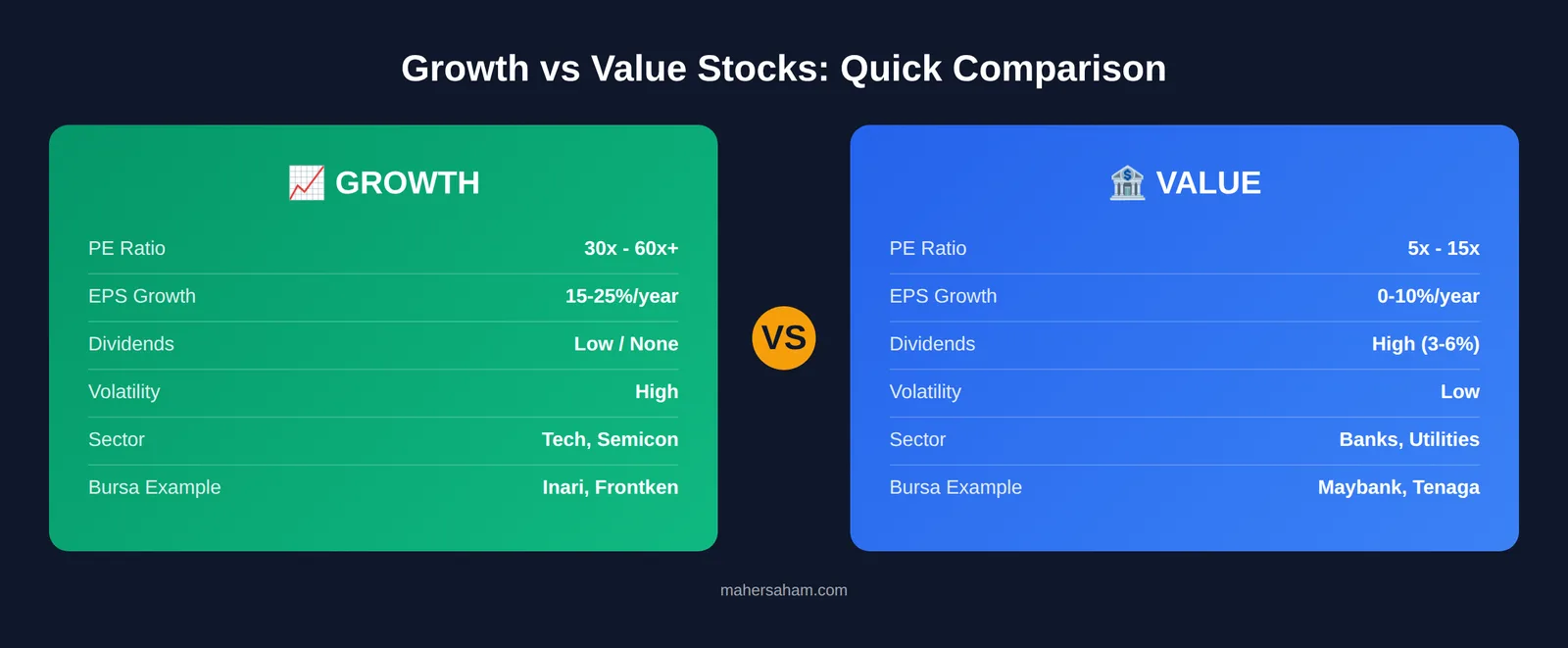
The table below summarises the main differences between these two investment strategies:
| Aspect | Growth Stocks | Value Stocks |
|---|---|---|
| Objective | Capital appreciation (price increase) | Buy undervalued, wait for re-rating |
| PE Ratio | High (30x - 60x or more) | Low (5x - 15x) |
| Dividends | Low or none | High (3-6% yield) |
| EPS Growth | 15-25%+ per year | 0-10% per year (stable) |
| Risk | High - prices can drop sharply | Moderate - margin of safety |
| Time Horizon | Medium to long term | Long term (value trap risk) |
| Common Sectors | Technology, healthcare, EV | Banking, utilities, REITs |
| Famous Practitioners | Peter Lynch, Cathie Wood | Warren Buffett, Seth Klarman |
Performance Data: Who Wins in the Long Run?
The growth vs value debate is not just theory. Actual data from the US market (which has the longest track record) shows both strategies take turns dominating based on economic cycles.
Long Term: Value Dominates
According to data from Hartford Funds, since 1927, value stocks have outperformed growth stocks by an average of 4.0% annually in the United States. Over nearly 100 years, value investing has been more profitable overall.
2025: Growth Wins Again
However, the trend reversed in 2025 as the AI boom powered mega-cap tech stocks. According to TradingKey:
- S&P 500 Growth Index: 19.9% return
- S&P 500 Value Index: 12.3% return
- Russell 1000 Growth: 16.3% vs Russell 1000 Value: 15.1%
2026: Value Makes a Comeback
In the first half of 2026, momentum shifted to value. According to InvestmentNews, as of June 2026:
- Vanguard Value ETF (VTV): +14.4% YTD
- Vanguard Growth ETF (VUG): +1.8% YTD
A 12.6% gap in just 6 months - this shows how dramatic the rotation between growth and value can be.
Valuation Metrics: How to Tell Growth From Value
To identify whether a stock falls into the growth or value category, investors can use these key metrics:
1. PE Ratio (Price-to-Earnings)
The most basic metric. Growth stocks typically have PE ratios of 30x and above, while value stocks sit below 15x. For Bursa Malaysia context, the KLCI average PE is around 14-16x. Stocks below this average can be considered value; those well above it are growth.
2. PEG Ratio (Price/Earnings-to-Growth)
The PEG ratio improves on PE by factoring in growth rate. Formula: PEG = PE Ratio / EPS Growth Rate. A PEG below 1.0 suggests a stock may be undervalued relative to its growth rate - this is actually the sweet spot where growth meets value.
For a deeper understanding of PEG, read PEG Ratio: How to Find Cheap Growth Stocks on Bursa Malaysia.
3. Price-to-Book Value (PBV)
PBV compares a stock's price with the company's book value. Value investors often look for stocks with PBV below 1.0 - meaning the market values the company at less than its net asset value. For Malaysian banking stocks, PBV typically ranges from 0.8x to 1.5x.
4. Dividend Yield
Value stocks typically offer higher dividend yields (3-6%) because the company is mature and does not need to retain all profits for growth. Growth stocks usually yield below 1% or pay no dividends at all.
5. Return on Equity (ROE)
Quality growth stocks typically have high ROE (15-25%+) because they generate strong returns on shareholder equity. Good value stocks should also have reasonable ROE - if ROE is too low, it might be a value trap.
When Does Growth Outperform Value (and Vice Versa)?
The relative performance of growth vs value heavily depends on the macroeconomic environment:
Growth Wins When:
- Interest rates are low - cheap borrowing costs help tech companies expand
- Economy is in early expansion - high confidence about the future
- New technological innovation - e.g., the AI boom of 2023-2025
- High market liquidity - "cheap money" flows into speculative stocks
Value Wins When:
- Interest rates are rising - investors prioritise current cash flow over future promises
- Economic uncertainty - investors seek safety in defensive stocks
- High inflation - commodity and financial companies typically benefit
- Growth valuations become extreme - bubbles burst, money flows to value
According to research by the CFA Institute, this rotation pattern also applies to Bursa Malaysia - value stocks tend to outperform growth during post-crisis economic recovery periods.
Hybrid Strategy: GARP (Growth at Reasonable Price)
You do not have to choose just one. Many successful investors use a hybrid approach called GARP - Growth at Reasonable Price.
GARP was popularised by Peter Lynch, the legendary Magellan Fund manager who delivered an average return of 29% per year over 13 years. The principle is simple: find stocks with strong earnings growth, but at a valuation that is still reasonable.
GARP Criteria:
- EPS growth of 15-25% per year (high enough for growth, but not speculative)
- PEG ratio below 1.5 (growth is not overpriced)
- Consistent ROE above 15%
- Manageable debt (Debt-to-Equity ratio below 0.5)
On Bursa Malaysia, stocks that may meet GARP criteria include technology companies with strong growth but PE still below 25x, or utility companies with stable growth and recurring income. For example, QL Resources and Sunway Berhad are often seen as GARP-type stocks - consistent growth with valuations that are not excessively stretched.
Growth and Value Stock Examples on Bursa Malaysia
To make it easier to understand, here are examples of stocks on Bursa Malaysia typically categorised as growth and value:
Growth Stocks on Bursa Malaysia:
| Stock | Sector | Growth Characteristics |
|---|---|---|
| Inari Amertron | Semiconductors | High earnings growth, premium PE, RF testing leader |
| Frontken Corp | Technology services | Expansion to Taiwan and Singapore, rising margins |
| Press Metal | Aluminium | Major capacity expansion, RE-based smelting, high PE |
| Genetec Technology | Automation | Growing order book, EV-related, capex expansion |
Value Stocks on Bursa Malaysia:
| Stock | Sector | Value Characteristics |
|---|---|---|
| Maybank | Banking | Low PE (~11x), ~6% dividend yield, stable business |
| Tenaga Nasional | Utilities | Electric grid monopoly, recurring income, consistent dividends |
| CIMB Group | Banking | Low PBV, turnaround story, rising dividends |
| RHB Bank | Banking | PBV below 1.0, undervalued vs peers |
Important note: A stock's categorisation as growth or value can change over time. A former growth stock can become a value stock if its growth slows - and vice versa.
Common Mistakes by Growth and Value Investors
Growth Investor Mistakes:
- Overpaying - buying growth stocks at PE 80x-100x without justifiable growth to match
- Ignoring cash flow - companies that keep losing money year after year may never become profitable
- Chasing momentum - buying because the price is going up, not because fundamentals are strong
Value Investor Mistakes:
- Value trap - stocks that are cheap because there is a serious fundamental problem (not a temporary discount)
- Impatience - re-rating can take years
- Ignoring industry shifts - "cheap" companies in dying industries may never recover
FAQ - Growth vs Value Stocks
Are growth stocks riskier than value stocks?
Yes, growth stocks generally have higher volatility. When growth expectations are not met, prices can drop 30-50% in a short time. Value stocks typically have a "price floor" supported by assets and strong cash flows.
Can I hold both growth and value stocks in my portfolio?
Yes, and this is actually the smartest approach. A balanced portfolio with a mix of growth and value reduces overall risk while maintaining return potential. The GARP strategy is also a combination of both approaches.
What percentage of my portfolio should be growth vs value?
There is no fixed formula. As a general guide, younger investors (20-30 years old) can lean more towards growth (60-70%), while investors near retirement may prioritise value (70-80%). The key is to match your own risk tolerance.
Is Warren Buffett a value or growth investor?
Buffett started as a pure value investor (cigar butt investing) following Ben Graham's teachings, but later shifted to "wonderful companies at a fair price" - essentially a blend of growth and value. He bought Apple, a growth stock, at what he considered a reasonable valuation.
What is a value trap and how do I avoid it?
A value trap is a stock that looks cheap (low PE, low PBV) but is actually cheap because there is a serious fundamental problem. To avoid them, check earnings trends (are they declining?), debt levels, and industry outlook. Stocks in dying industries are typically value traps.
Which growth stocks are suitable for beginners on Bursa Malaysia?
For beginners, choose established growth stocks with a positive earnings track record. Avoid speculative growth stocks (penny stocks) that have not yet generated profits. Make sure the stock is on the SC Shariah-compliant list if you are a Muslim investor.
Why are banking stocks often categorised as value?
Banking stocks typically trade at low PE ratios (8-13x), offer high dividend yields (4-6%), and have stable but slow earnings growth. This makes them classic value candidates. On Bursa Malaysia, Maybank, Public Bank, CIMB and RHB all exhibit value characteristics.
Can Shariah-compliant stocks be growth or value stocks?
Yes, Shariah compliance and growth/value categorisation are two separate things. Many growth stocks like Inari and Frontken are Shariah-compliant, as are value stocks like Tenaga and Petronas Dagangan. Check the latest list on the Securities Commission Malaysia website.
Conclusion
Growth vs value is not about which is better - it is about which suits you at a given time. Data shows both strategies take turns dominating based on economic cycles. The smartest investors are not locked into one camp - they understand both approaches and adjust their portfolios according to current market conditions.
Whether you choose growth, value, or a combination of both, the most important first step is to start your investment journey.
Open your CDS trading account through M+ Online here to start investing on Bursa Malaysia as well as international markets like US and Hong Kong stocks.
Download the free ebook Stock Market Basics to understand key concepts before you start investing.
Further Reading
- PEG Ratio: How to Find Cheap Growth Stocks on Bursa Malaysia
- Defensive vs Growth Stocks: Why a Smart Portfolio Needs Both
- PE Ratio: How to Tell If a Stock Is Expensive or Cheap by Sector
- Seth Klarman & Margin of Safety: The Quiet Value Investor Who Beat Buffett
- Phil Fisher: 15 Scuttlebutt Questions Before Buying Growth Stocks