How to Do Fundamental Analysis on Stocks: A Simple & Quick Guide

What Is Fundamental Analysis?
Fundamental analysis is the study of financial information to determine the financial position and performance of a company. For example, when investing in stocks on Bursa Malaysia, before investing in a company, we need to know and study the following:
1. Does the company have sufficient resources to grow?
2. Does the company have enough capital to invest in new projects?
3. Does the company's revenue meet earnings expectations?
Therefore, by looking at fundamental analysis, it helps investors identify and determine the financial performance of a particular company.
4 Fundamental Analysis Ratios
1. Gross Profit Margin
Gross Profit Margin is used to measure a company's earnings from the revenue generated. The formula to calculate Gross Profit Margin is:
Gross Profit Margin = (Gross Profit / Revenue) x 100%
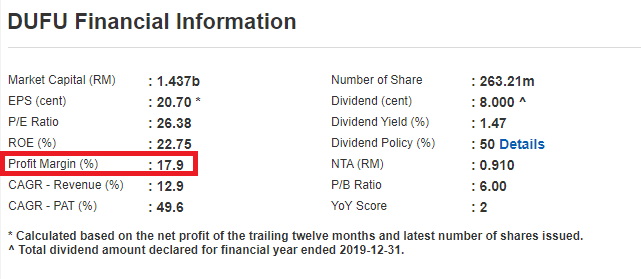
For example, the Profit Margin for DUFU shares is 17.9%.
Source: Malaysiastock.biz
This means that for every RM1 of revenue earned by the company, DUFU earns RM0.179 in profit to cover expenses or cost of sales.
Generally speaking, the higher the Profit Margin value of a company, the better the financial health of that company.
2. Earning Per Share (EPS)
Earning Per Share provides investors with information on how well a company generates income and returns sufficient earnings to its shareholders.
The formula to calculate EPS is:
Earning Per Share = (Net Income / Number of Shares) x 100 sen
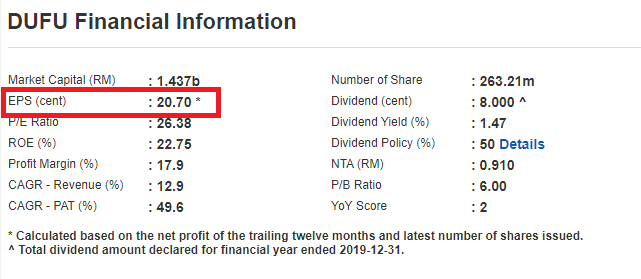
For example, the EPS for DUFU shares recorded 20.70 sen.
Source: Malaysiastock.biz
This means that for DUFU's financial year ending 31 December 2019, every share held by DUFU shareholders earned 20.70 sen in income.
This income can either be distributed to shareholders as dividends or retained by the company as retained earnings for the purpose of further expanding the company's business.
And it remains the property of the shareholders as long as the investor holds DUFU shares.
3. Return On Equity (ROE)
Return On Equity is used by investors to identify the level of return that will be received for every RM1 of capital invested in a company.
If the rate of return provided is not satisfactory, investors can look for other stocks that have more attractive fundamental analysis metrics.
However, it all depends on the investor's own investment time horizon, whether they want to invest for the short, medium, or long term.
The formula to calculate ROE is:
Return on Equity = (Net Income / Shareholder's Equity) x 100%
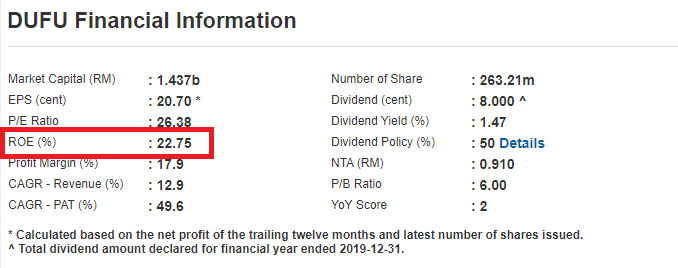
Looking at DUFU's ROE, it shows 22.75%.
Source: Malaysiastock.biz
How do you determine whether a company's returns are satisfactory or otherwise?
Investors can compare the rate of return obtained with the returns provided by other stocks or alternative investments.
One tip from Mahersaham for studying a company's ROE: a good ROE is when ROE is greater than 15.
4. Price Earning Ratio (PE)
PE Ratio shows how much value investors are willing to pay to earn income from a company.
A good PE Ratio is when the PE is less than 15. The formula to calculate PE Ratio is:
P/E Ratio = Price per Share / Earning Per Share
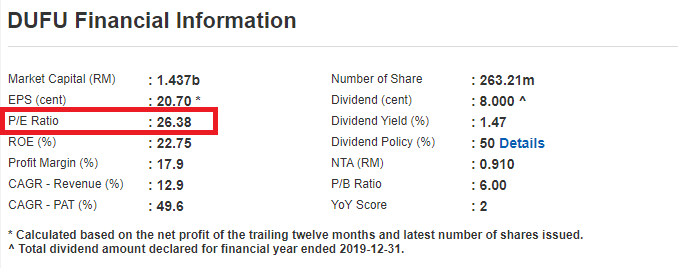
If we refer to DUFU's PE Ratio, it shows 26.38.
Source: Malaysiastock.biz
This means DUFU shares are currently being sold at 26.38 times its earnings, which is higher than 15.
Therefore, if a new investor wants to own this stock at its current price, RM5.460 is already considered overvalued.
Conclusion
In conclusion, long-term investors in particular are advised to thoroughly study a company's fundamental analysis before making a decision on whether to invest in a company or not.
By looking at the 4 fundamental criteria shown here, it is sufficient for investors to determine the performance of a company — whether it is capable of growing and surviving in the long run or otherwise.
We hope this has been beneficial!
FAQ: Fundamental Analysis on Stocks
What is fundamental analysis?
Fundamental analysis is the study of a company's financial information to determine its true value and growth potential.
What are the 4 key ratios in fundamental analysis?
The four key ratios are Gross Profit Margin, Earning Per Share (EPS), Return On Equity (ROE), and Price Earning Ratio (PE). These ratios help investors evaluate a company's financial performance.
What does PE Ratio mean?
PE Ratio (Price-to-Earnings Ratio) measures how many times the share price is relative to the company's earnings. The lower the PE, the cheaper the stock's valuation.
Is fundamental analysis enough to make investment decisions?
Fundamental analysis is very important for long-term investors, but it is recommended to combine it with technical analysis for a more complete picture of the stock.
After understanding the basics of fundamental analysis, the next step is to start applying this knowledge in real investments on Bursa Malaysia.
Open a CDS account with Mahersaham to start investing in stocks on Bursa Malaysia.
Download the free Stock Basics Ebook to learn the fundamentals of stock investing from scratch.
Further reading: