How to Read IPO Balloting Results & Understand Them

Many people are now familiar with IPOs and have started applying for them, whether through Miti or Online Banking.
When you apply for an IPO, there are key dates you must be aware of:
- Opening Date – The date IPO applications open
- Closing Date – The date IPO applications close
- Balloting Date – The date of the ballot draw
- Listing Date – The date the shares are listed on the exchange
You can check all these IPO dates in the details section of the IPO when applying.
After completing your IPO application, the balloting result will be released on the Balloting Date.
What Is a Balloting Result?
When the balloting result is released, there are 6 things you need to know.
From the balloting results, applicants can find out how many total applications were received for a particular IPO, what the winning rate percentage is, how many share units they will receive, and much more.
Based on these results, applicants can conduct their balloting analysis.
As an example, here is the balloting result for IPO CEKD:
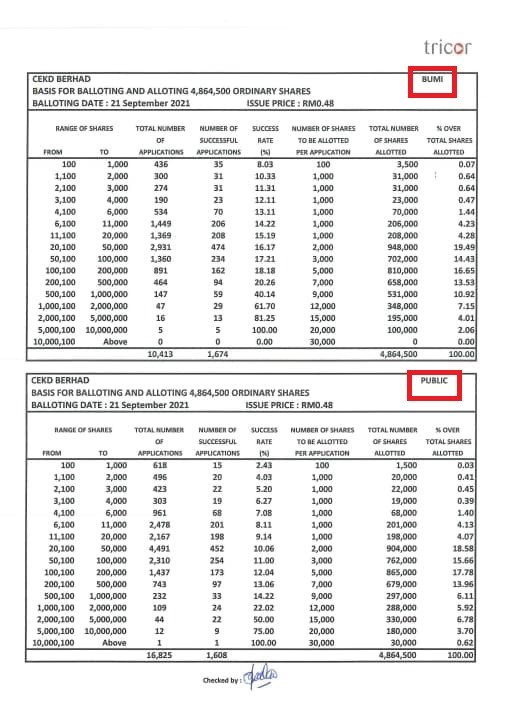
Based on this CEKD Berhad balloting result, you can refer to your application under 2 categories: either 'Bumi' or 'Public'.
How to Read Balloting Result 'Bumi' / 'Public'
In an IPO balloting result, there are 6 things you need to know.
1. Range Of Shares: Check how many IPO units you applied for.
2. Total Number Of Applications: The number of applicants who applied for the IPO based on the range of shares.
3. Number Of Successful Applications: Applicants who successfully received the IPO allocation.
4. Success Rate (%): The percentage of applicants who successfully received the IPO allocation.
5. Number Of Shares To Be Allotted Per Application: The number of units each successful applicant will receive.
6. Total Number Of Shares Allotted: The total number of units allocated (based on the number of successful applicants).
Once you understand the meaning of each item in the balloting result, you can then check how many units you are likely to receive based on your application.
In fact, IPO results tend to favour Bumi applicants over Public applicants. If you look at the Success Rate (%), 'Bumi' typically has a higher rate than 'Public'.
Example Scenario: IPO Application & Balloting Result
For example, Mak Kiah applied for 7,100 units of CEKD IPO.
This falls within the Range Of Shares of 6,100 to 11,000 units (based on the CEKD balloting result).
The Total Number Of Applications was 1,449 applicants. However, only 206 applicants were successful in receiving the IPO, which equates to a 14.22% success rate.
If Mak Kiah is among the successful applicants, she will receive 1,000 units of CEKD shares (as shown in the Number Of Shares To Be Allotted Per Application) in her portfolio on the Listing Date.
The remaining amount from Mak Kiah's application (7,100 - 1,000) = 6,100 units x RM0.48 = RM2,928 will be refunded.
IPO Listing Date
Successful IPO applicants can check their portfolio. The shares you applied for and the units you received will appear there.
For those who were unsuccessful, your capital will be refunded to your bank account within 3 to 7 working days.
Learn IPO From A to Z
This article is part of a series of articles written on Mahersaham about IPOs. For the full list of articles, refer to A Complete Guide to Learning IPO From A to Z.
Conclusion
For IPO applicants, first and foremost, be aware of all the important dates and details of the IPO you are applying for.
On the balloting date, you can check the balloting results on the TIIH website.
You may also read about how to check your IPO application results.
In the Supertrader class, IPO analysis is also taught in greater detail. However, Mahersaham no longer offers paid classes. The Supertrader class is exclusively for clients of Tuan Maher Alias.
If you do not have a CDS account yet, you can register for a CDS Account with us.
Not only that, you can also start by downloading the free Ebook from Mahersaham.
FAQ — IPO Balloting Results
What is an IPO balloting result?
An IPO balloting result is the outcome of the ballot draw that determines which applicants successfully receive shares from an IPO. It shows the total number of applications, success rate, and number of shares allotted per successful application.
How do I check my IPO balloting result?
You can check your IPO balloting result on the TIIH Online website. The results are typically published on the balloting date stated in the IPO details.
What happens if my IPO application is unsuccessful?
If your IPO application is unsuccessful, your full application amount will be refunded to your bank account within 3 to 7 working days.
What is the difference between Bumi and Public categories in IPO balloting?
The Bumi category is reserved for Bumiputera applicants and typically has a higher success rate compared to the Public category, which is open to all Malaysian citizens regardless of ethnicity.
If I applied for more units than allotted, what happens to the excess?
If you are a successful applicant but applied for more units than what was allotted, the excess amount (difference in units multiplied by the IPO price) will be refunded to your bank account.