Jet Fuel Hedging: How Airlines Protect Against Rising Oil Prices

Jet fuel prices nearly doubled since early 2026 due to the US-Iran conflict, and AirAsia is now the worst-performing airline stock in the world for not hedging its fuel. Every US$1 per barrel increase in jet fuel cuts AirAsia's profit by RM80 million. Meanwhile, smart hedging airlines like Southwest Airlines and Air France-KLM each saved nearly US$1 billion.
But what exactly is fuel hedging? How does crude oil from the TAPIS platform off the coast of Terengganu end up in an aircraft's fuel tank? And why do some airlines choose not to hedge at all?
This article uncovers the jet fuel supply chain from oil well to airport, Malaysia's role in the global oil market, and the hedging strategies used by global and local airlines.
What Is Jet Fuel?
Jet fuel - also known as Jet A-1 - is a type of kerosene used specifically for aircraft turbine engines. It is not raw crude oil that comes straight from the ground, but a refined product that goes through several complex processes.
Key Jet A-1 specifications:
- Flash point: Minimum 38 degrees C - for handling safety
- Freeze point: Maximum -47 degrees C - so it does not freeze at 35,000 feet altitude
- Boiling range: 150 degrees C to 300 degrees C
- Sulfur content: Very low, below 0.3%
Jet A-1 differs from car petrol (gasoline) and diesel because it is designed to burn at very high temperatures and pressures inside turbine engines. It also needs to remain stable at extremely low temperatures during high-altitude flight.
In the crude oil refining process, jet fuel (kerosene) accounts for only about 10% of total products produced from each barrel of crude oil - making it a high-value but low-volume product compared to gasoline or diesel.
The Supply Chain: From Crude Oil to Aircraft Tank
The journey of jet fuel from underground to an aircraft's tank involves a long and complex supply chain. Here are the stages involved:
Stage 1: Crude Oil Extraction
Crude oil is extracted from oil wells - either onshore or offshore. In Malaysia, most extraction is done offshore Terengganu and Sabah/Sarawak by PETRONAS and its partners.
Stage 2: Transport to Refinery
Crude oil is transported via pipeline or tanker ships to refineries. Malaysia has several major refineries including PETRONAS Penapisan (Melaka) Sdn Bhd and Hengyuan Refining Company in Port Dickson.
Stage 3: Refining
This is the most critical stage. Crude oil is heated in a distillation tower and separated by molecular weight:
- Top section: Light gases (LPG, butane)
- Upper-middle section: Gasoline (petrol)
- Middle section: Kerosene/Jet fuel
- Bottom section: Diesel, heavy oil
After distillation, kerosene undergoes a hydrotreatment process - hydrogen treatment to remove sulfur, nitrogen, and other impurities. This produces a cleaner product that meets the strict Jet A-1 specifications.
Finally, kerosene from various processes (direct distillation and hydrocracking) is blended with special additives for corrosion control, thermal stability, anti-icing, and electrostatic dissipation. Only after testing confirms it meets all specifications can it officially be called "jet fuel".
Stage 4: Distribution to Airports
Jet fuel is delivered to storage depots at airports via pipeline, fuel trucks, or ships. At KLIA for example, jet fuel is stored in large holding tanks and pumped directly to aircraft through an underground hydrant system.
Stage 5: Into-Plane Fueling
Finally, fuel is pumped into aircraft tanks by fueling companies - in Malaysia, key players include PETRONAS Dagangan and Shell.
TAPIS: Malaysia's Premium Crude Oil
TAPIS (Tapis Blend) is a premium-grade crude oil extracted from the Tapis Oil Field, located approximately 200 km offshore Terengganu in the South China Sea. It was discovered in 1969 and began production in 1978.
Why Is TAPIS Special?
TAPIS is recognised as one of the highest-quality crude oils in the world due to two key characteristics:
- Very light: API gravity 42.7 degrees to 45 degrees (the higher, the lighter and easier to refine)
- Very sweet: Sulfur content of only 0.04% (extremely low compared to other crude oils)
For context, Brent crude (the global benchmark) has an API gravity of around 38 degrees and sulfur of 0.37% - making TAPIS far easier and cheaper to refine into high-value products like jet fuel.
TAPIS as Asia's Benchmark
TAPIS was once the primary crude oil price benchmark in the Asia-Pacific region, particularly for pricing light and sweet crude oil. Although its benchmark role has diminished since 2008, it remains an important reference for crude oil trading in Singapore - Asia's largest oil trading hub.
TAPIS prices are typically higher than Brent and WTI due to its superior quality. In March 2026, TAPIS prices surged past US$116 per barrel - a new record high due to Middle East supply disruptions.
Malaysia in the Global Oil Market
Where does Malaysia stand on the global oil map?
Oil Production
Malaysia produces approximately 570,000 barrels of oil per day as of 2024, placing it at #29 in the world. In a global context, this contributes less than 1% of world oil production which exceeds 80 million barrels per day.
Despite the small percentage, Malaysia is the second-largest petroleum producer in Southeast Asia after Indonesia, and is the fifth-largest LNG exporter in the world.
Petroleum Exports
Nearly all of Malaysia's crude oil and condensate exports in 2023 were shipped to the Asia-Pacific region. Malaysia also exported 1.3 million barrels of petroleum products per day in 2023 - a 7% increase from the previous year. 79% of these exports were destined for the Asia-Pacific region.
Contribution to the Economy
The oil and gas industry is projected to contribute more than 20% to the national GDP by 2026. PETRONAS as the national oil company remains the largest contributor to Malaysian government revenue, with annual dividends worth billions of ringgit.
Fuel Costs: What Percentage of Airline Operating Costs?
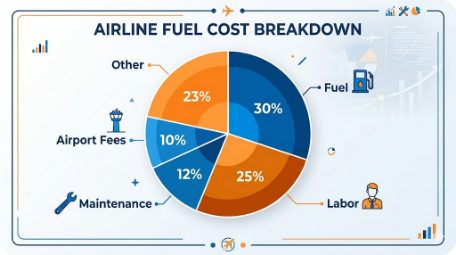
Jet fuel is the largest operating expense for most airlines, contributing between 20% to 40% of total operating costs depending on current oil prices.
For 2026, IATA estimates fuel will account for 25.7% of total global airline operating expenses - slightly down from 26.8% in 2025.
Typical Airline Operating Cost Breakdown
| Cost Component | Percentage |
|---|---|
| Jet fuel | 20-40% |
| Staff salaries & benefits | 20-25% |
| Aircraft maintenance | 10-15% |
| Airport & navigation charges | 8-12% |
| Aircraft lease/financing | 8-10% |
| Others (catering, insurance, etc.) | 10-15% |
When oil prices surge as they did in early 2026 - with jet fuel prices reaching US$173.91 per barrel (nearly double from the start of the year) - fuel costs can exceed 40% of operating costs. This forces airlines to either raise fares, impose fuel surcharges, or reduce routes.
What Is Fuel Hedging?
Fuel hedging is a financial strategy used by airlines to protect themselves from rising oil prices in the future. The concept is simple - airlines "lock in" a fuel price at a certain rate for a future period, so they are not fully exposed to market price fluctuations.
Imagine you are a financial manager at AirAsia. You know the company will need 1 million barrels of jet fuel for the next 6 months. The current price is US$80 per barrel. You are worried the price will rise to US$120 per barrel due to Middle East conflict.
With hedging, you can "lock in" a price of US$85 per barrel for 500,000 barrels (50% of requirements) through a financial contract. If the price does rise to US$120, you still get half your supply at US$85 - saving millions of dollars.
How Much Do Airlines Typically Hedge?
Airlines typically hedge between 30% to 60% of their fuel requirements for 6 to 12 months ahead. No airline hedges 100% because:
- Hedging premium costs are quite high
- If oil prices fall, they are "stuck" with a more expensive price
- The jet fuel hedging market is quite small and illiquid
Hedging Instruments: Forwards, Options & Swaps
Airlines use several types of financial derivative instruments for hedging:
1. Forward Contracts
This is the most basic form of hedging. Two parties agree to buy/sell a specific quantity of oil at a fixed price on a future date.
Example: AirAsia agrees to buy 100,000 barrels of jet fuel at US$85/barrel for delivery in September 2026.
- Advantage: Price is locked in, no surprises
- Disadvantage: If the price falls to US$60, AirAsia still has to pay US$85
2. Options
Options give airlines the right, not the obligation, to buy oil at a specific price. It is like buying insurance.
Example: Malaysia Airlines buys a "call option" for 100,000 barrels at US$85 (strike price), paying a premium of US$3/barrel.
- If the price rises to US$120 - MAS exercises the option, buys at US$85 (saves US$32/barrel after deducting premium)
- If the price falls to US$60 - MAS lets the option expire, buys at market price US$60 (loses only the US$3 premium)
3. Swaps
A swap is an agreement where airlines exchange a floating price for a fixed price with a counterparty (usually a bank or oil company).
Example: The airline pays a fixed price of US$85/barrel to the bank, and the bank pays the current market price to the airline. If the market price rises to US$120, the bank absorbs the difference. If it falls to US$60, the airline absorbs the difference.
The Big Problem: Crude Oil vs Jet Fuel
Here is the critical issue that many people miss - most airline hedging is done based on crude oil benchmarks (Brent or WTI), not actual jet fuel prices. This is because the dedicated jet fuel hedging market is too small and expensive.
In 2026, this problem became very apparent - jet fuel prices nearly doubled, but crude oil prices only rose by about a third. This means airlines that hedged based on crude oil were still exposed to jet fuel price increases that were not fully protected.
AirAsia vs Malaysia Airlines: Two Different Hedging Strategies
Malaysia's two main airlines have taken very different approaches to fuel hedging:
AirAsia: Minimal Strategy
AirAsia practises a very minimal hedging policy. The company rarely hedges in large volumes, and when it does hedge, it only uses plain vanilla forward contracts in small amounts.
This decision backfired in 2026. When the US-Iran war triggered an oil price surge, AirAsia became the worst-performing airline stock in the world. Every US$1 per barrel increase in jet fuel cuts AirAsia's profit by RM80 million (5.3%).
Malaysia Airlines: Conservative Approach
MAS takes a more conservative approach using floor options (put options) that set both minimum and maximum price limits. This "range-bound" strategy provides protection against price increases while limiting losses if prices fall.
Lessons Learned
The difference between these two approaches highlights the real risks of hedging decisions. AirAsia saved on hedging premium costs when prices were low, but is now bearing losses far greater. MAS paid a consistent premium cost, but sleeps better when oil prices are volatile.
Global Airline Hedging Strategies
How do other airlines around the world manage oil price risk?
Southwest Airlines (US) - The Hedging King
Southwest Airlines is renowned as the most aggressive airline in hedging. In the early 2000s, Southwest saved billions of dollars through long-term hedging that locked in low prices. However, this strategy also hurt them when oil prices fell sharply.
Singapore Airlines - Structured Hedging
Singapore Airlines takes a structured approach by combining crude oil and jet fuel hedging. They are among the few Asian airlines that have direct protection against jet fuel prices, not just crude oil.
US and China Airlines - No Hedging
Several major airlines in the US and China have no hedging contracts at all, leaving them fully exposed to oil price surges. This approach is based on the assumption that premium hedging costs are not worthwhile in the long run.
The 2026 Hedging Crisis: The Crude-Jet Fuel Gap
The year 2026 exposed the biggest weakness in the global aviation hedging system - the price gap between crude oil and jet fuel.
What Happened?
The US-Iran conflict that began in early 2026 caused supply disruptions of oil from the Middle East. The effects:
- Jet fuel prices: Nearly doubled to US$173.91/barrel
- Crude oil prices: Rose by approximately one-third only
- Spread: The price difference between crude and jet fuel widened dramatically
Why Did Hedging Fail to Fully Protect?
Most airlines hedge based on crude oil prices (Brent) because the crude oil derivatives market is far larger and more liquid. But when jet fuel prices rise much faster than crude - hedging based on crude only provides partial protection.
Cathay Pacific itself acknowledged that its hedging is based on crude oil and does not fully protect against jet fuel price increases.
Impact on Consumers
Malaysia Aviation Group (MAG) is now reviewing flight fares and fuel charges. Malaysia Airlines has announced phased price adjustments, while Batik Air has issued notices regarding fuel surcharge adjustments for domestic and international routes.
The Malaysian government itself is considering suspending commercial flights due to fuel price surges that are unsustainable for some airlines.
Sustainable Aviation Fuel (SAF): The Future of the Industry?
Amid the fossil fuel price crisis, the aviation industry is also shifting to Sustainable Aviation Fuel (SAF) - fuel produced from renewable sources such as used cooking oil, agricultural waste, and biomass.
SAF can reduce carbon emissions by up to 80% compared to conventional jet fuel. Malaysia, as the world's second-largest palm oil producer, has enormous potential in SAF production from palm oil industry waste.
In 2025, BZI and FHE announced the construction of a SAF refinery in Malaysia - a move that could transform the aviation fuel supply chain dynamics in the region and reduce dependence on crude oil.
FAQ: Jet Fuel Hedging
What is fuel hedging in the aviation industry?
Fuel hedging is a financial strategy where airlines use derivative contracts (forwards, options, or swaps) to lock in fuel prices at a specific rate for a future period. The purpose is to protect the company from unexpected rises in oil prices.
Why does AirAsia not hedge?
AirAsia practises a minimal hedging policy. When oil prices were low, this approach saved on premium hedging costs. However, when jet fuel prices surged in 2026 due to the US-Iran conflict, AirAsia became the worst-performing airline stock in the world due to having no protection against rising prices.
What percentage of fuel costs make up airline operations?
Jet fuel contributes 20% to 40% of total airline operating costs. For 2026, IATA estimates this at 25.7% globally. When oil prices spike, this percentage can exceed 40%.
What is TAPIS crude oil?
TAPIS (Tapis Blend) is Malaysia's premium crude oil extracted from the Tapis Oil Field offshore Terengganu. It is very light (API gravity 42.7 degrees to 45 degrees) and very sweet (sulfur of only 0.04%), making it among the highest-quality crude oils in the world and once the primary benchmark for oil prices in the Asia region.
What is Malaysia's contribution to the global oil market?
Malaysia produces approximately 570,000 barrels of oil per day - less than 1% of global oil production. However, Malaysia is the second-largest petroleum producer in Southeast Asia and the fifth-largest LNG exporter in the world.
Why is crude oil-based hedging not fully effective?
Most airlines hedge based on crude oil prices (Brent/WTI) because the crude derivatives market is larger and more liquid. But jet fuel prices can rise far faster than crude (as in 2026, when jet fuel doubled while crude rose only a third). This gap means crude hedging only provides partial protection.
What is SAF (Sustainable Aviation Fuel)?
SAF is Sustainable Aviation Fuel produced from renewable sources such as used cooking oil, agricultural waste, and biomass. It can reduce carbon emissions by up to 80% and is seen as the future of aviation fuel.
How does rising oil prices affect airline ticket prices?
When jet fuel prices rise, airlines either raise ticket fares, impose additional fuel surcharges, or reduce the frequency of less profitable routes. Malaysia Airlines and Batik Air announced price adjustments in 2026 due to the jet fuel price surge.
Conclusion
Jet fuel hedging is not merely a financial transaction - it is a strategic decision that can determine the survival or downfall of an airline. The 2026 crisis shows that companies that wisely manage risk through structured hedging are more resilient against oil price shocks. At the same time, the jet fuel supply chain - from TAPIS crude oil on Terengganu's offshore platforms to aircraft tanks at KLIA - is a complex chain exposed to geopolitical disruptions.
Understanding how the aviation industry works, including hedging strategies and the fuel supply chain, can give you an edge as an investor. Aviation and energy sector stocks are heavily influenced by global oil price dynamics.
If you want to start investing on Bursa Malaysia and also in foreign stocks like US and Hong Kong markets, open a CDS Trading Account for full access to the stock market.
Download our free Stock Market Basics Ebook to learn the fundamentals of investing before making your first decision.
Further Reading
- Oil and Gas Stock Growth Factors: 7 Key Catalysts Investors Need to Know
- Strait of Hormuz: The 33km Narrow Passage That Could Collapse Asia's Economy
- Iran War 2026: How It Is Reshaping Malaysia's Stock Investment Landscape
- The Connection Between Global Oil Prices, the Stock Market & Profit Opportunities for Investors