Magic Formula Investing: Does It Work for Malaysian Investors?

In this article, we will be sharing about Magic Formula Investing — a powerful yet simple strategy that any investor can follow.
Let us begin.

What Is Magic Formula Investing?
The magic formula is a term used to describe the strategy outlined in the book 'The Little Book That Beats the Market'.
This strategy was developed by Joel Greenblatt.
It is a blueprint — a framework that uses fundamental investing principles.
The beauty of this technique is that it can be replicated and used by anyone.
Why?
Because the method is straightforward enough for everyone to follow and apply.
Annual Compound Return
Annual compound return refers to the rate of investment return over a specific period, expressed as an annual percentage.
![Annual Compound Return Of Superinvestors [CHART]](https://d2wsh2n0xua73e.cloudfront.net/wp-content/uploads/2015/08/Bestinvestors-Charlie-Munger-Joel-Greenblatt-WarrenBuffett-Walter-SchlossAnnual-Compound-Return-of-Superinvestors-v2.png)
Why is Warren Buffett among the top?
Because he has been able to consistently achieve returns of between 20% to 25% for more than 55 years.
Among other notable investors is Joel Greenblatt (the founder of the magic formula strategy), who achieved returns of 40% over a 20-year period.
So, we want to replicate something that we can turn into a sustainable source of income.
PE and ROE
PE Ratio (Price to Earnings Ratio)
The PE ratio is the price you pay compared to the company's earnings.
A higher PE ratio means you are paying a more expensive price.
The PE ratio can also be thought of as an expectation indicator.
PE Ratio = Market Price Per Share / Earnings Per Share
Why would the PE be high?
The market has excessively high expectations for the company, so investors are willing to pay a more expensive price compared to what is considered normal.
In simple terms, the PE ratio represents expectation.
It is not an accurate reflection of the company's actual condition.
ROE (Return On Equity)
ROE refers to the return on profit to shareholders.
This means ROE is based on fact.
If ROE is high, that is a good sign.
The higher, the better.
The question is: why are PE ratio and ROE such important components in magic formula investing?
Because the technique used by Joel Greenblatt revolves around earnings yield (EY) and return on invested capital (ROIC).
At Mahersaham, we use PE ratio and ROE in our magic formula investing approach.
Why?
Because these two metrics are the easiest to access, view, and find on financial websites.
What Is the Difference Between ROE and ROIC?
Before that, do you know where a company's financial capital comes from to run its business?
When a company wants to operate its business, funding comes from shareholders or from bank loans.
ROIC calculates profit based on both components — shareholders' equity and bank loans.
However, ROE only calculates profit based on shareholders' equity alone.
Nevertheless, if a company is in good financial health with little or no debt, then ROE and ROIC are essentially the same.
As mentioned earlier, ROE is easier to obtain compared to ROIC.
How to Set Up Magic Formula Investing
Let us do this together, step by step.
Step 1: Go to KLSE Screener
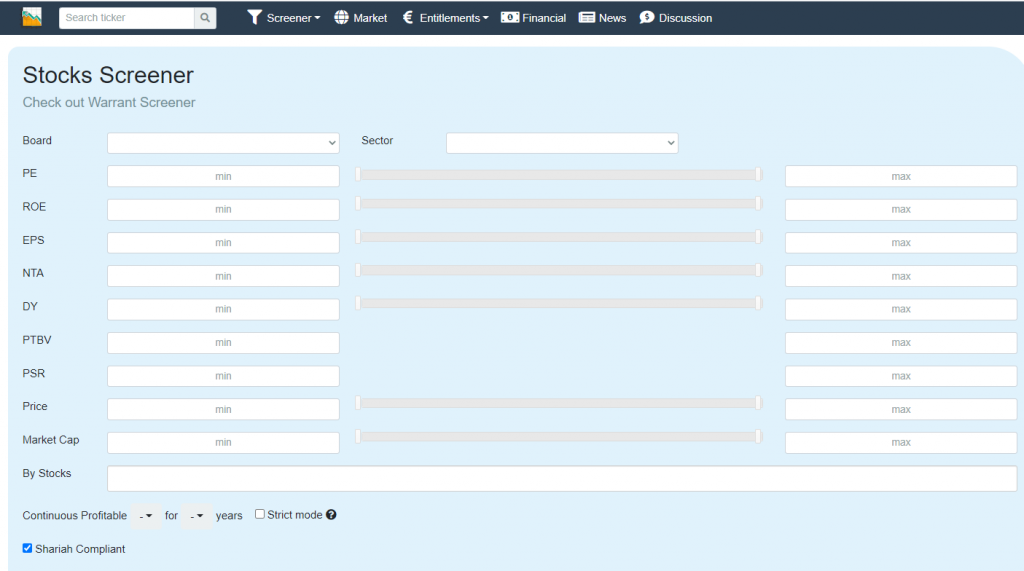
You can set the PE value (15, 20, or 30).
For ROE, set a minimum value above 10 (because we want stocks with at least double-digit ROE).
Then tick the Shariah Compliant box and click Screen.
What happens next?
The data for the relevant counters will appear.
The image below shows the counters that meet the criteria.
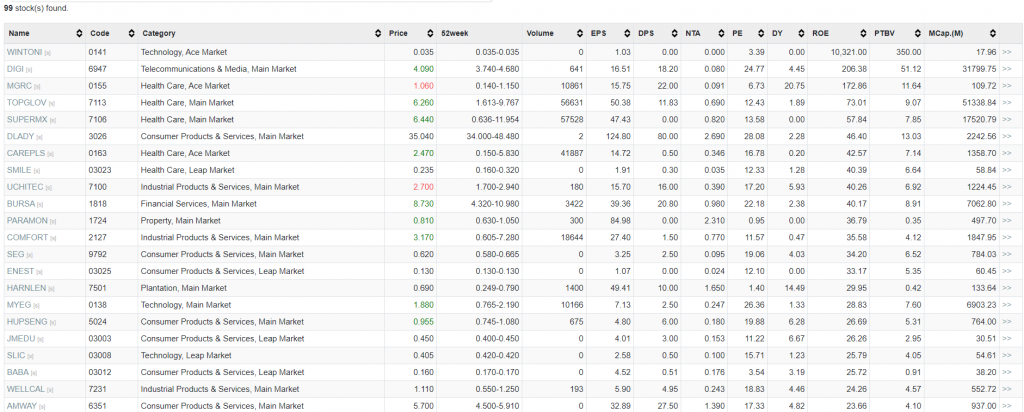
A total of 99 stock counters met the criteria.
Copy all the data from the counter table.
Step 2: Open Excel
Paste the data you copied from KLSE Screener.
Your Excel sheet should look like the image below.
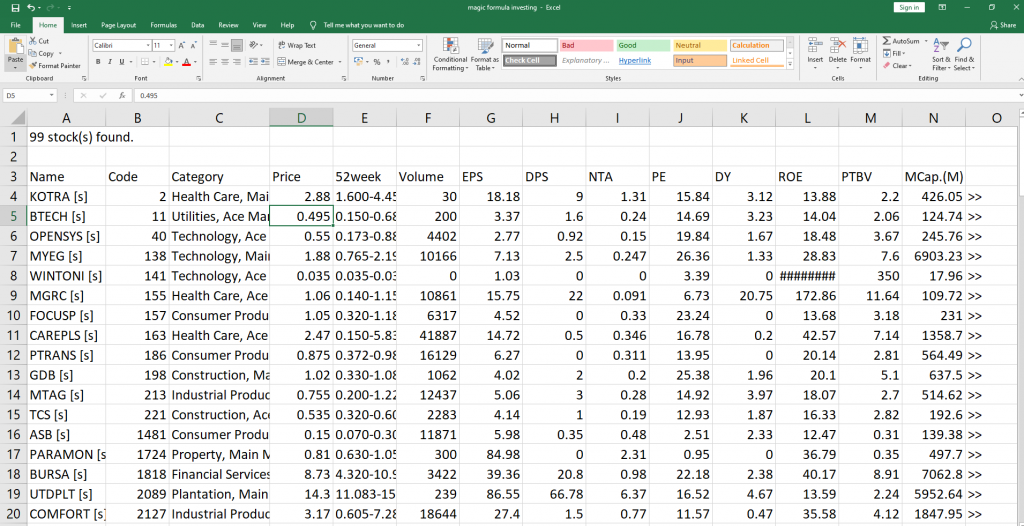
What do you need to do next?
Simply click anywhere within the data, then press CTRL + T on your keyboard to create a table.
When the small dialogue box appears, click OK.
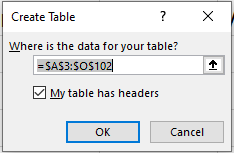
After clicking OK, your table is ready.
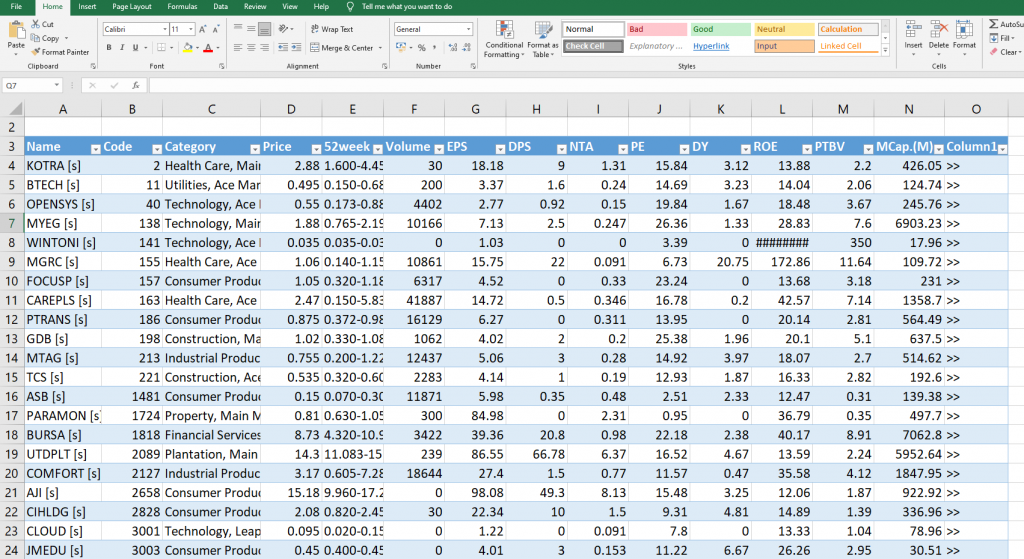
You can hide the other data columns and keep only:
- 1. Name
- 2. PE
- 3. ROE
Your new table will look like this.
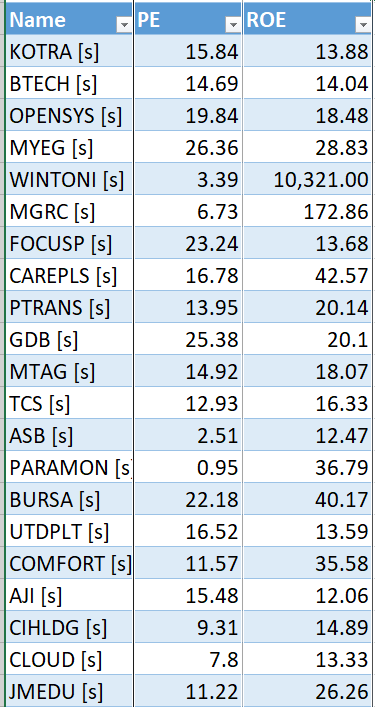
Next, add the following new columns:
- 1. PE Score
- 2. ROE Score
- 3. Total Score
Do you know the advantage of using Excel for this?
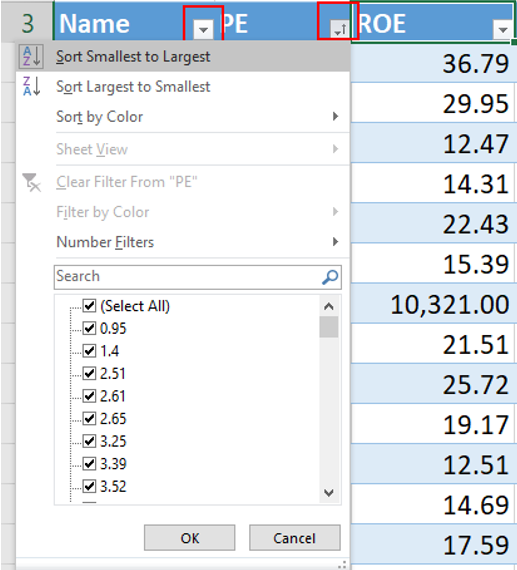
Notice that in the table header there is a dropdown button (highlighted in the red box).
The advantage is that we have the option to sort from smallest to largest or vice versa.
Which PE Value Is Better?
A low PE value or a high PE value?
Actually, the lower the PE, the better — because it means the stock is not expensive.
So in our table, we sort with the smallest values at the top and the largest at the bottom.
Click Sort Smallest to Largest.
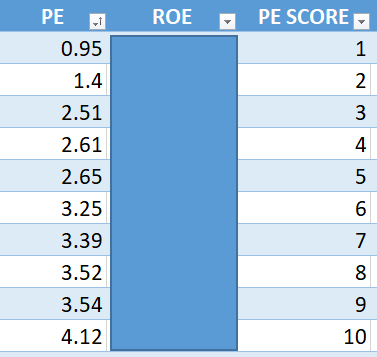
Then go to the PE Score column and assign values starting from 1 onwards.
How does this work?
Here is a simple example: based on the data, there are 10 counters involved.
You have already sorted the PE values.
PE values from smallest to largest.
Correct?
So the PE Score is based on the PE value.
The smallest PE value = PE Score of 1
The largest PE value = PE Score of 10
Refer to the image below for clarity.
What About ROE?
Is a smaller value better, or a larger value?
As explained above, the larger the ROE value, the better.
So we sort the column from largest to smallest.
Click the dropdown on the ROE column and select Largest to Smallest.
Similar to PE and PE Score:
The ROE Score is based on the ROE value.
For example, based on the data, there are 10 counters involved:
The smallest ROE value = ROE Score of 10
The largest ROE value = ROE Score of 1
Refer to the image below.
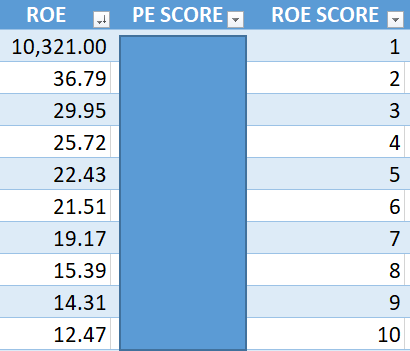
That completes the process of obtaining the PE Score and ROE Score.
What comes next?
You need to calculate the Total Score.
How?
It is simply the sum of the PE Score and the ROE Score.
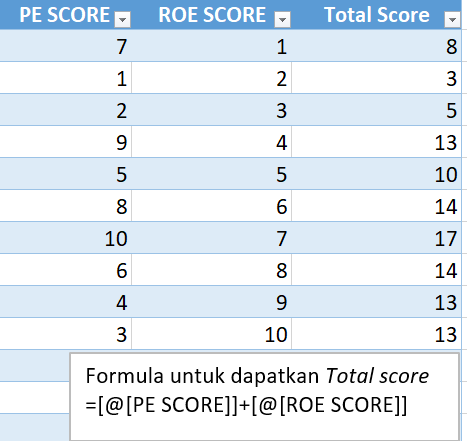
To get the Total Score, simply write the formula displayed in the Total Score column:
- 1. Click the equals sign (=)
- 2. Click the PE Score column
- 3. Click the plus sign (+)
- 4. Click the ROE Score column
- 5. Press Enter
Done!
If you do not want to create the table manually, do not worry.
Go to the Mahersaham App and sign up for free.
Navigate to the Screener section, find Fundamental, and then click Magic Formula Investing.
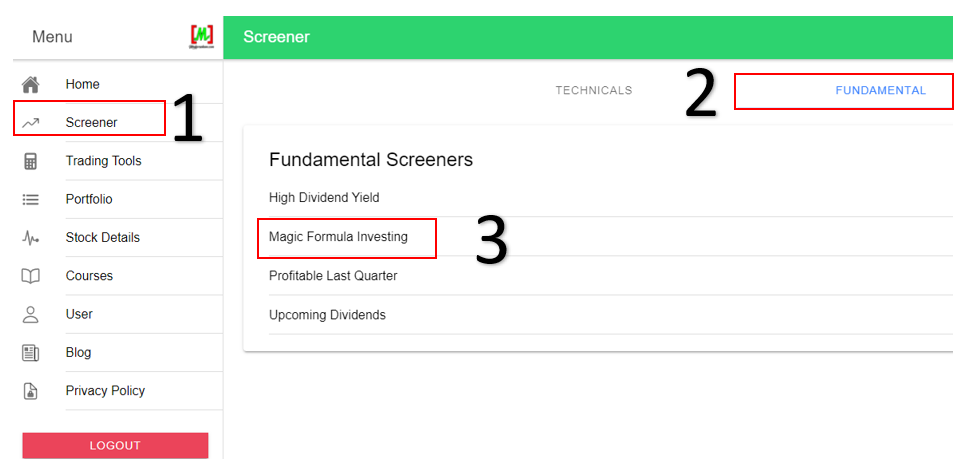
We have already prepared it for you.
You can refer to the article How to Use Mahersaham Screener for guidance on how to use the screener.
Once you know the Total Score, what do you do next?
Naturally, you want to know which counters are the best ones.
The question is: which Total Score is better?
A small value or a large value?
What do you think?
The answer is the counter with the lowest Total Score.
So we look for counters where the Total Score is the lowest.
Conclusion
Magic formula investing is one of the techniques that traders and investors use in their stock research.
If you are interested, feel free to apply this technique.
Make sure you fully understand the method before putting it into practice.
Frequently Asked Questions (FAQ)
1. What is Magic Formula Investing?
Magic Formula Investing is an investment technique introduced by Joel Greenblatt. It combines two key metrics — Earnings Yield and Return on Capital — to identify stocks that are undervalued yet of high quality.
2. How do you calculate the Magic Formula?
The Magic Formula is calculated based on the combined ranking of Earnings Yield (EBIT/Enterprise Value) and Return on Capital (EBIT/Net Fixed Assets + Working Capital). The lower the total ranking, the better the counter.
3. Is the Magic Formula suitable for beginner investors?
Yes, the Magic Formula is suitable for beginner investors because it provides a systematic and easy-to-understand method for selecting stocks without requiring deep experience in fundamental analysis.
4. Where can I find a Magic Formula screener for Malaysian stocks?
You can use the Magic Formula screener through the Mahersaham App. Refer to the Mahersaham App tutorial for guidance on how to use the screener.
Start Your Investment Journey
Now that you understand Magic Formula Investing, it is time to put this knowledge into practice. Open a CDS account with Mahersaham to start investing in quality stocks on Bursa Malaysia. If you are still new, get the free Mahersaham ebook for a beginner's guide to stock investing.