Mayor Elections in Malaysia: Role in Economic Development & Pros vs Cons

The debate over mayoral elections has once again taken centre stage in Malaysia after Federal Territories Minister Hannah Yeoh directed a feasibility study on holding elections for the Mayor of Kuala Lumpur in early February 2026. A survey by Invoke found that 62% of KL residents prefer electing their mayor directly, while 28% still support government appointments. This article examines the role of mayors in economic development, the history of local government elections in Malaysia, and the arguments for and against this proposal.
What Is a Datuk Bandar & Local Authority (PBT)?
A Datuk Bandar is the chief executive of a city — equivalent to a Mayor in other countries. In Malaysia, the Datuk Bandar administers City Halls such as DBKL (Kuala Lumpur), MBPP (Penang), and MBSA (Shah Alam). This position is currently appointed by the government, not elected by the people.
Local Authorities (PBT) encompass all forms of local government — from City Halls to Municipal Councils and District Councils. According to the Department of Local Government (JKT), there are over 150 local authorities across Malaysia responsible for urban planning, solid waste management, infrastructure maintenance, and community services.
Under the Local Government Act 1976 (Act 171), local authorities have two main types of functions:
- Mandatory functions: Assessment tax collection, waste management, road and drain maintenance, building control
- Discretionary functions: Development of public facilities, recreational parks, housing, and commercial activities
History of Local Government Elections in Malaysia
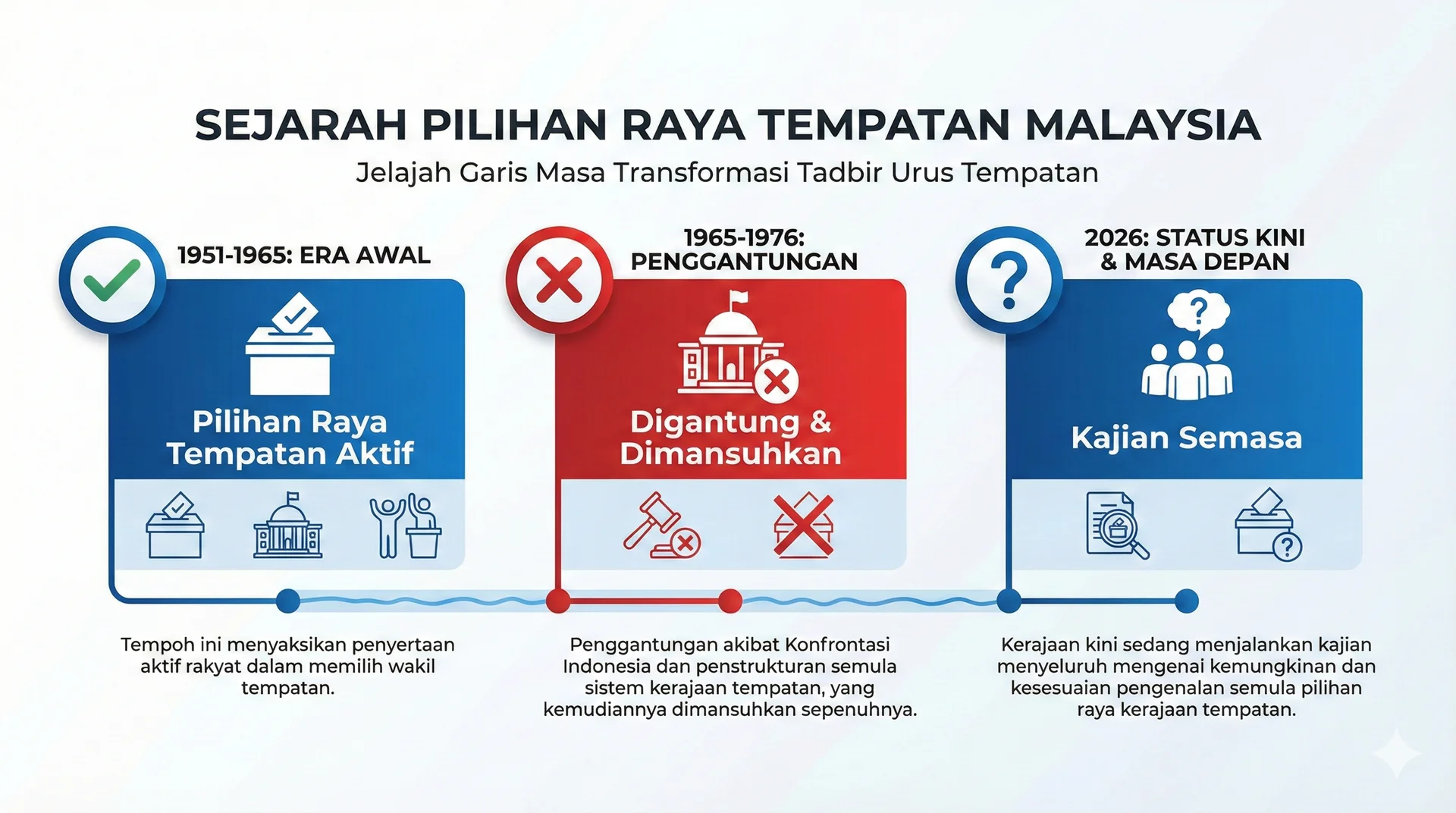
Many people are unaware that Malaysia actually once held local government elections. Here is an important timeline:
The Election Era (1951-1965)
- 1951: The first municipal election was held in George Town, Penang
- 1952: Kuala Lumpur held its municipal election — the UMNO-MCA alliance won 9 of 12 seats
- 1953-1963: Local government elections continued across Malaya as part of the democratic process
Suspension (1965-Present)
- 1964: The Indonesia-Malaysia Confrontation led to the declaration of emergency
- 1965: Local government elections scheduled for 1965-1966 were suspended
- 1965: A Royal Commission recommended reinstating elections — the federal government rejected this
- 1976: The Local Government Act 1976 was enacted — local government elections were officially abolished, with the power to appoint council members given to state governments
Since 1976, all Mayors, Council Presidents, and council members have been appointed — not elected.
Modern Attempts (2008-2026)
- 2008: The Penang and Selangor state governments (Pakatan Rakyat) attempted to revive local elections as a manifesto promise — unsuccessfully
- 2021: Housing Minister Reezal Merican rejected the proposal citing costs (~RM2 million per local authority)
- 2024 (February): Housing Minister Nga Kor Ming stated local elections were "not a priority"
- 2026 (February): Hannah Yeoh directed a feasibility study on KL mayoral elections
The Role of Mayors in Economic Development
A Mayor is not merely a ceremonial position — it plays a critical role in the economic development of a city. Here is how Mayors influence the local economy:
1. Urban Planning & Development
Mayors influence the approval of development projects, business zones, and local plans. Decisions about where commercial centres are built, how traffic is planned, and which areas are zoned for industry — all affect economic growth.
2. Tax Collection & Local Authority Expenditure
Local authorities collect assessment taxes, business licences, and various service fees. How these revenues are spent — whether on infrastructure, public amenities, or entrepreneurship programmes — directly impacts local economic activity.
3. Investment Attraction
A city that is efficiently managed, clean, and has good infrastructure attracts more investment. For example, DBKL's efficient management makes KL a premier ASEAN business hub. According to PLANMalaysia, Smart City initiatives led by local authorities also contribute to economic competitiveness.
4. Public Service Management
The quality of services such as public transport, waste management, and road maintenance affects business costs and worker quality of life — both important factors in economic productivity.
Current Studies: KL Mayoral Elections (2026)
Two major studies are currently underway:
Federal Territories Ministry Study
According to Sinar Harian, Hannah Yeoh described mayoral elections as "more practical" compared to local government elections involving multiple council members. She noted structural confusion as KL is currently administered simultaneously by the Mayor, Members of Parliament, and DBKL advisors.
This proposal requires amendments to the Federal Capital Act 1960 — or new legislation if amendments prove too extensive.
UIAM Study
The International Islamic University Malaysia (UIAM) began conducting a separate study on local government elections since December 2025. Findings are expected to be presented to the Cabinet and made public in March 2026.
Arguments For Mayoral Elections (Pros)
1. Accountability & Transparency
An elected mayor must answer to voters — not to the government that appointed them. This means city administration performance can be evaluated at each election, driving more transparent governance.
2. Majority Public Support
The Invoke 2025 survey showed 62% of KL residents support direct mayoral elections. Three-quarters of Indian and Chinese respondents and 52% of Malay respondents also agreed.
3. More Responsive Economic Planning
An elected mayor has a direct mandate to address local economic issues — from cost of living, traffic congestion, to affordable housing. This political mandate provides the power to act more swiftly.
4. Positive International Experience
Many of the world's most successful cities are led by elected mayors — London, Seoul, Tokyo, New York, and hundreds more. Sadiq Khan (London) introduced the London Growth Plan targeting 150,000 quality jobs by 2028. Former Seoul Mayor Park Won-soon won the Lee Kuan Yew World City Prize for transforming Seoul into an inclusive and innovative city.
5. Democratic Participation
Mayoral elections allow citizens to be directly involved in determining the direction of their city's development — in line with broader democratic principles.
Arguments Against Mayoral Elections (Cons)
1. No Constitutional Requirement
According to lawyer Zainul Rijal Abu Bakar (Pembela), the Federal Constitution only guarantees voting rights for Parliament and State Assemblies — there is no specific provision for local elections. KL as a Federal Territory has a unique constitutional status.
2. Risk of Racial Conflict
40% of survey respondents were concerned that elections could trigger racial tensions. There are fears that one ethnic group could monopolise positions in certain areas.
3. Mandate Clashes
An elected mayor with their own political legitimacy could clash with federal government control over land, finances, and security in the Federal Territory. The existing Westminster accountability principle could also be undermined.
4. High Costs
Former Housing Minister Reezal Merican estimated the cost of local elections at approximately RM2 million per local authority. With over 150 local authorities, the total cost could exceed RM300 million if implemented nationwide.
5. Risk of Third-Party Interference
PAS Secretary-General Takiyuddin Hassan described the proposal as "overly simplistic and naive." UMNO also raised concerns about potential interference by irresponsible parties in local election campaigns.
Comparison: Malaysia vs Other Countries
How does Malaysia compare with other countries in terms of mayoral selection?
| Aspect | Malaysia | UK (London) | South Korea (Seoul) | Japan (Tokyo) |
|---|---|---|---|---|
| Selection method | Government-appointed | Elected by citizens | Elected by citizens | Elected by citizens |
| Term of office | No fixed term (by appointment) | 4 years | 4 years | 4 years |
| Economic authority | Limited (follows government directives) | Extensive (own budget, GLA) | Extensive (own budget) | Very extensive (¥15 trillion budget) |
| Accountability | To the government | To voters | To voters | To voters |
| Urban planning | Under state/federal government | High autonomy | High autonomy | High autonomy |
Frequently Asked Questions (FAQ) About Mayor Elections in Malaysia
Did Malaysia ever have local government elections?
Yes. Malaysia held municipal elections from 1951 to 1965. The first election was held in George Town (1951) and Kuala Lumpur (1952). They were suspended during the Indonesia-Malaysia Confrontation and officially abolished through the Local Government Act 1976.
Can ordinary citizens vote for the Mayor now?
No. Currently, all Mayors, Council Presidents, and council members are appointed by the government — not elected. However, a feasibility study for KL mayoral elections is underway.
Who supports mayoral elections?
The Invoke 2025 survey showed 62% of KL residents support direct mayoral elections. Key supporters include DAP, some PKR members, and civil society groups advocating for local democracy.
Why do some parties oppose it?
Opponents are concerned about racial conflict risks, high election costs, mandate clashes with the federal government, and the absence of specific constitutional provisions for local elections.
What is the economic impact if the Mayor is elected?
An elected mayor has the mandate to drive local economic development more aggressively. International experience shows cities led by elected mayors such as London, Seoul, and Tokyo have more ambitious economic programmes that are responsive to residents' needs.
When will the decision on KL mayoral elections be announced?
The UIAM study is expected to be completed and findings made public in March 2026. After that, the government will prepare a Cabinet paper for the final decision.
Will mayoral elections be implemented across all of Malaysia?
The current proposal only focuses on Kuala Lumpur as a Federal Territory. Implementation in other states would require the consent of respective state governments and may require different legislative amendments.
How would mayoral elections affect property investors?
An elected mayor could potentially bring more responsive development policies — including business zones, housing, and infrastructure. This could positively impact property values, but policy stability could also be affected if there are frequent mayoral changes.
Conclusion
The debate over mayoral elections in Malaysia reflects fundamental questions about the balance between local democracy, political stability, and economic development. With the UIAM study expected to be completed in March 2026, Malaysians will soon have a clearer picture of whether the country is ready to restore voting rights at the local government level after more than 60 years of suspension.
Understand the Malaysian Economy in Greater Depth
Government policy decisions — including at the local level — have a direct impact on financial markets and investment opportunities.
Open a CDS Trading Account to start investing in shares listed on Bursa Malaysia and capitalise on investment opportunities arising from changes in national economic policy.
Download the free Stock Market Basics Ebook to understand how government policies affect the stock market and your investments.
Further Reading
- Malaysian Economy Strong, Ringgit Strengthens, But Why Is Bursa Malaysia 'Red'?
- Economic Outlook 2026: Why Malaysia's Tech & Semiconductor Sector Will Bounce Back
- Sun Life Reveals: 64% of Malaysians Will Work Past 60
- Complete Guide to Corporate Exercises on Bursa Malaysia
- Property Investment in Malaysia: Complete Guide for Modern Investors