SCA Solutions IPO (SCA 0487): HVAC and Fire Safety Specialist Riding the Data Centre Wave at 28 Sen

SCA Solutions Berhad, a supplier of HVAC (heating, ventilation and air-conditioning) instrumentation and fire safety solutions based in Kayu Ara, Petaling Jaya, opened its IPO applications on 18 November 2026 at RM0.28 per share. The company is scheduled to list on the ACE Market of Bursa Malaysia on 9 December 2026 under the stock name SCA (code 0487). At the IPO price, its market cap is RM159.5 million.
Behind the ceilings of shopping malls, MRT stations and data centres sit hundreds of control valves, sensors and smoke detectors. SCA does not manufacture any of them. It buys from big brands such as Belimo and Honeywell, then supplies them to M&E contractors together with technical consultation, testing and commissioning services. Its net profit has grown almost fourfold in three years, driven by data centre projects in Johor. The question is how durable this growth is when more than half of its purchases come from just two suppliers. This article summarises the key facts from the official prospectus dated 18 November 2026, including the share allocation, use of proceeds, financials, valuation and risks.
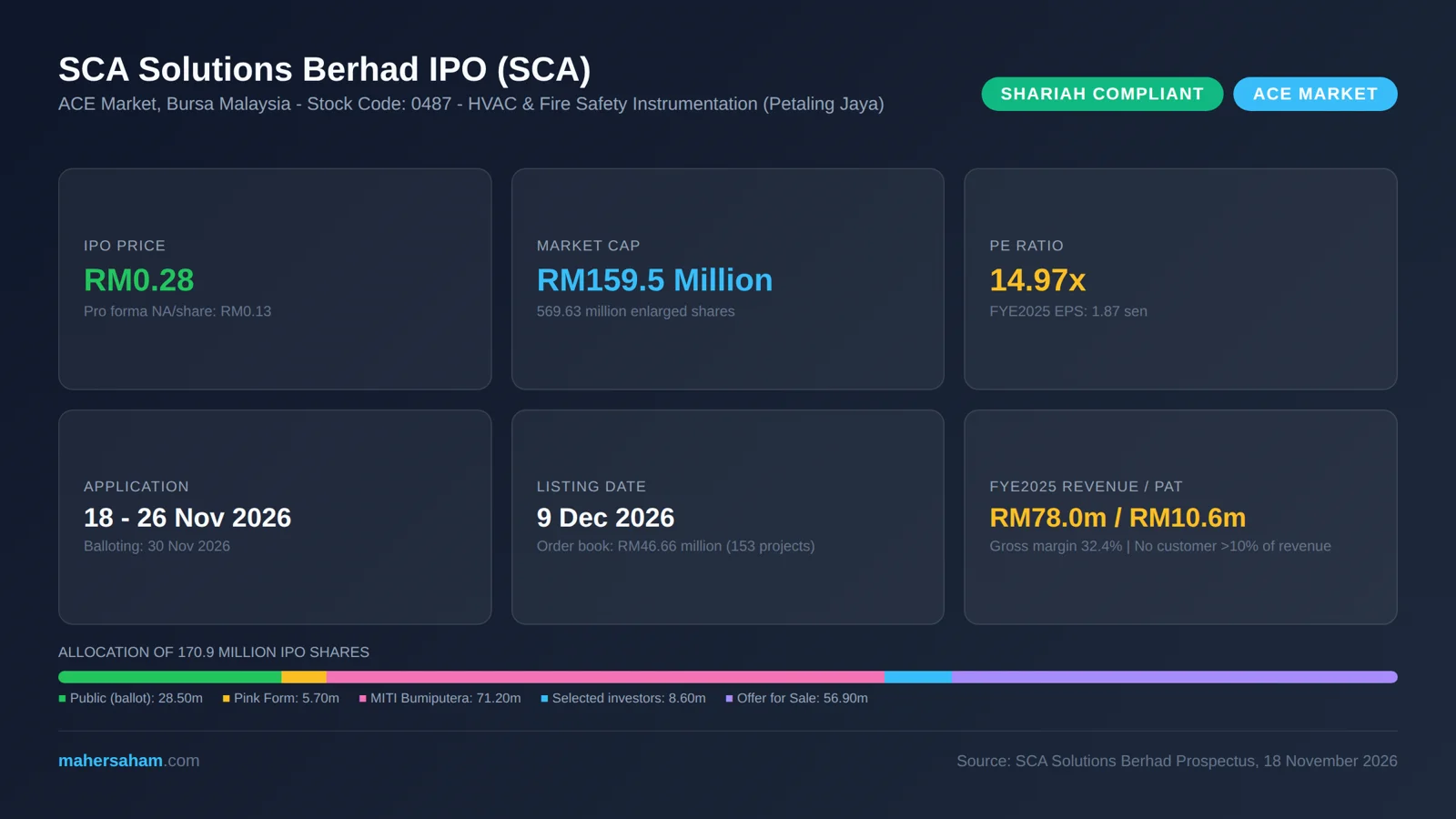
Quick summary: IPO price RM0.28 | Market cap RM159.5 million | PE 14.97x (FYE2025) | Shariah compliant | Applications close 5pm, 26 November 2026 | Balloting 30 November | Listing 9 December 2026. View SCA IPO data →
Who Is SCA Solutions Berhad?
SCA's history began on 21 July 2003, when Source Code Asia Sdn Bhd was incorporated and started distributing HVAC instruments from a shop office of about 2,000 square feet in Subang Jaya. Belimo, the Swiss brand of damper actuators and control valves, became its first principal in the same year. Two mechanical engineers who graduated from the University of Glamorgan have led the company from the start: Tan Cheng Eng (now Managing Director, 31 years of experience, formerly an engineer at York Malaysia) and Liong Chian Leek (Executive Director, 29 years of experience, formerly with Johnson Controls). Since 2010, the two of them have been the sole shareholders of the operating company.
The business expanded into fire safety products in 2006 (Honeywell's Notifier and System Sensor) and into water treatment for HVAC systems in 2008 through Greneco. The listing vehicle, SCA Solutions Berhad, was incorporated in October 2025 and acquired all three subsidiaries in January 2026:
- Source Code Asia Sdn Bhd (100%) - the main operating company, focused on large-scale projects and high-specification products
- Ace Victech Sdn Bhd (100%) - the same activities but for smaller projects and a more affordable product range
- Greneco Sdn Bhd (100%) - water treatment solutions for HVAC systems, with a workshop in Shah Alam
The product list is available on the official SCA Solutions website.
What does SCA actually do?
SCA is an M&E solutions provider. It does not manufacture, does not design systems (it only assists consultants) and does not install equipment (installation is done by its customers). Its value add is selecting the right components for each project, supplying them, then testing and commissioning the system so it works. There are two segments:
- HVAC and fire safety (90.9% of FPE2026 revenue) - damper actuators, control valves, sensors and energy meters (Belimo, Kamstrup), drives (ABB), fire alarm panels (Notifier) and smoke detectors (System Sensor, Xtralis), sold either as project solutions or as standalone component supply.
- Water treatment (9.1% of FPE2026 revenue) - water treatment systems for cooling towers and chillers, chemicals, and maintenance packages of 1 to 5 years.
Its customers are M&E contractors and building owners across commercial buildings, factories (data centres, semiconductors) and infrastructure such as MRT/LRT stations. Almost 99% of revenue comes from Malaysia.
SCA Solutions IPO Details
| Item | Details |
|---|---|
| Company Name | SCA Solutions Berhad |
| Stock Name / Code | SCA / 0487 |
| Market | ACE Market, Bursa Malaysia |
| IPO Price | RM0.28 per share (fixed price) |
| Shariah Status | Shariah compliant (Shariah Advisory Council of the SC, 8 October 2026) |
| Total Shares After IPO | 569,625,400 shares |
| Market Cap at RM0.28 | RM159.5 million |
| Public Issue (new shares) | 114.0 million shares (20.01%) - RM31.92 million to the company |
| Offer for Sale (OFS) | 56.9 million shares (9.99%) - RM15.93 million to the two promoters |
| Total IPO Size | 170.9 million shares (30.0%) - about RM47.85 million |
| FYE2025 EPS (enlarged share capital) | 1.87 sen |
| PE at RM0.28 | 14.97 times (10.04 times based on annualised FPE2026 PAT) |
| Pro Forma NA per Share | RM0.13 (P/NA about 2.13 times) |
| Dividend Policy | No formal policy and no target payout |
| Principal Adviser, Sponsor, Underwriter & Placement Agent | Malacca Securities Sdn Bhd |
| Issuing House | Malaysian Issuing House Sdn Bhd |
Bursa Securities listing approval was obtained on 26 August 2026, followed by SC approval relating to Bumiputera equity on 27 August 2026. There is no greenshoe and no price stabilisation mechanism. The official summary of the offering is available on the Bursa Malaysia IPO summary page.
SCA's Shariah-compliant status remains valid until the next review by the Shariah Advisory Council, which updates its list twice a year in May and November. The official list is available on the Securities Commission Malaysia website.
Key Application Dates
| Event | Date |
|---|---|
| Applications open | 10am, 18 November 2026 |
| Applications close | 5pm, 26 November 2026 (Thursday) |
| Balloting | 30 November 2026 |
| Share allotment | 7 December 2026 |
| Listing on the ACE Market | 9 December 2026 |
Applications are made in units of 100 shares, electronically through internet banking or a broker platform. At RM0.28, 100 shares cost RM28. If you have never applied for an IPO before, refer to the guide on how to apply for a Bursa IPO using MPlus Global. If the IPO concept itself is still new to you, start with our article on what an IPO is and how it works in Malaysia.
Share Allocation: 71.2 Million for MITI Bumiputera Investors, Only 28.5 Million for the Public Ballot
| Category | Number of Shares | % of Enlarged Capital |
|---|---|---|
| Malaysian public (balloting) - half for Bumiputera | 28,500,000 | 5.00% |
| Pink Form (directors, key senior management, employees) | 5,696,200 | 1.00% |
| Private placement to MITI-approved Bumiputera investors | 71,204,000 | 12.50% |
| Private placement to selected investors (new shares) | 8,599,800 | 1.51% |
| Private placement to selected investors (OFS) | 56,900,000 | 9.99% |
| Total | 170,900,000 | 30.00% |
The most important point for retail applicants: the public ballot tranche is only 28.5 million shares, equivalent to about RM7.98 million or 16.7% of the total IPO size. Half of it (14.25 million shares) is reserved for Bumiputera and the other half for other Malaysian public investors. In comparison, the MITI Bumiputera tranche of 71.2 million shares (about RM19.94 million) is 2.5 times larger. This is an SC requirement: 12.5% of the enlarged capital must be allocated to MITI-approved Bumiputera investors at IPO, and at least 50% of the balloted shares to the Bumiputera public. Any unsubscribed portion of the MITI tranche will first be offered to the Bumiputera public.
Total private placement comes to 136.7 million shares (24.0% of capital), so most IPO shares go to institutional and selected investors. Also note where the money flows: RM31.92 million from new shares goes to the company, while RM15.93 million from the OFS goes directly to the two promoters, Tan Cheng Eng (about RM10.20 million) and Liong Chian Leek (about RM5.74 million). There is a fuller explanation in our article on the difference between public issue, offer for sale and private placement.
Use of Proceeds: 82.8% for a New Hub in Kapar
The public issue raises RM31.92 million for the company. The breakdown:
| Purpose | RM million | % | Timeframe |
|---|---|---|---|
| Repayment of term financing for the Kapar Property | 10.00 | 31.3% | 24 months |
| Balance payment for the Kapar Property | 0.75 | 2.3% | 24 months |
| Renovation of the Kapar Property | 4.13 | 12.9% | 24 months |
| Customer experience centre and demo lab | 1.05 | 3.3% | 24 months |
| Working capital for Kapar operations | 10.49 | 32.9% | 48 months |
| Estimated listing expenses | 5.50 | 17.2% | 3 months |
| Total | 31.92 | 100% |
Kapar Property (RM12.88 million). SCA bought a freehold plot of about 54,713 square feet with a 30,500-square-foot building in West Coast Industrial Park, Kapar, Klang. The building is still under construction (45% complete) and vacant possession is expected in the second quarter of 2027. The purchase was first funded with RM10.0 million of Islamic financing, which will then be repaid using IPO proceeds, saving about RM3.91 million in profit costs.
Why Kapar? The existing storage space of about 9,000 square feet is already 80% to 90% utilised. The Kapar hub will house Greneco's workshop, a logistics warehouse, a sales office and the customer experience centre, with operations starting in the first quarter of 2028.
Working capital (RM10.49 million). This includes 15 new hires (RM2.33 million), additional inventory (RM2.0 million), Kapar administrative costs for 30 months (RM4.17 million) and marketing (RM2.0 million), compared with historical marketing spend of around RM0.1 million to RM0.24 million a year.
What you should note: there is no dedicated allocation for new products or overseas expansion. Almost all the money goes into one property and its operations, which only start in 2028. Listing costs of 17.2% are moderate for an ACE Market IPO, but RM3.82 million of the RM5.50 million total is charged to the income statement, so FYE2026 profit will be weighed down by this one-off cost.
SCA Solutions Financial Performance
| RM million | FYE2022 | FYE2023 | FYE2024 | FYE2025 | 6 months 2025 | 6 months 2026 |
|---|---|---|---|---|---|---|
| Revenue | 40.76 | 47.24 | 61.63 | 78.01 | 38.13 | 51.33 |
| Revenue growth | - | +15.9% | +30.5% | +26.6% | - | +34.6% |
| Gross profit | 9.39 | 12.81 | 17.33 | 25.29 | 12.95 | 18.15 |
| Gross margin | 23.0% | 27.1% | 28.1% | 32.4% | 34.0% | 35.4% |
| Profit before tax | 4.10 | 6.88 | 10.51 | 14.73 | 8.22 | 10.93 |
| Net profit (PAT) | 2.93 | 5.09 | 7.78 | 10.65 | 5.91 | 7.95 |
| Net margin | 7.2% | 10.8% | 12.6% | 13.6% | 15.5% | 15.5% |
| Net cash from operations | 1.18 | 2.13 | 8.48 | 6.35 | - | 7.18 |
| Gearing ratio (times) | 0.19 | 0.16 | 0.22 | 0.16 | - | 0.16 |
SCA's financial year ends on 31 December. The six-month 2026 figures (FPE2026) are audited, while the six-month 2025 comparatives are unaudited. Revenue grew at a compound annual rate of about 24% from FYE2022 to FYE2025, while net profit grew faster, at about 54% a year, as gross margin rose from 23.0% to 32.4%. As at 30 June 2026, the group held RM15.95 million in cash against RM7.50 million in borrowings, a net cash position of about RM8.45 million.
Why are SCA's margins rising?
A shift towards fire safety. Fire safety's contribution jumped from 25.6% of revenue in FYE2022 to 49.2% in FYE2025, and the segment's gross margin rose from 32.2% to 41.6%. In FYE2025, fire safety contributed about 63% of group gross profit. The drivers were data centre projects that need higher-grade components, plus higher Notifier selling prices.
More solutions, fewer component sales. Project solutions (supply plus testing and commissioning) rose from 62.4% of revenue to 74.4%, while standalone component supply fell from 28.2% to 16.5%. After marketing staff costs, standalone supply margins are only around 16% to 19%, compared with 37.5% for solutions (FPE2026).
Keep in mind that operating cash flow was weak in FYE2022 and FYE2023 (RM1.18 million and RM2.13 million) because receivables and inventory absorbed cash, a common feature of project-based businesses.
Valuation: PE of 14.97 Times, or 10.04 Times Annualised
At RM0.28, the PE is 14.97 times based on FYE2025 net profit of RM10.65 million and 569.6 million shares after the IPO. The prospectus also states a PE of 10.04 times if the six-month 2026 profit (RM7.95 million) is doubled to RM15.90 million. This second figure is a simple annualisation, not a profit forecast, and it does not yet account for the listing cost charge that will weigh on FYE2026 profit. For comparison, the Emits IPO, which lists on the ACE Market on 1 December 2026, was offered at a PE of 14.4 times.
On an asset basis, the pro forma NA per share after the IPO is RM0.13, giving a P/NA of about 2.13 times. IPO investors face dilution of RM0.15 per share, or 53.6% of the IPO price. The promoters, meanwhile, acquired their shares at an effective cost of around RM0.073 per share.
There are no directly comparable listed companies for a straight PE comparison. The independent market research (IMR) report by Smith Zander compares SCA with private players in Malaysia's HVAC instrumentation and fire safety industry:
| Company | Revenue (RM million) | Gross margin | Net margin |
|---|---|---|---|
| Valmatic Engineering | 89.03 | N/A | 14.1% |
| SCA Group | 78.01 | 32.4% | 13.6% |
| VIC Engineering | 70.25 | 33.1% | 9.9% |
| Envalco | 52.51 | 30.4% | 10.4% |
| Metrosis | 23.91 | 53.1% | 31.8% |
SCA is the second-largest player by revenue on this list, with one of the better net margins. According to the IMR, Malaysia's HVAC instrumentation and fire safety industry reached RM1.11 billion in 2025, growing 14.6% a year since 2023, and SCA's market share is about 6.5%. This growth is supported by the surge in data centre, semiconductor and pharmaceutical investments recorded by MIDA, as well as building fire safety requirements enforced by the Fire and Rescue Department of Malaysia.
Order Book of RM46.66 Million
As at 20 October 2026, SCA had an unbilled order book of RM46.66 million across 153 projects. Of this, RM14.50 million is expected to be recognised in the remainder of FYE2026 and RM32.15 million in FYE2027. The order book is equivalent to about 0.6 times FYE2025 revenue, so it gives visibility for roughly seven months, not years.
Fire safety solutions dominate with RM21.13 million (48 projects, RM18.12 million of which are industrial projects), followed by HVAC solutions at RM8.18 million (52 projects). The largest ongoing project is a data centre in Johor worth RM31.74 million (started October 2023, expected completion in the second quarter of 2027), followed by another Johor data centre (RM5.13 million), a mixed development in Kuala Lumpur (RM4.95 million) and metro rail stations in Johor (RM4.20 million). Note that SCA works on purchase orders, not long-term contracts. Customers are not obliged to keep placing orders, so the order book has to be replenished continuously.
Strengths of the SCA Solutions IPO
- A track record of more than 20 years, with 1,063 projects completed during the review period
- Strong and consistent growth: revenue rose every year from RM40.8 million (FYE2022) to RM78.0 million (FYE2025), and the first half of 2026 grew another 34.6%
- Exposure to the data centre theme through high-margin industrial fire safety projects
- No customer concentration: no customer exceeds 10% of revenue, and the top five customers account for only around 21% to 26%
- Healthy balance sheet: net cash, gearing of 0.16 times (falling to 0.10 times after the IPO), and interest cover of 77.6 times in FPE2026
- A 42-person engineering team, the key differentiator from ordinary distributors
Risks and Weaknesses to Consider
1. Dependence on Belimo and Honeywell
Belimo and Honeywell together make up 55% to 67% of purchases each year, and the prospectus states plainly that the group depends on both. All distribution rights are non-exclusive. The Belimo agreement is renewed annually and is deemed terminated if the renewal is not signed before 31 March 2027. It also contains a non-compete clause (SCA cannot distribute products from Belimo's competitors), and SCA missed its Belimo sales targets in FYE2024 and FYE2025, although no penalty was imposed. The Honeywell agreement is valid until 31 March 2028 but can be terminated for convenience with 30 days' notice. If either principal withdraws its rights, the impact flows straight to revenue and margins.
2. The construction cycle and data centre projects
SCA's business depends on construction activity in Malaysia. According to the IMR, the value of construction work rose from RM132.16 billion (2023) to RM178.62 billion (2025), and the latest construction statistics can be tracked through the Department of Statistics Malaysia (DOSM). However, much of SCA's margin expansion has come from data centre projects in Johor. If the data centre wave slows, contractors delay projects or price competition intensifies, revenue and margins could fall.
3. Receivables and working capital needs
SCA gives customers credit terms of 60 to 90 days, and its trade receivables collection period is 84 to 103 days. A receivables impairment of RM0.50 million was recorded in FPE2026 (involving 7 customers, with legal action against 2 of them), and a further RM0.96 million was impaired after 30 June 2026. Together these equal about 12% of FPE2026 profit. Inventory has to be bought in advance, so rapid growth can absorb cash.
4. Execution risk on the Kapar project
More than 80% of the IPO proceeds are tied to the Kapar Property, which is still under construction. Delays in vacant possession, higher renovation costs (an additional RM1.21 million in incidental costs must be self-funded) or higher-than-expected operating costs would weigh on profit. The benefits will only be felt from 2028.
5. Listing charges and no dividend policy
A total of RM3.82 million in listing costs is charged to the income statement, and most of it will appear in FYE2026, so reported profit may look lower than the annualised PAT. SCA paid dividends every year before the IPO (payout ratios of around 26% to 75%), but that money went to the two promoters. After listing, there is no formal dividend policy and no target payout.
Other risks
- Dependence on executive directors and key senior management, plus competition for skilled engineers
- Supply disruptions from overseas principals and product liability claims
- Related party transactions with Rancang Segar Sdn Bhd, an M&E contractor wholly owned by the Managing Director (around 0.4% to 1.7% of revenue)
- The promoters control 68.4% after the IPO, and ACE Market share liquidity may be low
Who Are the Major Shareholders After the IPO?
| Shareholder | Before IPO | After IPO |
|---|---|---|
| Tan Cheng Eng (promoter, Managing Director) | 62.73% | 43.78% |
| Liong Chian Leek (promoter, Executive Director) | 35.28% | 24.63% |
| Tan Choon Seng (Director of Greneco) | 1.12% | 0.89% |
| Liong Chian Yie (Technical Director) | 0.29% | 0.36% |
| Lo Weng Hoe (Business Development Director) | 0.29% | 0.36% |
The two promoters collectively hold 68.4% after the IPO and are the only substantial shareholders. Liong Chian Yie is the younger brother of Liong Chian Leek. The shares of the promoters and Liong Chian Yie (68.77% of capital) are fully locked up for the first 6 months, 45.0% remains locked up for the following 6 months, and the rest is then released progressively at one third a year. Tan Choon Seng and Lo Weng Hoe are not subject to the moratorium. Read why the end of a lock-up period matters in our article on the IPO lock-up period. The board is chaired by Dato' Chan Choy Lin, and four of the six directors are independent.
IPO Review and IPO Financing
Still deciding whether to apply? We will hold an online review of the SCA IPO on Wednesday, 25 November 2026, at 3:30pm, one day before applications close. The session is free, and our remisier will walk through the prospectus, valuation and application strategy. Join the IPO Review with a Remisier.
If you want to apply for a larger quantity, IPO financing is available for SCA (0487). Apply for 5x/10x IPO Financing. Remember that financing magnifies both potential gains and potential losses, so understand the risks first in our article on share margin and IPO financing.
Gold members can read the full prospectus analysis (Gold), including an outlook on the HVAC instrumentation and fire safety industry, a margin breakdown by segment and a detailed valuation. All the key offering figures are also on the SCA IPO data page.
Frequently Asked Questions (FAQ) About the SCA Solutions IPO
When does the SCA Solutions IPO application close?
Applications close at 5pm on Thursday, 26 November 2026. Balloting takes place on 30 November and the shares list on the ACE Market on 9 December 2026.
Is SCA Shariah compliant?
Yes. The Shariah Advisory Council of the Securities Commission classified SCA Solutions as Shariah compliant on 8 October 2026. This status is reviewed twice a year.
What is the PE of the SCA Solutions IPO?
Based on FYE2025 net profit of RM10.65 million and 569.6 million shares after the IPO, EPS is 1.87 sen and the PE at RM0.28 is about 14.97 times. The prospectus also states a PE of 10.04 times based on annualised six-month 2026 profit, but that is not a forecast.
What does SCA Solutions Berhad do?
SCA supplies HVAC instrumentation and fire safety solutions to M&E contractors, as well as water treatment for HVAC systems. It does not manufacture, but instead distributes brands such as Belimo and Honeywell.
How many shares are offered to the public?
Only 28.5 million shares (5.0% of capital) through balloting, half of them for Bumiputera. The largest tranche is 71.2 million shares for MITI-approved Bumiputera investors through private placement.
How will SCA use its IPO proceeds?
RM26.42 million (82.8%) goes to expanding operations at the Kapar Property, including repaying RM10.0 million of financing, renovation, a customer experience centre and working capital. The remaining RM5.50 million covers listing costs.
Will SCA pay dividends?
There is no formal dividend policy and no target payout. Any dividend is at the discretion of the Board of Directors.
Conclusion
The SCA Solutions IPO offers a Shariah-compliant business with a track record of more than 20 years, revenue that has risen every year, expanding margins, net cash and exposure to the data centre wave. However, more than half of its purchases depend on Belimo and Honeywell through non-exclusive distribution rights, its high margins are largely supported by data centre projects, receivables need watching, and more than 80% of the IPO proceeds are tied to a Kapar hub that only starts operating in 2028. At 14.97 times earnings (or 10.04 times annualised), the valuation needs to be weighed against these risks. The stock market is always uncertain, including how IPO shares perform after listing, so make your decision based on your own research and risk tolerance.
Before applying for this IPO or any upcoming one, make sure you already have an active CDS account.
Open a CDS trading account to invest on Bursa Malaysia as well as in foreign markets such as US and Hong Kong stocks.
Download our free Stock Market Basics Ebook to understand the fundamentals before you invest.
Disclaimer: This article is for educational purposes only and is not a recommendation to buy or sell any stock. Investing in shares involves risk, and past performance does not guarantee future returns.
Further Reading
- What Is an IPO? How Initial Public Offerings Work in Malaysia
- Difference Between Public Issue, Offer For Sale and Private Placement in IPO
- Why IPO Stocks Can Crash 6 Months After Listing: Lock-Up Period & Cornerstone Investors Explained
- How to Apply for a Bursa IPO Using MPlus Global (BM)
- Share Margin Financing & IPO Financing: What Malaysian Investors Must Know
- Emits IPO (EMITS 0486): Penang Maker of Motorola Walkie-Talkie Antennas Prices at 16 Sen