Emits IPO (EMITS 0486): Penang Maker of Motorola Walkie-Talkie Antennas Prices at 16 Sen

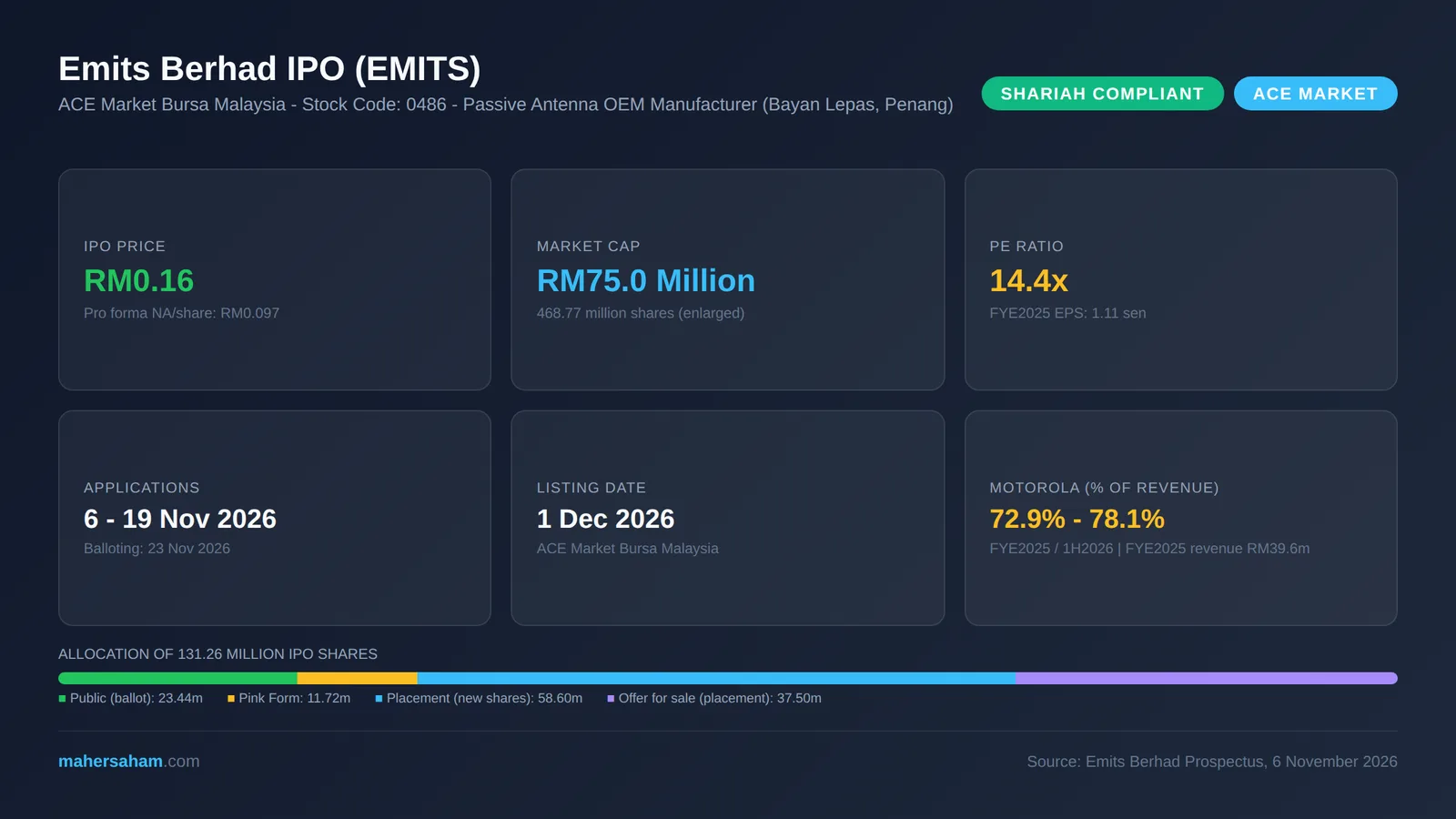
Emits Berhad, a passive antenna manufacturer based in Bayan Lepas, Penang, opened its IPO for applications on 6 November 2026 at RM0.16 per share. The company is scheduled to list on the ACE Market of Bursa Malaysia on 1 December 2026 under the stock name EMITS (code 0486). At the IPO price, its market capitalisation is RM75.0 million.
If you have ever seen a police officer, security guard or factory worker holding a walkie-talkie, there is a good chance the small antenna on top of that radio was made by an OEM manufacturer like Emits. Nearly three quarters of this company's revenue comes from a single customer, the Motorola Group. The question is whether that level of dependence is worth paying 14.4 times earnings for. This article summarises the key facts from the official prospectus dated 6 November 2026: offer details, share allocation, use of proceeds, financial performance, why revenue fell in two consecutive periods, the still unproven 5G antenna project, and the strengths and risks you should understand before applying.
Quick summary: IPO price RM0.16 | Market cap RM75.0 million | PE 14.4x (FYE2025) | Shariah compliant | Applications close 5pm, 19 November 2026 | Balloting 23 November | Listing 1 December 2026. View IPO data →
Who Is Emits Berhad?
Emits traces its history to 28 October 2015, when two former Amphenol Malaysia engineers, Ts. Loy Boon Liang and H'ng Chuen Yeou, set up Emits Technology Sdn Bhd. Amphenol had just relocated its antenna operation to China, so the pair brought existing expertise and customer relationships with them. Penang entrepreneur Dato' Seri Goh Eng Hoe became a major shareholder in February 2016, and the relationship with Motorola began the same year.
The listing vehicle, Emits Berhad, was incorporated in February 2025 specifically for the IPO and completed its acquisition of Emits Technology in September 2026. The group has three subsidiaries:
- Emits Technology Sdn Bhd (100%) - the main operating company, making antennas and related components at its own factory in the Bayan Lepas Free Industrial Zone
- Emits Radio Wave (Taiwan, 100%) - an antenna assembly line in Taoyuan, Taiwan
- Emits (RF) Sdn Bhd (100%) - dormant since incorporation
What does Emits make?
Emits is an OEM service provider that designs, sources, manufactures, assembles and tests passive antennas for brand owners (mostly telecommunications companies) and EMS providers. Its core product is the LMR (land mobile radio) antenna for walkie-talkies and handheld radios, which made up 91.6% of FYE2025 revenue and 95.5% of revenue in the first half of 2026. Other products include embedded antennas (LTE, Wi-Fi, Bluetooth), dome antennas for ceilings and vehicle roofs, and 5G base station antennas, which have not generated revenue yet.
Why an assembly line in Taiwan? Certain US customers require LMR antennas from a "Designated Country" that has a trade agreement with the US. Taiwan is a party to the WTO government procurement agreement, while Malaysia is not. The Taiwan line is run by supplier Jy Chyun Enterprise, not by Emits' own staff.
Emits IPO Details
| Item | Details |
|---|---|
| Company | Emits Berhad |
| Stock Name / Code | EMITS / 0486 |
| Market | ACE Market, Bursa Malaysia |
| IPO Price | RM0.16 per share (fixed price) |
| Shariah Status | Shariah compliant (SC Shariah Advisory Council, 7 May 2026) |
| Shares After IPO | 468,769,000 shares |
| Market Cap at RM0.16 | RM75.0 million |
| Public Issue (new shares) | 93.75 million shares (20.0%) - RM15.0 million to the company |
| Offer for Sale (OFS) | 37.50 million shares (8.0%) - RM6.0 million to five selling shareholders |
| Total IPO Size | 131.26 million shares (28.0%) - about RM21.0 million |
| FYE2025 EPS (enlarged capital) | 1.11 sen |
| PE at RM0.16 | 14.4 times (11.5 times on pre-IPO share capital) |
| Pro Forma NA per Share | RM0.097 (P/NA about 1.65 times) |
| Dividend Policy | Targets about 20% of PAT each year (no formal policy) |
| Principal Adviser, Sponsor, Underwriter & Placement Agent | Mercury Securities Sdn Bhd |
| Issuing House | Vistra Investor & Issuing House Services (formerly Tricor) - TIIH Share Issue Account No. 840 |
Mercury Securities holds every advisory role and underwrites 35.16 million shares for the public and Pink Form tranches under an agreement dated 19 October 2026. Bursa Securities approved the listing on 19 August 2026. According to The Star's coverage of the prospectus launch, most of the money raised will go to the 5G antenna project and R&D equipment. The official offer summary is also available on Bursa Malaysia's IPO summary page.
EMITS' Shariah-compliant status stays valid until the next review by the Shariah Advisory Council, which updates its list on the last Friday of May and November. The official list is published by the Securities Commission Malaysia.
Key Application Dates
| Event | Date |
|---|---|
| Applications open | 10am, 6 November 2026 |
| Applications close | 5pm, 19 November 2026 (Thursday) |
| Balloting | 23 November 2026 |
| Share allotment | 30 November 2026 |
| Listing on the ACE Market | 1 December 2026 |
Applications are made in units of 100 shares, electronically through internet banking or your broker's platform. At RM0.16, 100 shares cost just RM16. If you have never applied for an IPO before, see our guide on how to apply for a Bursa IPO with MPlus Global (in Malay).
Share Allocation: Only 23.4 Million Shares for the Public Ballot
| Category | Shares | % of Enlarged Capital |
|---|---|---|
| Malaysian public (ballot) - half reserved for Bumiputera | 23,439,000 | 5.0% |
| Pink Form (directors, employees, contributors) | 11,719,000 | 2.5% |
| Private placement to selected investors (new shares) | 58,596,000 | 12.5% |
| Private placement to selected investors (OFS) | 37,502,000 | 8.0% |
| Total | 131,256,000 | 28.0% |
The public ballot tranche is only 23.44 million shares, worth about RM3.75 million. Half of it (11.72 million shares) is reserved for Bumiputera investors. There is no MITI-approved Bumiputera placement tranche at this IPO. Instead, the SC requires 12.5% of the share capital to be allocated to MITI-approved Bumiputera investors within five years of listing or one year after meeting the Main Market profit requirement, whichever comes first.
It also pays to separate the two types of shares on offer: the RM15.0 million from new shares goes to the company, while the RM6.0 million from the OFS goes straight to the selling shareholders, including Dato' Seri Goh (about RM2.46 million) and Loy and H'ng (about RM1.44 million each). For more on this, read our article on the difference between a public issue, offer for sale and private placement.
Use of Proceeds: RM6 Million for a 5G Project With No Contract Yet
The public issue raises RM15.0 million for the company. The breakdown:
| Purpose | RM million | % | Timeframe |
|---|---|---|---|
| Working capital (including RM6.0 million for 5G antenna production) | 6.80 | 45.3% | 24 months |
| R&D machinery and equipment | 4.00 | 26.7% | 24 months |
| Estimated listing expenses | 4.20 | 28.0% | 1 month |
| Total | 15.00 | 100% |
5G project working capital (RM6.0 million). This covers raw materials for the first three months (RM5.2 million), 40 contract workers and factory overheads for mass production of 5G base station antennas for CCI, a private US seller of wireless network equipment. If the CCI project does not go ahead, the money will be redirected to other 5G antenna orders. The remaining RM0.8 million goes to insurance, marketing and post-listing professional fees.
R&D machinery (RM4.0 million). A PCB prototyping machine, 3D printer, 3D mould simulation software, three moulding machines, two laser welding machines and a thermal shock chamber. All are based on supplier quotations and none have been contracted yet.
What you should note: 28.0% of the proceeds go to listing costs, a high ratio even for an ACE Market IPO. Of the RM4.2 million, about RM2.86 million has not yet been expensed and will hit the income statement around the listing quarter, so profit in that quarter is likely to be depressed. None of the money goes to repaying debt.
Financial Performance
| RM million | FYE2023 | FYE2024 | FYE2025 | 1H2025 | 1H2026 |
|---|---|---|---|---|---|
| Revenue | 32.01 | 40.99 | 39.65 | 20.27 | 18.15 |
| Revenue growth | - | +28.1% | -3.3% | - | -10.4% |
| Gross profit | 8.10 | 12.38 | 11.12 | 5.81 | 4.84 |
| Gross margin | 25.3% | 30.2% | 28.0% | 28.7% | 26.7% |
| Profit before tax | 3.01 | 7.90 | 6.20 | 2.94 | 2.52 |
| Net profit (PAT) | 2.17 | 5.83 | 5.20 | 2.14 | 2.07 |
| Net margin | 6.8% | 14.2% | 13.1% | 10.6% | 11.4% |
| Net cash from operations | 8.65 | 8.88 | 6.82 | - | 2.66 |
| Gearing (times) | 0.8 | 0.4 | 0.2 | - | 0.2 |
Emits' financial year ends on 31 December. The first-half 2026 figures are audited, while the first-half 2025 comparatives are unaudited. The group was in a net cash position of RM1.48 million at 30 June 2026, and all its borrowings are secured US dollar term loans.
Why did revenue fall in FYE2025 and the first half of 2026?
FYE2025 (-3.3%). Sales to Motorola dropped RM4.1 million (from RM33.0 million to RM28.9 million) because fewer new models were developed and orders for existing models declined. The prospectus also blames the US reciprocal tariff framework (24% announced in April 2025, then 19% from 1 August 2025) for making US customers more cautious. Gross margin slipped from 30.2% to 28.0% on the minimum wage increase to RM1,700 and a weaker US dollar. Net profit fell only RM0.6 million thanks to a RM0.6 million tax saving from reinvestment allowance on the 5G machinery.
First half of 2026 (-10.4%). This is a clear example of currency risk. Revenue in US dollars was almost unchanged (USD4.55 million versus USD4.57 million), but the average exchange rate fell from RM4.423 to RM3.985 per dollar. Prototype and tooling sales also dropped RM1.5 million as customers reused existing antenna models, and there were no dome antenna sales at all. We explain what currency moves mean for local investors in what a moving ringgit means for Bursa Malaysia investors.
Valuation: 14.4 Times Earnings for a Company With Falling Revenue
There is no pure-play antenna maker listed on Bursa for a direct PE comparison. The Independent Market Research (IMR) report by Providence Strategic Partners compares Emits with private players in Malaysia:
| Company | Revenue (RM million) | Gross margin | Net margin |
|---|---|---|---|
| Amphenol TCS (Malaysia) | 622.07 | 41.7% | 29.9% |
| Amphenol DC Electronics Malaysia | 476.08 | 31.2% | 20.6% |
| TE Connectivity Malaysia | 264.68 | 9.3% | 1.8% |
| Auto Antenna Manufacturer | 72.77 | 14.7% | 6.6% |
| Huber+Suhner (M) | 52.54 | 24.7% | 12.8% |
| Emits Berhad | 39.65 | 28.0% | 13.1% |
Emits' margins sit in the middle of the pack, ahead of TE Connectivity and Auto Antenna but well below Amphenol. Note that competitors' revenue may include non-antenna businesses. Emits holds only 0.2% of the USD4.8 billion global passive antenna market (2025).
At RM0.16, the PE is 14.4 times FYE2025 earnings. If first-half 2026 profit is simply doubled (not a forecast), the PE rises to about 18 times. That is more expensive than other ACE Market IPOs this month, such as the Yes Group IPO (12.68 times) and the Impact Capital IPO (11.28 times). On assets, the P/NA is about 1.65 times, and IPO investors absorb dilution of RM0.063 per share, or 39.4%. By comparison, the promoters and management acquired their shares at an effective cost of about RM0.02 per share.
The 5G Project: Big Opportunity, But No Contract Yet
Emits spent RM5.45 million setting up four 5G base station antenna production lines in December 2025, with capacity of about 6,336 units a year. In 2025, these lines produced only five demo units. CCI received 40 demo units in the first quarter of 2026 and gave conditional approval for one model in May 2026, but then asked for engineering changes (extending the low band from 698 MHz to 617 MHz) and a new set of demo units in September 2026.
The latest timeline: 6 to 9 months to redesign, pre-qualification completed in the fourth quarter of 2027, and the first mass production order no earlier than the first quarter of 2028. CCI may need 4,000 to 6,000 units a year at an indicative price of at least USD1,000 per unit. In theory that is worth roughly RM16 million to RM24 million a year, equal to 40% to 60% of FYE2025 revenue. But there is no binding contract, no other 5G customer, and the prospectus itself admits 5G margins may be lower than the historical 25% to 30%. Treat these figures as potential, not a projection.
Strengths of the Emits IPO
- A 10-year track record with Motorola and other listed brand owners whose supplier audits are strict (evaluation can take up to a year), so customers do not switch suppliers easily
- A solid balance sheet: RM1.48 million net cash, 0.18 times gearing, and 97.4% of trade receivables at 30 June 2026 already collected
- Positive operating cash flow every year, between RM6.8 million and RM8.9 million a year in FYE2023-2025
- An owned factory in the Bayan Lepas Free Industrial Zone (valued at RM18.5 million), with duty exemptions on imported materials and 7,677 sq ft of space for expansion
- A dividend target of about 20% of PAT, which few ACE Market IPOs commit to
- A 5G option that could change the size of the company if CCI orders materialise
Risks and Weaknesses to Consider
1. Extreme dependence on Motorola
Motorola contributed 72.9% of FYE2025 revenue and 78.1% of first-half 2026 revenue. It is the only customer above 10%, and the top five customers exceed 91%. The prospectus states plainly that the group is "highly dependent" on Motorola. The supply agreement dated 29 July 2024 is based on purchase orders with no volume commitment, and can be terminated for material breach. If Motorola cuts orders, moves production elsewhere or squeezes prices through its most-favoured pricing clause, the impact flows straight to Emits' profit. Motorola is also a slow payer, with collection periods of 102 to 167 days.
2. Revenue in USD, costs in ringgit
Almost 100% of revenue is transacted in US dollars, but a large part of costs (wages, contract workers, some materials) is paid in ringgit. The first half of 2026 already showed the effect: USD sales were flat but ringgit revenue fell 10.4%. If the ringgit keeps strengthening, margins will stay under pressure. Outstanding forward contracts are only about USD0.5 million.
3. The 5G project is unproven
RM6.0 million of IPO money is earmarked for a project with no contract, repeated design changes, and a first order not expected before 2028. Meanwhile the RM5.45 million 5G lines are built but not yet producing revenue, and group depreciation rose from RM0.59 million to RM0.90 million in the first half of 2026.
4. US tariffs and geopolitics
About 60% of revenue is delivered to the US. US reciprocal tariffs were already blamed for the FYE2025 sales decline, and the prospectus cites a 10% tariff on Malaysian exports under Section 301 from 24 July 2026. We cover the background in our article on the US Section 301 investigation into Malaysia. The directors also flag Middle East conflict as a risk to input and transport costs.
5. Stalled growth and listing charges
Revenue fell in two consecutive periods, and FYE2025 profit was helped by an unusually low effective tax rate (16.0%). Add about RM2.86 million of listing costs still to be expensed, and the first few quarters after listing may look weak.
Other risks
- Dependence on Jy Chyun Enterprise for the Taiwan assembly line (the largest supplier, about 38% of purchases)
- Dependence on executive directors and skilled engineers
- MIDA, Customs licensed manufacturing warehouse and MBPP licences that must be renewed
- Product warranty claims of up to 18 months
- Promoters control 60.6% after the IPO, and ACE Market liquidity may be thin
Who Are the Major Shareholders After the IPO?
| Shareholder | Before IPO | After IPO |
|---|---|---|
| Dato' Seri Goh Eng Hoe (promoter) | 46.6% | 34.0% |
| Ts. Loy Boon Liang (promoter, Group Managing Director) | 19.0% | 13.3% |
| H'ng Chuen Yeou (promoter, Executive Director) | 19.0% | 13.3% |
| Por Chee Seong (Chief Technology Officer) | 7.6% | 5.4% |
| Lim Kean Yap (pre-listing investor) | 4.1% | 3.3% |
The three promoters collectively hold 60.6% after the IPO. Dato' Seri Goh is not a director of Emits, but his son-in-law Chan Tsai-Huo sits on the board as a Non-Independent Non-Executive Director. The promoters' shares (60.7% of capital) are locked for the first 6 months, 45.0% stays locked for the following 6 months, and the rest is released in stages of one third a year. Pre-listing investors Lim Kean Yap and Tiong Keng Woo are locked for 6 months, while Por Chee Seong (5.4%) and Ho Kooi Yong (2.0%) are not under any moratorium. Read why lock-up expiry matters in our article on IPO lock-up periods. The board is chaired by Dato' Low Suet Moi, and four of its seven directors are independent.
IPO Review and IPO Financing
Still deciding whether to apply? We will hold an online review of the Emits IPO on Wednesday, 18 November 2026, at 3:30pm, one day before applications close. Our remisier will walk through the prospectus, valuation and application strategy. Join the IPO Review with a Remisier.
If you want to apply for a larger quantity, IPO financing is available for EMITS (0486). Apply for 5x/10x IPO Financing. Remember that financing magnifies both potential gains and potential losses, so understand the risks first in our article on share margin and IPO financing.
Gold members can read the full prospectus analysis, including the passive antenna industry outlook and a detailed valuation, in the Emits IPO Review.
Frequently Asked Questions (FAQ)
When does the Emits IPO application close?
Applications close at 5pm on Thursday, 19 November 2026. Balloting takes place on 23 November and the shares list on the ACE Market on 1 December 2026.
Is EMITS Shariah compliant?
Yes. The Shariah Advisory Council of the Securities Commission classified Emits as Shariah compliant on 7 May 2026. The status is reviewed twice a year, on the last Friday of May and November.
What is the PE of the Emits IPO?
Based on FYE2025 net profit of RM5.20 million and 468.77 million shares after the IPO, EPS is 1.11 sen and the PE at RM0.16 is about 14.4 times.
What does Emits Berhad do?
Emits is an OEM manufacturer of passive antennas, mainly LMR antennas for walkie-talkies and handheld radios, with a factory in Bayan Lepas and an assembly line in Taiwan. It is also developing 5G base station antennas.
How much of Emits' revenue comes from Motorola?
Motorola contributed 72.9% of FYE2025 revenue and 78.1% of revenue in the first half of 2026. It is the only customer above 10% of revenue.
Why did Emits' revenue fall?
FYE2025 revenue fell 3.3% as Motorola orders declined and US customers turned cautious over tariffs. First-half 2026 revenue fell 10.4% mainly because the ringgit strengthened, even though US dollar sales were almost unchanged.
How will the Emits IPO proceeds be used?
RM6.8 million for working capital (including RM6.0 million for 5G antenna production), RM4.0 million for R&D machinery and RM4.2 million for listing costs.
Will Emits pay dividends?
There is no formal policy, but the board targets a payout of about 20% of net profit each year, at its discretion.
Conclusion
The Emits IPO offers a Shariah-compliant antenna maker with a 10-year track record, positive cash flow, net cash and a 20% dividend target. However, nearly three quarters of its revenue depends on Motorola, almost all its sales are in US dollars while the ringgit is strengthening, revenue has fallen in two consecutive periods, and the 5G project that forms the growth story has no contract before 2028. At 14.4 times earnings, it is priced above several other ACE Market IPOs this month. The stock market is always uncertain, including how IPO shares perform after listing, so make your decision based on your own research and risk tolerance.
Before applying for this IPO or any upcoming one, make sure you already have an active CDS account.
Open a CDS trading account to invest on Bursa Malaysia as well as in foreign markets such as US and Hong Kong stocks.
Download our free Stock Market Basics Ebook to understand the fundamentals before you invest.
Disclaimer: This article is for educational purposes only and is not a recommendation to buy or sell any stock. Investing in shares involves risk, and past performance does not guarantee future returns.
Further Reading
- What Is an IPO? How Initial Public Offerings Work in Malaysia
- Difference Between Public Issue, Offer For Sale and Private Placement in IPO
- Why IPO Stocks Can Crash 6 Months After Listing: Lock-Up Period & Cornerstone Investors Explained
- Yes Group IPO (YES 0485): Corporate Incentive Travel Specialist Opens Applications at 18 Sen
- Share Margin Financing & IPO Financing: What Malaysian Investors Must Know