Share Buyback on Bursa Malaysia: Why Do Companies Buy Back Their Own Shares?

Have you ever been browsing announcements on the Bursa Malaysia website and suddenly spotted a heading that reads "Notice of Shares Buy Back by a Company Pursuant to Section 127"?
For new investors, this might seem overly technical. But for seasoned investors who have been around the block, a Share Buyback (SBB) announcement is actually a major signal. It is as though the company is whispering in your ear, "Hey, our shares are really cheap right now!"
Let us break down everything you need to know about Share Buyback on Bursa Malaysia in plain, practical language.
Share Buyback on Bursa Malaysia: Why Do Companies Buy Back Their Own Shares?
What Exactly Is a Share Buyback (SBB)?
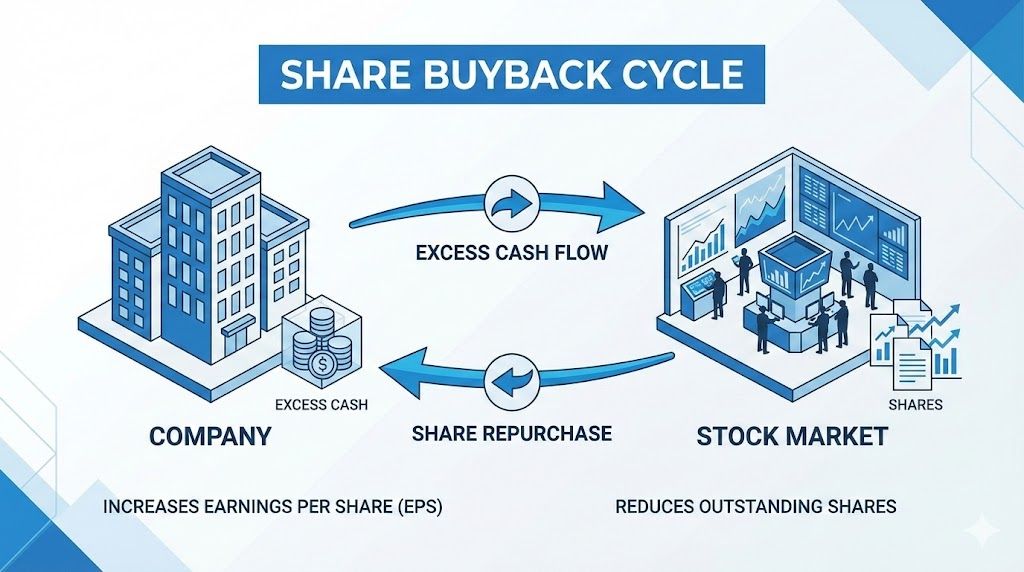
In simple terms, a Share Buyback or Share Repurchase is a corporate action where a listed company uses its surplus cash to repurchase its own shares from the open market (Bursa Malaysia).
Imagine you run a nasi lemak business. There are 100 shares of your company held by the public. Suddenly, you realise your business is booming, but the price people are selling your shares for is far too low. So you take some of your profits and buy back 10 of those shares. Now, only 90 shares remain in circulation.
When there are fewer units in the market, each remaining unit automatically becomes more valuable. That is the fundamental concept behind SBB.
Why Do Companies Go Through the Effort of SBB? (The Strategic Moves)
Companies do not spend money buying their own shares on a whim. There are usually strategic reasons behind it:
1. Shares Are Too Cheap (Undervalued)
This is the most common reason. The company's management (Board of Directors) knows the true value of their business better than anyone. If the market price has plummeted due to global sentiment or panic selling, but the company's fundamentals remain solid, the company will execute an SBB to provide support for the share price.
2. Confidence Signal
When a company uses its own money to buy shares, it signals that the leaders within the organisation are highly confident about the company's future. It serves as a "Vote of Confidence" for external investors. "We are willing to buy — surely you would not want to sell?"
3. Improving Financial Ratios (Financial Engineering)
SBB automatically reduces the total number of shares in circulation. The effects include:
- Earnings Per Share (EPS) Rises: Because the net profit is divided among fewer units.
- Return on Equity (ROE) Increases: This shows the company is more efficient at managing its capital.
4. Managing Excess Cash
Rather than letting millions of ringgit sit idle in the bank earning low interest rates, the company reinvests that money back into itself through SBB.
The Rules of SBB in Malaysia: What Does the Law Say?
In Malaysia, companies cannot carry out SBB as they please. They are subject to the Companies Act 2016 (Section 127) and Bursa Malaysia regulations.
- 10% Mandate: A company is only permitted to buy back a maximum of 10% of its total issued shares.
- Solvency Test: Before purchasing, the company must pass a "Solvency Test". This means that after buying back the shares, the company must still have sufficient funds to pay its debts and continue operations. They cannot go bankrupt just to buy their own shares!
- Shareholder Approval: The company must obtain permission from shareholders (like you!) at the Annual General Meeting (AGM). This mandate is typically valid for one year.
What Happens After the Company Buys Back the Shares?
Shares that have been bought back are called Treasury Shares. The company has several options:
- Retain as Treasury Shares: They can be resold when the price rises later (profit on the upside!).
- Distribute as Share Dividends: Instead of paying cash dividends, the company gives free shares to investors. This is something many investors love!
- Use for ESOS: Given to outstanding employees as a reward or bonus.
- Cancel the Shares: The shares are permanently "disposed of". This permanently reduces the company's share capital and increases the value of the remaining shares.
SBB: Good News or a Red Flag for Investors?
Do not jump for joy the moment you hear a company is doing SBB. Let us look at the pros and cons:
| Advantages for Investors | Risks to Watch Out For |
| Share Price Stability: SBB acts as a 'floor price' to prevent the price from falling further. | No New Investment Ideas: Sometimes companies do SBB because they have no idea where else to invest the money (stagnant growth). |
| Share Dividends: The opportunity to receive additional share units for free without putting in extra capital. | Wasting Cash: If the company buys back shares when the price is at a peak (expensive), it actually wastes the company's cash. |
| Increased Ownership: Your percentage stake in the company rises 'for free' because the total number of units has decreased. | Financial Window Dressing: The company might deliberately do SBB to mask weak profit growth (to make EPS look better). |
If you would like to learn more about other types of corporate exercises such as bonus issues, share splits, share consolidation, and more, read our guide:
Complete Guide to Corporate Exercises on Bursa Malaysia: What Investors Need to Know
How to Monitor SBB Activity on Bursa Malaysia
You can track SBB activity in real-time. Here is how:
- Visit the Bursa Malaysia website.
- Go to the Company Announcements section.
- Search for the "Shares Buy Back" category.
There, you can see how many units the company purchased, at what price, and their remaining Treasury Shares balance. If a company is buying consistently every day, that is a sign they are aggressively supporting the share price.
Conclusion: Should We Follow and Buy Too?
A Share Buyback is a very useful financial tool when used correctly. For savvy investors, SBB is an indicator that management believes their shares are undervalued.
However, do not base your investment decisions on SBB alone. Make sure you also check:
- Does the company still have growth potential?
- Is the company's debt under control?
- Is their cash flow still positive after conducting the SBB?
Remember, the best investments are those backed by knowledge and thorough fundamental analysis.
Why not start learning and investing in shares on Bursa Malaysia yourself? If you are still a complete beginner and have no idea where to start, you can begin by opening a CDS account under Mahersaham. Tuan Maher is a registered dealer's representative under Broker Mplus.
If you are interested in opening a CDS account, click here: OPEN CDS ACCOUNT
FAQ – Share Buyback on Bursa Malaysia
What is a share buyback?
A share buyback (SBB) is a corporate action where a listed company uses its surplus cash to repurchase its own shares from the open market on Bursa Malaysia, reducing the number of shares in circulation.
Is a share buyback always a good sign for investors?
Not necessarily. While it often signals that management believes the shares are undervalued, it can also mean the company lacks new growth opportunities or is trying to artificially improve financial ratios like EPS.
How much can a Malaysian company buy back?
Under the Companies Act 2016 (Section 127), a company may only buy back a maximum of 10% of its total issued shares, subject to passing the solvency test and obtaining shareholder approval at the AGM.
What happens to shares after a buyback?
Bought-back shares become Treasury Shares. The company can retain them, redistribute them as share dividends, use them for employee share option schemes (ESOS), or cancel them permanently.
How can I track share buyback activity on Bursa Malaysia?
Visit the Bursa Malaysia website and go to the Company Announcements section. Filter by the "Shares Buy Back" category to see daily buyback activity, including the number of units purchased and the price paid.