Stock Portfolio by Age: How to Allocate Investments in Your 20s, 30s & 40s on Bursa Malaysia

A 25-year-old investor and a 45-year-old investor should not have the same portfolio. Not because stocks are worth differently to them, but because the time they have and their risk tolerance are fundamentally different. The 25-year-old has 35-40 more years before retirement — they can absorb large market shocks and fully recover. The 45-year-old has only 15-20 years — the same shock can destroy their retirement plans.
But most retail investors in Malaysia do not follow this principle. They buy stocks based on current trends, tips from friends, or what is "popular" in Telegram groups — without thinking whether the portfolio fits their age and life stage. The result: young investors who are too cautious miss out on growth opportunities, while older investors who are too aggressive can be wiped out before they have time to recover.
This article explains how to structure a stock portfolio by age — 20s, 30s, and 40s — in the Malaysian market context. Not rigid mathematical formulas, but principles you can adapt to your personal circumstances.
Short Answer
As a basic guide, use the "110 minus age" rule for the percentage of stocks in your portfolio: 20s = 85-90% stocks (lots of growth), 30s = 75-80% stocks (growth + start adding dividends/REITs), 40s = 65-70% stocks (more defensive & income, reduce high-risk). The remainder: cash, bonds, ASB/Sukuk, and stable assets. Adjust for personal debt, dependents, and risk tolerance.
Why Age Matters in Investing
Three main reasons that make age the most important factor in portfolio design.
First, time horizon. You need time to recover from market shocks. History shows the US stock market takes 1-3 years on average to recover from typical declines, but big crises like 2008 took 5-6 years. If you are 28 and the market falls 40%, you have 30+ years to recover and continue to harvest long-term compounding. If you are 58, you may not have time to fully recover before you need to start withdrawing for retirement.
Second, risk capacity differs from risk tolerance. Tolerance is how much risk you can stomach emotionally. Capacity is how much risk you should take based on financial circumstances. Young investors may have low tolerance (afraid to lose) but high capacity (can withstand losses because they have time to recover). Older investors may have high tolerance (experienced) but low capacity (no time to recover). A portfolio should be built based on capacity, not tolerance alone.
Third, income sources and obligations. A 20s investor is usually single, salary just starting, no children. A 40s investor may have a family, housing instalments, children in university, elderly parents. These financial obligations require a higher level of stability and cash accessibility — which shapes portfolio composition.
20s Portfolio: Maximum Growth, Highest Risk
In this decade, you have one advantage older investors cannot buy with any amount of money: time. Compounding works best over long periods. RM1,000 invested at age 25 at a CAGR of 8% becomes RM21,725 at age 65 — without you adding a single sen more. If you start at age 35, the same amount only becomes RM10,063.
Suggested 20s portfolio allocation:
- 80-90% Stocks (especially growth)
- 5-10% REITs or high dividend (to get used to cash flow)
- 5-10% Cash/ASB/Sukuk (emergency + buying opportunities)
Within the stock component:
- 50-60% growth stocks (tech, healthcare, consumer growth) — give exposure to long-term growth
- 20-30% blue-chip stocks (big banks, top-tier plantations) — stability and moderate dividends
- 10-20% small/mid-cap high-growth — high risk but big potential
Main sectors for 20s: technology (Inari, ViTrox, Greatech), healthcare (IHH, KPJ), consumer growth (Padini, MyNews), and structural themes like data centre / AI semiconductor. Young investors can absorb the high volatility of these sectors.
Common 20s mistake: too focused on one "tip" stock, too little diversification, or the opposite — too cautious (too much in fixed deposits) when time is on your side.
30s Portfolio: Growth + Start Adding Income
The 30s is a transition decade. You have a few years of investing experience, perhaps you have seen a bear market once or twice. Income is usually more stable than in your 20s. But obligations start to appear — marriage, buying a house, children (maybe), and retirement planning starts to become serious.
Suggested 30s portfolio allocation:
- 70-80% Stocks
- 10-15% REITs + high dividend (passive income starts to matter)
- 10-15% Cash/ASB/Sukuk/Bonds
Within the stock component:
- 40-50% blue-chip & defensive (banks, utilities, consumer staples)
- 25-30% growth (tech, healthcare, structural themes)
- 15-20% high-dividend stocks (REITs, telco, oil & gas)
- 5-10% special-opportunity stocks (small-cap, special situations)
At this stage, you start to build an income-producing portfolio, not just capital growth. REITs like KLCC, IGB REIT, Sunway REIT enter the picture. Bank stocks with 5-6% dividends become a core portfolio holding.
It is also important to understand that you need to diversify across sectors — not just count of stocks. We explain this in depth in How Many Stocks Should You Hold in Your Portfolio? Optimal Size & the Risk of 'Diworsification'.
Common 30s mistake: staying "aggressive like a 20-something" even with children and housing loans (your risk capacity has dropped), or the opposite — becoming too conservative too early because "I have a family". Balance is the key.
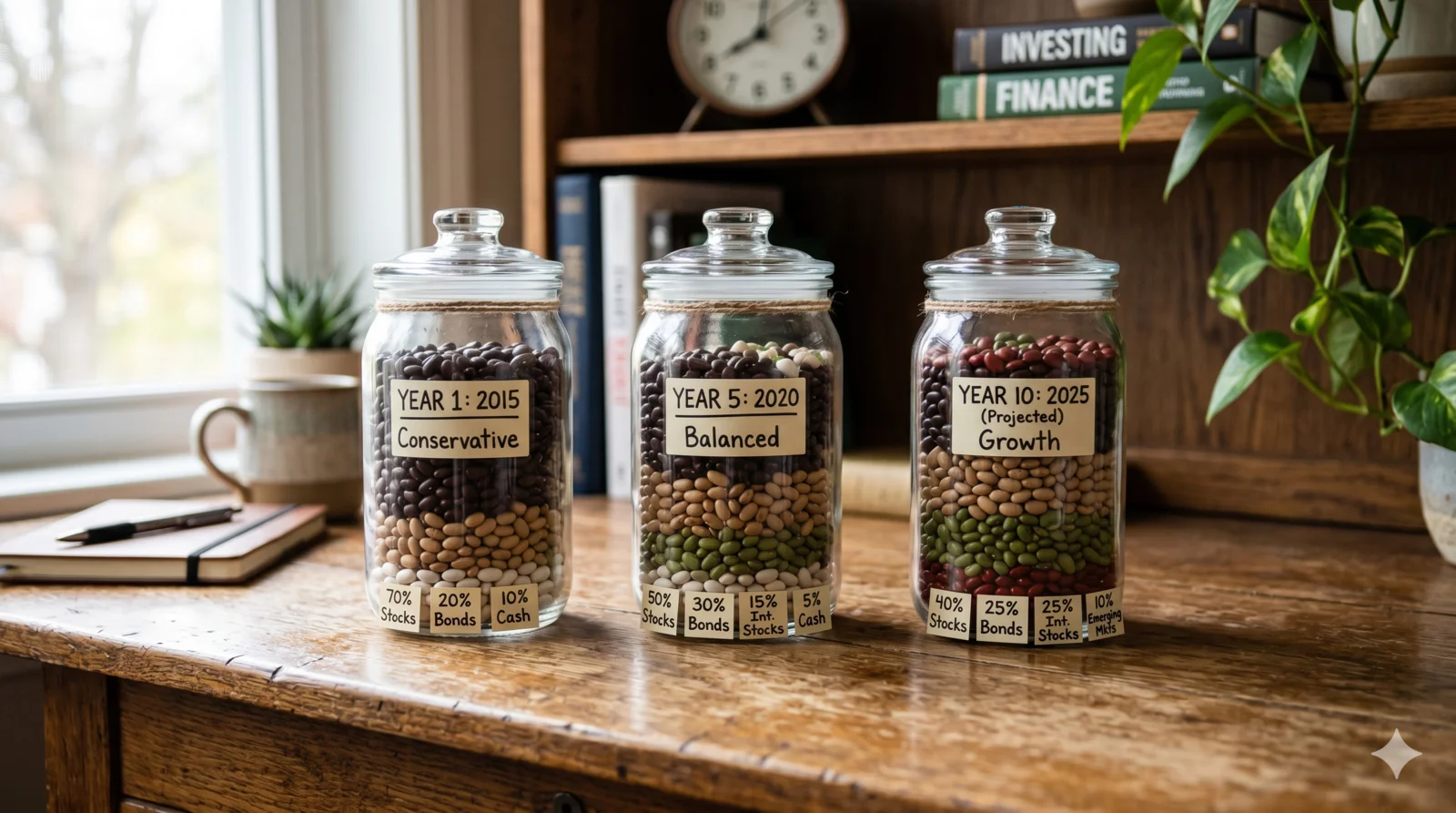
40s Portfolio: Balanced, Protect the Capital You Have Built
The 40s is a "wealth preservation matters now" decade — but you still have 15-20 years before retirement. That means you still need growth, but you cannot take extreme risks because time to recover from a big shock keeps shrinking.
Suggested 40s portfolio allocation:
- 60-70% Stocks
- 15-20% REITs + high dividend
- 15-25% Cash/ASB/Sukuk/Bonds
Within the stock component:
- 50-60% blue-chip & defensive (top-tier banks, utilities, consumer staples, large telco)
- 20-25% high-dividend & REITs
- 15-20% growth (but in proven companies, not speculative ones)
- 5-10% special-opportunity stocks or personal picks
At this stage, the focus shifts to dividends + moderate growth. Every RM of dividend received is a cash flow you can reinvest or use if needed. Maybank, Public Bank, Tenaga, RHB — companies with long and stable dividend records are very suitable.
REITs in particular become increasingly important. They give property exposure without the management hassle, and 5-7% annual dividends are a stable cash flow. We explain the concept of defensive stocks and why a mature portfolio needs them in Defensive vs Growth Stocks: Why a Smart Portfolio Needs Both.
Common 40s mistake: switching off from growth stocks too soon (losing the growth opportunity of the last decade before retirement), or the opposite — using a 20s strategy (high-risk small-caps) even though risk capacity has dropped sharply.
Important Adjustments: Factors Other Than Age
The suggestions above are a STARTING POINT, not a fixed formula. Several factors should adjust your allocation:
Number of dependents. A 30s investor with 3 young children has far higher cash obligations than a single 30s investor. They may need more cash/liquid assets and less short-term risk.
Debt level. If you have high-interest debt (credit cards, personal loans), the real priority may be pay off the debt first, not invest aggressively. A stock investment earning 8% a year does not make sense if you are paying 12% interest on debt.
Income level & career stability. Stable salaried professionals (doctors, engineers, civil servants) can take higher portfolio risk than freelancers with uncertain income, even at the same age.
Retirement plan. Investors planning early retirement (age 50) cannot use the "standard 40s template" — they need to shift to a 50s profile earlier. Conversely, professionals who may work until 70 have a longer time horizon.
Real emotional tolerance. Even if your capacity allows 80% stocks, if you cannot sleep when the portfolio drops 30%, that is the wrong strategy for you. Build what you can stick to without quitting halfway. We explain investor emotional traps in Investor Psychology: 7 Mental Biases That Make You Lose Money on Bursa Malaysia.
Typical Mistakes by Age
20s: Too Conservative — many young investors are so afraid of losing that they put everything in ASB or fixed deposits. They miss the golden decade of compounding. Ironically, youth IS the time to take calculated risks.
20s: YOLO Trading — on the flip side, some are too aggressive, high leverage on speculative stocks. When the market falls hard, they get buried before they have a chance to learn.
30s: Forgetting to Adjust After Marriage/Kids — their portfolio stays "like single-life" even though obligations have changed drastically. When a family financial crisis hits, there is no cash to access.
30s: Too Cautious Because of "Having a Family" — conversely, many become too conservative too early, missing the growth opportunity they should have been maximising.
40s: Still "All-In Stocks" Like When Young — they were once successful with the aggressive strategy and do not want to change. But a bear market at this age takes longer to recover from relative to retirement timing.
40s: Mental Retirement Too Soon — conversely, many shift everything to bonds and cash too quickly. They miss the last decade of growth that should have substantially grown their retirement portfolio.
When & How to Shift Allocation
Portfolio allocation is not a one-time decision. It should change gradually, not abruptly on a particular birthday.
Practical suggestions:
- Annual review: every year (perhaps on your birthday, or early January), check whether the allocation still fits your current life situation.
- After major life events: marriage, having a child, buying a house, career change, death in the family — all require an allocation review.
- 5-10 year shift: do not wait until your 30th birthday to "switch to 30s mode". Start adjusting gradually from age 28-29.
- Use new contributions to rebalance: rather than selling stocks and incurring capital gains, direct new contributions to the asset class you want to increase. More tax-efficient.
For consistent investing that enables natural rebalancing through regular contributions, read Dollar Cost Averaging and Regular Savings Plans.
FAQ
1. Is the "110 minus age" rule mandatory? No. It is a useful starting point, but you need to adjust based on personal risk level, obligations, debt, and retirement timeline. A 30s investor with 4 young children may be better suited to an early-40s profile.
2. What is the difference between asset allocation and diversification? Asset allocation = the percentage in different asset CLASSES (stocks vs bonds vs real estate vs cash). Diversification = the spread WITHIN a single asset class (many stocks from different sectors). Both matter but are not the same thing.
3. Should I drastically change my portfolio when entering a new decade? No. Changes should be gradual. Rather than drastically restructuring at age 30, begin a slow shift from age 28-29. This avoids bad market timing.
4. Do KWSP & ASB count in my portfolio? Yes — they are part of your retirement assets. For investors with large KWSP contributions (invested with a somewhat conservative/defensive profile), your personal stock portfolio can be slightly more aggressive to balance it out.
5. What if the market crashes hard while I am in my 40s? That is exactly why 40s allocation should be less aggressive than 20s. But you still have 15-20 years to recover, so do not panic-sell everything. A holding strategy + continued DCA usually works better than selling in panic.
6. Do foreign stocks (US, HK) count in the same allocation? Yes — they are all in the "stocks" class even from different geographies. But overseas investments add a layer of diversification (less reliance on the Malaysian economy alone). Serious investors should consider 20-30% foreign exposure, especially in their 30s and 40s.
7. What about Malaysian bonds/sukuk — should I buy directly? Retail investors rarely buy individual bonds because of high minimum sizes and low liquidity. More practical: get bond exposure through a bond ETF (if available), bond unit trust funds, or indirectly through ASB invested in fixed income.
8. I am 25 but already have a family and housing instalments. Which profile suits me? Try an "early 30s" profile — needs more liquid cash, less extreme risk, but still aggressive enough to maximise long-term compounding. Physiological age and financial age are sometimes different, and adjusting for personal obligations is very important.
Conclusion
There is no single portfolio that fits everyone. A 25-year-old and a 45-year-old have different time horizons, risk capacity, and financial obligations — and their portfolios should reflect those differences. Use the basic rule (110 minus age) as a starting point, then adjust to your personal circumstances.
What matters more than the exact formula: be consistent with your strategy, review annually, and shift gradually when life circumstances change — not as a panic reaction to short-term market movements.
To start building a portfolio that fits your age and financial situation, you need a platform that gives you access to the stocks you want to buy.
Open a CDS and trading account to start investing in stocks on Bursa Malaysia as well as foreign markets such as the United States and Hong Kong through a single platform.
If you are just starting out and want to understand the basics of stock investing properly, download the free Stock Market Basics Ebook as your first step.
Further Reading
- How to Measure Your Own Portfolio Performance: 5 Basic Metrics & How to Compare Against the Index
- How Many Stocks Should You Hold in Your Portfolio? Optimal Size & the Risk of 'Diworsification'
- Defensive vs Growth Stocks: Why a Smart Portfolio Needs Both
- Dollar Cost Averaging and Regular Savings Plans
- Investor Psychology: 7 Mental Biases That Make You Lose Money on Bursa Malaysia