Stocks for Beginners 2026: 7 Criteria to Choose Your First Stock on Bursa Malaysia

"Which Stock Should I Buy?"
This is perhaps the most popular question asked by everyone who is just starting to invest in stocks on Bursa Malaysia.
And the answer... is not a specific stock name.
On Bursa Malaysia, there are more than 1,000 listed companies. From banking giants worth hundreds of billions of ringgit, all the way to small companies with share prices below 5 sen. As a beginner, choosing your first stock can be extremely overwhelming.
Many end up falling into traps — buying stocks based on "hot tips" from Telegram groups, following friends who say "this stock is guaranteed to go up", or being influenced by viral TikTok videos. The result? Many suffer losses at the beginning of their investment journey.
This article is not a buy call. We will not recommend any specific stock names for you to buy. Instead, we will teach you 7 practical criteria to evaluate and select stocks yourself — so you can make wise investment decisions, not emotional ones.
Quick Answer
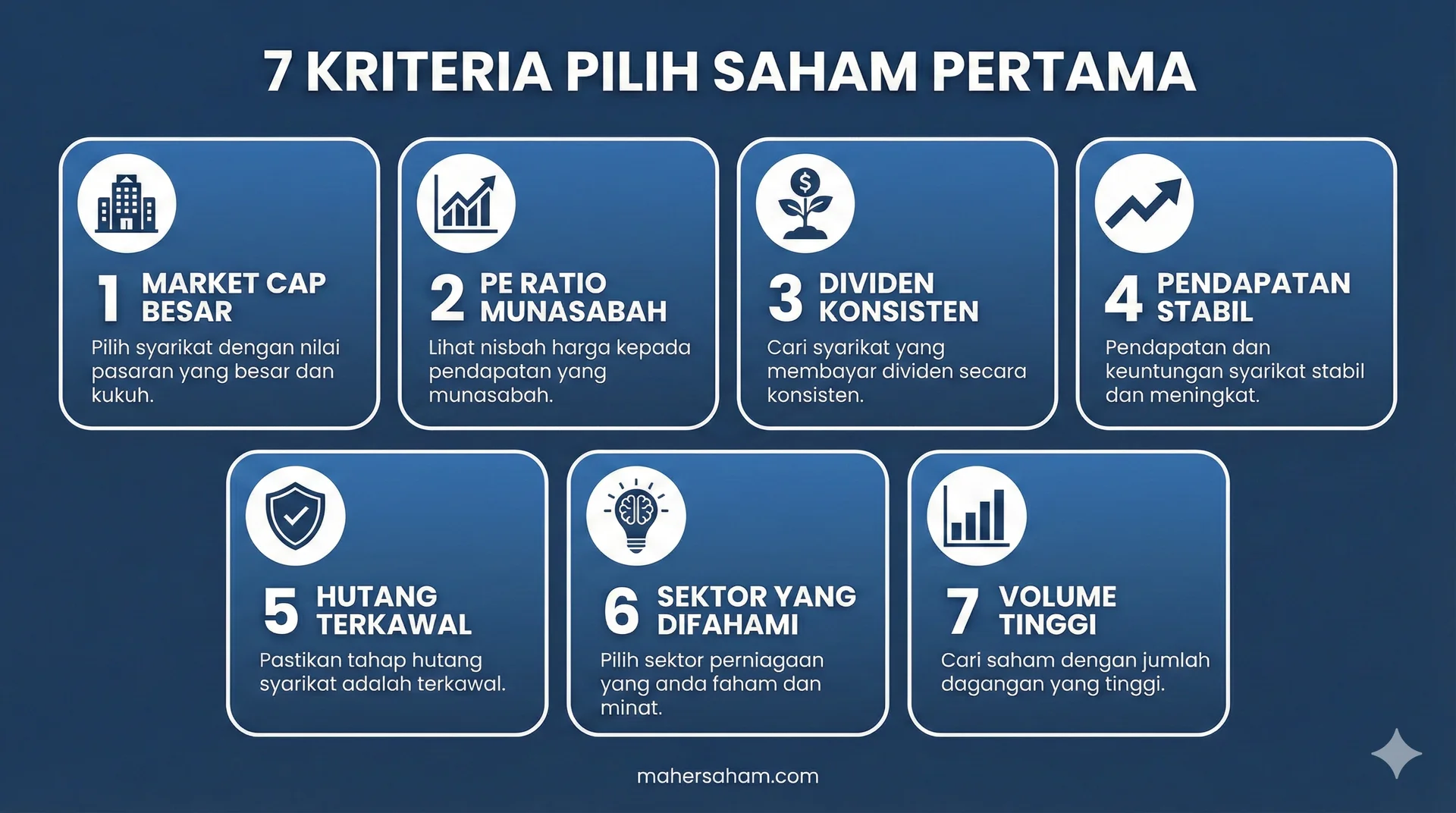
Beginners should focus on stocks that meet these 7 criteria: large market cap, reasonable PE ratio, consistent dividend payment record, stable company revenue, manageable debt levels, being in a sector you understand, and having high trading volume. It is not a specific stock name that matters — but rather the framework for you to evaluate on your own.
Why Beginners MUST Have Criteria Before Buying Stocks
Imagine walking into a night market without a list of what you want to buy. You will leave with bags full of things you do not need.
The same goes for stocks. Without clear criteria, you are not investing — you are gambling.
The reality in Malaysia is quite concerning. In 2023 alone, losses related to investment fraud in Malaysia reached RM437 million according to the Securities Commission Malaysia. The majority of victims were new investors who were lured by promises of extraordinary returns.
The "penny stock mania" phenomenon also frequently occurs on Bursa Malaysia, where stocks priced below 10 sen become targets for price manipulation by syndicates. New investors without investment criteria become the easiest victims.
With the 7 criteria we will share below, you will have your own "filter" to distinguish stocks with potential from stocks that are simply waiting to cost you money.
Criteria #1: Market Cap and Company Size
Market capitalisation (market cap) is the total value of all a company's outstanding shares in the market. The calculation is straightforward: the current share price multiplied by the total number of shares issued.
As a simple guide:
| Category | Market Cap | Characteristics |
|---|---|---|
| Large Cap | Over RM10 billion | Giant companies, stable, less volatile |
| Mid Cap | RM2 billion – RM10 billion | Moderate growth, moderate risk |
| Small Cap | Below RM2 billion | High growth potential, high risk |
For beginners, start with Large Cap or at the very least Mid Cap. Large companies such as those in the FBM KLCI index (the 30 largest companies on Bursa Malaysia) are typically more stable and less exposed to price manipulation.
Why? Because large companies have well-established operations, are monitored by many analysts, and are difficult for any party to manipulate.
Practical tip: Use the screener at mahersaham.com or Bursa Malaysia to filter stocks by market cap.
Criteria #2: PE Ratio (Price-to-Earnings)
PE Ratio is the ratio between a stock's price and its earnings per share (EPS). In simple terms, the PE ratio tells you how many years it would take to "break even" based on the company's current earnings.
For example, if a stock's PE ratio is 10x, it means you would need 10 years of current earnings to match the price you paid.
PE Ratio guide for beginners:
| PE Ratio | Interpretation |
|---|---|
| Below 10x | Potentially undervalued — but investigate why it is cheap |
| 10x – 15x | Attractive for value stocks |
| 15x – 20x | Reasonable range (fair value) |
| Over 25x | Premium — typically for high-growth companies |
Important warning: A very low PE ratio (below 5x) is not necessarily good. Sometimes, a stock is cheap because the company genuinely has serious problems. This is called a value trap — it looks cheap, but it truly is worth very little.
Use PE ratio as one of several criteria, not the sole factor.
Criteria #3: Dividend Yield — Stocks That Pay You a "Salary"
Dividends are a portion of a company's profits distributed to shareholders. Dividend yield is the percentage of dividends relative to the current share price.
For beginners, stocks that pay dividends consistently are a wise choice for several reasons:
- Steady returns — you receive a "salary" even if the stock price does not rise
- Discipline — dividend stocks teach you to be patient and hold for the long term
- Better than FD — a dividend yield of 3-5% beats the current FD rate of approximately 2.5%
Target for beginners: Look for stocks with a dividend yield of more than 3% per year and a track record of dividend payments for at least 5 consecutive years.
An important concept beginners should know is dividend reinvestment. When you receive dividends, reinvest them to buy more units of stock. This creates a compounding effect — returns on returns — which becomes extremely powerful over the long term.
Criteria #4: Revenue Stability (Revenue and Profit)
Good stocks come from companies that consistently generate revenue and profit.
Check the company's financial records for the past 3 to 5 years. What you want to see:
- Revenue that is increasing or at least stable each year
- Net profit that is consistently positive
- Profit margin that is stable — not fluctuating drastically
- ROE (Return on Equity) above 10% — showing the company efficiently uses shareholders' capital
Major red flag: A company that has only just turned profitable after years of losses. One year of profit does not mean the company has fully recovered. Beginners should focus on companies with a proven track record of profitability.
Want to learn how to read a company's financial statements in depth? Read our guide on Financial Statements Analysis.
Criteria #5: Company Debt (Debt-to-Equity Ratio)
Debt-to-Equity (D/E) Ratio measures how much debt a company uses compared to shareholder equity. In simple terms, it shows how dependent the company is on debt to operate.
D/E Ratio guide:
| D/E Ratio | Interpretation |
|---|---|
| Below 0.5 | Very healthy — low debt |
| 0.5 – 1.0 | Healthy — manageable debt level |
| 1.0 – 2.0 | Moderate — needs attention |
| Over 2.0 | High — exercise caution |
Important exception: The banking and utilities sectors naturally have high D/E ratios. Banks inherently operate with high leverage — that is their business model. Therefore, compare D/E ratios with companies within the same sector, not across different sectors.
Companies with excessively high debt face significant risk during economic downturns. When revenue falls, debt repayments still need to be made — and this can erode profits or worse, cause the company to go bankrupt.
Criteria #6: Choose a Sector You Understand
Warren Buffett, the world's most successful investor, always adheres to the concept of the "Circle of Competence" — only invest in businesses you understand.
Bursa Malaysia has 13 main sectors:
- Technology — IT companies, semiconductors, software
- Finance — banks, insurance, investment companies
- Property — property developers, REITs
- Healthcare — hospitals, pharmaceuticals, medical devices
- Energy — oil & gas, renewable energy
- Utilities — electricity, water, telecommunications
- Construction — contractors, infrastructure
- Consumer — food, beverages, retail
- Industrial — manufacturing, logistics
- Plantation — palm oil, rubber
- Transportation — aviation, ports, logistics
- Telecommunications — telcos, digital media
- REIT — real estate investment trusts
Tip: If you work in the banking industry, you have a natural advantage in understanding financial sector stocks. Use your existing knowledge.
The current Malaysian economic context is also important — Malaysia's GDP grew 5.7% in Q4 2025, and the FBM KLCI recorded its highest level since October 2018 in early 2026. Understand which sectors are benefiting from this economic growth.
Criteria #7: Trading Volume and Liquidity
Trading volume refers to the number of stock units traded within a given period. It indicates how "active" a particular stock is in the market.
Why is volume important for beginners?
- High liquidity = you can buy and sell at any time without issues
- Low liquidity = you may get "stuck" — wanting to sell but there are no buyers
- Small spread — stocks with high volume typically have a small bid-ask spread, meaning lower trading costs
Guide for beginners: Choose stocks with a minimum daily trading volume of 100,000 units. Stocks with excessively low volume are not only difficult to sell but are also more easily manipulated by certain parties.
For more in-depth learning on how to analyse stocks from a fundamental perspective, refer to our guide on Fundamental Analysis in Stocks.
Red Flags: 5 Signs a Stock is NOT Suitable for Beginners
Besides knowing what to look for, you also need to know what to avoid. According to Majalah Labur and Smart Investor Malaysia, these are among the most common mistakes made by beginner investors:
1. Stocks Priced Below RM0.10 (Penny Stocks)
These stocks are prime targets for price manipulation syndicates. Prices can rise 50% in a single day and fall even worse the next. Beginners who enter usually become "exit liquidity" for the syndicates.
2. Companies Losing Money for Years
If a company has recorded losses for 3 consecutive years or more without clear signs of recovery, it is not the place for beginners to put their money.
3. "Hot Tips" From Telegram or WhatsApp Groups
When someone shares "stock tips" for free in group chats, ask yourself: why are they sharing? Usually, they have already bought early and want others to enter to push the price up so they can sell. Also read the Multiply guide on avoiding investment scams.
4. Price Up 50%+ in a Week Without Clear Reason
A sudden price surge without supporting corporate news or financial results is typically a sign of pump and dump. Beginners who enter at this point usually buy at the peak.
5. Zero Analyst Coverage
Stocks that are not covered by any analyst or brokerage house mean no professional party is monitoring the company. This increases risk for retail investors.
Next Steps: You Have the Criteria, Now What?
Congratulations for reading this far! You now have a basic framework for evaluating stocks. Here are your next steps:
- Open a CDS account if you do not have one yet — follow our complete guide: How to Open a CDS Account with Mplus (2026)
- Learn basic chart reading — TradingView guide for beginners: Basic TradingView Guide
- Understand risk management — do not skip this important topic: Introduction to Stock Risk Management
- Use a screener to filter stocks that meet the 7 criteria above — Mahersaham Screener
- Keep learning — read our complete guide: Guide to Start Investing in Stocks 2026
Frequently Asked Questions (FAQ)
What is the minimum capital to start buying stocks on Bursa Malaysia?
The minimum lot on Bursa Malaysia is 100 units. If the stock price is RM1.00 per unit, you would need approximately RM100 + brokerage costs (~RM8-12). So, you can start with capital as low as RM55-120 depending on the stock price chosen.
Do stocks for beginners have to be blue chip only?
Not necessarily, but blue chip (large cap) stocks are the safest starting point. Once you have more experience and deeper understanding, you can start exploring mid cap stocks and other sectors with potential.
How do I find the PE ratio and dividend yield of a stock?
Platforms such as Bursa Malaysia (bursamalaysia.com), MalaysiaStock.biz, TradingView, and the screener at mahersaham.com provide this data for free. Look for the "Financial Ratios" or "Key Statistics" section on any platform.
Are penny stocks completely off-limits?
Not entirely, but they are not for beginners. Penny stocks require advanced technical understanding, strict risk management, and strong mental fortitude. They are more suitable for experienced traders who know when to enter and exit.
How long should beginners hold a stock?
There is no fixed answer, but as a general guide, beginners should think in terms of at least 6 months to 1 year. Long-term investment (3-5 years) tends to deliver better returns and reduces the impact of market volatility.
Should I buy stocks based on recommendations from friends or Telegram groups?
Not recommended. Use recommendations as a starting point for your own research, not as a final decision. Always conduct your own analysis using the 7 criteria in this article before making a buy decision.
What is the difference between Shariah-compliant and conventional stocks?
Shariah-compliant stocks are shares of companies whose business activities adhere to Islamic principles — not involved in gambling, alcohol, excessive interest, and so on. The list of Shariah-compliant stocks is updated twice a year by the Securities Commission Malaysia. For Muslim investors, this is an additional factor to consider.
Conclusion
The question "which stock should beginners buy?" is actually not the right question. The better question is: "What criteria should I use to choose a stock?"
With the 7 criteria we have shared — market cap, PE ratio, dividend yield, revenue stability, debt levels, a sector you understand, and trading volume — you now have a solid framework for evaluating any stock on Bursa Malaysia.
Remember: no single stock is "perfect" for everyone. What matters is that you make decisions based on analysis and clear criteria, not based on emotions or "tips" from irresponsible parties.
Start Your Investment Journey
Download the Basic Investment Ebook for FREE and open a CDS account to start investing today.