2026 Strait of Hormuz Crisis: Oil Prices Surge, Food Costs Rise - How It Affects Malaysians

Since 28 February 2026, the world has been shaken by military conflict between the United States-Israel and Iran. The joint US-Israel strikes on Iran - including the killing of Supreme Leader Ali Khamenei - have triggered the biggest geopolitical crisis of the decade.
The result? Iran closed the Strait of Hormuz, the world's most important sea lane for oil exports. And Malaysians? We are not spared from this shockwave.
In this article, we will thoroughly examine what the Strait of Hormuz is, what actually happened, how it affects global oil prices, and most importantly - how it impacts food prices, petrol costs, and the cost of living for Malaysians.
What Is the Strait of Hormuz and Why Does It Matter?
The Strait of Hormuz is a narrow sea passage connecting the Persian Gulf to the Arabian Sea. Under normal conditions, according to a Federal Reserve Bank of Dallas report:
- Around 20 million barrels of oil per day pass through this strait - equivalent to 20% of the world's oil supply
- 80% of oil exported from the Persian Gulf to Asia flows through this route
- Countries like Saudi Arabia, Kuwait, Iraq, UAE and Iran itself depend on this route for their oil exports
When Iran declared the strait "closed" on 4 March 2026, it became the largest energy supply disruption in history - bigger than the 1970s oil crises.
According to estimates from the International Energy Agency (IEA), even if all alternative pipeline capacity were utilised, approximately 16 million barrels per day remain at risk of being stranded. No alternative route can replace this volume quickly.
Crisis Timeline - What Has Happened Since 28 February?
Here is the chronology of key events you need to know:
| Date | Event |
|---|---|
| 28 Feb 2026 | US & Israel launch military strikes on Iran |
| 4 Mar | Iran declares Strait of Hormuz closed - only Chinese vessels allowed through |
| 8 Mar | Brent crude surpasses USD100/barrel for the first time in 4 years |
| 12 Mar | Iran attacks 21 merchant ships attempting to pass through the strait |
| 19 Mar | US military begins operations to reopen the strait |
| 21 Mar | Trump issues 48-hour ultimatum to Iran - threatens to strike power plants |
| 26 Mar | Iran allows ships from 5 countries (China, Russia, India, Iraq, Pakistan) through the strait |
| 27 Mar | PM Anwar announces Malaysian ships allowed through Strait of Hormuz |
| 30 Mar | Trump postpones strike deadline to 6 April |
As of now, tanker traffic through the strait has dropped over 90%, and oil exports from the Gulf region have fallen by approximately 60%.
Global Oil Prices Surge Dramatically
The most immediate impact is a surge in crude oil prices unprecedented in the past decade:
| Metric | Value |
|---|---|
| Brent price before conflict | ~USD70/barrel |
| Peak Brent price (Mar 2026) | USD126/barrel |
| Current Brent price | ~USD100/barrel |
Even though 32 countries have released 400 million barrels from strategic reserves, prices remain around USD30 higher than pre-conflict levels. Experts warn prices could reach USD150/barrel if the conflict extends beyond Q2 2026.
This surge happened far more rapidly than any previous conflict. Within just 8 days of the first strikes, Brent had already surpassed the USD100 mark.
Impact on the Global Economy
This crisis is not just about oil prices. It threatens the entire global economy:
- Global GDP is projected to decline by 2.9 percentage points (annualised) in Q2 2026
- Shipping and vessel insurance costs have surged dramatically
- Global supply chains are disrupted - not just oil, but also liquefied natural gas (LNG)
- Major oil importing nations like Japan, South Korea and India are worst affected as 80% of Gulf oil is shipped to Asia
This poses a real risk of stagflation - high inflation occurring simultaneously with slow economic growth. The most frightening economic scenario for any country.
Impact on Malaysia: Deeper Than We Think
Malaysia Is an Oil Producer - But Still Affected?
Many ask: "Malaysia has Petronas, so why are we affected?"
The answer is simple but surprising. As explained by SAYS:
- Malaysia exports its own crude oil (high grade, premium price)
- However, around 70% of imported crude oil for refineries comes from the Persian Gulf
- Malaysian refineries depend on the Strait of Hormuz route for supply
- Petronas produces around 2 million barrels per day, but much of it is for export and various uses
In short: Malaysia exports expensive oil and imports cheaper oil from the Gulf for refineries. When the Gulf route is cut off, our refineries suffer.
Fuel Subsidies - Government Bears a Massive Burden
The government has taken steps to protect citizens through the BUDI95 programme:
| Item | Detail |
|---|---|
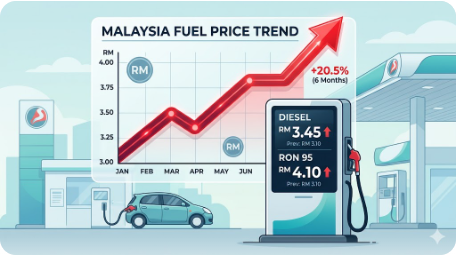
| RON95 price (BUDI95) | Maintained at RM1.99/litre |
| Actual unsubsidised price | ~RM3.87/litre |
| Government subsidises the difference | RM1.88/litre per litre |
| Total subsidy burden | Surged to RM4 billion/month (from RM0.7B in January) |
| BUDI95 quota | Reduced from 300L to 200L/month starting 1 April |
For diesel, the unsubsidised price has reached approximately RM5.52/litre, while public transport and logistics still receive subsidised diesel at RM2.15/litre through the Subsidised Diesel Control System (SKDS).
Fiscal Impact - Concerning Figures
Budget 2026 was prepared assuming oil prices of USD65/barrel. At USD100/barrel, according to analysis by The Edge Malaysia:
- The government gains an additional RM10.5 billion in oil & gas revenue
- BUT fuel subsidy burden: RM19.8 billion - nearly double the additional revenue
- Budget deficit is expected to rise by approximately 0.4 percentage points from the 3.5% GDP target
In short: the additional revenue is not enough to cover subsidy costs. The government actually loses more despite higher oil prices.
Food and Goods Prices - This Is What Malaysians Feel Most
The impact of rising oil prices extends beyond the petrol pump. It seeps through the entire supply chain and ultimately reaches our dinner table.
Chain Reaction - From Oil Well to Your Kitchen
Here is how crude oil prices affect your food prices:
- Crude oil prices rise
- Diesel and petrol costs increase
- Lorry and ship transportation costs rise
- Fertiliser costs surge 100-150%
- Food production costs increase
- Wholesale prices rise
- Retail prices rise
- Consumers bear the burden
Every step in this chain adds cost, and ultimately consumers bear the full burden.
Foods Affected
Based on reports from RTM and CodeBlue:
| Category | Expected Increase | Reason |
|---|---|---|
| Vegetables | +30% to 50% | Fertiliser costs up 100-150%, farm transport costs |
| Rice | At risk of increase | Malaysia imports rice - sea transport costs rising |
| Chicken & eggs | At risk of increase | Animal feed (corn, soy) depends on imports |
| Cooking oil | Upward pressure | Higher logistics & production costs |
| Restaurant dining | Gradually rising | All raw material + gas + transport costs rising simultaneously |
The chairman of the Cameron Highlands Malay Farmers Association warned that vegetable prices could rise up to 50% temporarily before stabilising at around 30% higher.
Fertiliser Costs - A Massive Hidden Impact
This is a fact many are unaware of, and it may be the most concerning medium-term impact:
- Fertiliser prices in Malaysia have risen 100-150% within just 2 weeks
- Some fertiliser manufacturers have halted new orders due to price instability
- Fertiliser depends on natural gas as a raw material - and gas supply is also disrupted by the Hormuz crisis
- This will affect crop yields over the next 1-3 months
The most important thing to understand: even if oil prices drop tomorrow, the impact on food prices will persist for several months due to the agricultural cycle. Expensive fertiliser today will produce expensive vegetables 2-3 months from now.
Transport Sector - Every Sector Affected
Rising diesel and petrol prices affect nearly every transport sector:
| Sector | Impact |
|---|---|
| Freight lorries | Diesel up - delivery costs rise - shop prices increase |
| P-hailing (Grab, Lalamove) | Rider operating costs rise - possible surcharges or higher fares |
| Buses & public transport | Diesel still subsidised at RM2.15/L, but pressure mounting |
| Aviation | Jet fuel up - flight ticket prices expected to rise |
| E-commerce (Shopee, Lazada) | Courier costs rise - may be passed to consumers |
What Is the Government Doing to Protect Malaysians?
The government has taken several key measures to shield citizens from the full impact of this crisis:
| Measure | Detail |
|---|---|
| BUDI95 maintained at RM1.99/L | Protects the majority of B40/M40 citizens |
| Public transport diesel at RM2.15/L | Through the Subsidised Diesel Control System (SKDS) |
| BUDI95 quota 200L/month | 90% of citizens use less than this - most are unaffected |
| FOMCA monitoring traders | Enforcement against traders who raise prices unreasonably |
| PM Anwar's diplomacy | Malaysian ships allowed through Strait of Hormuz - diplomatic advantage |
| Petronas as buffer | Government leverages Petronas' global network to find alternative supply |
PM Anwar's announcement that Malaysian ships are allowed through the Strait of Hormuz is a significant diplomatic achievement. This means crude oil supply for Malaysian refineries is not completely cut off, even though costs are higher.
Outlook - What Could Happen Next?
Best Case Scenario
- Negotiations succeed, strait fully reopened before Q2 ends
- Oil prices fall back to around USD80-85/barrel
- Food prices stabilise within 2-3 months
- Government subsidies remain sustainable
Worst Case Scenario
- Conflict drags on past Q2 2026
- Oil prices reach USD150/barrel
- Government subsidies become unsustainable - BUDI95 quota may be reduced further
- Food prices rise 20-50% overall
- Risk of stagflation - high inflation + slow economy simultaneously
- Ringgit weakens due to global pressure
5 Things Malaysians Can Do Now
- Monitor your petrol usage - stay within the 200L BUDI95 quota
- Compare prices before buying goods - do not accept price increases without question
- Report traders who raise prices unreasonably to the Domestic Trade Ministry (KPDN)
- Reduce food waste - every sen counts in these times
- Consider public transport or carpooling to save on petrol
Frequently Asked Questions (FAQ)
Will the RON95 petrol price increase?
For now, the RON95 BUDI95 price remains at RM1.99/litre. The government is committed to maintaining this price as long as possible. However, the monthly quota has been reduced from 300L to 200L starting 1 April 2026.
Why is Malaysia affected when we are an oil producer?
Malaysia exports its high-grade crude oil at premium prices but imports around 70% of crude oil from the Persian Gulf for domestic refineries. When the Strait of Hormuz route is disrupted, supply to our refineries is also affected.
How long will food prices remain high?
Even if oil prices drop tomorrow, the impact on food prices is expected to persist for 2-3 months due to the agricultural cycle. High fertiliser costs today will affect crop prices for several months ahead.
Is the 200L BUDI95 quota enough for ordinary Malaysians?
Yes, for most citizens. Data shows the average Malaysian petrol consumption is around 100 litres per month, and nearly 90% of users consume less than 200 litres.
Could this situation get worse?
Yes. If the conflict drags on and oil prices reach USD150/barrel, the government may be forced to further reduce the BUDI95 quota or review the subsidy structure. Food prices could also rise by 20-50% overall.
What about RON97 and diesel prices?
RON97 and diesel do not enjoy the same subsidies as RON95 BUDI95. Both prices have been adjusted upward in line with global market prices. Unsubsidised RON97 is now around RM4.50+/litre while diesel is approximately RM5.52/litre.
How does this crisis relate to prices on Shopee/Lazada?
Courier and logistics costs rise when diesel prices increase. Courier companies may impose surcharges or raise delivery fees. Ultimately, these costs may be passed on to buyers.
Is this the worst oil crisis in history?
Yes, according to economists and the IEA, the 2026 Strait of Hormuz closure represents the largest energy supply disruption in the history of global oil markets - surpassing the 1973 and 1979 oil crises.
Conclusion
The 2026 Strait of Hormuz crisis is not merely about rising oil prices. It is the largest energy supply disruption in modern history, with effects that seep into every aspect of life - from vegetable prices at the market, Grab rides to work, to the cost of flight tickets home. The government is bearing an enormous burden to protect its citizens, but if this conflict drags on, everyone will feel the impact.
In uncertain economic times like these, it is important to stay informed about current developments and make wise financial decisions.
If you want to understand more deeply how geopolitical situations and the global economy affect your investments and personal finances, the first step is to equip yourself with knowledge.
Open a CDS trading account today to invest in Bursa Malaysia and global markets like US and Hong Kong - Register for a CDS Account here.
Download the free Stock Market Basics Ebook to understand investment fundamentals and how to protect your money - Get the Free Ebook.