Essential Things to Know About Rights Issue

What Is a Rights Issue?
A rights issue is one form of corporate exercise.
It is an activity where a listed company raises capital from its existing shareholders.
Before a company is listed on Bursa Malaysia, capital is raised through an IPO — where the company obtains funds from the general public.
For your information, a rights issue involves the issuance of new shares.

For example, Company ABC previously had 1 billion shares. When the company conducts a rights issue, the total number of shares increases.
By how much? That depends on the company.
It is up to the shareholders whether they wish to subscribe or not.
However, if existing shareholders do not subscribe, their percentage of shareholding in the company will decrease.
How can this happen?
Imagine Company ABC originally had 1 billion shares.
At that time, Puan Taichy held 50% or 500 million shares in the company.
However, after the company conducts a rights issue, the total number of shares increases to 3 billion.
What is Puan Taichy's shareholding percentage now?
1 billion shares = 50%
3 billion shares = 16.67%
So, if Puan Taichy does not want her shareholding percentage to decrease, she needs to subscribe to the rights issue.
Why Do Companies Conduct Rights Issues?
There are several reasons why companies carry out rights issues, including:
- 1. To expand the business.
- 2. To address financial difficulties.
- 3. To restructure the company's capital.
Most companies that conduct rights issues do so because they are facing financial challenges.
What Happens During a Rights Issue?
- 1. The "-OR" symbol appears on the trading platform.
- 2. The rights share price is usually offered at a discount to the market price. This can act as a price floor.
For example, if the current share price of Company ABC is RM1.10, when the company issues a rights offering, the price will be lower — perhaps 90 sen or 80 sen.
Why?
Because the company wants to attract and encourage existing shareholders to subscribe.
- 3. There is no "dilution" in shareholding percentage if the shareholder subscribes to the rights issue.
- 4. The share price will be adjusted on the ex-date due to the increase in total shares.
- 5. EPS will be "diluted" due to the increase in share count, which causes the PE ratio to rise.
Important Things About Rights Issues
- 1. When is the ex-date?
- 2. What is the conversion ratio?
- 3. Trading of rights
- 4. Acceptance & payment
- 5. Offer price
- 6. Listing
Let us refer to the case study of Green Ocean Corporation Berhad.
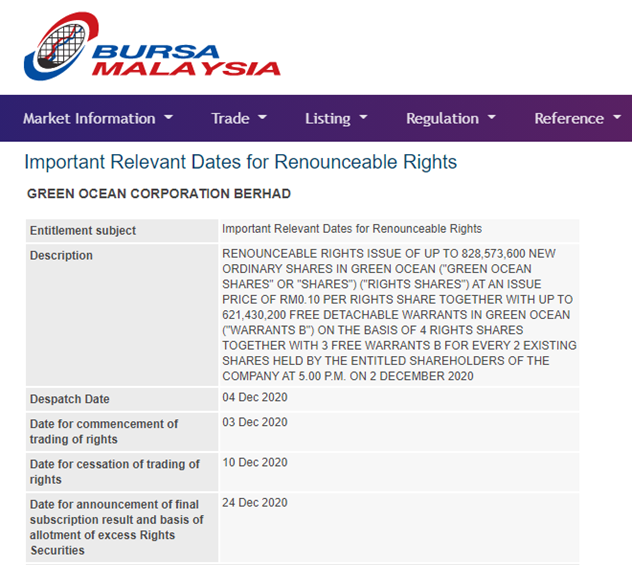
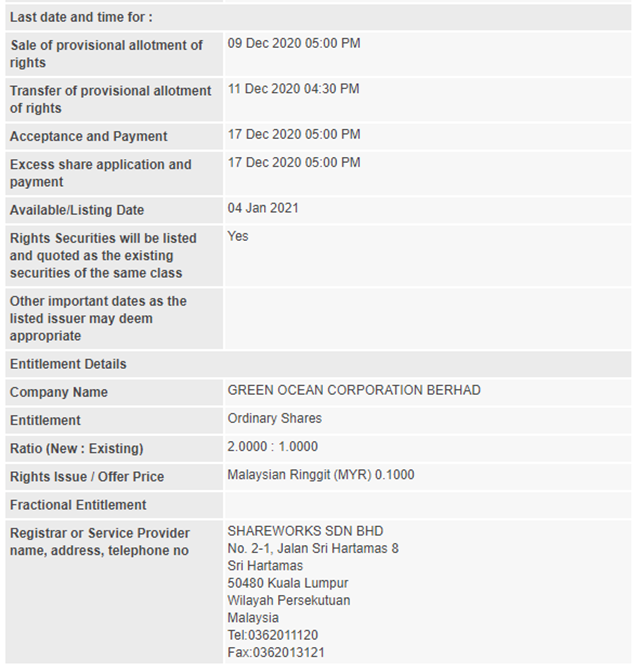
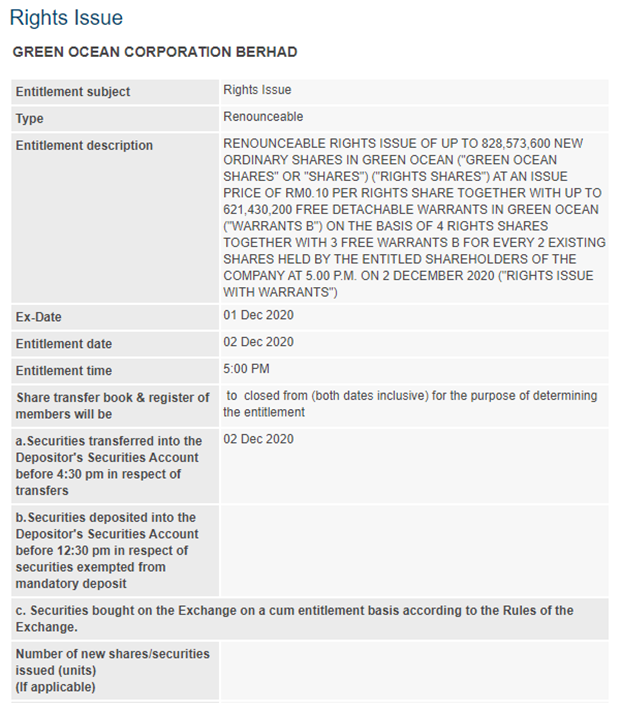
What information can you gather from the images above?
You should be able to extract several key details from that announcement.
1. When Is the Ex-Date?
What does the ex-date mean?

The ex-date is the cut-off date used to determine eligibility for a corporate exercise.
Based on this case study, the ex-date was 1 December 2020.
If you purchased shares on or after 1 December 2020, you would not be eligible for the rights issue.
One important thing to understand: when a shareholder is eligible for a rights issue, they have three options:
- 1. Subscribe
- 2. Do not subscribe
- 3. Sell the rights on the open market
2. What Is the Conversion Ratio?
Ratio (new:existing) = 2:1
For every 1 existing share held, shareholders are entitled to 2 new shares — provided they subscribe.
3. Trading of Rights
As mentioned earlier, rights can be sold on the open market. The trading period is based on the announcement from Bursa Malaysia.
In this case study, the trading period for the rights was from 3/12/2020 to 9/12/2020, as shown in the diagram above.
4. Acceptance & Payment
If a shareholder intends to subscribe to the rights issue, they must accept and make payment by 17/12/2020 (in this case study).
The acceptance steps are usually communicated by the registrar.
5. Offer Price
The price offered by Green Ocean Corporation Berhad for the rights issue was RM0.10.
Meanwhile, the market price at the time was 15.5 sen — meaning the offer price was cheaper than the prevailing market price.
6. Listing
On 4/1/2021, the listing date, the new shares appeared in each shareholder's portfolio.
The company's total number of shares was also updated, increasing in accordance with the announcement on Bursa Malaysia.
We hope you have learnt something valuable from this article.
Frequently Asked Questions (FAQ)
What is a rights issue in the stock market?
A rights issue is a corporate exercise where a listed company offers new shares to existing shareholders, usually at a price lower than the current market price. The purpose is to raise additional capital for the company's operations or expansion plans.
Is it compulsory for investors to accept a rights issue?
No, investors are not obligated to accept a rights issue. They can choose to subscribe, decline, or sell their rights on the open market. However, if they take no action, their shareholding will experience dilution as the total number of shares increases.
How do you subscribe to a rights issue?
Investors need to follow the instructions provided by the company's registrar. Typically, you must make payment at the offer price before the closing date. Full details are usually included in the offer letter sent by the registrar to eligible shareholders.
What is the impact of a rights issue on share price?
After a rights issue, the share price is typically adjusted through an ex-date adjustment process. The new reference price is calculated based on the theoretical ex-rights price (TERP). The increase in total shares may cause the share price to temporarily adjust downward.
Ready to start investing in stocks on Bursa Malaysia? Open your CDS account with Mahersaham today.
Download the free stock basics ebook from Mahersaham and start learning from the ground up!
Further reading: