Types of Stocks on Bursa Malaysia: Blue Chip, Penny & Growth

There are various types of stocks in investment on Bursa Malaysia that you need to know.
Each stock is different depending on their respective investment objectives.
From time to time, this knowledge can help investors differentiate certain stocks according to their categories.
Furthermore, stock investment offers attractive potential returns and profits according to the appropriate capital for the investor.
The risk and returns also depend on the profile and characteristics of the company. Several characteristics that can be observed include dividend payments, company size, company growth, and company profits within the business cycle.
These categories determine the portfolio to achieve a good balance of risk and return.
Classification Based on the Market Where the Stock Is Listed
In Bursa Malaysia, there are three different boards or markets.
Main Market
Stocks or companies listed here are the most stable and highest quality. Companies listed here must meet several stringent criteria such as: The most recent Financial Year must exceed after-tax profits of RM6 million.
There must be a minimum of 200 shareholders from the public who own no less than 100 units, and this public holding must represent at least 25% of the total shares available.
ACE Market
Companies that are newly listing typically start from here. Previously, this market was called MESDAQ, almost similar to NASDAQ in the US.
From an IPO perspective, the price offered to the public is usually 60 sen and below.
LEAP Market
A shorter route for a company to list their shares. However, the initial offering is only available to sophisticated investors. Who are they?
- Accredited investors
- High net worth entities
- High net worth individuals
Since most readers of this blog or article are individuals, what is meant by high net worth individuals is:
- Total net personal assets or total net joint assets with their spouse exceeding RM3 million (excluding the value of their primary residence)
- Gross annual income exceeding RM300,000 for the most recent 12 months
- If combined with joint income – exceeding RM400,000
- Total net personal investment portfolio, or jointly with their spouse, exceeding RM1 million
Classification Based on Stock Characteristics
Several categories classified in the market include Technology Stocks (Tech Stock), Speculative Stocks (Speculative Stock), Cyclical Stocks (Cyclical Stock), and Defensive Stocks (Defensive Stock).
Tech and Growth Stock
Technology stocks represent the technology sector of the market, including companies that produce computers, semiconductors, software, and data devices.
These stocks also include companies that provide internet services, networking equipment, and wireless communication.
Some of them are blue-chip stocks. Technology stocks offer very high potential returns, but they also involve significant risk and may be suitable for investors who are more inclined towards risk.
Typically in today's era, technology stocks are stocks that can grow rapidly. Although there may be stocks or companies in other sectors that can grow quickly, that is usually rare.
Speculative Stock
Generally, speculative stocks are unstable and characterised by uncertainty. These stocks are exposed to very rapid and erratic price changes.
These stocks are also often associated with the existence of 'syndicates' that have taken control of share ownership and can manipulate stock prices illegally. It is not impossible for stocks of this type to rise more than 100% in less than 1 month.
However, investors need to identify the rhythm of the stock market according to current trends. I also always remind my clients, 'know when to enter and know when to exit. You need to extra monitor stocks of this type'.
This is because speculative stocks do not have a consistent track record, but their stock prices have the potential to rise.
Therefore, investors require substantial knowledge to gain capital profits in managing these stocks.
Cyclical Stock
The profits of cyclical stock companies are closely related to the overall economy.
The stocks of these companies tend to move up and down following the economic market cycle.
These companies include home manufacturing goods and vehicles such as Alcoa, Caterpillar, Lennar, and Timken.
Generally, the movement of cyclical stocks will increase when the economy is advancing. Likewise, their performance tends to decline when the economy is weak.
Defensive Stock
Investors may look for stocks that have stable and steady prices, or ones that can increase even when economic activity is declining.
These stocks are known as defensive stocks.
They are less prone and exposed to downswings in a business cycle. These stocks include companies in industrial and consumer goods, food, beverages, and pharmaceuticals.
An example of a defensive stock is Walmart. This company is among the world's leading retailers because it is not susceptible to economic recession.
Defensive stocks are usually suitable for aggressive investors to 'park' their funds while awaiting economic recovery until market conditions improve.
Classification by Market Capitalisation or Company Size
Understanding Market Capitalisation
The formula for Market Capitalisation is:
Market Capitalisation = Price per unit of share X Total number of shares available
The higher the stock price, the greater its potential to increase the company size. The same applies if the company can increase the number of shares it has.
However, if the company wants to add shares compared to the existing amount, the price will adjust. The size should only be based on the public demand for the stock.
For example:
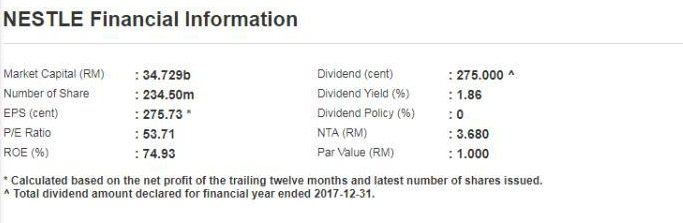
Nestle has a market capital worth RM34.729 billion. This is equivalent to 234.5 million units of shares (Number of Shares) multiplied by the stock price, which at the time this image was captured was RM148.
Blue Chips
This refers to stocks whose businesses are truly EXCELLENT. The stock prices are also quite high compared to the average. However, it does not mean only EXPENSIVE stocks can generate profit. Blue Chip stocks typically have a market capitalisation of RM1 billion and above.
Among the reasons blue chip stocks are strong:
- Good business track record
- Profits increasing every year
- Debt that is not large
- Stable stock prices such as NESTLE, F&N, MAYBANK, TNB & many more.
Medium or Mid Cap
Mid Cap stocks are in the middle between BLUE CHIP & SMALL CAP. Mid Cap typically has a market capitalisation of RM100 million – RM1 billion.
Small Cap
These are stocks at the lowest category compared to BLUE CHIP & Mid Cap. Small Cap stocks typically have a market capitalisation below RM100 million. These stocks are usually very volatile and I often label them as stocks that syndicates favour, 'game' stocks, and many of them consist of penny stocks – priced at less than 20 sen per unit.
Conclusion
Stocks in different categories will require different investment strategies. There is no single technique that can be used effectively in every situation.
For this reason, an investor or trader needs to have comprehensive understanding and knowledge about stock investment.
New to Stocks?
Want to learn about stocks? Want to know more?
But don't know where to start?
Don't worry, download the FREE ebook from Mahersaham now!
If you do not yet have a CDS account, click here to open a CDS account with Mahersaham.
FAQ — Types of Stocks on Bursa Malaysia
What are the different markets on Bursa Malaysia?
Bursa Malaysia has three markets: the Main Market (for established, high-quality companies), the ACE Market (for newly listing companies, similar to NASDAQ), and the LEAP Market (for sophisticated investors only, with higher net worth requirements).
What is the difference between blue chip and penny stocks in Malaysia?
Blue chip stocks have a market capitalisation of RM1 billion and above, with strong business track records and stable prices (e.g., NESTLE, MAYBANK). Penny stocks are priced below 20 sen per unit, are highly volatile, and often associated with syndicate activity.
Are growth stocks and technology stocks the same thing?
Not exactly. While most technology stocks are growth stocks due to their rapid expansion potential, growth stocks can come from any sector. Technology stocks specifically include companies in semiconductors, software, internet services, and wireless communication.
What is market capitalisation and why does it matter?
Market capitalisation is calculated as the share price multiplied by the total number of shares. It determines a company's size category — Blue Chip (above RM1 billion), Mid Cap (RM100 million to RM1 billion), or Small Cap (below RM100 million) — which influences investment strategy and risk level.
What are defensive stocks and when should I invest in them?
Defensive stocks are from companies in essential industries like food, beverages, and pharmaceuticals. They tend to maintain stable prices even during economic downturns. They are suitable for investors who want to 'park' their funds while waiting for economic recovery.