What Are Preference Shares in Malaysia? Types, ICPS, Dividends & Risks

When it comes to investing on Bursa Malaysia, most new investors tend to picture the classic "buy low, sell high" strategy using ordinary shares. However, the stock market can sometimes be extremely volatile, which puts off many beginners from getting started.
But did you know there is another investment instrument that is seldom talked about, yet often serves as a "secret weapon" for conservative investors seeking passive income?
This instrument is known as Preference Shares (or Saham Keutamaan in Bahasa Melayu).
Preference shares are unique. They offer safety features similar to Fixed Deposits or Bonds, yet they are still traded on the stock market. If you are looking for a fixed dividend rate without having to worry about drastic daily price swings, preference shares might just be the answer you have been searching for.
In this article, we will dissect what preference shares actually mean, the key differences compared to ordinary shares, and whether they are worth adding to your investment portfolio.
By definition, Preference Shares are a type of equity security that grants special privileges to their holders compared to ordinary shareholders.
That definition might sound a bit technical, right? Let us simplify it with an easy analogy.
Think of preference shares as a "Hybrid Child" between Shares and Debt (Bonds). They carry ownership characteristics (like shares), but at the same time promise fixed payments (like loans/bonds).
Why Are They Called "Preference"?
The term "Preference" is used because holders of these shares receive VIP treatment in two critical situations:
Priority in Dividend Payments: When a company declares profits, preference shareholders must be paid dividends first before a single cent can be given to ordinary shareholders. Typically, the dividend rate is already fixed (for example: 6% per annum) and does not change even if the company's profits skyrocket.
Priority in Asset Claims (If the Company Goes Bankrupt): This is the most important safety feature. If a company is wound up (liquidation) and its assets need to be sold to settle debts, preference shareholders have the right to claim remaining company funds after creditors (banks), but before ordinary shareholders.
In simple terms: If there is money left after a company shuts down, you (as a preference shareholder) get paid first. Ordinary shareholders only receive whatever is left over (if any).
Therefore, preference shares are often regarded as a safer, lower-risk investment compared to ordinary shares, even though the potential for capital gains may not be as high.
Many new investors are confused; if Preference Shares are "safer", why doesn't everyone just invest in them? Why do Ordinary Shares remain the top choice on Bursa Malaysia?
The answer lies in risk and reward.
The table below summarises the key differences between Preference Shares and Ordinary Shares so you can make an informed choice:
| Feature | Preference Shares | Ordinary Shares |
|---|---|---|
| Dividend Payment | Prioritised. Must be paid first before ordinary shareholders. | Second. Only paid after preference shareholders receive their portion. |
| Dividend Rate | Fixed. (e.g. 5% or 6% per annum). Does not increase even if the company earns huge profits. | Variable. Depends on company profits. Can be very high or nothing at all. |
| Voting Rights (AGM) | None. You typically cannot vote to appoint Board of Directors members. | Yes. You have the right to speak and vote at the Annual General Meeting (AGM). |
| Price Appreciation Potential | Limited. Share price tends to be stable and does not spike suddenly (low capital gain). | High. Price can rise (or fall) significantly based on company performance. |
| Asset Claims (If Bankrupt) | Priority. Paid after creditors/banks, but before ordinary shareholders. | Last. Only receives remaining assets (if any) after all other parties are paid. |
| Investment Risk | Lower. Less exposed to drastic market fluctuations. | Higher. Prices are highly sensitive to market sentiment and the economy. |
Quick Summary for You:
Choose Preference Shares If: You are a conservative investor who wants stable cashflow and peace of mind. You do not mind if the share price does not skyrocket, as long as dividends come in every year.
Choose Ordinary Shares If: You want capital growth. You are willing to bear the risk of price drops for the chance of multiplied returns when the company thrives.
If you browse the list of stocks on Bursa Malaysia, you may have noticed stock codes ending with peculiar suffixes like "-PA", "-PB", or long acronyms like ICPS.
Do not panic. These are not secret codes—they simply tell you the type of preference share. Each type has different rules about how dividends are paid and what happens when the share matures.
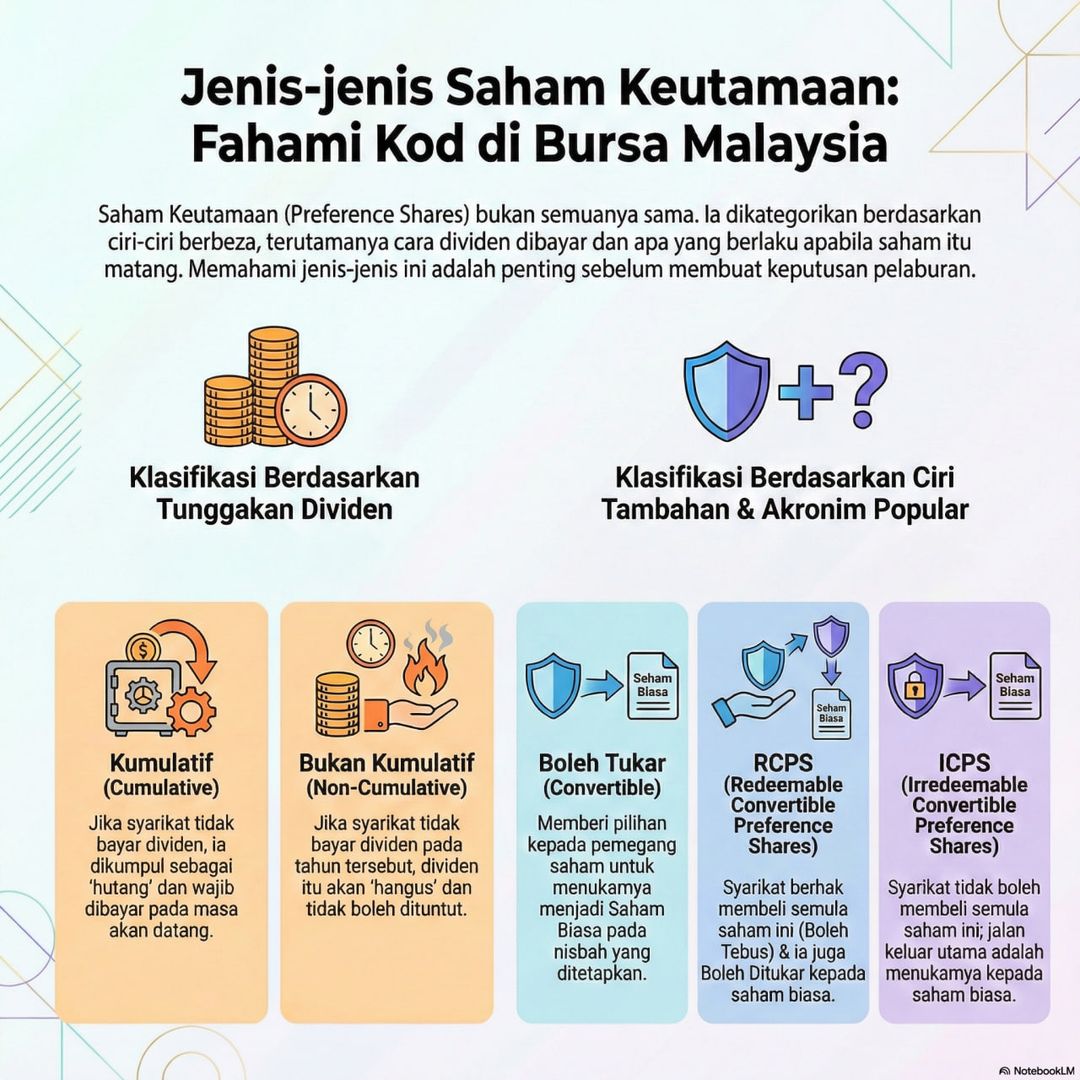
Here are the main types you need to know:
A. Cumulative vs Non-Cumulative Preference Shares
This relates to dividend arrears.
Cumulative (Cumulative Preference Shares): This is the type most favoured by investors. If the company makes a loss this year and cannot pay dividends, the dividend does not expire. It accumulates (remains owed) and must be paid in future years when the company returns to profitability.
Example: The company promises to pay 5 sen per year. In 2024 it does not pay. In 2025 the company must pay 10 sen (5 sen in arrears + 5 sen current).
Non-Cumulative (Non-Cumulative): This type is riskier. If the company does not declare a dividend in a given year, that dividend is forfeited for good. You cannot claim it back.
This type gives you the option to convert your status from "Preference Shareholder" to "Ordinary Shareholder".
There is usually a Conversion Ratio that is pre-set. For example, you can convert 2 units of Preference Shares to get 1 unit of the Parent Share (Ordinary Shares).
This gives investors the opportunity to enjoy price appreciation (capital gain) if the parent company's share price surges.
C. Popular Acronyms on Bursa Malaysia: ICPS & RCPS
In Malaysia, preference shares rarely stand alone. They are often combined with the features above into hybrid products. The two most popular are:
RCPS (Redeemable Convertible Preference Shares)
Redeemable: The company has the right to buy back these shares from you at a specified price after the maturity period.
Convertible: If not redeemed, you can convert them into ordinary shares.
Why do companies issue RCPS? Typically to borrow money from investors for short-term projects without having to take on bank debt.
ICPS (Irredeemable Convertible Preference Shares)
Irredeemable: The company cannot buy back these shares for cash.
Convertible: The only exit is to convert them into ordinary shares (Parent Shares) or sell them on the open market before the expiry date.
This means that sooner or later, ICPS holders will most likely become ordinary shareholders of the company.
Advantages and Risks of Investing in Preference Shares
Like any other investment in the world, there is no such thing as a "perfect investment". Preference shares have their own pros and cons. Before you hit the 'BUY' button on your broker platform, let us weigh up the good and the bad.
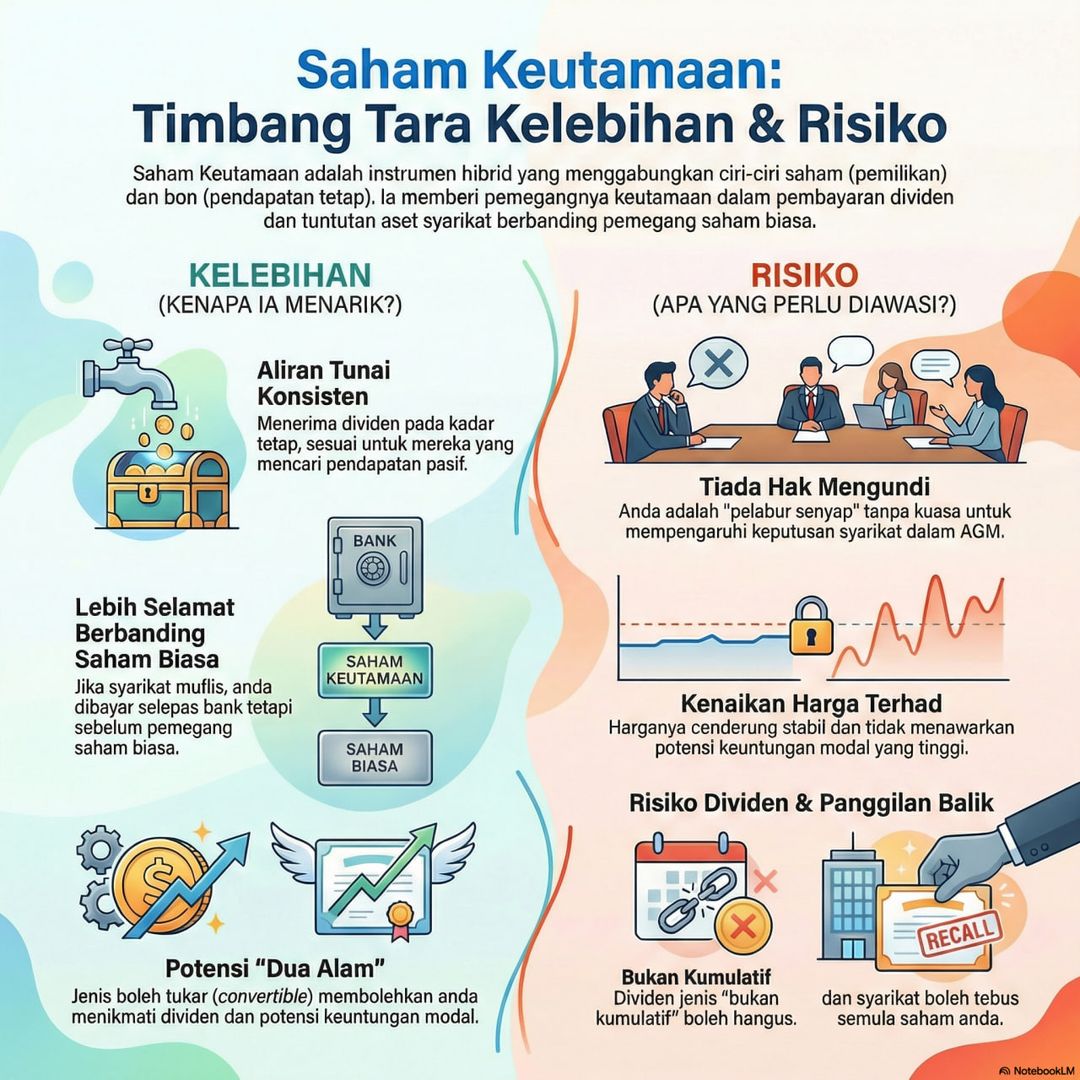
Advantages: Why Many Investors Love Them
1. Consistent Cashflow (Fixed Dividends) This is the main attraction. Preference shares typically offer a fixed dividend rate (e.g. 6% or 7% per annum). This makes financial planning easier because you know exactly how much "salary" you will receive from this investment, regardless of whether the stock market is going up or down. It is especially suitable for retirees or passive income seekers.
2. Safer Than Ordinary Shares In the worst-case scenario where a company faces financial trouble or goes bankrupt, preference shareholders are at the front of the queue to reclaim their capital compared to ordinary shareholders. While the risk is not zero (creditors/banks are still paid first), at least you are not the last person waiting for leftover money.
3. "Best of Both Worlds" Potential (For Convertible Types) If you hold the Convertible type (such as ICPS/RCPS), you get "best of both worlds" benefits. If the market is sluggish, you enjoy fixed dividends. If the company suddenly thrives and the parent share price soars, you can convert your preference shares into parent shares to enjoy capital gains.
Risks: What You Need to Watch Out For
1. No Voting Rights As a preference shareholder, you are typically a "silent investor". You do not have voting power at the Annual General Meeting (AGM). If management makes a decision you disagree with, you cannot protest through a ballot.
2. Limited Price Appreciation Do not expect preference share prices to jump 100% or 200% in a short time like technology or speculative stocks. Their prices tend to be stable and move slowly around the par value or redemption price. If you are the type of investor chasing multibaggers, this is not the place for you.
3. Call Risk For Redeemable types, the company has the right to buy back the shares when market interest rates fall. This could be disadvantageous if you were comfortably receiving high dividends, only for the company to recall the shares, forcing you to find another investment that may offer lower dividends.
4. Non-Cumulative Dividend Risk Be cautious with Non-Cumulative types. If the company has a tough year and decides not to pay dividends, you will lose that year's income permanently.
It is important for you to understand that preference shares exist in two very different "worlds". The risks of each are worlds apart.
A. On Bursa Malaysia (Open Market)
These are preference shares issued by Public Listed Companies. They are legitimate, tightly regulated by the Securities Commission (SC), and can be bought or sold at any time during trading hours.
How to Identify: Look at the end of the stock name. It usually has a suffix like -PA, -PB, or sometimes -LR.
Example: If the parent stock is Sime Darby Property, its preference share might be listed as SIMEPROP-PA.
Liquidity: High. If you need cash, you can sell these shares immediately on the market (provided there are buyers).
B. Off-Exchange (Private Mandate / Sdn Bhd)
This is the category you need to be extremely careful about. Many private companies (Sdn Bhd) issue preference shares—often called iRPS (Islamic Redeemable Preference Shares)—to raise business capital.
Recently, the country was shaken by an investigation case involving a prominent Islamic finance figure related to iRPS offerings. This serves as a major lesson for retail investors about the risks of such instruments when they are not traded on the exchange:
No Easy "Exit": Unlike on Bursa, you cannot simply press "Sell" if you need emergency cash. You are bound by a contract (typically 3-5 years) before you can redeem your capital.
Risk of Misconduct: Sdn Bhd companies are prohibited from openly offering shares to the "public" (public offering) unless they meet strict requirements from the Companies Commission of Malaysia (SSM). Many scam schemes disguised as "Islamic Preference Shares" exploit this loophole.
Lack of Transparency: Sdn Bhd companies are not required to publish quarterly financial statements to the public like Bursa-listed companies. You may not know the company is losing money until it shuts down entirely.
Important Reminder: If you are offered an investment opportunity in "Preference Shares" that promises fixed monthly returns but is not listed on Bursa Malaysia, please verify with the Securities Commission. Do not be fooled just because it uses the name of a famous personality or Islamic terminology.
Conclusion
Preference Shares are a unique investment instrument. They offer a middle ground for those who want more safety than ordinary shares, but higher returns than fixed deposits.
However, they are not an automatic ticket to getting rich.
For Conservative Investors: Preference shares listed on Bursa Malaysia can form part of your "passive income" portfolio through consistent dividends.
For Savvy Investors: Avoid getting trapped by preference share offerings from private companies (unlisted) that promise the moon and stars, especially if you do not understand their business model. Recent high-profile cases prove that big names are no guarantee your investment is safe.
Remember the golden rule of investing: Understand the risks before chasing returns.
Q: Are all preference shares Shariah-compliant?
A: Not necessarily. On Bursa Malaysia, you need to check the Shariah-compliant status of the particular share (usually marked with a small circle symbol [s]). For conventional preference shares (issued by banks, for example), they may not be Shariah-compliant as they involve interest elements or non-halal businesses.
Q: What happens if I buy preference shares of a Sdn Bhd company and it goes bankrupt?
A: You risk losing your entire capital. Although you have "preference" over ordinary shareholders, the assets of Sdn Bhd companies are usually limited and may be entirely used up to settle bank debts first.
Q: Can I buy preference shares through my regular stock trading account?
A: Yes, for Bursa-listed preference shares. You can search for the stock ticker with the -PA or -PB suffix and buy them the same way you would buy ordinary shares through your broker.
Q: How are preference share dividends taxed in Malaysia?
A: Generally, dividends in Malaysia are tax-exempt under the single-tier tax system. However, you should consult a tax professional for your specific situation, especially for unlisted preference shares.
Level Up Your Investment Knowledge
Knowledge is the first step. But without action, knowledge alone will not produce results.
Learn the Basics:
Download free Stock Market Basics Ebook for a complete beginner-friendly guide.
Start Investing:
To invest on Bursa Malaysia, Open a CDS Trading Account today.