Dow Jones vs S&P 500 vs Nasdaq: What’s the Difference?

You may have heard the names Dow Jones, S&P 500 and Nasdaq, but you are still not sure what actually sets these three indices apart. You are not alone - many investors on Bursa Malaysia hear these names on the radio and television, yet never fully understand what makes each one different.
The reality is that movements in the United States (US) stock market often ripple through to Bursa Malaysia and other global markets. So understanding the difference between the three major US indices is not just extra knowledge - it helps you interpret market news more accurately.
In this article, we compare Dow Jones, S&P 500 and Nasdaq by number of companies, how each index is calculated, sector focus, risk level, and how Malaysian investors can start investing in all three.
Dow Jones vs S&P 500 vs Nasdaq at a Glance
The main difference between these three indices lies in the number of companies they represent and how the index value is calculated. The Dow Jones tracks 30 companies and is calculated based on share price, the S&P 500 covers around 500 companies by market capitalisation, while the Nasdaq Composite includes over 2,500 companies that lean heavily towards technology.
The table below summarises the key differences we will unpack one by one:
| Feature | Dow Jones (DJIA) | S&P 500 | Nasdaq Composite |
|---|---|---|---|
| Number of companies | 30 companies | ~500 companies (503 stocks) | Over 2,500 companies |
| Calculation method | Price-weighted | Market-cap weighted | Market-cap weighted |
| Main focus | Large blue-chip companies across sectors | Broad picture of the US economy | Heavy on technology & innovation |
| Year founded | 1896 | 1957 | 1971 |
| Popular ETF | DIA | VOO / SPY / IVV | QQQ (Nasdaq-100) |
| Volatility | Low to moderate | Moderate | High |
Stock Exchange vs Stock Index
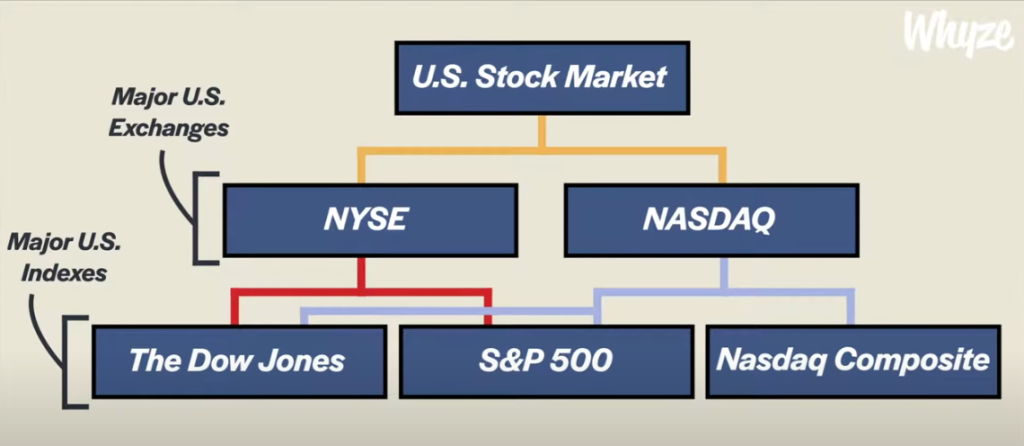
Before comparing the three indices, we need to be clear about the difference between a stock exchange and a stock index, as the two are often confused.
Stock exchange: A marketplace where companies are listed for the public to buy and sell ownership shares - for example the New York Stock Exchange (NYSE) and Nasdaq in the US, or Bursa Malaysia here at home.
Stock index: A group of selected companies combined to measure the overall performance of a market. An index is not a place to trade - it is simply a benchmark or measurement. Dow Jones, S&P 500 and Nasdaq Composite are all indices, not exchanges.
US Stock Exchanges: NYSE and Nasdaq
In the United States, there are two major stock exchanges: the New York Stock Exchange (NYSE) and Nasdaq. Companies wishing to list must meet certain eligibility requirements, including a strong financial track record, sufficient capital, and transparency such as annual reports to the public.
Keep in mind: NYSE and Nasdaq are exchanges (places to trade), while Dow Jones and S&P 500 are indices that draw companies from both. Nasdaq is unique because it is the name of an exchange and an index (the Nasdaq Composite) at the same time. For a deeper comparison of US exchanges, see similarities and differences between NYSE, Nasdaq and AMEX.

What Is the Dow Jones (DJIA)?
The Dow Jones - its full name is the Dow Jones Industrial Average (DJIA) and often called "The Dow" - is an index made up of 30 of the largest and most influential companies in the United States. It was created by Charles Dow and his business partner Edward Jones in 1896, making it one of the oldest indices in the world.
Companies in the Dow are chosen to represent the US economy broadly and are drawn from both the NYSE and Nasdaq. They include Apple, Coca-Cola, McDonald's, Nike and Microsoft. The list changes over time when a company no longer reflects the current economy.
The most important feature of the Dow Jones is that it is price-weighted. According to S&P Dow Jones Indices, this means higher-priced stocks have a bigger impact on the index - regardless of the actual size of the company. We will explain the implications shortly.

What Is the S&P 500?
The S&P 500 is an index covering roughly 500 of the largest companies in the United States (503 stocks in fact, because some companies such as Alphabet have more than one share class). The index was created by Standard & Poor's in 1957.
Many analysts consider the S&P 500 the best benchmark for the US stock market. According to S&P Global, the index covers about 80% of US stock market capitalisation - far more comprehensive than the 30 companies in the Dow Jones.
Unlike the Dow, the S&P 500 is market-cap weighted. This means larger companies have a bigger impact on the index's movements. That is why technology giants like Apple, Microsoft and Nvidia carry significant influence over the S&P 500.

What Is the Nasdaq Composite?
The Nasdaq Composite is an index tracking over 2,500 companies listed on the Nasdaq exchange. According to Nasdaq, the index leans heavily towards technology and innovation, though it also covers healthcare, information services and financial sectors.
Like the S&P 500, the Nasdaq Composite is also market-cap weighted. Because it is dominated by large technology companies, it is often viewed as a gauge of the global technology sector's "mood" - which is also why it is more volatile than the other two indices.
Don't confuse the Nasdaq Composite with the Nasdaq-100. The Nasdaq Composite covers all companies on the Nasdaq exchange, while the Nasdaq-100 tracks only the 100 largest non-financial companies. The popular QQQ ETF actually tracks the Nasdaq-100, not the Composite - an important distinction that is often misunderstood.
The Most Important Difference: How Each Index Is Calculated
This is the technical difference that confuses investors the most, yet it is the most important to understand. How an index is calculated determines which companies most influence its movement.
Dow Jones - price-weighted
In a price-weighted index, the share price determines a company's influence. A $500 stock has a bigger impact than a $50 stock - even if the second company is far larger in actual value. This is the Dow's main weakness: with only 30 companies and weighting based on price rather than size, it can give a less accurate picture of the market.
S&P 500 & Nasdaq - market-cap weighted
In a market-cap weighted index, a company's size (share price multiplied by number of shares) determines its influence. A $3 trillion company has far more impact than a $50 billion company. This approach is considered a better reflection of economic reality, which is why the S&P 500 is used as a benchmark more often than the Dow. A fuller explanation is available at Investopedia.

Difference in Sectors and Diversification
The three indices also differ in the sectors they represent:
- Dow Jones - 30 blue-chip companies across sectors (finance, healthcare, consumer, technology). Represents large, stable companies but is less comprehensive with only 30 names.
- S&P 500 - the most diversified, with ~500 companies across the 11 major sectors of the US economy. This is why it is often seen as the "true picture" of the US economy.
- Nasdaq Composite - the most concentrated in technology. When tech surges, the Nasdaq usually outperforms the other two; when tech falls, the Nasdaq tends to drop the hardest.
Difference in Volatility and Risk
Because their compositions differ, so does their volatility:
The Nasdaq Composite is usually the most volatile because it is heavy on technology stocks that are sensitive to interest rates and growth sentiment. The S&P 500 sits in the middle - diversified enough to avoid being too wild, but still influenced by large tech companies. The Dow Jones is generally the most stable as it consists of large, established companies, though this also means its returns can sometimes be slower when tech markets surge.
There is no single "best" index for everyone - it depends on your risk tolerance and investment goals.
Which One Should Malaysian Investors Follow?
For most long-term investors, the S&P 500 is often the top choice because it gives broad exposure to the US economy in a single investment. If you believe in technology growth, the Nasdaq offers higher potential returns with higher risk. The Dow, meanwhile, is useful as a reference for the performance of large, established giants.
The easiest way for Malaysian investors to gain exposure to these indices is through ETFs (Exchange Traded Funds) that track them:
- Dow Jones - SPDR Dow Jones ETF (DIA)
- S&P 500 - Vanguard (VOO), SPDR (SPY), or iShares (IVV)
- Nasdaq - Invesco QQQ (tracks the Nasdaq-100)
To buy these ETFs, you need an account that allows foreign stock trading. Note also that the US imposes a 30% withholding tax on dividends for non-residents, and you usually need to complete a W-8BEN form through your broker.
3 Common Misconceptions About US Indices
1. "The Dow Jones is the most important because it is mentioned most often." In reality, the Dow is quoted most often for historical reasons, but professional analysts rely more on the S&P 500 as a benchmark because it is more comprehensive.
2. "An index is where I buy stocks." No. An index is only a performance measure. You cannot "buy the Dow Jones" directly - you buy an ETF or fund that tracks the index.
3. "QQQ is the same as the Nasdaq Composite." Wrong. QQQ tracks the Nasdaq-100 (the 100 largest non-financial companies), not the entire Nasdaq Composite of over 2,500 companies.
FAQ - Dow Jones, S&P 500 and Nasdaq
1. What is the main difference between Dow Jones, S&P 500 and Nasdaq?
The Dow Jones tracks 30 large companies and is price-weighted; the S&P 500 covers ~500 of the largest companies and is market-cap weighted; while the Nasdaq Composite covers over 2,500 companies, most of which are in the technology sector.
2. Which index is the best benchmark for the US market?
The S&P 500 is often considered the best benchmark because it covers ~500 companies across various sectors and represents about 80% of US market capitalisation - far more comprehensive than the 30 companies in the Dow Jones.
3. What is the difference between the Nasdaq Composite and Nasdaq-100?
The Nasdaq Composite covers all companies (over 2,500) listed on the Nasdaq exchange, while the Nasdaq-100 covers only the 100 largest non-financial companies. The popular QQQ ETF tracks the Nasdaq-100, not the Composite.
4. Why does the Dow Jones have only 30 companies?
The Dow was designed in 1896 as a simple index representing the largest and most influential industrial companies in the US. Although it has only 30 companies, it is deliberately kept small so it is easy to track and represents stable blue-chip names.
5. Why is the Nasdaq more volatile than other indices?
Because the Nasdaq is heavy on technology stocks that are more sensitive to interest rates and growth sentiment. When the tech sector surges or falls, the impact on the Nasdaq is more pronounced than on the Dow or S&P 500.
6. Can Malaysian investors invest in these indices?
Yes. Malaysian investors can invest through ETFs such as DIA, VOO, SPY or QQQ. You first need an account that allows foreign stock trading.
7. Do US index movements affect Bursa Malaysia?
Yes. The US market often influences global market sentiment, including Bursa Malaysia. When Wall Street drops sharply, Bursa Malaysia is usually affected the next day, though the magnitude varies.
8. Why should Malaysian investors understand US stock indices?
Understanding the Dow Jones, S&P 500 and Nasdaq helps you interpret market news more accurately, compare investment performance, and make smarter global investment decisions.
Conclusion
In short, the key differences between the Dow Jones, S&P 500 and Nasdaq come down to the number of companies, how each index is calculated, and their sector focus. The Dow represents 30 giant companies on a price-weighted basis, the S&P 500 offers a comprehensive picture of the US economy, while the Nasdaq concentrates on technology with higher risk and higher potential returns.
Once you understand the differences between these three indices, the next step is having access to a platform that lets you invest, whether in Malaysia or abroad.
Open a CDS account today to start investing in Bursa Malaysia as well as foreign stocks such as the US and Hong Kong through a single platform.
Download our free stock market basics ebook to understand the fundamentals of investing from A to Z before going further.