What Is Inflation? How It's Measured & Why Every Malaysian Should Care

Have you noticed how a plate of nasi lemak that used to cost RM1.50 now goes for RM3 or more? Or how cooking oil keeps getting pricier every year? This phenomenon isn't just "prices going up" — it's an economic mechanism called inflation.
Many people hear the word inflation, but few truly understand what it means, how it's measured, and why it matters for your personal finances. In this article, we'll break down all these questions in simple, easy-to-understand language.
Quick Answer: What Is Inflation?
Inflation is the general and sustained increase in the prices of goods and services in an economy. When inflation occurs, your purchasing power decreases — meaning RM100 today cannot buy the same amount of goods as RM100 ten years ago.
Inflation doesn't mean one or two items become more expensive. It refers to a broad-based price increase — from food and rent to transportation and daily essentials.
Why Does Inflation Happen? 5 Key Causes
Inflation doesn't occur randomly. Several key factors drive sustained price increases:
1. Demand-Pull Inflation
When demand for goods and services exceeds available supply, prices rise. A simple example: during festive seasons, demand for chicken and meat surges, causing prices to spike.
2. Cost-Push Inflation
When production costs increase — such as raw material prices, worker wages, or energy costs — producers raise their product prices to maintain profit margins. Rising global crude oil prices are a classic example that creates a chain reaction affecting transportation and goods prices.
3. Expectation Inflation
When consumers and businesses expect prices to rise in the future, they act early — consumers buy more now, while businesses raise prices preemptively. These expectations themselves become a catalyst for inflation.
4. Increased Money Supply
When central banks print more money or loosen monetary policy, more money circulates in the economy. If the supply of goods doesn't increase at the same rate, prices will rise. This happened notably during the COVID-19 pandemic when many countries implemented massive fiscal stimulus.
5. External and Import Factors
Malaysia, as an open economy, is highly exposed to imported inflation. When import prices increase — whether due to a weakening ringgit exchange rate or rising global commodity prices — domestic prices are affected too.
How Is Inflation Measured in Malaysia?
This is an important question: how do we know inflation is happening, and what's its rate?
Consumer Price Index (CPI) — The Main Measurement Tool
In Malaysia, inflation is measured using the Consumer Price Index (CPI), known locally as Indeks Harga Pengguna (IHP). The CPI is calculated monthly by the Department of Statistics Malaysia (DOSM).
The CPI measures the average price change for a "basket" of goods and services commonly purchased by Malaysian households. If the CPI increases from month to month or year to year, it means inflation is occurring.
Simple formula:
Inflation Rate (%) = [(Current CPI − Previous CPI) ÷ Previous CPI] × 100
Example: If the January 2026 CPI is 135.7 and the January 2025 CPI is 133.6, then the inflation rate is:
[(135.7 − 133.6) ÷ 133.6] × 100 = 1.57% (rounded to 1.6%)
This means, on average, prices of goods and services rose 1.6% compared to the previous year.
What Is the "CPI Basket"? Components & Weights
The CPI basket isn't a physical basket — it's a list of goods and services representing the spending patterns of Malaysians. DOSM groups thousands of items into 12 main categories, each given different weights based on how much people spend on that category.
12 Main Groups in Malaysia's CPI Basket
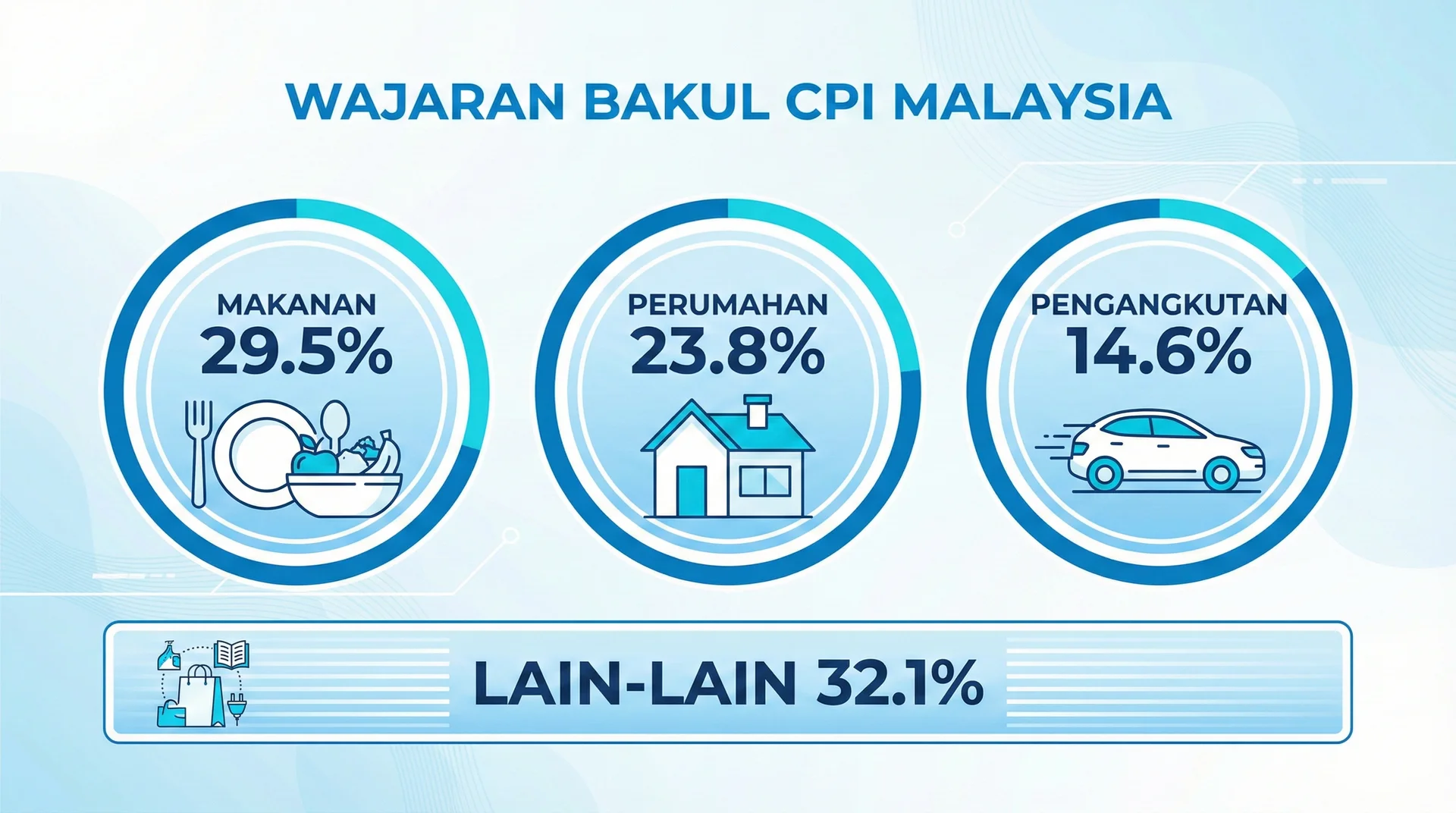
| No | Category | Weight (%) |
|---|---|---|
| 1 | Food & Non-Alcoholic Beverages | 29.5 |
| 2 | Housing, Water, Electricity, Gas & Fuel | 23.8 |
| 3 | Transport | 14.6 |
| 4 | Restaurants & Hotels | 5.8 |
| 5 | Miscellaneous Goods & Services | 5.6 |
| 6 | Recreation & Culture | 4.8 |
| 7 | Communication | 4.7 |
| 8 | Health | 3.0 |
| 9 | Clothing & Footwear | 2.8 |
| 10 | Furnishing & Household Maintenance | 2.7 |
| 11 | Education | 1.5 |
| 12 | Alcoholic Beverages & Tobacco | 1.2 |
Source: CPI Technical Notes, DOSM
Notice that Food & Beverages dominates nearly one-third of the CPI basket. That's why when food prices rise, Malaysians feel the impact very acutely.
How Are Weights Determined?
Weights are updated every 5 years based on the Household Expenditure Survey (HES) conducted by DOSM. This survey examines actual household spending patterns — how much is spent on food, rent, transport, and so on.
The current CPI basket uses 2022 as the weight reference period, expressed at December 2023 prices.
Latest Data: Malaysia's Inflation Rate
According to DOSM, Malaysia's inflation increased to 1.6% in January 2026 with the CPI recording 135.7 points compared to 133.6 in January 2025.
Breakdown by Category (January 2026):
- Food away from home: +2.5% (slightly down from 2.7%)
- Food at home: +0.6%
- Meat: +1.3% (fresh chicken up 1.5% to RM10.53/kg)
- Transport: -0.7% (down from +0.1% in December 2025)
Regional Comparison (December 2025):
| Country | Inflation Rate |
|---|---|
| Vietnam | 3.5% |
| Indonesia | 2.9% |
| South Korea | 2.3% |
| Malaysia | 1.6% |
| China | 0.8% |
| Thailand | -0.3% |
This data shows Malaysia's inflation remains controlled and lower than most neighbouring countries. However, it still erodes purchasing power gradually.
Types of Inflation
Inflation isn't one-size-fits-all. It comes in various forms depending on its rate and conditions:
Creeping Inflation
Price increases between 1-3% per year. This is considered healthy and normal in a growing economy. Malaysia mostly falls in this category.
Walking Inflation
Price increases between 3-10% per year. At this level, consumers start feeling significant cost of living pressure.
Galloping Inflation
Price increases exceeding 10% per year. This is already a serious problem requiring drastic action from the government and central bank.
Hyperinflation
Extremely severe price increases — hundreds or thousands of percent per year. Historical examples include Zimbabwe (2008) and Venezuela (2018) where local currencies became virtually worthless.
Deflation
The opposite of inflation — general price decreases. Although it sounds positive, deflation is actually dangerous because it can cause companies to lay off workers, consumers to postpone purchases, and economies to stagnate. Thailand recorded deflation of -0.3% in December 2025.
How Inflation Affects Your Personal Finances
Inflation isn't just a number in economic news. It directly impacts your wallet:
1. Purchasing Power Decreases
The RM1,000 you save today will lose value over time. At 2% annual inflation, your RM1,000 would only be worth about RM820 in purchasing power after 10 years.
2. Savings "Burn" Silently
If you save money in a bank account earning 1.5% interest but inflation is 2%, you're actually losing 0.5% per year in real terms. Your money grows in numbers but shrinks in actual value.
3. Debt Can Become "Cheaper"
Conversely, if you have fixed-rate debt, inflation actually benefits borrowers because you're paying back with money that's worth less.
4. Investments Need to Beat Inflation
This is the main reason why keeping money under the mattress or in a basic savings account isn't enough. You need to invest so returns exceed the inflation rate — only then does your wealth truly grow.
How Does the Government Control Inflation?
Bank Negara Malaysia (BNM) as the central bank plays a key role in controlling inflation through several mechanisms:
Monetary Policy
BNM can raise the Overnight Policy Rate (OPR) to make borrowing more expensive, thereby reducing spending and demand in the economy. This helps curb demand-pull inflation.
Price Controls
The Malaysian government implements price controls on certain essential goods such as RON95 petrol, sugar, flour, and cooking oil through the Ministry of Domestic Trade and Cost of Living (KPDN).
Subsidies
Government subsidies for items like petrol, electricity, and basic food help reduce the cost burden on citizens. However, prolonged subsidies put pressure on government finances.
Fiscal Policy
Through taxation and government spending, fiscal policy can also influence inflation levels. Reducing government spending or increasing taxes can help reduce money circulating in the economy.
How to Protect Your Money from Inflation
Knowing what inflation is isn't enough — you need to take action to protect your wealth:
1. Invest in Assets That Beat Inflation
Stocks, real estate, and gold have historically provided returns that exceed inflation over the long term. For example, EPF dividends have consistently exceeded the inflation rate.
2. Diversify Your Portfolio
Don't put all your eggs in one basket. Combine investments across stocks, bonds, real estate, and fixed deposits to reduce risk.
3. Increase Your Income
In the long run, the best way to handle inflation is to increase your income beyond the inflation rate — whether through salary raises, side income, or investments.
4. Reduce Variable Rate Debt
Variable rate debt becomes more expensive when BNM raises the OPR to control inflation. Try to convert to fixed rates if possible.
Frequently Asked Questions (FAQ) About Inflation
What is a "normal" inflation rate for Malaysia?
Malaysia typically records inflation between 1-3% per year. This rate is considered healthy for a growing economy. As of January 2026, Malaysia's inflation rate is 1.6%.
Is inflation always bad?
Not necessarily. Moderate inflation (1-3%) is actually a sign of a healthy, growing economy. What's dangerous is high uncontrolled inflation, or prolonged deflation.
What's the difference between inflation and cost of living?
Inflation measures average price changes across the entire economy. Cost of living is more subjective — it depends on lifestyle, location, and individual spending patterns. You might feel the cost of living rises higher than the official inflation rate because your spending basket differs from the CPI basket.
Why do food prices seem to rise a lot but inflation is only 1-2%?
This is because inflation measures the overall average — including categories whose prices are stable or declining (like communications and electronics). Food does rise more, but it's offset by other categories. Also, Food's weight in the CPI is 29.5%, so even if food rises 3%, its contribution to overall inflation is only about 0.9%.
How can I check Malaysia's latest inflation rate?
You can check the latest inflation data on the OpenDOSM portal managed by the Department of Statistics Malaysia. Data is updated monthly.
Can stock investing protect against inflation?
Yes, historically stock investments have provided returns exceeding inflation over the long term. However, they come with short-term volatility risk. Portfolio diversification is key.
What is core inflation?
Core inflation is a measure of inflation that excludes volatile items like fresh food and fuel. It provides a more stable picture of inflation trends and is often used by Bank Negara for monetary policy decisions.
Why does DOSM update the CPI basket every 5 years?
People's spending patterns change over time. For example, spending on communications and internet data is now higher compared to 10 years ago. Updating every 5 years ensures the CPI basket remains relevant to current spending realities.
Conclusion
Inflation is an economic reality that affects everyone — from the price of nasi lemak to the value of your retirement savings. Understanding what inflation is, how it's measured through the CPI and CPI basket, and how to protect your finances from it is the first step toward smarter money management.
If you want to start protecting your wealth from inflation erosion, the first step is to begin investing.
Open a CDS trading account to start investing on Bursa Malaysia through this registration link.
Download also the free Stock Market Basics Ebook to understand the fundamentals of stock investing before you begin.