What You Must Know About Share Consolidation

Share consolidation is one type of corporate exercise.
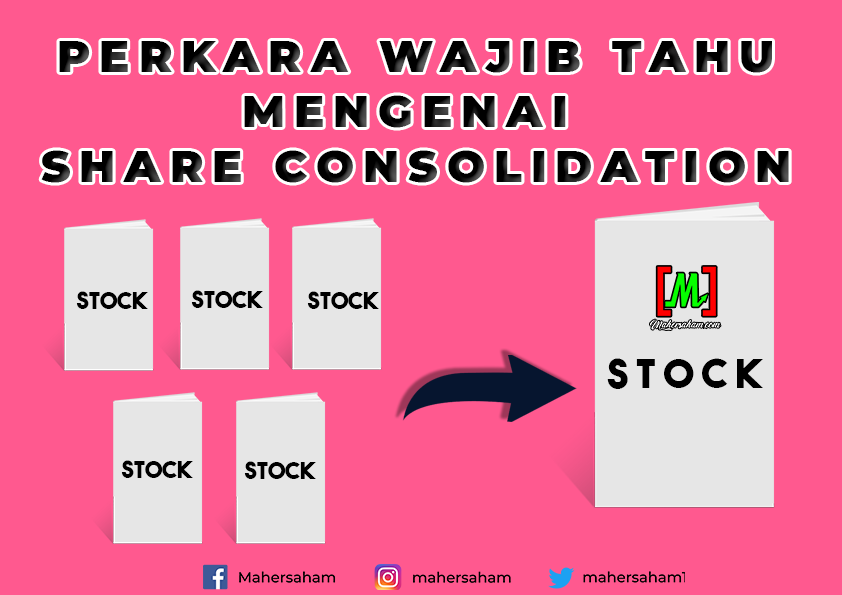
It is a process of merging shares and is a corporate action that combines multiple units of shares into a single unit.
- 1. When is the ex-date?
- 2. What is the conversion ratio?
- 3. You need to know the amount after consolidation.
To understand further, let us learn through a case study.
The case study this time involves the company DGB Asia Berhad.
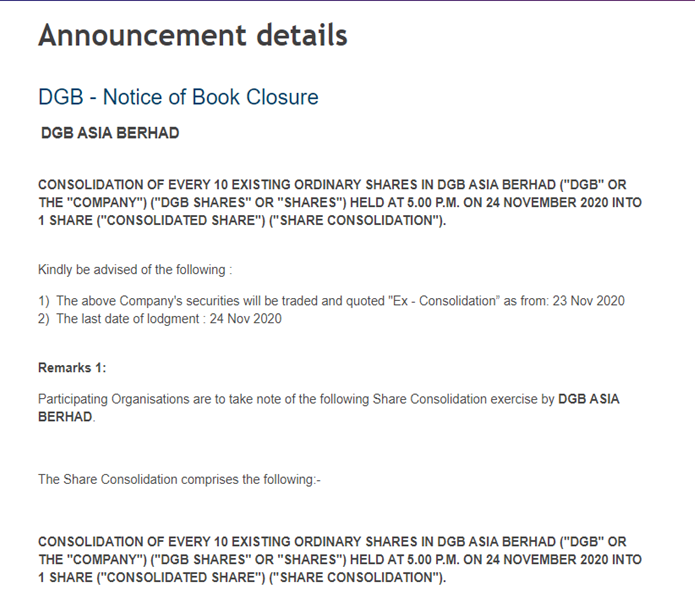
Based on the diagram above, the first piece of information we can identify is the ex-date.
The ex-date for DGB was 23 November 2020.
What Does Ex-Date Mean?

The ex-date is the last day of calculation before the share is subjected to a corporate exercise. In this case, it is a share consolidation.
Based on this case study, the ex-date was 23 November 2020.
So if you purchase shares on or after 23 November 2020, the share consolidation will not apply to you.
What is the Conversion Ratio?
Secondly, you need to know the conversion ratio.
In this case, the ratio (old:new) is 10:1.
This means every 10 units of shares will become 1 unit.
Thirdly, and most importantly, you need to know the total number of shares you hold before the share consolidation takes place.
If you hold shares, you must stay alert to announcements on Bursa Malaysia.
Why is this important? Why must you know the total number of shares?
Let me give you an example for better understanding.
For instance, before 23/11/2020 you had 10,000 units and after the share consolidation on 23/11/2020 (the ex-date), the number of shares became 1,000 units.
Please remember that:
The number of share units will decrease, but the share price will increase.
At this point, some shareholders may not have noticed that the share consolidation has occurred.
That person then sold shares based on the original number of units, which was 10,000 units, because they did not realise. What happens is that the person has oversold their shares.
On most platforms during a share consolidation, the number of shares in your portfolio still shows the old amount, which is 10,000 units instead of 1,000 units.
For Mplus users, the Mplus system now auto-adjusts. You will not accidentally oversell.
Let me explain for users of other platforms that do not auto-adjust.
For example, before the ex-date you bought 10,000 units at a price of RM0.03, with a capital of RM300.
On the ex-date, 23/11/2020, your units become only 1,000 because of the 10:1 ratio.
However, on the ex-date, your portfolio still shows 10,000 units.
Even though the share consolidation has already taken place, your portfolio should only show 1,000 units of shares.
Unfortunately, the system has not yet updated.
You might think you are making a profit.
Why a profit? As I explained earlier, after the share consolidation, the number of share units decreases but the share price increases.
In your portfolio, you see a profit of RM4,000 because 10,000 units x RM0.400 (price after consolidation) = RM4,000.
Since the price is rising, you decide to sell everything.
But you actually only have 1,000 units.
This has now become a short selling issue.
You sold 10,000 units, which means you have short sold 9,000 units.
What happens is that you are now in debt to your broker.
You must buy 9,000 units to avoid a buying-in (penalty) on that same day.
If you do not buy, Bursa will enforce a buying-in at a price 10 bids higher than the last traded price or the previous day's closing price, whichever is higher.
That is why before selling, you must know the actual quantity of your shares to avoid short selling incidents.
Profit or Loss?
- You need to understand why the company is carrying out the consolidation.
2. In terms of share price, it will appear more expensive.
3. In terms of market capitalisation, it does not change.
We hope this has been beneficial!
What are you waiting for? Register for a CDS account with Mahersaham and you can join exclusive classes for Mahersaham clients.
Watch the video we have prepared:
We hope this has been beneficial.
Frequently Asked Questions (FAQ)
What is share consolidation in the stock market?
Share consolidation is the process of merging several units of shares into one larger unit of shares. For example, if the consolidation ratio is 10:1, every 10 old share units will be combined into 1 new share unit, with the price adjusted according to that ratio.
Does share consolidation cause losses for investors?
In theory, share consolidation does not cause losses because the total value of your shareholding does not change. However, the share price per unit will appear higher after consolidation, and investors must ensure their share unit count is correct to avoid short selling issues.
Why do companies carry out share consolidation?
Companies typically carry out share consolidation to increase the share price per unit so it appears more valuable to institutional investors, to meet the minimum listing price requirements of the stock exchange, and to reduce the number of excessive shares in the market.
What should investors do when a company announces a share consolidation?
Investors should check their existing share unit count, understand the consolidation ratio announced, and ensure the share quantity is sufficient before making any sales to avoid buying-in penalties from the exchange.
Interested in starting your investment journey? Open a CDS account with Mahersaham and join our exclusive classes for clients.
Want to learn stock market basics from scratch? Get our free stock basics ebook now.
Further reading: