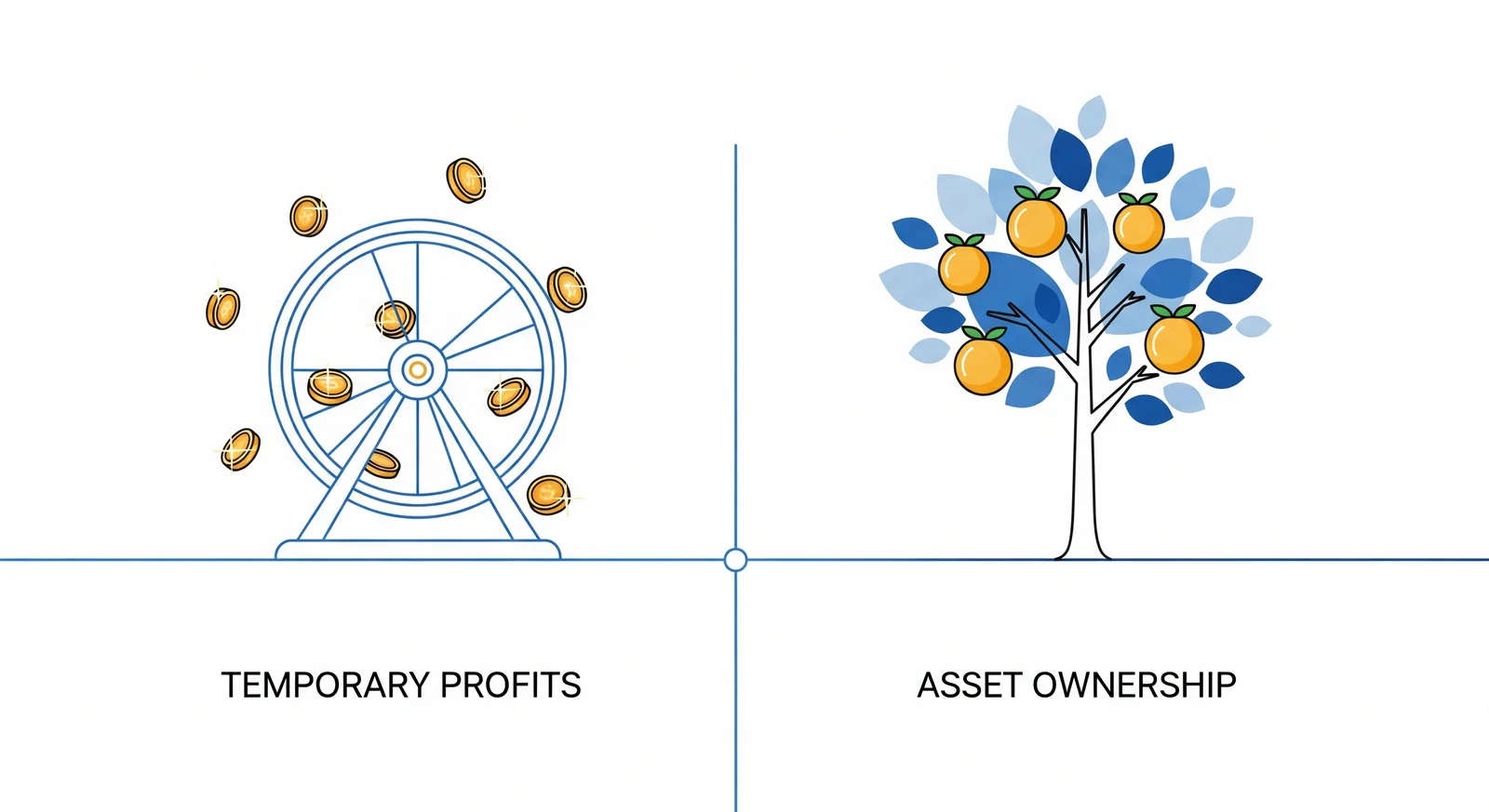
Focus on Owning Assets, Not Chasing Temporary Profits

Many investors are busy chasing "buy low, sell high" opportunities. Every day they stare at price charts, waiting for the perfect moment to enter and exit the market. Yet after years of doing this, they realise a painful truth - the profits have been spent, and they own nothing.
This is the biggest problem in investing today. The majority of retail investors are so focused on temporary gains that they forget the real purpose of investing - to own assets.
This article reveals why chasing quick profits often fails, and how you can shift your approach towards asset ownership that builds real wealth over the long term.
What Are "Temporary Gains" in Investing?
Temporary gains refer to profits earned from short-term buying and selling activities. You buy a stock at a low price, wait for it to rise, then sell. Money enters your account - and you feel successful.
But here is the trap.
After you sell, what do you have? Just cash. That cash is then used to pay commitments, buy things, or re-enter the market to try profiting again. This cycle repeats endlessly.
The problem is that profits from short-term trading are temporary because:
- No lasting assets - after selling, you no longer own those shares
- No passive income - cash sitting in your account generates nothing
- Constant pressure - you need to continuously find new opportunities to profit
- High transaction costs - broker commissions, spreads, and taxes reduce actual returns
- Emotional risk - hasty decisions driven by greed or fear often lead to losses
According to research by the Securities Commission Malaysia, the majority of actively trading retail investors record lower returns compared to investors who buy and hold stocks for the long term.
Asset Ownership: True Investors Buy to Own
Truly successful investors share one thing in common - they focus on asset ownership, not temporary gains.
When you buy shares in a company, you are actually buying ownership in that business. You become a co-owner. If the company profits, you profit through dividends. If the company's value increases, your ownership value increases too.
This is what Warren Buffett means when he says:
"If you aren't willing to own a stock for ten years, don't even think about owning it for ten minutes."
This concept is simple but many overlook it. Buying stocks is not just "trading" - it is purchasing ownership in a real business.
Selling for Profit vs Owning for Wealth
| Aspect | Selling for Profit (Temporary Gains) | Owning for Wealth (Asset Ownership) |
|---|---|---|
| Goal | Quick profit | Accumulate quality assets |
| Duration | Days / weeks / months | Years / decades |
| Income | Capital gain (one-time) | Dividends + capital appreciation (recurring) |
| After selling | Nothing left | Still own other assets |
| Stress | High - must monitor daily | Low - let assets work for you |
| End result | Money spent | Wealth grows through compounding |
Why Do Wealthy People Focus on Accumulating Assets?
Robert Kiyosaki in his book Rich Dad Poor Dad explains a fundamental principle - the rich buy assets, while the poor and middle class buy liabilities they think are assets.
An asset is something that puts money into your pocket. A liability takes money out of your pocket.
For example:
- Dividend stocks - pay you every quarter or annually without you having to do anything
- Rental property - tenants pay you monthly rent
- Unit trusts - fund managers invest your money and provide returns
- Businesses - business systems that run even when you are not present
All of these are assets that work for you. The more assets you own, the more passive income you receive. And this is the key to financial freedom.
Dividends: Proof That Your Assets Work for You
Dividends are cash payments that companies distribute to shareholders from their profits. If you own shares in a company that consistently pays dividends, you receive money regularly without having to sell your shares.
This means:
- You remain an owner - shares stay in your portfolio
- You receive income - dividends enter your account automatically
- Asset value can appreciate - share prices can rise over time
- Dividends can be reinvested - compounding effect multiplies your wealth
For example, if you own RM100,000 worth of shares in a company paying 5% annual dividends, you receive RM5,000 per year without selling a single share.
After 10 years with reinvested dividends, your portfolio can grow to approximately RM163,000 - without adding any new capital. This is the power of compounding through consistent asset ownership.
Data from Bursa Malaysia shows that the FBM KLCI Total Return Index (with reinvested dividends) consistently outperforms the price-only index, proving that dividends contribute a significant portion to long-term returns.
Types of Assets You Should Accumulate
Not all assets are created equal. Here are the categories of assets that long-term investors should focus on:
1. Quality Company Stocks
Buy shares in companies with consistent profit records, good management, and competitive advantages (economic moat). Such companies tend to increase their dividends year after year.
On Bursa Malaysia, sectors with consistent dividend-paying companies include banking, utilities, and telecommunications.
2. REITs (Real Estate Investment Trusts)
REITs allow you to own commercial property without buying buildings yourself. REITs are required to distribute at least 90% of their net income as dividends, making them an attractive source of passive income.
3. Physical Property
Owning rental property is one of the oldest ways to build wealth. Property values tend to appreciate over the long term, and you receive cash flow from monthly rent.
4. Fixed Deposits and Fixed Income Instruments
Although returns are lower, instruments like Tabung Haji, ASB, and government bonds provide stability and consistent income as part of a diversified portfolio.
5. Your Own Business
If you have specific skills, building a business that can operate without your 100% presence is the most valuable asset. A good business system generates income even while you sleep.
The Financial Freedom Formula Through Asset Ownership
Financial freedom is achieved when the passive income from your assets exceeds your monthly expenses.
Simple formula:
Monthly Passive Income > Monthly Expenses = Financial Freedom
Say your monthly expenses are RM5,000. You need at least RM5,000 per month (RM60,000 per year) in passive income.
With an average dividend yield of 5% per year, you need a stock portfolio worth approximately RM1.2 million to generate RM60,000 annually.
This figure may seem large, but with consistency and compounding over 20-25 years, it is very achievable. Many Malaysian investors who have planned early retirement through the FIRE strategy use this asset ownership approach.
Common Mistakes: Why Investors Fail to Accumulate Assets
1. Selling Too Early
An investor buys a good stock, the price rises 20%, and they immediately sell. Then the price climbs another 200%. They lost ownership in an asset that continued to grow because they were greedy for a small profit.
2. Fear of Temporary Losses
A stock drops 10-15% and the investor panic sells. Yet the company is still strong and profitable. This is called prospect theory - the human tendency to feel the pain of losses more intensely than the joy of gains.
3. Chasing "Hot Tips" and Speculative Stocks
Hearing a friend say stock XYZ is going up and buying without research. Pump and dump schemes only benefit syndicates, not ordinary investors. In the end, money is gone and no assets remain.
4. No Long-Term Plan
Many investors enter the market without clear goals. They do not know how many assets they need to accumulate, when they want to achieve financial freedom, or how much dividend income they need each month.
5. Over-Reliance on Capital Gains
Capital gains (profits from selling stocks) are tempting, but they are unpredictable and inconsistent. Compared to dividends paid regularly, capital gains are a bonus - not a core strategy.
Practical Steps to Start Focusing on Asset Ownership
If you are ready to shift your mindset from "chasing profits" to "accumulating assets", here are steps you can take today:
Step 1: Define your financial goals. How much monthly passive income do you need? What portfolio value is required to generate that amount?
Step 2: Identify suitable assets. Are you more comfortable with dividend stocks, REITs, property, or a combination? Each individual has different risk tolerance and financial circumstances.
Step 3: Buy consistently. Do not wait for the "best time" to enter the market. Buy a little each month (dollar-cost averaging). What matters is that you keep adding to your asset ownership.
Step 4: Reinvest dividends. Do not spend the dividends you receive. Use them to buy more shares. This accelerates the compounding process and increases the amount of assets you own.
Step 5: Monitor assets, not prices. Focus on the business performance of companies you own - are profits growing? Are dividends consistent? Do not worry too much about daily price movements.
Step 6: Be patient and consistent. Building wealth through asset ownership is not a one-day job. It requires discipline over many years. But the results are worth it - true financial freedom.
Asset Ownership in Islam
For Muslim investors, the concept of asset ownership aligns with Islamic principles. Investing in Shariah-compliant assets that generate halal returns is encouraged. Islam teaches its followers to build wealth ethically and responsibly.
Owning Shariah-compliant stocks on Bursa Malaysia means you become a co-owner of businesses that comply with the Securities Commission Malaysia guidelines. The Shariah-compliant stock list is updated twice a year, and over 80% of stocks on Bursa Malaysia are Shariah-compliant.
This provides ample opportunity for Muslim investors to build a halal and blessed asset ownership portfolio.
Frequently Asked Questions (FAQ)
How long does it take to achieve financial freedom through asset ownership?
It depends on your savings and investment rate. On average, with 20-30% of income invested consistently, financial freedom can be achieved within 15-25 years.
Does "buy and hold" mean never selling at all?
Not necessarily. You can sell if the company's fundamentals change - for example, the company starts recording consistent losses, management issues arise, or the industry becomes irrelevant. But do not sell simply because the price dropped temporarily.
What is the minimum capital to start accumulating stock assets?
On Bursa Malaysia, you can start with as little as RM100 through odd lots or platforms that support fractional share purchases. What matters is not the capital amount, but the consistency of adding to your holdings regularly.
What stocks are suitable for an asset ownership strategy?
Focus on companies with consistent dividend records, stable earnings, and strong market positions. Sectors such as banking, utilities, telecommunications, and consumer goods are popular choices for this strategy.
How do I know if a stock is suitable for long-term ownership?
Look for several key criteria: the company has recorded profits for at least 5 consecutive years, a healthy dividend payout ratio (30-60%), manageable debt, and competitive advantages over rivals.
Can I combine trading and asset ownership strategies?
Yes, but ensure the majority of your portfolio (70-80%) is for long-term asset ownership. Only use 20-30% for short-term trading if you have the skills and time to actively monitor the market.
What is the biggest risk in an asset ownership strategy?
The biggest risk is choosing the wrong company - for example, a company that appears strong but actually has internal problems. Therefore, diversification (spreading ownership across multiple companies and sectors) is essential to mitigate this risk.
Is property or stocks better for asset ownership?
Both have their own advantages. Stocks are more liquid (easier to sell), require lower capital, and provide dividends. Property is more stable, can be used as collateral, and provides rental income. Combining both in your portfolio is a wise approach.
Conclusion
The key to real wealth is not in your ability to chase temporary gains through short-term trading. It lies in the patience and discipline to continuously accumulate quality assets that generate consistent passive income. Shift your mindset from "sell for profit" to "own for wealth" - and let your assets work for you.
If you are ready to start building your asset ownership portfolio in the stock market, the first step is opening an investment account.
Open a CDS account and start investing on Bursa Malaysia as well as international stocks like US and Hong Kong markets through this link.
Download the free Stock Market Basics ebook here to understand the fundamentals before you start investing.
Further Reading
- Rich Dad Poor Dad: Why the Rich Buy Assets and the Poor Buy Liabilities
- What Are Stock Dividends? A Complete Guide for Bursa Malaysia Investors
- FIRE Malaysia: How to Retire Early with RM1 Million & the 4% Withdrawal Rule
- The Psychology of Money: Why Managing Money Is 80% Behaviour, Not Intelligence
- Financial Planning Roadmap: What to Do in Your 20s, 30s, 40s Until Retirement