Michael Burry: Today's Market Feels Like "The Last Months of the 1999-2000 Bubble"

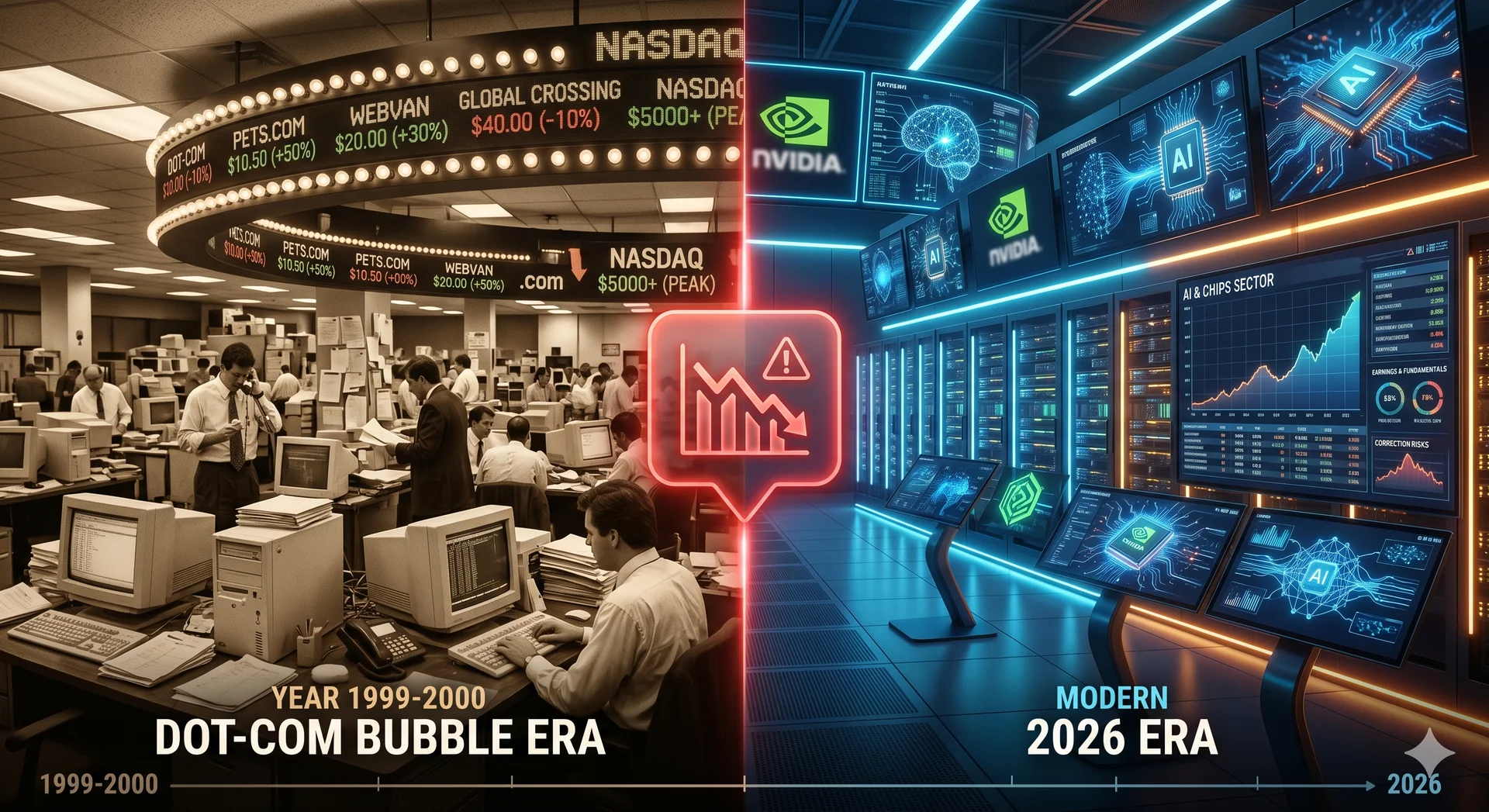
On May 8, 2026, Michael Burry - the contrarian investor famous for predicting the 2008 US housing crash and immortalized in the film The Big Short - issued a stark warning to global stock markets. He wrote: "Stocks are not up or down because of jobs or consumer sentiment - feeling like the last months of the 1999-2000 bubble."
This is more than a casual statement. It is a signal to retail investors riding the AI-driven rally - including Bursa Malaysia investors with exposure to NVIDIA, AMD, or local OSAT names like INARI and PENTA. Burry highlighted one specific metric: the average return of the top 10 Nasdaq 100 stocks over the past 12 months is 784% - higher than the 622% recorded in the period following the dot-com peak in March 2000.
In this article, we unpack: - What Burry actually said (full context from CNBC report) - Burry's track record and why his warning deserves attention - Specific data points he highlighted (SNDK +3,960% YoY, SOX +65% YTD, top 10 +784%) - Why "stocks not reacting logically to economic data" is a danger signal - Implications for Bursa Malaysia investors (NVDA exposure, OSAT spillover, sentiment risk)
What Did Burry Actually Say?
On Friday afternoon, May 8, 2026 (1:35 PM EDT), CNBC published a report by Yun Li. The report featured Burry's social media post containing three main points:
Point 1 - Stocks no longer react logically:
"Stocks are not up or down because of jobs or consumer sentiment."
Translation: economic data such as employment reports (NFP), consumer confidence, retail sales - traditional data that should move stock prices - is now irrelevant. Stocks rise on AI sentiment; stocks fall when AI sentiment shifts. Conventional economic logic has stopped working.
Point 2 - Feeling like 1999-2000 bubble:
"Feeling like the last months of the 1999-2000 bubble."
Burry refers to the final phase before the dot-com bubble burst - when stocks rose parabolically without fundamental backing, and retail investors all felt "supremely confident" before the 89% crash within 30 months that followed.
Point 3 - Top 10 names average 784%: Burry compared rolling 12-month returns: - 1999 top 10 Nasdaq performers: average 559% - 12-month period following the March 2000 peak: average 622% - Latest 12-month period (May 2025 - May 2026): average 784%
Meaning: today is more extreme than the peak of the 1999-2000 bubble itself.
SNDK as Case Study
Benzinga reported that Burry specifically highlighted SanDisk Corporation (SNDK) - a memory semiconductor player: - +3,960% in 12 months (May 2025 - May 2026) - +493.98% YTD 2026 alone - Burry said: "SNDK is beating that by 1300bps" - referring to the QCOM 1999 record (which rose 2,620% over 52 weeks at peak)
This is a historical benchmark broken in less than a year.
Who Is Michael Burry? Track Record That Makes This Warning Matter
Before we dismiss this as just another statement, understand who Burry is:
2008 Housing Crash Prediction
Burry founded Scion Capital (later Scion Asset Management). Between 2005-2007, he bought credit default swaps against subprime mortgage securities - betting the US housing market would crash. At the time, everyone called him crazy. Results: - 2008 crash: US housing market collapsed - Lehman Brothers bankrupt - Scion Capital made US$725 million for investors - Burry personally earned US$100 million from that trade
The story was immortalized in "The Big Short" by Michael Lewis (2010), later adapted into an Oscar-nominated film with Christian Bale playing Burry.
Track Record After 2008
Burry has made several other contrarian calls since: - 2017: warning about index funds bubble (still hasn't truly burst) - 2021: short Tesla (unprofitable position for several quarters) - 2022: warned of market crash that didn't really happen - 2023: long China stocks (good timing overall) - 2024: short Nvidia (closed within months) - 2025: market crash warning (see our previous article)
Not all Burry's calls are well-timed. But when he speaks with this urgent tone, the market needs to listen - at least to consider the risk.
What Made the 1999-2000 Bubble So Notable?
To understand the full implications of Burry's comparison, let's recall what happened from late 1999 through March 2000:
The Final Phase (Jan-Mar 2000)
- Nasdaq Composite: from ~3,500 (Nov 1999) to peak 5,048 (March 10, 2000), up ~44% in 4 months
- Cisco became the world's most valuable company at US$555 billion market cap
- CMR.com, Pets.com, Webvan and hundreds of unprofitable startups soared 100-500% within months
- QCOM (Qualcomm) rose 2,620% over a 52-week peak
The 2000-2002 Crash
- Nasdaq fell from 5,048 to 1,114 (Oct 2002) - drop of 78%
- Cisco fell 88% (US$79 → US$9.50)
- Many dot-com companies went bankrupt
- The bubble took 15 years to recover to peak levels
For deeper context on Cisco's 2000 era and implications for NVIDIA today, read our article: NVIDIA Today = Cisco 2000? Historical Lessons & Other AI Stocks for Investors.
Specific Data Burry Highlighted
Let's record the data systematically:
Philadelphia Semiconductor Index (SOX)
- Up >10% in a single week (through May 8, 2026)
- +65% YTD 2026
- Trajectory mirrors the run-up before the March 2000 collapse
Top 10 Nasdaq 100 Performers Comparison
| Period | Average Return Top 10 |
|---|---|
| 1999 (year-end) | 559% |
| Year ending March 2000 (peak bubble) | 622% |
| Year ending May 2026 | 784% |
Today is more extreme than the peak of the 1999-2000 bubble.
Single Stock Champion: SanDisk (SNDK)
- 12-month return (May 2025 - May 2026): +3,960%
- YTD 2026: +493.98%
- "Beating QCOM 1999 record by 1300bps"
SanDisk is a memory player - relevant to the HBM and AI memory boom theme we covered earlier. But a 3,960% rise in a year is not normal - even with the very real AI memory boom.
Why "Stocks Not Reacting Logically to Economic Data" Is a Danger Signal
Burry highlighted one very specific signal. Let's unpack it:
Before Bubbles - Standard Logic
In a "normal" market: - Strong jobs report = consumers spend more = corporate revenue rises = stocks rise - Weak jobs report = consumers tighten = recession risk = stocks fall - Fed rate cut = lower borrowing cost = stocks rise
Logical relationships between economic data and stock prices are the market's self-correcting mechanism.
In the Final Bubble Phase - Logic Breaks
When a bubble enters its final phase: - Strong jobs report: stocks rise because of "macro support thesis" - Weak jobs report: stocks rise because "Fed will cut rates" - Fed cuts rates: stocks rise because of "liquidity" - Fed hikes rates: stocks rise because "economy is strong"
Every data point becomes justification to rise. This is a signal the market no longer reacts to fundamentals - it reacts to momentum and sentiment.
1999 Déjà Vu
In 1999, this happened: - US economy strong → "AI stocks rise on recovery" - Fed cut rates → "AI stocks rise on liquidity" - Y2K bug fixed → "AI stocks rise on certainty" - Earnings disappoint → "doesn't matter because of growth story"
Then, in March 2000, everything changed within weeks.
Implications for Bursa Malaysia Investors
How is this news relevant to you? Let's map it out:
Direct Exposure (US Tech Stocks)
If you hold: - NVIDIA (NVDA), AMD, AVGO, TSM - Tesla (TSLA), Microsoft (MSFT), Meta (META) - Nasdaq 100 ETFs (QQQ) or S&P 500 (SPY)
...then Burry's warning is directly relevant. This doesn't mean sell everything, but: - Trim exposure if weight exceeds 30% of portfolio - Take some profit from positions that have surged - Set stop-loss or clear exit plan
Indirect Exposure (Bursa OSAT/Tech)
Bursa Malaysia stocks with AI/semiconductor cycle exposure: - INARI (0166), VITROX (0097), PENTA (7160), FRONTKN (0128) - UNISEM (5005), MPI (3867), GREATECH (0208)
These names move cyclically with the global semiconductor industry. If the US AI bubble bursts, valuations of Bursa OSAT stocks (many trading at P/E >40-80x) will compress too.
For a more complete framework of AI ecosystem stocks worth monitoring, read Beyond NVIDIA: 8 Companies Profiting from the AI Boom.
ETF / Unit Trust Exposure
Many Malaysian unit trusts and ETFs have US tech exposure via: - Public Mutual Tech Fund - AmGlobal Equity Fund - Maybank Asset Management funds with US allocation
If you hold ASB, ASW, ASN - the exposure is smaller but still present through PNB diversification.
Sentiment Risk - "Contagion"
History shows US bear markets typically trigger Asian bear markets too. The KLCI didn't fall as severely as the Nasdaq in the 2000-2002 crash, but several weaker names suffered significantly.
What Should Investors Do? (Not a Buy/Sell Call)
I'm not in a position to give buy or sell calls. But as an investor thinking through risk frameworks, several prudent steps:
1. Audit Your Exposure
Open your portfolio. Calculate: - What % of portfolio is in US tech? - What % in Bursa OSAT/tech? - What % in ETFs/unit trusts with high US tech allocation?
If the total "AI / semiconductor / tech" theme exceeds 30% of portfolio, you're over-concentrated.
2. Ask Yourself: "Can I Withstand a 50% Drawdown?"
Burry compared with 1999-2000. Drawdowns possible: 30-60% over 12-24 months.
If you can't withstand that drawdown (financially or psychologically), trim exposure now before the cycle turns.
3. Define Your Exit Strategy
Without "buy and hope," set: - Automated stop-loss for individual positions - Trailing stops that lock in some profit - Re-allocation triggers (e.g., when NVDA P/E exceeds 60x, trim 25%)
This strategy removes emotional decision-making when markets swing.
4. Diversify Across Asset Classes
When bubbles burst, typically: - Cash and bonds outperform - Defensive stocks (utilities, consumer staples) hold up better - Gold and precious metals often rally as safe haven
Gold has already broken US$3,400/oz in 2026. Diversification across stocks + bonds + commodities helps cushion drawdowns.
5. Distinguish Between "Burry Bear" and "Permanent Bear"
Burry isn't a permanent bear. He has a track record of short selling but also long positions. The point: this warning isn't to panic-sell everything, but to defensively position during phases when the market becomes extreme.
Risks of Listening to Burry's Warning
There are also risks in following Burry blindly:
1. Burry Is Often Early
While his 2008 call was correct, he started shorting housing from 2005 - three years before the crash. Investors who followed him early had to absorb losses for 2-3 years before being vindicated.
2. Not All Burry Calls Are Right
- Short Tesla (2021): unprofitable
- Predicted 2022 crash: didn't really happen
- Short Nvidia (2024): closed quickly
- Bubble warning 2025: market continued rising
His post-2008 track record is more mixed.
3. Selling at "Last Months" Means You May Miss 20-30% More Upside
The March 2000 peak came after months of the final bubble phase. Investors who sold in December 1999 missed 25-30% more rally before the peak.
Perfect exit timing isn't realistic. What matters is risk management, not precise timing.
FAQ: Common Questions
1. Does this mean NVIDIA will crash?
Not necessarily. Burry gave a historical comparison, not a price prediction. NVIDIA may continue rallying for several more months, or correct now. Nobody can predict precisely. What matters: don't over-allocate to a single name.
2. Should I sell all my AI stocks now?
That's a personal decision depending on: - Your time horizon (long-term holders can ride out cycles) - Risk tolerance (can you withstand 50% drawdown?) - Tax implications (capital gains tax in your country) - Investment alternatives (cash returns vs equity)
There's no one-size-fits-all answer.
3. How does Burry's call now differ from 2008?
2008: Burry shorted subprime CDS - a specific, asymmetric position. Low cost, high payoff.
2026: Burry gives broad sentiment warnings. This is harder to monetize - exit timing always tricky.
4. Will Bursa Malaysia fall along with the US?
History of crashes 2000, 2008, 2020 shows the KLCI typically falls less than the Nasdaq, but still drops: - 2000-2002: Nasdaq -78%, KLCI -29% peak-to-trough - 2008: Nasdaq -54%, KLCI -45% - 2020 COVID: Nasdaq -30%, KLCI -22%
There's partial decorrelation, but not total immunity.
5. Should I follow Buffett (long-term hold) or Burry (cyclical bear)?
Both are valid - depending on profile: - Buffett-style: long-term hold quality companies, ride out cycles - Burry-style: tactical positioning, ride bull but exit before crash
Buffett also said in 2026 that the market is "extremely valued" but didn't sell aggressively. His approach balances: maintain core positions, build cash for opportunities.
6. What concrete steps for Malaysian retail investors?
Five practical steps: 1. Audit portfolio - know your real exposure 2. Trim concentrated positions if overweight on AI/tech theme 3. Build 10-20% cash position for future opportunities 4. Diversify into defensive sectors (REITs, utilities, healthcare) 5. Set rules for exit if sentiment changes
7. Is this article "fearmongering"?
No - this is analysis based on Burry's public statements reported by mainstream media (CNBC, Benzinga). I also highlight that Burry isn't always right, and investors must make their own decisions based on their profile.
8. What should I monitor next?
Indicators to watch: - Hyperscaler Q2 2026 earnings (Microsoft, Meta, Google, Amazon) - if AI capex slows → first signal - NVIDIA H2 earnings - if revenue growth slows below expectations → signal - Federal Reserve meetings - if Fed turns hawkish unexpectedly → trigger - Nasdaq 100 breaks key support (e.g. 50-day moving average) → momentum shift signal
Conclusion
Michael Burry's warning on May 8, 2026 - that today's market is more extreme than the final phase of the 1999-2000 bubble - deserves serious attention even if not followed blindly. The data he presents is objective: top 10 Nasdaq stocks up 784% in a year (vs 622% at the March 2000 peak), SanDisk +3,960%, and stocks not reacting logically to economic data - these are not features of a "normal" market.
For Bursa Malaysia retail investors, this is a wake-up call to: 1. Audit exposure to US tech and Bursa OSAT/AI themes 2. Resist emotional FOMO to add positions at the peak 3. Build exit discipline before sentiment changes 4. Diversify across asset classes and geographies
Before making any major investment decisions, ensure you have an active trading account and a strong understanding of stock investing fundamentals.
To start investing in Bursa Malaysia and overseas markets like the US and Hong Kong, you need a CDS account - register your CDS account with Mahersaham here.
For investing fundamentals including reading financial statements, valuing cyclical companies, and portfolio risk management strategies, get our free stock investing fundamentals ebook.
Further Reading
- NVIDIA Today = Cisco 2000? Historical Lessons & Other AI Stocks - Historical bubble context for the AI era
- Beyond NVIDIA: 8 Companies Profiting from the AI Boom - Diversifying across the AI value chain
- AI Memory Chips: Samsung Joins Trillion Dollar Club - Context on SNDK and the memory boom Burry highlighted
- Michael Burry Predicts 2025 Stock Market Crash - Earlier Burry warning context
- Plantation Stocks: CPO Cycle & When Investors Should Enter - Defensive Malaysian sector for diversification