Bus Cap Signs Exclusive MOU with BYD to Build Electric Bus Factory in Perak

Bus Cap Berhad (BUSCAP, 0455) and BYD Malaysia Sdn Bhd have signed an exclusive Memorandum of Understanding (MOU) on August 18, 2026 in Shenzhen, China to develop a New Energy Commercial Vehicle (NECV) platform in Malaysia. This collaboration includes plans to build an electric bus assembly and manufacturing facility in Perak - a strategic move that could reshape the nation's public transportation landscape.
Partnership Background
This agreement connects two complementary entities. BYD, the Chinese technology giant and the world's largest electric vehicle manufacturer, brings new energy vehicle technology expertise and global experience. Bus Cap offers local manufacturing capabilities built since 1968 through its subsidiary, Sin Hock Leong Coach Works Sdn Bhd (SHL Coach) in Perak.
The MOU covers several key areas of collaboration:
- Electric bus product development and localization
- Sales, marketing, and distribution
- Comprehensive after-sales services
- Local assembly and manufacturing
- Evaluation of appropriate investment and operating structure
Both parties will assess detailed commercial terms before signing a definitive agreement. The MOU is valid for 12 months.
Why Perak Was Chosen
The selection of Perak as the factory location is no coincidence. Bus Cap has nearly 60 years of bus manufacturing history in the state through SHL Coach, headquartered in Ipoh. Existing infrastructure, skilled workforce, and established supply chains make Perak the strategic choice for the next growth phase.
According to Bernard Ng Chong Yan, Executive Director of Bus Cap, "The exclusive MOU with BYD Malaysia is a significant milestone in our growth journey. BYD brings new energy vehicle technology and global experience, while we have local manufacturing capabilities and after-sales infrastructure."
BYD Vice President Luo Zhongliang stated that Bus Cap has "a local manufacturing base, customer access, and market understanding that are essential" to making this platform successful in Southeast Asia.
Malaysia's Growing Electric Bus Demand
This partnership comes at a pivotal time. Malaysia is accelerating the transition of its public transportation sector to electric vehicles through several key initiatives:
National Energy Transition Roadmap (NETR)
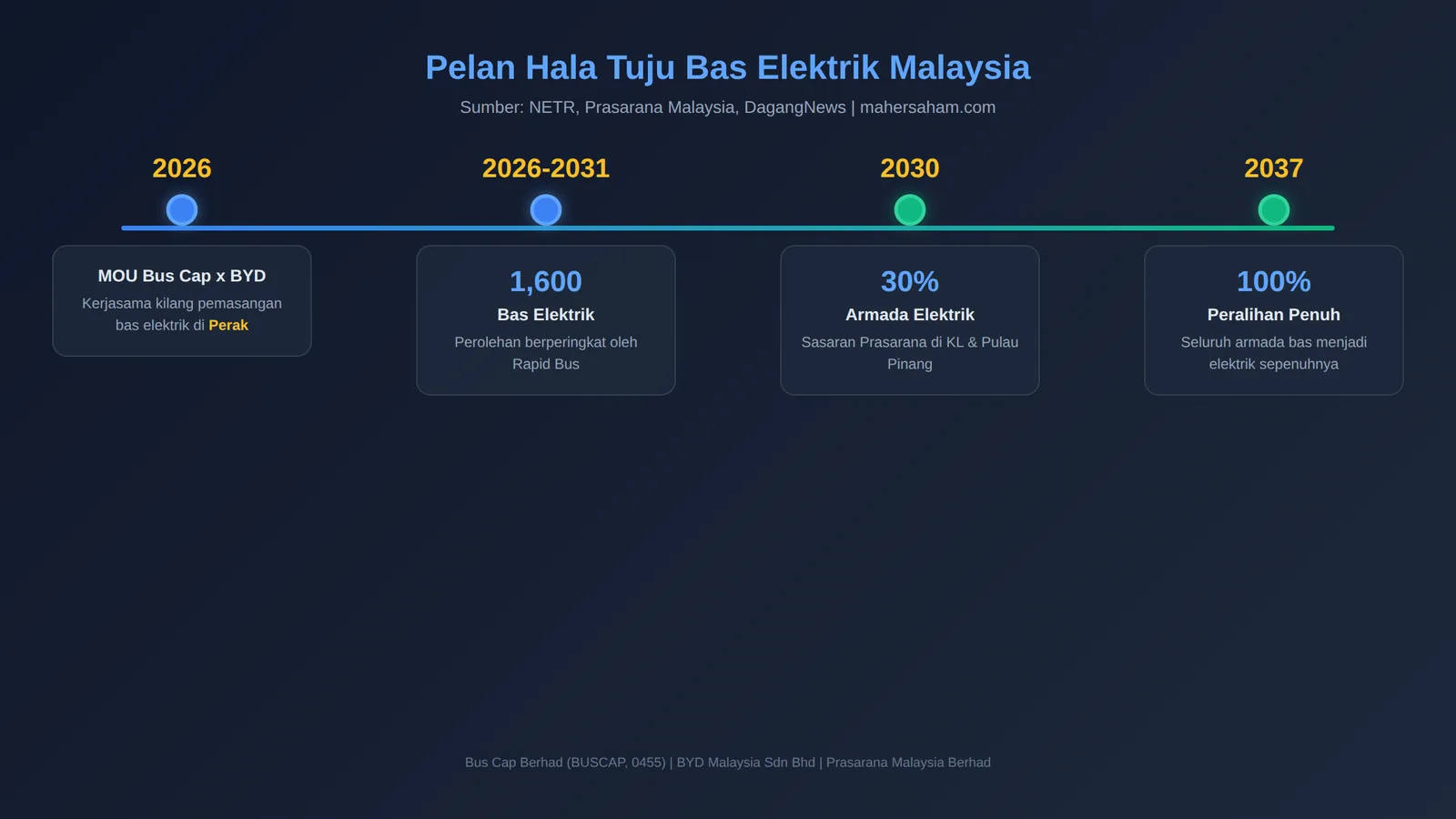
Under the NETR, the Malaysian government has set clear targets for public transport electrification. Prasarana Malaysia Berhad plans to integrate over 1,045 electric buses for services in the Klang Valley and Penang by 2030.
Full Transition by 2037
Prasarana Malaysia has confirmed that its recent procurement of 310 diesel buses will be the last before transitioning fully to electric platforms. Rapid Bus targets 30% of its fleet to be electric by 2030, with the goal of 100% electric buses by 2037.
150 Electric Feeder Buses for LRT Shah Alam
Beyond regular city buses, there is also demand for 150 electric feeder buses to support the new Shah Alam LRT Line operations.
Overall, Rapid Bus plans to procure up to 1,600 electric buses in phases from 2026 to 2031.
Expansion Potential Beyond Buses
Interestingly, the scope of this collaboration is not limited to electric buses alone. Both parties intend to evaluate opportunities in:
- Electric trucks - for logistics and goods delivery
- Electric forklifts - for warehousing and manufacturing sectors
- Electric vans and minibuses - for smaller transportation services
- Rail-transit-related solutions - subject to market demand
This means Bus Cap could potentially transform from a traditional bus manufacturer into an integrated player in the commercial electric mobility ecosystem - an evolution that could multiply the company's addressable market.
Implications for Investors
Bus Cap Berhad was recently listed on Bursa Malaysia's ACE Market on June 3, 2026 at an IPO price of 23 sen per share. The company's IPO received overwhelming response with 72.24 times oversubscription, indicating strong investor confidence in the company's prospects.
Key considerations for investors:
Positives:
- Access to globally proven BYD technology
- Clear long-term demand driven by government policy (NETR)
- Large pipeline - over 1,600 electric buses needed by 2031
- Expansion potential into other segments (trucks, forklifts, vans)
- Factory in Perak leverages existing infrastructure
Risks:
- MOU has not yet become a definitive agreement - still subject to feasibility studies
- MOU valid for only 12 months - implementation timeline remains unclear
- Competition from other players in Malaysia's electric bus market
- Bus Cap is still a small company (market cap ~RM88 million at IPO) with limited capacity
- Dependent on government budget allocation for electric bus procurement
Industry Context: BYD in Malaysia
BYD is not a newcomer to Malaysia. The company has announced the construction of its first CKD factory in Tanjung Malim, Perak which began operations in 2026 for passenger vehicles. With the Bus Cap partnership, BYD is now expanding its presence into the commercial vehicle segment.
This move aligns with BYD's strategy to establish a regional manufacturing hub in Southeast Asia, positioning Malaysia as a base to serve both domestic and regional market demand.
Frequently Asked Questions (FAQ)
What is the MOU between Bus Cap and BYD?
The MOU (Memorandum of Understanding) is an exclusive agreement signed on August 18, 2026 in Shenzhen to explore collaboration in manufacturing and assembling electric buses in Perak, Malaysia. It is valid for 12 months.
When will the electric bus factory in Perak be completed?
The completion date has not been announced. Both parties are still in the evaluation phase for investment and operating structures before signing a definitive agreement.
How many electric buses does Malaysia need?
Prasarana Malaysia plans to procure over 1,600 electric buses in phases from 2026 to 2031, targeting a fully electric fleet by 2037.
What is Bus Cap's stock code on Bursa Malaysia?
Bus Cap Berhad is listed on the ACE Market with stock code 0455 and trading name BUSCAP.
Is this partnership only for electric buses?
No. The MOU scope also includes potential expansion into electric trucks, forklifts, vans and minibuses, as well as rail-transit solutions.
Who are Bus Cap's competitors in Malaysia's electric bus market?
Competitors include companies such as Yutong (China), Higer (China), and other local players offering electric bus solutions to Malaysian public transport operators.
What advantage does Bus Cap have over competitors?
Bus Cap has local manufacturing capabilities built since 1968, established after-sales infrastructure, and now access to globally proven BYD technology.
Conclusion
The exclusive partnership between Bus Cap and BYD is a positive development for Malaysia's commercial electric vehicle industry. With clear electric bus demand driven by government policy and Prasarana's large pipeline, a local assembly facility will play a crucial role in meeting national requirements. However, investors should remember this is still at the MOU stage and needs to be monitored for definitive agreement developments.
If you're interested in investing in Malaysian stocks including the electric vehicle sector, the first step is having a CDS account that allows investment on Bursa Malaysia as well as international stocks in the US and Hong Kong.
Open your CDS account via this link to start investing today.
Download our free Stock Market Basics Ebook to understand investment fundamentals before making your first investment decision.