Should I Buy This Product? A Halal Decision Flow You Can Actually Use

There is a flowchart that keeps circulating on WhatsApp and social media: "Should I buy this product from you?" It opens with one simple question - is the owner Muslim? - then branches into halal certification, premise cleanliness, ingredient sourcing, and finally your own personal conviction.
I agree with the logic of that chart. It is practical, it does not brand anyone haram wholesale, and it puts the responsibility on the consumer to ask before deciding. But one thing needs saying up front: that chart is not an official fatwa. It is a thinking framework. Other people may have their own chart with a different entry point, and that is acceptable too, as long as it rests on the same Shariah principles.
Short Answer: Should You Buy a Product Without Halal Certification?
Yes, if you are confident the product is free from haram ingredients and the preparation process complies with Shariah. The absence of halal certification does not automatically make a product haram - it only means there is no official verification from the authorities. But if doubt (syubhah) arises and you cannot resolve it by asking, the default ruling is to leave it and find a clearer alternative.
That is the summary. Now let us break the flowchart down branch by branch, and see where it actually rests on real fatwa.
The Decision Flowchart: The Version I Agree With
Here is the structure of that chart in a more readable form. Notice that every branch ends in one of three outcomes: Buy, Do Not Buy, or Check First.
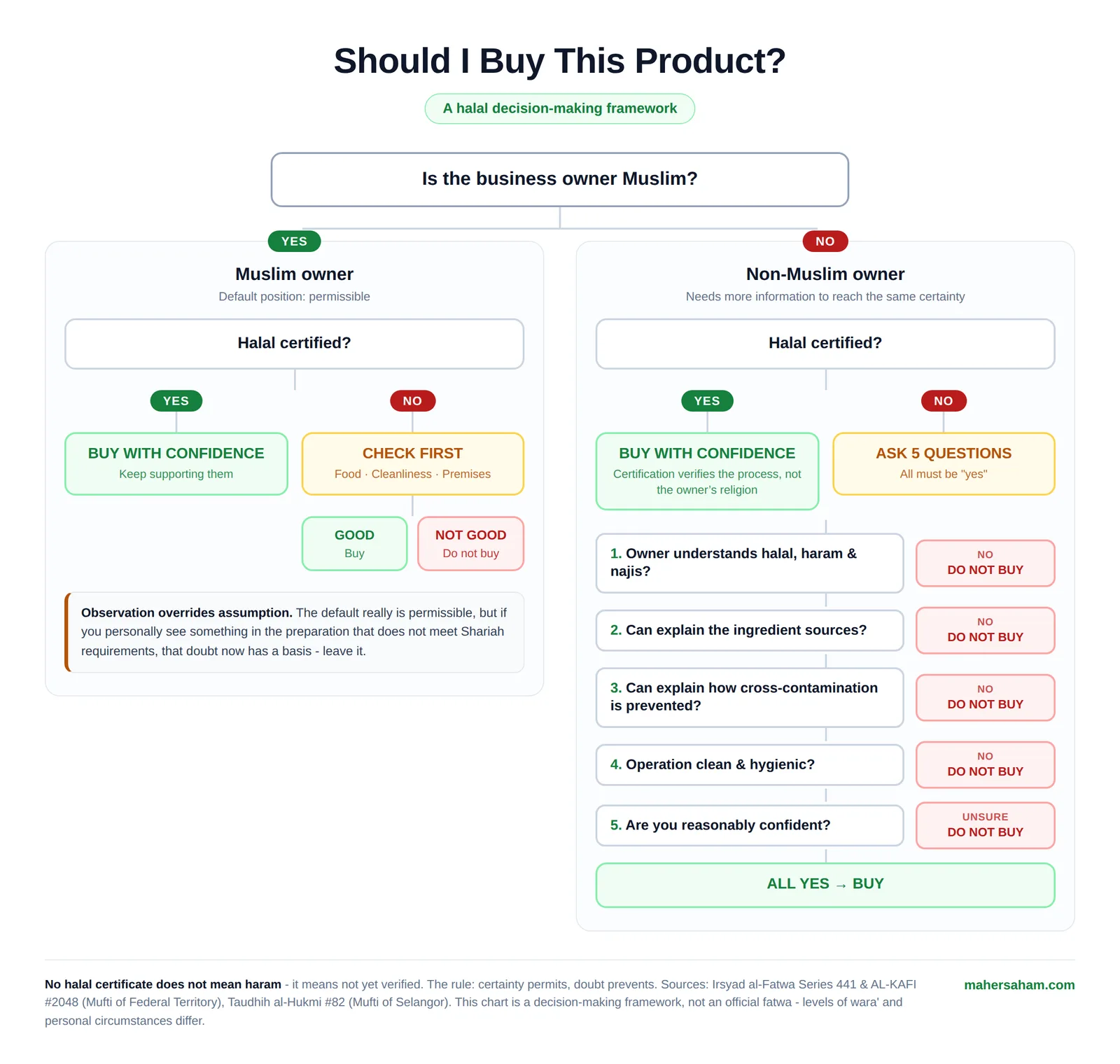
Opening question: Is the business owner Muslim?
If YES (Muslim owner):
- Has halal certification? Yes - buy with confidence and keep supporting them.
- No certification? Check three things first: the type of food sold, the standard of cleanliness, and the condition of the premises. If all three are satisfactory - buy. If not - do not buy.
If NO (non-Muslim owner):
- Has halal certification? Yes - buy with confidence. JAKIM or JAIN certification does not consider the owner's religion, it verifies the process.
- No certification? Here the chart gets stricter, deliberately so. You need to work through five layers of questions:
- Does the owner understand the concepts of halal, haram and najis? If no - do not buy.
- Can the owner explain the source of the ingredients used? If no - do not buy.
- Can the owner explain how cross-contamination with non-halal material is prevented? If no - do not buy.
- Is the operation clean and hygienic? If no - do not buy.
- Do you have reasonable confidence in the halal integrity of this operation? If unsure - do not buy. If yes - buy.
The logic behind this asymmetry is not prejudice. It is about the information burden. A Muslim trader already operates under the baseline assumption that they are bound by the same rulings, so the structural risk is lower. A non-Muslim trader may be entirely honest and scrupulous, but is not bound by that same framework, so a Muslim consumer needs to ask more questions to reach an equivalent level of confidence. It is not about who is better, but about how much information you need before you are convinced.
First Branch: A Muslim Trader Without Certification
This is the most common case in Malaysia. The roadside nasi lemak stall, the home bakery, the frozen food seller on Facebook - most are Muslim-owned and most have no JAKIM halal certification.
The Mufti of Federal Territory addressed this directly in Irsyad al-Fatwa Series 441. The conclusion is clear: small and medium enterprise (SME) products owned by Muslims without a JAKIM halal logo cannot be considered haram, as long as they are proven free from haram elements and the preparation technique meets Shariah requirements.
The fiqh maxim applied here is al-yaqin la yazulu bi al-syak - certainty is not removed by mere doubt. In other words, you do not need to manufacture doubt that has no basis. If an auntie sells curry puffs outside the surau, you do not need to interrogate her like an enforcement officer.
But the same fatwa carries a warning: if you personally observe something in the preparation process that does not meet Shariah requirements, that doubt now has a basis and the product should be left. The fatwa gives fairly specific examples, such as eggs not being washed before use. So the principle is not "Muslim owner, buy without thinking" - the principle is "the default is permissibility, but observation overrides assumption".
This is why the left branch of that chart still contains a "Check Food, Cleanliness & Premises" box. It is not an insult to Muslim traders. It is an acknowledgement that halal and toyyib (wholesome) are two separate conditions, and cleanliness falls under toyyib.
Second Branch: A Non-Muslim Trader Without Certification
Here Malaysian scholars themselves are not uniform, and that is important to understand.
The Mufti of Federal Territory (AL-KAFI #2048) states that eating at a restaurant without a halal logo is permissible on certain conditions: the food is confirmed free of haram ingredients, the preparation process meets Shariah requirements, the food is halalan toyyiban, and there is no doubt about its halal status. The evidence cited includes the hadith of the Prophet SAW, "Leave that which makes you doubt for that which does not make you doubt," together with Allah's command in Surah al-Ma'idah verse 88 regarding food that is lawful and good.
However, the Mufti Department of Selangor takes a more cautious position, classifying non-Muslim restaurants without halal verification as syubhah that ought to be avoided.
This difference is not a contradiction to be anxious about. Both agree on the core principle: certainty permits, doubt prevents. What differs is their estimate of how easily an ordinary consumer can reach that level of certainty inside a commercial kitchen they cannot see from the outside. The Federal Territory position leaves the door conditionally open; the Selangor position closes it more tightly because it assesses the syubhah risk as higher.
The five layers of questions in the right branch of that chart are in fact a practical way to bridge this gap. If a non-Muslim trader can answer all five convincingly, you have effectively built certainty manually - the work a halal certificate was supposed to do for you.
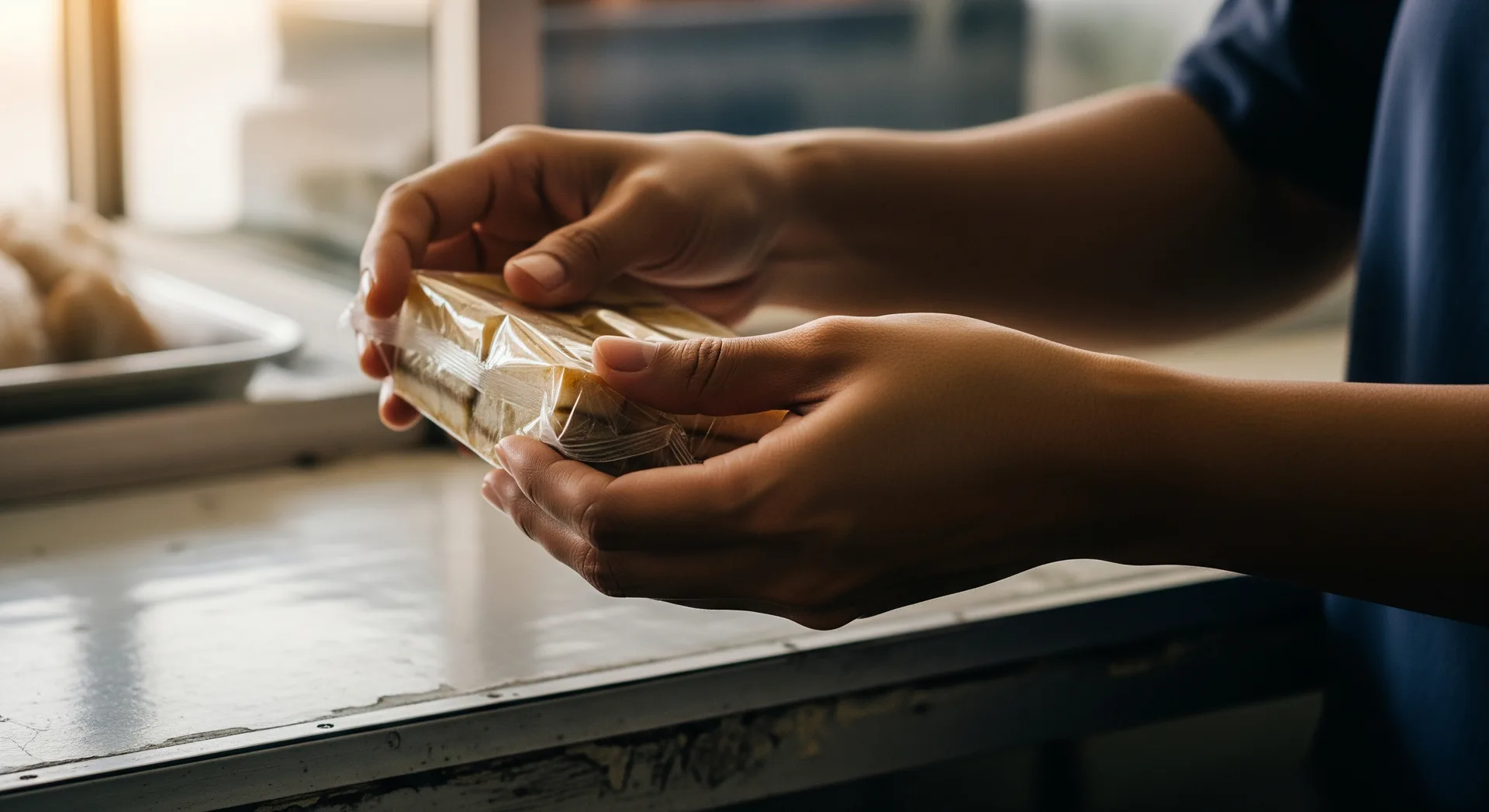
Why "No Certificate" Does Not Mean "Haram"
This is the single biggest misunderstanding in Malaysia's halal conversation, and it has a clear structural basis.
The MYeHALAL JAKIM portal records roughly 13,000 halal-certified food premises nationwide. Compare that to the actual number of food operators in Malaysia, which runs into the hundreds of thousands once you count stalls, small grocers, online sellers and home-based producers. The gap is enormous - and that gap is not evidence that most food in Malaysia is haram.
The main reasons small traders do not apply for certification are usually operational, not doctrinal:
- Cost and time - the application involves documentation, premise inspection and standards compliance that can take months.
- Business scale - a stall operating four hours a day may not see a return that justifies the effort.
- Rented or mobile premises - food trucks and night market stalls face extra hurdles because of fixed-premise requirements.
- Application in progress - some have already applied and are simply waiting for approval.
So when you see a premise without a halal logo, the actual information you are receiving is "not yet verified", not "verified as non-halal". Two very different things. Labelling every uncertified premise as non-halal by default is not only inaccurate from a Shariah perspective, it is also unjust to small traders who are working their way up.
Why Someone Else's Chart May Differ From Yours
This is the part rarely discussed. Two equally committed Muslims can reach different decisions at the same stall, and neither is wrong.
Different levels of wara'. Some people choose to avoid permissible things that edge close to doubt as a personal precaution. That is commendable, but it is a personal choice, not a ruling that can be imposed on others.
Different local context. A standard that is practical in Kuala Lumpur with thousands of certified options may be impractical in a small town or while travelling abroad. Fiqh takes circumstances into account.
Different responsibilities. Someone buying for themselves can accept the risk of their own judgement. Someone ordering catering for 200 wedding guests carries a trust on behalf of others, so a stricter standard is entirely reasonable.
Different personal experience. Someone who has been burned before will naturally set a higher bar. That is not paranoia, that is learning.
The takeaway: use the chart to discipline your own thinking, not to audit other people's choices. Differences in matters open to ijtihad should produce mutual understanding, not arguments in the comment section.
The Economics Angle: Every Ringgit Is a Vote
Looking at this from an economics perspective, there is one layer that consistently gets overlooked - the aggregate effect of individual purchasing decisions.
Malaysia's halal industry contributed RM118.2 billion to GDP up to the third quarter of 2025, around 7.94 percent of the national economy. Halal exports reached RM68.52 billion in 2025, up 10.9 percent year on year, with food and beverage making up more than half of that.
Numbers that size are not built on government policy alone. They are built from millions of small decisions at the checkout counter every day. When enough consumers ask "do you have halal certification?", that demand becomes a market signal. Traders who have not applied start seeing certification as a commercial investment rather than a compliance cost. This is the same mechanism that drives any industry standard: consumers demand, producers invest, standards rise.
But the mechanism cuts both ways. If consumers are too lax, there is no incentive for traders to upgrade. If consumers are so harsh that they boycott every small uncertified trader, we kill the micro-businesses we should be helping to level up. The balance point is this: ask, give them room to explain, and encourage them to apply. Conditional support builds more than blanket boycott or blind acceptance.
The same principle applies when we discuss consumer power in boycott campaigns - the real power is not in momentary anger, but in consistent spending patterns sustained over time.
How to Check for Yourself Before Buying
If you want that flowchart to work in real life, you need tools to answer its questions. Here are the most practical methods.
Check through the official portal
Visit the MYeHALAL JAKIM portal, select the search category (food premises for restaurants, or products for packaged goods), enter the company or brand name, and the system will display the certification status along with the expiry date. That expiry date matters - a lapsed certificate means the verification is no longer active.
Use the Verify Halal app
This mobile app lets you scan the QR code on a product label or search by name. Useful when you are standing in the aisle and need a decision on the spot.
Four questions that are polite but effective
If there is no certificate and you need to assess it yourself, ask questions that build rather than accuse:
- "Which supplier do you get the meat from?" - tests the ingredient source.
- "Is anything non-halal cooked in the same kitchen?" - tests cross-contamination risk.
- "Do you use any alcohol in cooking or flavouring?" - tests the additives people commonly overlook.
- "Are you planning to apply for halal certification?" - opens space for encouragement rather than pressure.
If the answers come confidently and consistently, you have enough information to decide. If the trader clearly does not understand the question at all, that in itself is an answer.
Five Common Mistakes Malaysian Consumers Make
- Assuming "No Pork" means halal. No pork does not mean no alcohol in the cooking, no improperly slaughtered meat, and no cross-contamination. It only rules out one of many issues.
- Trusting a displayed halal logo without verifying it. There have been cases of self-designed logos and expired certificates still hanging on the wall. Check the certificate number on the official portal.
- Treating foreign halal logos as equivalent. Only bodies recognised by JAKIM are accepted in Malaysia. Logos from other countries need their recognition status checked.
- Focusing on food only. Halal considerations also cover cosmetics, medication, personal care products, and your sources of income and investment.
- Condemning without asking. Accusing a premise of being non-halal on social media without verification can permanently destroy someone's livelihood, and that is a heavy responsibility in Shariah.
The Same Principle Applies to Investing
Interestingly, that same flowchart transfers almost entirely to financial decisions. When you buy a stock, you are buying a small slice of a business - and the underlying questions are similar: what are this company's revenue sources, are they mixed with impermissible elements, and is there third-party verification?
The difference is that in the stock market, the "halal certificate" already exists formally. The Shariah Advisory Council of the Securities Commission publishes a list of Shariah-compliant securities twice a year, complete with clear financial benchmarks. You do not need to interrogate each CEO individually.
Still, the "check first" logic remains. Shariah-compliant status can change when a company's financial ratios shift, much like a halal certificate can expire. Serious investors need to understand the actual criteria behind that status, not just look at the label. For a broader view of how the two approaches differ, this comparison of Shariah and conventional investing gives a fuller picture.
Frequently Asked Questions (FAQ)
Is food from a shop without halal certification automatically haram?
No. According to Irsyad al-Fatwa Series 441, a product without halal certification cannot be considered haram as long as it is proven free from haram elements and its preparation meets Shariah requirements. Certification is official verification, not the sole determinant of halal status.
Can I eat at a non-Muslim owned restaurant with no halal logo?
The Mufti of Federal Territory permits it on condition that you are confident the food is free of haram ingredients and the preparation meets Shariah requirements. The Mufti of Selangor is more cautious and treats it as syubhah best avoided. If you cannot reach certainty, leave it.
Why do so many Muslim traders not apply for halal certification?
The main reasons are operational: application cost, processing time, fixed-premise requirements, and small business scale. Some are already in the process waiting for approval. It rarely has anything to do with the product contents.
How do I check JAKIM halal certification officially?
Visit the MYeHALAL portal at myehalal.halal.gov.my and search by company name, brand, or certificate number. Alternatively, use the Verify Halal app to scan the QR code on the product. Always check the certificate expiry date.
Does a "No Pork No Lard" label mean the food is halal?
No. That label only rules out pork and lard. It does not guarantee the absence of alcohol in cooking, properly slaughtered meat, or separation of utensils from non-halal ingredients.
What should I do if doubt arises after I have already bought something?
If the doubt arises after purchase with no clear evidence of haram elements, the original certainty is not removed by mere suspicion. But if you receive convincing information that haram elements are involved, leave it and do not repeat the purchase at the same place.
Am I sinful if I judge wrongly and the product turns out to be non-halal?
Islam takes effort and intention into account. Someone who made a reasonable attempt to verify but was deceived is not in the same position as someone who deliberately ignored the matter. What matters is the sincere effort to verify, and improving the process once you know better.
Does this halal concept apply to investments and stocks as well?
Yes. Sources of income and investment are subject to the same Shariah considerations. The difference is that Malaysia's stock market has an official Shariah-compliant securities list from the SC Shariah Advisory Council, which functions much like a halal certificate for investments.
Conclusion
That flowchart is useful because it converts a vague question - "is this halal or not?" - into a series of answerable ones. It does not label anyone wholesale, it does not demand perfection, and it places personal conviction as the final arbiter. That aligns with the mainstream fatwa approach in Malaysia.
What we should remember is that your chart will not necessarily match someone else's. Differences in wara', local context, and the responsibility you carry will produce different entry points. As long as the axis is the same - certainty permits, doubt prevents - that difference is a space for ijtihad, not a battlefield. Choose wisely, live with barakah.
This awareness of choosing what is lawful should not stop at the checkout counter. It should also shape how you save and invest.
If you want to start investing in a Shariah-compliant way, you will need a CDS account to trade on Bursa Malaysia as well as foreign shares such as the United States and Hong Kong markets - apply for a CDS account here.
If you are just starting out and want to understand the basics of the stock market first, download the stock market basics ebook for free.
Further Reading
- Boycott, Divestment & Sanctions (BDS): What Islam Says and What Else We Can Do
- Shariah vs Conventional Investment: The Real Difference for Stocks, Unit Trusts, EPF & Takaful
- What Are the Requirements for Shariah-Compliant Stocks?
- How to Purify Wealth and Cleanse Non-Shariah-Compliant Money
- Why Business Should Focus on Delivering Value, Not Just Chasing Profit